Loading NuWatt Energy...

We use your location to provide localized solar offers and incentives.
We serve MA, NH, CT, RI, ME, VT, NJ, PA, and TX
Loading NuWatt Energy...
NuWatt designs, installs, and manages solar, battery, heat pump, and EV charger systems across 9 states. One company, one warranty, one point of contact.
Get a Free Quote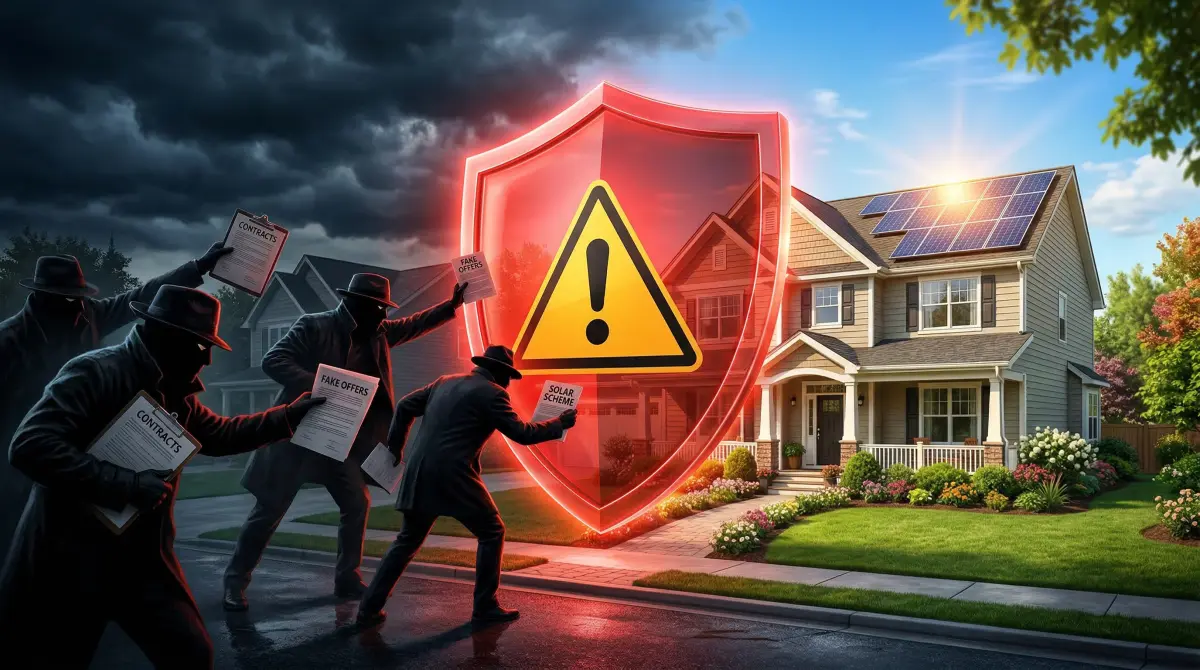
The residential solar tax credit is dead. Scammers are still promising it. Here are the 10 biggest red flags to watch for and how to verify any solar company before you sign a contract.
Quick Answer
The biggest solar scam in 2026 is companies claiming you qualify for the 30% federal tax credit on a cash or loan purchase — that credit (Section 25D) expired December 31, 2025. Other red flags include high-pressure sign-today tactics, no written contract, unrealistic savings claims, door-to-door salespeople with no verifiable company, and lease escalators hidden in fine print. Always check the installer's contractor license, BBB rating, Google reviews, and NABCEP certification before signing.
For over a decade, the 30% federal solar tax credit (Section 25D) was the centerpiece of every residential solar proposal. Homeowners could deduct 30% of their system cost from their federal taxes, turning a $30,000 system into a $21,000 net investment. That credit expired on December 31, 2025, as part of the One Big Beautiful Bill Act signed on July 4, 2025.
But millions of homeowners do not know the credit is gone. And dishonest solar companies are exploiting that knowledge gap. According to the Solar Energy Industries Association, consumer complaints about misleading sales practices surged 40% in the first quarter of 2026 compared to the same period in 2025.
The scam playbook is straightforward: promise a 30% tax credit that does not exist, inflate the system price to cover the "discount," and pressure the homeowner to sign before they can verify the claim. Some companies have simply continued using 2025 sales materials that reference 25D as if nothing changed.
Section 25D (Residential)
$0
Expired Dec 31, 2025. Homeowner gets nothing on cash or loan purchases.
Section 48/48E (Commercial)
30%
Still active. Claimed by the financing company on lease/PPA — not by you.
If you encounter any of these warning signs, stop the conversation and walk away.
The #1 solar lie in 2026
The residential solar tax credit (Section 25D) expired on December 31, 2025. Any company telling you that you can claim 30% off your cash or loan purchase is lying. Period. The only scenario where a 30% credit applies is when a third-party company owns the system (lease or PPA) and claims the commercial ITC under Section 48/48E. If a salesperson says YOU get 30% off a cash or loan purchase, walk away immediately.
What to say:
"Show me the IRS form number I would file for this credit. What is the IRC section?"
High-pressure urgency tactics
Legitimate solar companies do not need pressure tactics. Solar prices do not change overnight. If a company says the price goes up tomorrow, the rebate expires today, or they only have one slot left this week, it is a manufactured urgency designed to prevent you from getting competing quotes. A real installer will give you a written proposal and encourage you to compare.
What to say:
"I need 48 hours to review this. If the price changes by then, I don't want to do business with you."
Everything must be in writing
A verbal promise is worthless in solar. If the salesperson says "we will handle everything" but the contract does not specify system size, panel brand, inverter model, installation timeline, permitting responsibility, and total cost — you have no protection. Vague contracts are designed to let the company substitute cheaper equipment, delay installation, or add surprise charges.
What to say:
"I need a line-item proposal with every component, warranty term, and installation date in writing before I sign anything."
Claiming 100% bill offset without data
Scammers promise to "eliminate your electric bill" without knowing your roof orientation, shading, panel count, or utility rate structure. In reality, most solar systems offset 70-90% of electricity usage, and net metering rules vary by state. In 2026, without the federal credit, payback periods are 8-17 years depending on your state. Any company promising a 3-5 year payback on a cash purchase is fabricating numbers.
What to say:
"Show me the production model with my actual roof azimuth, tilt, and shading data. What software did you use?"
Unknown reps at your front door
Door-to-door solar sales account for the majority of solar complaints filed with state attorneys general. These representatives often work for subcontractors hired by national companies — they earn commission and move on. They cannot answer technical questions, have no authority to honor promises, and frequently misrepresent pricing. A legitimate company will have a website, a local office, and verifiable reviews.
What to say:
"What is your contractor license number? What company do you actually work for? Give me a business card and I will research you."
Skipping legal requirements
Every solar installation requires a building permit and utility interconnection agreement. If a company does not mention these steps, they either plan to skip them (illegal and dangerous) or they are so inexperienced they do not know the process. Unpermitted solar can void your homeowner insurance, fail inspection, and leave you with a system the utility will not connect.
What to say:
"Who handles the building permit and utility interconnection? Is that included in the price?"
2.9% per year compounds fast
A solar lease with a 2.9% annual escalator turns a $130/month payment into $164 by year 10 and $240 by year 25. Over the full 25-year term, you pay $55,000-$65,000 for a system that cost $25,000-$30,000 to install. The company buries this escalator on page 14 of a 30-page contract. Always calculate your total cost over the full lease term before signing.
What to say:
"What is my total payment over 25 years including escalators? Show me the year-by-year payment schedule."
It is a lease or PPA, not a gift
No company gives away $25,000-$35,000 worth of equipment. "Free solar" means a lease or power purchase agreement (PPA) where you pay monthly for 20-25 years and never own the panels. The financing company owns your roof space. You may face complications when selling your home, refinancing your mortgage, or if the company goes bankrupt.
What to say:
"If it is free, who owns the panels? Where is the contract? What happens if I sell my house?"
Panel warranty does not cover installation
Solar panels have 25-year manufacturer warranties, but that only covers the product. If the installation was done poorly — bad wiring, roof leaks, improper mounting — the panel manufacturer will not help you. A legitimate installer provides a separate 10-25 year workmanship warranty covering labor, roof penetrations, and electrical work. If they do not offer one, they do not stand behind their work.
What to say:
"Do you provide a written workmanship warranty separate from the panel warranty? For how many years?"
Fly-by-night operators
National solar companies that subcontract everything to local crews and disappear after installation are a leading cause of solar orphans — homeowners with broken systems and no one to call. Check for a physical office in your state, a contractor license, Better Business Bureau rating, and Google reviews. If the company was founded last year and has no reviews, you are their guinea pig.
What to say:
"How long have you been installing in my state? Can I visit your office? What is your BBB rating?"
| What They Do | Scam Company | Legitimate Installer |
|---|---|---|
| Tax credit claim | "You get 30% off your cash purchase" | "The residential credit expired. Here are your real costs." |
| Pricing pressure | "Sign today or the price goes up" | "Take this proposal home and compare with other quotes" |
| Savings estimate | "We will eliminate your electric bill" | "Based on your usage, we project 75-85% offset" |
| Proposal detail | Vague totals, no equipment specs | Line-item breakdown with model numbers |
| Warranty | "The panels have a 25-year warranty" (no workmanship) | "We offer a 25-year workmanship warranty in addition to panel warranty" |
| Permitting | No mention of permits or inspections | "Permitting and interconnection are included and handled by us" |
| Company presence | No local office, out-of-state subcontractors | Local office, own installation crews, 5+ years in business |
| Response to questions | Deflects, changes subject, pressures | Answers directly, provides documentation |
Before signing any solar contract, complete every step on this list.
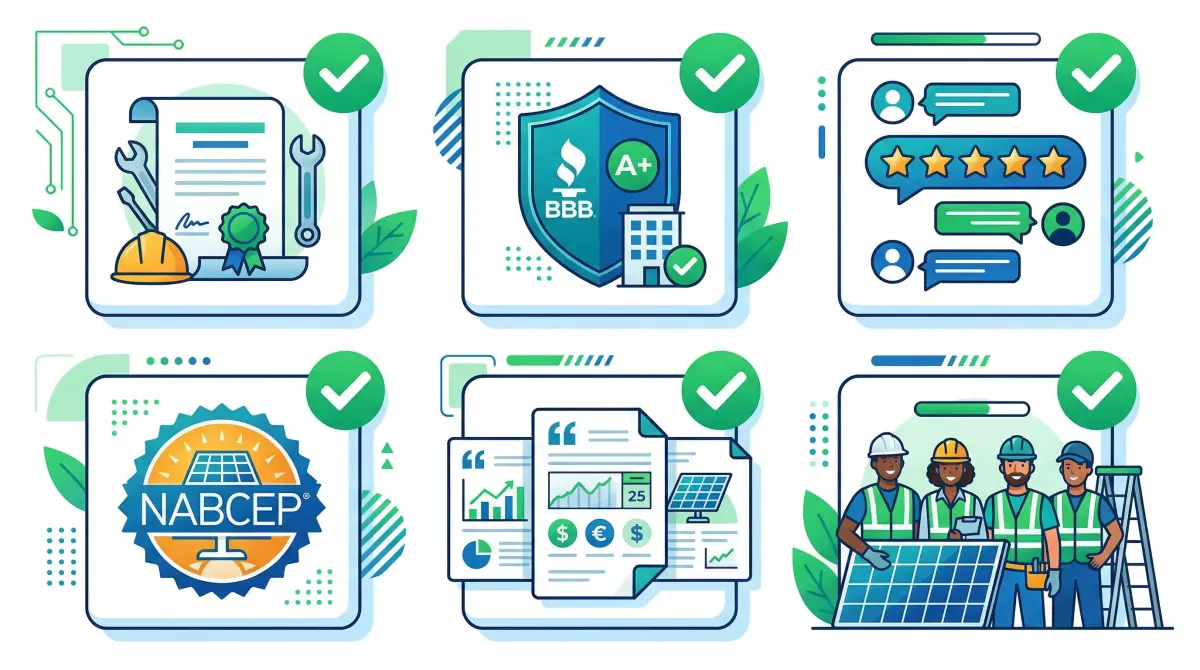
Every state requires solar installers to hold an electrical or general contractor license. Look up the license number on your state licensing board website. In Massachusetts, check the Board of Building Regulations. In Connecticut, check DCP License Lookup.
Look up the company on bbb.org. Check their rating (A+ through F), years in business, complaint history, and how complaints were resolved. A pattern of unresolved complaints is a dealbreaker.
A 4.8-star rating means nothing if they have 12 reviews. Look for 50+ reviews, read the negative ones, and check whether the company responded professionally. Search "[company name] solar complaints" to find reviews outside Google.
The North American Board of Certified Energy Practitioners (NABCEP) is the gold standard for solar installer certification. Search the NABCEP directory at nabcep.org to confirm the installer or their lead electrician is certified.
Never sign with the first company. Get at least 3 written proposals with identical system specs so you can compare apples to apples. Any company that discourages you from getting other quotes has something to hide.
Does the company use its own W-2 employees or subcontract everything? Subcontracted installs often mean less quality control and harder warranty claims. Ask directly: "Who will be on my roof?"
A real solar proposal is a detailed engineering document, not a glossy brochure with a single number. If your proposal does not include all of the following, ask for a revised one before signing.
NuWatt standard: Every NuWatt proposal includes all 12 items above, plus a custom 3D roof model with shade analysis. No hidden fees, no escalators, no surprises.
Starting payment: $130/month with 2.9% annual escalator over 25 years
| Year | Monthly Payment | Annual Cost | Cumulative Paid |
|---|---|---|---|
| 1 | $130 | $1,560 | $1,560 |
| 5 | $146 | $1,756 | $8,311 |
| 10 | $169 | $2,032 | $17,773 |
| 15 | $196 | $2,349 | $28,723 |
| 20 | $226 | $2,717 | $41,366 |
| 25 | $262 | $3,141 | $55,941 |
Total paid over 25 years: ~$55,941 for a system that cost ~$28,000 to install. That is $27,941 in profit for the leasing company — nearly double the equipment cost.
If you signed at home, the FTC Cooling-Off Rule gives you 3 business days to cancel. Send written notice via certified mail.
Report to your state Attorney General, the FTC (reportfraud.ftc.gov), and your state contractor licensing board.
File a BBB complaint. Companies that value their rating often resolve complaints to maintain their standing.
If the company made false claims about tax credits or savings, you may have grounds for rescission or damages. Many attorneys offer free consultations.
No. The residential solar tax credit (Section 25D) expired on December 31, 2025. Homeowners who purchase solar with cash or a loan get $0 in federal tax credits. The only way to access a 30% credit is through a solar lease or PPA, where the financing company (not you) claims the commercial ITC under Section 48/48E.
File a complaint with your state Attorney General, the Federal Trade Commission (FTC) at reportfraud.ftc.gov, the Better Business Bureau, and your state contractor licensing board. If you signed a contract under false pretenses, consult a consumer protection attorney about your right to rescind.
Some are, but door-to-door solar generates the most consumer complaints in the industry. These reps often work for subcontractors, earn high commissions, and may misrepresent pricing or tax credits. Always verify the company independently and never sign anything at the door.
A lease escalator increases your monthly payment by a fixed percentage each year — typically 1.5-2.9%. A $130/month payment with a 2.9% escalator becomes $240/month by year 25, totaling $55,000-$65,000 over the contract for a system that cost $25,000-$30,000 to install. Always calculate total cost over the full term.
"Free solar panels" means a solar lease or power purchase agreement (PPA) where you pay nothing upfront but make monthly payments for 20-25 years. You never own the panels. The financing company owns the system on your roof and claims the commercial tax credit. It is not free — it is a long-term contract.
Check their state contractor license, BBB rating, Google reviews (50+), and NABCEP certification. Confirm they have a local office, have been in business for 5+ years, and use their own installation crews. Get at least 3 written quotes to compare.
A legitimate proposal includes: system size (kW), panel and inverter brand/model, estimated annual production (kWh), total installed price with line-item breakdown, financing terms, workmanship warranty duration, permitting and interconnection details, and a conservative payback calculation.
Most states have a 3-day right of rescission for contracts signed at your home (FTC Cooling-Off Rule). Some states extend this to 5-7 days for solar contracts specifically. Check your state consumer protection laws and send a written cancellation notice within the allowed window.
The expiration of the residential tax credit created confusion that scammers exploit. Many homeowners do not know the 30% credit is gone, so dishonest companies use it as a closing tool. Additionally, rising electricity rates drive demand, attracting fly-by-night operators who see quick profit.
Yes, but you need accurate numbers. Solar costs $2.50-$3.30/W in 2026, and payback periods are 8-17 years depending on your state and utility rates. State incentives (MA SMART, NJ ADI, RI REG) still help. Lease and PPA options offer $0-down savings because the financing company claims the commercial ITC. Work with an honest installer who gives you real numbers.
9 red flags in solar lease and loan contracts
Read guideSide-by-side quote comparison framework
Read guide25+ questions before signing a solar contract
Read guideWhy escalating PPA payments can cost you more
Read guideHow financing works without the federal credit
Read guideReal pricing data for 10 states in 2026
Read guideNuWatt provides transparent, line-item proposals with no hidden fees, no escalators, and no false tax credit claims. NABCEP certified. Local crews. 10+ years in business.
Sarah tracks state and federal energy incentives, utility rate structures, and consumer protection issues. She has helped hundreds of homeowners navigate complex solar financing decisions and identify fraudulent claims.