Loading NuWatt Energy...

We use your location to provide localized solar offers and incentives.
We serve MA, NH, CT, RI, ME, VT, NJ, PA, and TX
Loading NuWatt Energy...
NuWatt designs, installs, and manages solar, battery, heat pump, and EV charger systems across 9 states. One company, one warranty, one point of contact.
Get a Free Quote
July 4, 2026 was a begin-construction safe harbor for the 30% federal ITC behind solar leases and PPAs — not an expiration. Projects that began on or before it locked in the longer timing pathway (placed in service through roughly 2030); projects starting now still qualify if placed in service by December 31, 2027. The residential credit (25D) already expired, so Section 48/48E is the last federal solar benefit available to homeowners through third-party ownership.
New-Start Deadline
placed-in-service deadline for Section 48E projects starting now
The Section 48/48E Investment Tax Credit (ITC) provides a 30% federal tax credit for solar energy systems owned by businesses (third-party owners). Under the OBBBA law signed July 4, 2025, July 4, 2026 was a begin-construction safe harbor, not an expiration: projects that began construction on or before that date locked in the longer timing pathway and can be placed in service through roughly 2030.
This timing matters for homeowners because it affects solar lease, PPA, and ESA projects. The financing company that owns your solar system claims the 30% ITC and passes those savings to you as a lower monthly rate. Projects that begin construction after July 4, 2026 still qualify for the credit, but generally must be placed in service by December 31, 2027 — a tighter window. Pricing can also shift over time due to tariffs, equipment availability, financing costs, and utility rates.
The residential solar tax credit (Section 25D) already expired on December 31, 2025. Section 48/48E is the last federal solar benefit available to homeowners through third-party ownership structures.
A plain-English explanation of the two Section 48/48E timing pathways, what stays the same, and why starting earlier keeps the most flexible window open.
The IRS provides two safe harbors for meeting the “begin construction” requirement. Projects that met either one on or before July 4, 2026 locked in the longer Section 48/48E timing pathway (placed in service through roughly 2030); projects that begin construction later still qualify if placed in service by December 31, 2027:
Meaningful physical work of a significant nature at the project site or off-site at a factory. Examples: installing racking, mounting panels, pouring concrete for ground mounts.
Pay or incur at least 5% of the total project cost. For a $25,600 system, that is $1,280 in equipment orders or deposits. Most financing companies use this method because it is easier to document and less weather-dependent.
Whether the Section 48E timing matters to you depends entirely on how you plan to go solar. Here is the breakdown.
The residential ITC (Section 25D) expired December 31, 2025. Your federal tax benefit is already $0 whether you buy before or after July 4, 2026, so the Section 48E timing does not change your math.
The financing company owns your system and claims the 30% ITC, which subsidizes your monthly payment. Projects that started on or before July 4, 2026 locked in the longer timing pathway; projects starting now still qualify if placed in service by December 31, 2027.
Concert Finance owns the system and claims the ITC + MACRS + FEOC bonus. Propel pricing depends on these credits. Available in ME and TX only.
Since January 1, 2026, homeowners who buy solar with cash or a loan receive $0 in federal tax credits. But leases and PPAs use a different tax code section. Here is exactly how Section 48 savings reach you.
You do not buy the system. A financing company (TPO) purchases and owns the solar equipment.
Because they own the system, they file IRS Form 3468 and claim the tax credit. On a $25,600 system, that is $7,680.
MACRS 5-year property with 100% first-year bonus depreciation (permanent under OBBBA). Adds roughly $4,000-5,000 in tax benefits.
The TPO receives $11,680-$12,680 in tax benefits. This is why your lease rate can be meaningfully lower than it would be without the credit.
Section 48 says the credit goes to the owner of the solar energy property. When you buy with cash, you are the owner and you need Section 25D (now expired). When you lease, the financing company is the owner and they use Section 48/48E (still active, with a July 4, 2026 begin-construction safe harbor for the longer timing pathway). This is not a loophole. It is the intended structure of the tax code. The third-party ownership model was specifically designed to make solar accessible to homeowners who cannot use tax credits directly.
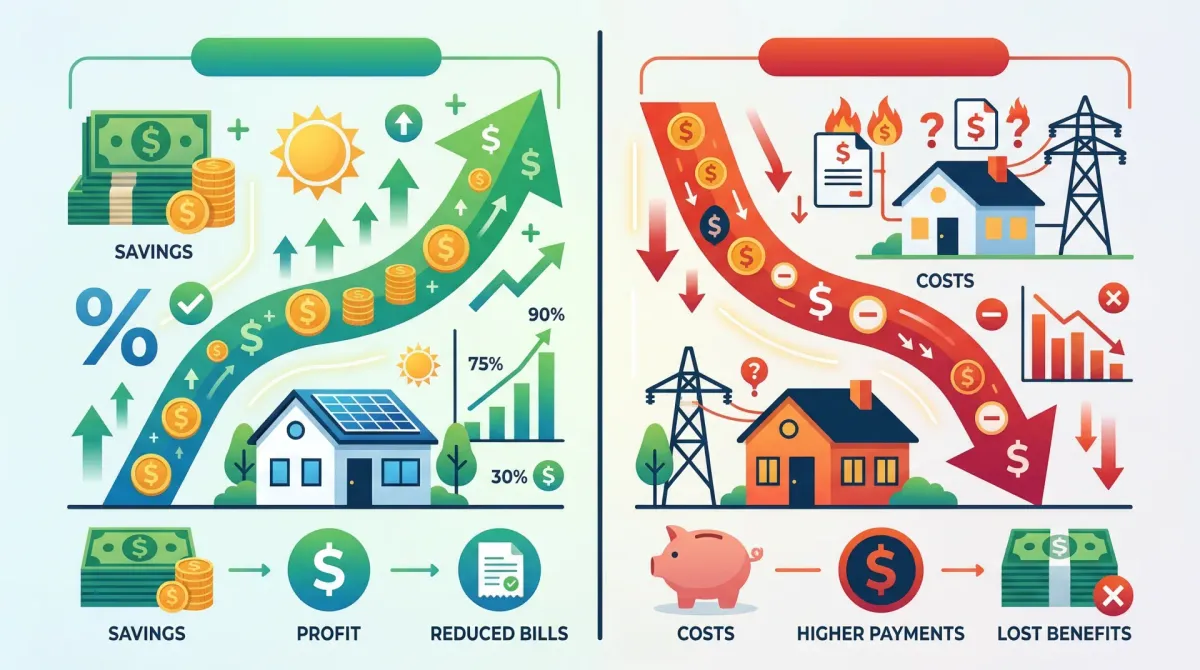
Here is a concrete example using a typical 8 kW residential system. The 30% ITC is available on both pathways — the difference is the placed-in-service window.
Longer Timing — In Service Through ~2030
This $14,340 in combined tax benefits is why the financing company can offer you a lease at $0.13-0.16/kWh instead of $0.20+/kWh. The savings are baked into your rate, and the longer timing keeps the most flexibility for permitting and interconnection.
Still Qualifies — In Service by Dec 31, 2027
The same 30% ITC and bonuses still apply — the project simply must be placed in service by December 31, 2027, a tighter window. Lease and PPA pricing can also move over time with tariffs, equipment availability, financing costs, and utility rates.
Solar installation takes 8-12 weeks from quote to construction start. Here is the realistic timeline to begin construction on or before the safe harbor and keep the most flexible window open.
Full installer capacity. 2-4 week scheduling. Ample time for permitting and interconnection.
16+ weeks before the safe harbor
Installer calendars filling. 4-8 week scheduling. Permitting offices see higher volume.
8-12 weeks before the safe harbor
Must have signed agreement by now. Equipment procurement starts. FEOC panels may be limited.
4-8 weeks before the safe harbor
Projects targeting the safe harbor needed to be in the pipeline by this point; permitting often had to be expedited.
<4 weeks before the safe harbor
Projects that began construction (5% safe harbor or physical work test) on or before this date locked in the longer Section 48/48E timing. Projects starting now still qualify if placed in service by Dec 31, 2027.
Safe-harbor date
Complete the IQ wizard. We design your system and provide pricing within 48 hours.
Sign your lease, PPA, or Propel ESA. Financing company begins ITC qualification process.
We handle all permitting, engineering, and utility interconnection paperwork.
Equipment ordered, 5% safe harbor met. Your project qualifies for Section 48 ITC.
Takes 5 minutes. No commitment required.
Lease value varies by state based on utility rates, state incentives, and lease economics. The Section 48E 30% credit applies in every NuWatt service area on both timing pathways.
SMART 3.0 incentive stacks with Section 48E. Highest utility rates maximize lease value.
Massachusetts solar guideSecond-highest electricity rates in the nation. Net metering at full retail makes leases extremely competitive.
Connecticut solar guideADI/SREC-II payments ($85.00/MWh) add revenue. 100% sales and property tax exempt.
New Jersey solar guideNo state rebate (SB 303 repealed). NEM 2.0 credits at a utility-specific share of retail value. Lease is the best remaining path.
New Hampshire solar guideNuWatt Propel ESA available (prepaid, $0 down, 7-year ownership transfer). Concert Finance owns system. ME + TX only.
Maine solar guidePick one: REG program (31.55¢/kWh for 15 yr, Small-Scale Solar I) OR REF rebate ($0.65/W, $5K cap) — they're mutually exclusive per Commerce RI. Either track gives RI the strongest state incentive in NE when combined with net metering.
Rhode Island solar guideNuWatt Propel ESA available. Deregulated market means rates are volatile. Locking in a fixed lease rate provides price certainty.
Texas solar guidePropel is a prepaid Energy Service Agreement (ESA) with $0 down. Concert Finance owns the system and claims the Section 48E ITC + FEOC domestic content bonus + MACRS depreciation. After 7 years, ownership transfers to you. Propel requires FEOC-compliant Silfab panels. Projects that began construction on or before July 4, 2026 locked in the longer Section 48/48E timing pathway; projects starting now still qualify if placed in service by December 31, 2027.
Learn about NuWatt PropelThe base 30% ITC is not the only credit available. Bonus adders can push the total credit to 50% or higher, and they follow the same Section 48/48E timing — projects that began construction on or before July 4, 2026 locked in the longer window, and new starts place in service by Dec 31, 2027.
Available when panels and components meet FEOC (Foreign Entity of Concern) compliance. Silfab panels, manufactured in the US, qualify. This bonus brings the effective ITC from 30% to 40%.
Available when the project is in a qualifying energy community: brownfield sites, areas near retired fossil fuel plants, or census tracts with high fossil fuel employment. Many areas in ME, TX, NJ, and parts of MA and CT qualify.
Modified Accelerated Cost Recovery System allows the system owner to depreciate the solar equipment (5-year property). OBBBA made the 100% first-year bonus depreciation permanent, so the entire depreciable basis is expensed in year one whether the system is placed in service in 2026 or 2027. This is a separate benefit from the ITC.
A project in an energy community using FEOC-compliant panels can stack the base 30% ITC + 10% domestic content + 10% energy community = 50% ITC. Add MACRS depreciation and the TPO recovers more than half the system cost through tax benefits alone.
The Section 48/48E credit does not vanish on July 4, 2026. Starting later mainly changes the placed-in-service window and tightens some timelines. Here is what to know.
Projects that begin construction after July 4, 2026 still get the 30% ITC, but generally must be placed in service by December 31, 2027 rather than the longer ~2030 window.
Lease and PPA rates can change due to tariffs, equipment availability, financing costs, and utility rates — independent of the tax credit. Locking a fixed rate earlier removes that uncertainty.
Propel depends on Section 48E ITC + FEOC bonus + MACRS, all of which continue. Starting on or before the safe harbor simply keeps the most flexible timeline for the program.
The 10% domestic content bonus continues, but FEOC component-sourcing thresholds step up for projects beginning construction in later years. US-made Silfab panels remain the qualifying path.
OBBBA made the 100% first-year bonus depreciation permanent, so projects placed in service in 2027 still expense the full depreciable basis in year one — the same as 2026. This benefit does not phase down.
Permitting, interconnection, and equipment lead times all take longer near a tighter window. Starting earlier gives the most room for delays without risking the longer timing pathway.
A comparison of how the two begin-construction pathways line up for an 8 kW residential solar system. The 30% ITC applies on both — the main difference is the placed-in-service window.
| Factor | Begin On/Before Jul 4, 2026 | Begin After Jul 4, 2026 |
|---|---|---|
| Section 48/48E ITC | 30% | 30% |
| Domestic Content Bonus | +10% | +10% (tighter FEOC thresholds) |
| Energy Community Bonus | +10% | +10% |
| MACRS Bonus Depreciation | 100% first-year | 100% first-year (unchanged) |
| TPO Tax Benefits (8 kW) | $14,340 | $14,340 |
| Placed-In-Service Window | Through ~2030 | By Dec 31, 2027 |
| Typical Lease Rate | $0.13-0.16/kWh | $0.13-0.16/kWh (may move with market) |
| Scheduling Flexibility | Most runway | Tighter timeline |
| Section 25D (Cash/Loan) | $0 (expired) | $0 (expired) |
| State Incentives | Available | Available |
Everything homeowners need to know about the July 4, 2026 Section 48E begin-construction safe harbor.
No. July 4, 2026 was a begin-construction safe harbor, not an expiration. Projects that began construction on or before that date locked in the longer Section 48/48E timing pathway and can be placed in service through roughly 2030. Projects starting now still qualify for the 30% credit, but generally must be placed in service by December 31, 2027. "Begin construction" means either meaningful physical work at the site or paying at least 5% of total project costs.
No. The residential solar tax credit (Section 25D) already expired on December 31, 2025, under the OBBBA law signed July 4, 2025. Whether you buy cash or finance with a loan, your federal tax benefit is already $0. The July 4, 2026 safe harbor only affects third-party owned systems like leases, PPAs, and ESAs where the financing company claims the commercial Section 48/48E credit.
The IRS defines "begin construction" in two ways. The Physical Work Test requires meaningful physical work at the project site, such as installing racking or mounting panels. The 5% Safe Harbor requires the taxpayer to pay or incur at least 5% of the total project cost. For a $25,600 system, that is $1,280 in equipment orders or deposits. Most financing companies use the 5% Safe Harbor method. Projects that began construction on or before July 4, 2026 locked in the longer placed-in-service window; projects starting now generally must be placed in service by December 31, 2027.
It is about timing flexibility, not a price cliff. Projects that began construction on or before July 4, 2026 locked in the longer Section 48/48E pathway (placed in service through roughly 2030). Projects starting now can still claim the 30% credit but generally must be placed in service by December 31, 2027 — a tighter window. Lease and PPA pricing can also move over time due to tariffs, equipment availability, financing costs, and utility rates, so starting earlier keeps the most flexible timeline open.
Section 48 is the traditional Investment Tax Credit for solar and other energy projects. Section 48E is the technology-neutral clean energy credit introduced by the Inflation Reduction Act. Both provide the same 30% base credit for solar installations. Under OBBBA, both used the same July 4, 2026 begin-construction safe harbor: projects that began on or before it locked in the longer timing, and projects starting now place in service by December 31, 2027. For homeowners considering a lease or PPA, the distinction is technical and the timing rules are identical.
Yes. Solar installations and the Section 48/48E credit both continue after July 4, 2026. Projects that begin construction after that date still qualify for the 30% credit, but generally must be placed in service by December 31, 2027. Cash and loan purchases are unaffected by this timing because the residential credit (25D) already expired. State incentives like SMART (MA), REG (RI), ADI (NJ), and net metering programs remain available regardless of the federal timing.
The typical timeline from initial quote to construction start is 8-12 weeks. This includes site survey (1-2 weeks), engineering and design (1-2 weeks), permitting (2-4 weeks), and equipment procurement (2-3 weeks). The July 4, 2026 safe harbor has passed; projects starting now target the December 31, 2027 placed-in-service deadline, and an 8-12 week start-to-construction runway leaves ample margin for permitting delays or equipment availability.
The FEOC (Foreign Entity of Concern) compliance requirement determines eligibility for the 10% domestic content bonus on top of the base 30% ITC. Panels manufactured by companies without foreign entity ties (like US-made Silfab panels) qualify. Like the base credit, the bonus follows the Section 48/48E begin-construction rules — projects that began construction on or before July 4, 2026 locked in the longer timing, and FEOC component-sourcing thresholds tighten for projects beginning construction in later years.
Complete guide to leasing vs buying solar in 2026.
How Section 48 works for homeowners who lease solar.
Deep dive into the technology-neutral clean energy credit.
The math behind why leasing now beats buying with no ITC.
Projects that began construction on or before July 4, 2026 locked in the longer placed-in-service window (through roughly 2030); projects starting now still qualify if placed in service by December 31, 2027. Start your free quote today to keep the most flexibility for permitting, engineering, and equipment procurement on your solar lease or PPA.