Loading NuWatt Energy...

We use your location to provide localized solar offers and incentives.
We serve MA, NH, CT, RI, ME, VT, NJ, PA, and TX
Loading NuWatt Energy...
NuWatt designs, installs, and manages solar, battery, heat pump, and EV charger systems across 9 states. One company, one warranty, one point of contact.
Get a Free Quote
The federal solar tax credit is dead for homeowners. Section 25D expired December 31, 2025. Cash buyers get $0. Loan buyers get $0. But lease and PPA providers still capture the 30% ITCthrough Section 48/48E — and pass $7,680+ in savings directly to you through lower payments.
The $7,680 advantage that used to make buying superior? Gone. The question is no longer “should I lease or buy?” The question is: “why would I pay $25,600 when a lease gets me the same solar for $0 down?”
$0
Buyer ITC
25D expired Dec 2025
30%
Lease/PPA ITC
48/48E still active
$0/mo
Propel Payment
ME + TX only
by 2027
Place in service
new-start ITC window
Section 25D — the residential solar tax credit — expired December 31, 2025. Homeowners who buy solar with cash or a loan now get $0 from the IRS. But third-party owners (lease and PPA companies) still claim the 30% ITC under Section 48/48E, worth $7,680+ on a typical 8 kW system. That credit is passed to you through lower monthly payments. The $7,680 gap that made buying the clear winner has vanished. For most homeowners in 2026, a solar lease or PPA now delivers a better short-term return than buying outright.
Until December 31, 2025, every homeowner who bought solar with cash or a loan received a 30% federal tax credit. On an 8 kW system at $3.20/W ($25,600), that was $7,680 back from the IRS. It made the effective cost just $17,920 and pushed payback to 7–9 years. Buying was the unambiguous winner.
On January 1, 2026, that advantage evaporated. The OBBBA ended Section 25D. Cash buyers now pay the full $25,600 — with zero federal offset. Meanwhile, lease and PPA companies still capture the identical 30% credit through Section 48/48E because theyare the system owner, not you. The competitive landscape has not just shifted — it has inverted.
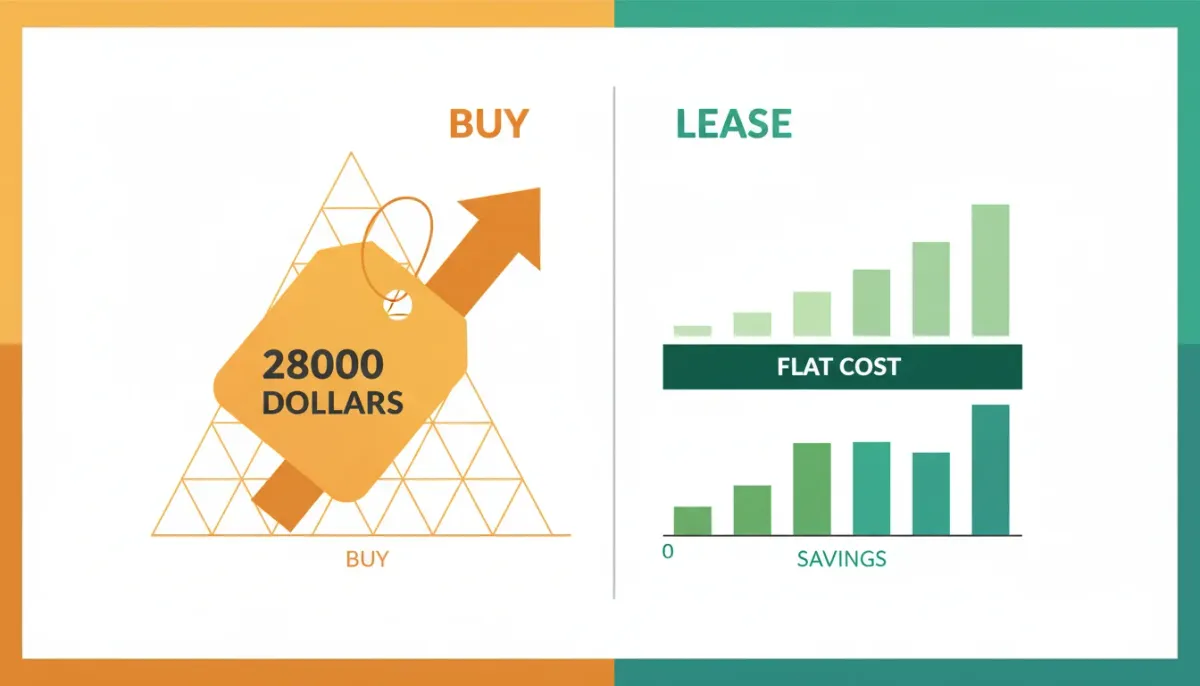
| Metric | Before 2026 (25D Active) | 2026 (25D Dead) | Winner |
|---|---|---|---|
| Federal tax credit (buyer) | 30% ($7,680 on $25,600) | $0 — Section 25D expired | Lease |
| Federal tax credit (lease/PPA) | 30% (claimed by owner) | 30% (still claimed by owner via 48/48E) | Lease |
| Effective buyer payback | 7–9 years | 12–14 years (no ITC) | Lease |
| Day 1 out-of-pocket (buyer) | $17,920 net ($25,600 – $7,680) | $25,600 gross (no credit) | Lease |
| Day 1 out-of-pocket (lease) | $0 | $0 | Tie |
| Monthly savings vs. utility | Buyer wins (lower net cost) | Lease wins — $20–50/mo day 1, buyer waits 14 years | Lease |
| Maintenance responsibility | Buyer handles | Buyer handles (lease: included) | Lease |
| 25-year total savings | Buyer wins by $30K+ | Buyer still wins by $15–20K (but requires $25,600 upfront) | Buy |
Scorecard:Leasing wins 6 of 8 metrics in 2026. Cash purchase still wins on 25-year total savings — but only if you have $25,600 sitting in your bank account and are comfortable waiting 14 years to break even. For everyone else, a lease, PPA, or Propel agreement is the stronger financial choice.
Real numbers for a typical 8 kW system (8 kW x $3.20/W = $25,600) at $0.28/kWh average utility rate. No hypothetical ITC — cash and loan buyers get exactly $0.
Propel available in Maine and Texas only. Lease/PPA available in all NuWatt states.
| Factor | Cash Purchase | Lease | PPA | Propel (ME/TX) | Wins |
|---|---|---|---|---|---|
| System cost | 8 kW × $3.20/W = $25,600 | $0 (TPO owns) | $0 (TPO owns) | $0 down | Lease |
| Federal credit | $0 (25D expired) | $7,680+ claimed by owner | $7,680+ claimed by owner | $7,680+ claimed by Concert Finance | Propel |
| FEOC bonus (domestic content) | N/A | +10% ($2,560) | +10% ($2,560) | +10% ($2,560) | Tie |
| Net cost to homeowner | $25,600 | $0 | $0 | $0 | Lease |
| Monthly payment | $0 | ~$100–130/mo | ~$0.12/kWh | $0/mo (prepaid ESA) | Propel |
| Monthly savings (at $0.28/kWh) | ~$150 (offset only) | $20–50/mo net | $20–80/mo net | ~$150/mo (no payment) | Propel |
| Payback period | ~14 years | Immediate (day 1) | Immediate (day 1) | Immediate (day 1) | Propel |
| Maintenance | You pay | Included | Included | Included (yr 1–7) | Lease |
| Ownership | Yours immediately | Never (unless buyout) | Never (unless buyout) | Yours at year 7 | Propel |
| Escalator risk | None | 1.5–2.9%/yr typical | 1.5–2.9%/yr typical | None (prepaid) | Cash |
| Panel degradation risk | You bear it | Owner bears it | Owner bears it | Owner bears it (yr 1–7) | Lease |
| 25-year total savings | ~$45,000 | ~$15,000–$25,000 | ~$15,000–$30,000 | ~$40,000–$50,000 | Cash |
Key insight: Cash purchase wins exactly 2 of 12 factors (escalator risk and 25-year total savings). Propel wins 5 factors. Lease wins 3. In 2024, cash would have won 7+ categories because the $7,680 ITC made it financially dominant. That advantage no longer exists.
Here is what each financing path looks like for a typical 8 kW system over 1, 5, and 10 years. No sugarcoating — real numbers, real tradeoffs.
Own it outright, but $0 ITC in 2026
Homeowners with $25,600+ cash who want max long-term savings and can wait 14+ years for payback
Own it with payments, but $0 ITC
Homeowners who want ownership but payments may exceed savings initially
ITC captured by owner — savings start day 1
Homeowners who want immediate savings, zero risk, and zero maintenance hassle
Best of both: $0/mo + ownership at year 7
ME + TX homeowners who want $0/mo, ITC benefit, and eventual ownership
The 30% ITC that makes lease and PPA rates so low is still available. Section 48/48E’s “begin construction” safe harbor closed July 4, 2026: projects that began construction on or before that date locked in the longest placed-in-service window (through roughly 2030), and projects starting now still qualify but generally must be placed in service by December 31, 2027.
Closed
Jul 4, 2026 safe harbor
Dec 2027
New-start place-in-service
100%
MACRS bonus (permanent)
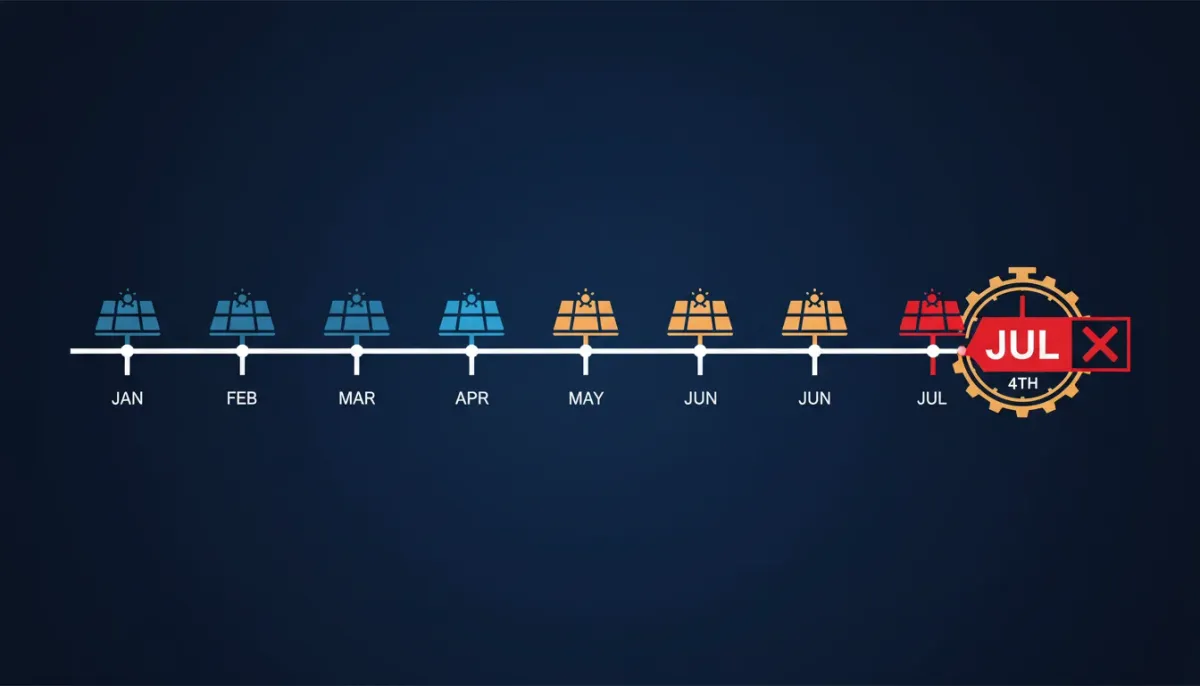
Under the One Big Beautiful Bill Act (OBBBA), Section 48/48E projects that began construction on or before July 4, 2026 locked in the full credit timing, with placement in service allowed through roughly 2030. Projects that begin construction after that date still qualify for the 30% ITC, but generally must be placed in service by December 31, 2027.
The $1,000 residential EV charger credit (Section 30C) expired June 30, 2026 and is no longer available. If bundling solar + EV charger, budget without it.
Projects that begin construction after July 4, 2026 must be placed in service by December 31, 2027 to claim Section 48/48E. By contrast, 100% first-year bonus depreciation was permanently restored under OBBBA — it does not phase out.
What “begin construction” means: The IRS requires either (1) physical work of a significant nature to start, or (2) at least 5% of total project costs to be incurred. Your TPO partner handles this documentation. Projects that met the test on or before July 4, 2026 locked in the longest placed-in-service window.
You cannot claim the tax credit yourself — Section 25D is dead. But you do not need to. Here is how third-party ownership turns the 30% ITC into real monthly savings without you filing a single IRS form.
This is not a loophole. Section 48/48E was specifically designed by Congress to allow any business entity — including solar financing companies — to claim the credit.
A financing company (the "third-party owner") purchases and installs solar panels on your roof. You don't buy the system — you agree to either lease it (fixed monthly payment) or buy the power it produces (PPA, per-kWh rate).
Because the financing company legally owns the system, it files IRS Form 3468 and claims the 30% Investment Tax Credit under Section 48/48E. On a $30,000 system, that's $9,000 back from the IRS. The company also claims MACRS depreciation (5-year accelerated schedule with 100% first-year bonus, permanently restored under OBBBA).
The financing company doesn't pocket the ITC — it uses the $9,000+ in tax benefits to reduce your monthly payment. This is why lease/PPA payments are typically 20–40% lower than what you'd pay on a standard solar loan without the ITC.
Your lease/PPA payment is locked in below your current electric bill rate. You save money starting month one. The system owner handles all maintenance, monitoring, and warranty claims.
With NuWatt's Propel program, the third-party owner transfers full ownership to you at year 5 — after the ITC recapture period expires. You get the best of both worlds: ITC savings upfront, full ownership long-term.
The biggest risk with a standard lease is the escalator clause — your payment increases 1.5–2.9% each year. But utility rates rise 3–5% annually. Here is a year-by-year analysis showing whether the lease stays cheaper than your utility bill.
Assumptions: $120/mo starting lease payment, 2.9% annual escalator. $150/mo utility bill, 4% annual utility rate increase. Both are conservative mid-range estimates.
| Year | Lease Payment | Utility Bill | Monthly Savings | Cumulative |
|---|---|---|---|---|
| Year 1 | $120/mo | $150/mo | $30/mo | $360 |
| Year 5 | $135/mo | $175/mo | $40/mo | $2,112 |
| Year 10 | $155/mo | $213/mo | $58/mo | $5,160 |
| Year 15 | $179/mo | $260/mo | $81/mo | $9,444 |
| Year 20 | $207/mo | $316/mo | $109/mo | $15,276 |
| Year 25 | $238/mo | $384/mo | $146/mo | $23,112 |
No crossover: The lease never becomes more expensive than the utility bill. Even with a worst-case 2.9% escalator, the lease payment stays below the utility bill for the entire 25-year term because utility rates historically rise faster (4%+/year). NuWatt also offers 0% escalator leasesat a slightly higher starting rate — locking your payment permanently.
Both platforms were built when the residential ITC existed. Their comparison models and financing defaults still assume homeowners capture the 30% credit — even though that credit has been $0 since January 1, 2026. Here is what you need to know.
Their marketplace ranks solar quotes by "net cost" — subtracting the 30% ITC from the purchase price. This default framing optimizes for purchased systems.
In 2026, homeowners get $0 ITC. EnergySage's comparison model was built when 25D existed. Their "net cost" calculation now shows the GROSS cost for cash/loan — but many customers don't realize this until they file taxes and get nothing back.
If you use EnergySage, compare total out-of-pocket after realizing $0 ITC. A lease/PPA quote through any provider — including NuWatt — will beat the "net cost" shown for a purchased system because the TPO company actually captures the credit.
Palmetto's financing defaults assume the homeowner captures the ITC, showing low "after-credit" prices and monthly payments.
These prices are fiction in 2026. The 30% credit no longer exists for homeowners. A $25,600 system costs $25,600 — not $17,920. Palmetto's loan calculator inflates savings by assuming a credit you cannot claim.
Ask any Palmetto rep: "What is my ITC amount in 2026?" The answer is $0. If they show you a price "after tax credit," that price is wrong. Compare the full $25,600 against a lease/PPA payment — that's the honest comparison.
Bottom line:If any solar company shows you a price “after the 30% tax credit” for a cash or loan purchase in 2026, that price is wrong. The credit does not exist for homeowners. Ask for the gross cost and compare it against lease/PPA payments. That is the only honest comparison.
Sunrun is the largest residential solar company in the US. They do many things well. But there are things they do not disclose upfront that you should know before signing a 25-year agreement.
Sunrun correctly explains that the 30% ITC is captured by the system owner and passed to customers through lower payments.
Sunrun rarely discloses how much of the ITC benefit actually reaches you vs. stays as margin. Independent PPAs and local providers often pass through more savings.
Sunrun offers legitimate 25-year solar leases with performance guarantees and included maintenance.
Many Sunrun contracts include a 2.9% annual escalator — meaning your payment in year 25 is 97% higher than year 1. Some competitors offer 0% escalator leases.
Sunrun operates in 22+ states with strong infrastructure and financing.
National providers typically use subcontracted installers. Local companies like NuWatt provide direct installation with the same financing structures — often with better post-install support.
Sunrun offers buyout options after year 5–7 at fair market value.
NuWatt's Propel program transfers ownership automatically at year 7 with no buyout fee — a hybrid model Sunrun doesn't offer.
Our position: Sunrun is a real company with legitimate products. But national providers use subcontractors and often include 2.9% escalators. NuWatt installs directly, offers 0% escalator options, and has the Propel ownership-transfer program that no national provider offers.
Most solar financing forces you to choose: own the system (but get $0 ITC) or lease it (but never own it). Propel eliminates this tradeoff entirely.
No upfront cost. Your 25-year loan with Concert Finance covers everything.
A third-party owner holds the system for years 1–5 and claims the 30% Section 48/48E credit. That savings is baked into your lower payment.
After the 5-year ITC recapture period, full ownership transfers to you — free of charge. No buyout required.
The third-party owner guarantees system performance and covers all maintenance for the first 5 years.
Because the ITC is factored in, your monthly payment is 15–25% lower than a standard solar loan.
Availability: Currently available in Maine and Texas. Requires 660+ FICO score. Concert Finance owns the system and claims the ITC + MACRS depreciation. Ownership transfers to you at year 7 with no buyout fee.
The 30% ITC is just the starting point. Each state has its own incentive stack. High-rate states like Massachusetts and Connecticut see the biggest lease/PPA savings.
Decision-focused answers for homeowners comparing lease, PPA, cash, and Propel in 2026.
Buying solar can still be worth it long-term — you save $45,000+ over 25 years with cash. But the math is very different. Without 25D, your payback stretches to 14 years on a $25,600 system. Compare that to a lease that saves you $20–50/month from day 1 with $0 risk. For most homeowners, a lease or PPA now makes more immediate financial sense.
Section 25D — the residential solar Investment Tax Credit — expired on December 31, 2025 as scheduled under the One Big Beautiful Bill Act (OBBBA) signed July 4, 2025. There are no current proposals to reinstate it. Homeowners who buy solar with cash or a loan in 2026 receive $0 from the IRS.
Section 48/48E — the commercial/investment tax credit — is separate from Section 25D. It provides a 30% credit to any business entity that owns a qualifying energy system. When a financing company owns the solar panels on your roof (via a lease, PPA, or Propel), that company claims the 48/48E credit as a business. This is the intended design of the tax code.
July 4, 2026 was the Section 48/48E begin-construction safe harbor. Projects that began construction — physical work of a significant nature, or 5% of project costs incurred — on or before that date locked in the full credit timing, with placement in service allowed through roughly 2030. Projects starting now still qualify for the 30% credit but generally must be placed in service by December 31, 2027. The credit was not eliminated; leases and PPAs still pass the 30% ITC through as lower payments. The placed-in-service window simply tightened for later starts, so starting sooner keeps the most flexible timeline open.
Many leases include a 1.5–2.9% annual escalator. At 2.9%, your $120/month payment becomes $237/month by year 25. However, utility rates rise 3–5% annually, so your lease payment still stays below utility costs. NuWatt offers 0% escalator options. Always compare 25-year total cost, not just year-1 payment.
Propel is NuWatt's prepaid Energy Service Agreement. Concert Finance owns the system and claims the 30% ITC under Section 48/48E. You pay $0/month — no lease payment, no loan payment. After 7 years, full ownership transfers to you with no buyout fee. It is the only financing structure that gives you both the ITC benefit AND eventual ownership with zero monthly payments. Available in Maine and Texas.
National companies like Sunrun offer legitimate products. But they use subcontracted installers, often include 2.9% escalators, and don't offer ownership-transfer programs like Propel. Local installers like NuWatt provide direct installation, typically lower escalators (or 0%), better post-install support, and often pass through more of the ITC savings to you.
EnergySage's marketplace was built when the 30% homeowner ITC existed. Their comparison model shows "net cost after tax credit" — but in 2026, that credit is $0 for cash/loan buyers. Many customers see an artificially low price, then discover at tax time they get nothing back. For accurate 2026 comparisons, compare gross cost ($25,600) against lease/PPA payments.
The Section 48/48E ITC is still available — it was not eliminated after July 4, 2026. New projects generally must be placed in service by December 31, 2027 to claim it, so waiting into 2027 leaves less room for permitting and interconnection delays. MACRS first-year bonus depreciation stays at a permanent 100% under OBBBA — it does not phase out. There is no indication Congress will reinstate Section 25D. And utility rates keep rising 3–5% a year, so waiting almost certainly means paying more regardless of which financing you choose.
Standard solar leases typically require a 650+ FICO score. NuWatt Propel requires 660+. If your credit is below 650, some PPA providers have lower thresholds. The advantage of a lease or PPA is that the financing company bears the financial risk — not you — so credit requirements are generally easier than a solar loan (which may require 680+).
We are not going to pretend leasing is always the right choice. Cash purchase still delivers the highest 25-year return. Here are the scenarios where buying outright remains the better financial decision — even without the ITC.
Propel combines the best of both worlds. You get the 48/48E ITC benefit (claimed by Concert Finance), $0 monthly payments (prepaid ESA), and full ownership transfer at year 7. It is the only financing option that delivers immediate savings, ITC access, andeventual ownership — all with zero monthly payments.
The real comparison in 2026:Cash purchase delivers ~$45,000 in 25-year savings but requires $25,600 upfront and 14 years to break even. A lease delivers ~$15,000–$25,000 in savings with $0 upfront and positive cash flow from month 1. The difference is not as large as it was when buyers got a $7,680 tax credit. Many homeowners now find the lower risk and immediate returns of leasing to be the more rational choice.
Before 2026, solar loans made sense because you could use the $7,680 ITC to pay down the loan balance. That math no longer works. Here is why solar loans are now the least attractive financing option for most homeowners.
A $25,600 solar loan at 7% APR over 15 years costs you $13,600 in interest— bringing the total cost to $39,200. Without the ITC to offset that, you are paying significantly more than the system is worth. Your monthly loan payment of ~$230 may exceed your electric bill savings of ~$150, meaning you lose money each month for the first several years.
Unlike a lease, a loan gives you ownership — which means you handle all repairs. An inverter replacement ($1,500–$3,000 at year 10–12) is your cost. Panel cleaning, monitoring subscriptions, and any warranty disputes are on you. With a lease, the TPO company covers everything.
If you want eventual ownership but cannot pay cash, NuWatt Propel is the better path. You pay $0/month (vs. $230/month on a loan), the TPO company captures the ITC (lowering your effective cost), and you own the system at year 7 with no buyout fee. In states without Propel, a 0% escalator lease with a year-7 buyout option gets you close to the same result.
Summary: In 2024, a solar loan was a reasonable way to buy solar with $0 down because the ITC paid down 30% of the balance. In 2026, you get $0 ITC and still pay $13,600+ in interest. A lease or Propel agreement gives you the same electricity savings with lower total cost and zero maintenance burden.
This is the most common objection to solar leasing — and the data overwhelmingly says no. Solar homes sell faster and for more money, regardless of whether the system is owned or leased.
4.1%
Higher sale price
Source: Zillow Research
2–4
Weeks to transfer lease
Standard process
80%+
Buyers accept transfer
SEIA market data
When selling a home with a leased solar system, you have two options:
In 2026 specifically: With utility rates at all-time highs ($0.28+/kWh in most NuWatt states), a locked-in lease rate of $0.12/kWh is an incredibly attractive feature for home buyers. Solar is increasingly viewed as a home upgrade, not a liability.
If you sell your home during the Propel ownership period (years 1–7), the buyer can assume the agreement or you can negotiate the system value into the sale price. After year 7, the system is fully yours — it transfers with the home just like any other owned equipment, adding directly to your sale price with no third-party involvement.
The Section 48/48E begin-construction safe harbor closed July 4, 2026. Here is what that changed for projects starting now — and what stays the same.
The takeaway:the 30% commercial ITC still flows through lease and PPA pricing after July 4, 2026 — payments did not jump. What changed is the schedule: new projects generally must be placed in service by December 31, 2027, so there is less slack for permitting and interconnection delays. Starting sooner keeps your project comfortably inside that window.
All cost comparisons use an 8 kW system at $3.20/W ($25,600) with a $0.28/kWh average utility rate. Lease payments reflect 2025–2026 TPO market rates from SEIA and Wood Mackenzie. Electric rates sourced from EIA Electric Power Monthly (January 2026 data). Section 48/48E guidance per IRS Notice 2024-30 and OBBBA provisions. Escalator analysis uses a 2.9% annual escalator (high end) against 4% utility rate growth (conservative). Propel terms based on Concert Finance program documentation.
Data Sources
Additional References
Compare all financing options side by side
How the commercial ITC works for residential solar
The clean energy credit that keeps leases affordable
What the begin-construction safe harbor means
$0/mo + ownership at year 7 (ME & TX)
Start your solar project
Cash buyers get $0 in federal credits. Lease and PPA customers still capture the 30% ITC, passed through as lower payments.
Permitting takes 4–8 weeks and utility interconnection another 2–4 weeks. New projects generally must be placed in service by December 31, 2027, so starting sooner keeps you comfortably inside that window.
MACRS first-year bonus depreciation stays at a permanent 100% under OBBBA. There is no indication Congress will reinstate the residential 25D credit. Waiting means paying more at rising utility rates — period.