Loading NuWatt Energy...

We use your location to provide localized solar offers and incentives.
We serve MA, NH, CT, RI, ME, VT, NJ, PA, and TX
Loading NuWatt Energy...
NuWatt designs, installs, and manages solar, battery, heat pump, and EV charger systems across 9 states. One company, one warranty, one point of contact.
Get a Free QuoteThe Texas Commission on Environmental Quality (TCEQ) is offering $2,500 grants for new electric, plug-in hybrid, and hydrogen fuel cell vehicles purchased on or after September 1, 2025. Available statewide through March 6, 2026 — or until funds run out. Combine with solar + EV charger installation to generate your own fuel.
$2,500
TCEQ Grant Amount
Mar 6
2026 Deadline
254
TX Counties Eligible
$0
Federal EV Credit (Repealed)
Federal EV Credits Repealed: The Section 30D new clean vehicle credit ($7,500) and Section 25E used EV credit ($4,000) were both repealed by the OBBBA, signed July 4, 2025. No federal EV purchase tax credits exist in 2026. The TCEQ LDPLIP $2,500 grant is the primary government EV incentive for Texas residents. The Section 30C EV charger credit (up to $1,000) expired June 30, 2026 and is no longer available.
The Light-Duty Motor Vehicle Purchase or Lease Incentive Program (LDPLIP) is a grant program administered by the Texas Commission on Environmental Quality (TCEQ) under the Texas Emissions Reduction Plan (TERP).
The federal landscape for EV incentives changed dramatically in 2025. The One Big Beautiful Bill Act (OBBBA), signed July 4, 2025, repealed the Section 30D new clean vehicle credit (up to $7,500) and the Section 25E used EV credit (up to $4,000). As of January 1, 2026, there are zero federal tax credits for purchasing an electric vehicle.
The TCEQ LDPLIP $2,500 grant is now the most significant government incentive available to Texas EV buyers. While $2,500 is less than the old federal credit, it is a direct grant — not a tax credit. You receive the money regardless of your tax liability. This is particularly valuable for lower-income buyers who may not have had enough tax liability to fully claim the old 30D credit.
TERP background: The Texas Emissions Reduction Plan was established in 2001 to improve air quality across Texas. TERP is funded through vehicle registration fees and emissions inspection fees. The LDPLIP is one of several TERP grant programs targeting transportation emissions.
The LDPLIP covers three categories of zero- and low-emission vehicles. All must be new (never previously titled) and purchased on or after September 1, 2025.
Examples: Tesla Model 3/Y, Chevrolet Equinox EV, Ford Mustang Mach-E, Hyundai Ioniq 5/6, Kia EV6/EV9, Rivian R1S/R1T, BMW iX, VW ID.4, Nissan Ariya
$2,500
LDPLIP Grant
Examples: Toyota RAV4 Prime, Jeep Wrangler 4xe, Chrysler Pacifica PHEV, BMW X5 xDrive50e, Hyundai Tucson PHEV, Kia Sportage PHEV
$2,500
LDPLIP Grant
Examples: Toyota Mirai, Hyundai NEXO (limited TX fueling infrastructure)
$2,500
LDPLIP Grant
Used vehicles, conventional hybrids (non-plug-in), conventional gas/diesel vehicles, vehicles purchased before September 1, 2025, and vehicles not registered in Texas. Low-speed vehicles, neighborhood electric vehicles, and golf carts are also excluded.
Six requirements must all be met to qualify for the $2,500 LDPLIP grant. Missing any one of these will result in application denial.
The vehicle must be a new (not used or pre-owned) light-duty motor vehicle. Dealer demos, loaners, and fleet buybacks do not qualify. The vehicle must have never been titled.
The vehicle must be purchased or leased on or after September 1, 2025. Vehicles bought before this date are not retroactively eligible, regardless of registration timing.
The vehicle must be registered and titled in the State of Texas. Out-of-state registrations are not eligible. The applicant must be a Texas resident or a Texas-based business.
The vehicle must be a battery electric vehicle (BEV), plug-in hybrid electric vehicle (PHEV), or hydrogen fuel cell vehicle that meets TCEQ emissions criteria under the TERP program.
The vehicle must not have received a prior TERP incentive grant. Each eligible vehicle can only receive one LDPLIP grant. One grant per person per biennium.
Applications must be submitted before March 6, 2026, or until funds are exhausted — whichever comes first. This is a first-come, first-served program with limited funding.
The application process is straightforward but must be completed before March 6, 2026, or before funds are exhausted. Apply as soon as possible after purchasing your vehicle.
Buy or lease a new BEV, PHEV, or hydrogen fuel cell vehicle from a Texas dealer on or after September 1, 2025. Keep all purchase documentation, including the bill of sale and the vehicle identification number (VIN).
Title and register the vehicle in the State of Texas through your county tax assessor-collector office. Obtain your Texas registration receipt and title documents.
Submit the LDPLIP application through the TCEQ online portal or by mail. Include proof of purchase (invoice/bill of sale), Texas registration, proof of Texas residency, and the vehicle VIN. Applications are reviewed in the order received.
TCEQ reviews applications and issues $2,500 grant payments. Processing typically takes 6-8 weeks after a complete application is submitted. Funds are paid directly to the applicant (not the dealer).
The LDPLIP is first-come, first-served. Previous TERP incentive programs have been oversubscribed well before their posted deadlines. TCEQ does not publish real-time fund balances. If you have already purchased an eligible vehicle, submit your application immediately. Visit tceq.texas.gov/airquality/terp/ldplip for the current application form and status updates.
The federal EV purchase credits are gone, and the Section 30C Alternative Fuel Vehicle Refueling Property Credit expired June 30, 2026. Texas utility EV-charger rebates and off-peak charging rates are now the way to offset charger costs.
Texas EV buyers can still stack these incentives — the federal §30C charger credit expired June 30, 2026:
TCEQ deadline: Mar 6, 2026. §30C expired Jun 30, 2026. Utility rebates vary.
Several Texas utilities offer EV charger rebates or special rate plans that can be combined with the TCEQ grant. With the federal 30C credit expired since June 30, 2026, these utility rebates and off-peak rates are the main way to offset charger costs.
Austin metro
Up to $1,200
Residential Level 2 EV charger rebate for Austin Energy customers. Must use qualified electrician. Additional TOU rate discounts for off-peak charging (nights/weekends).
San Antonio
Up to $500
EV charger rebate for CPS Energy residential customers in San Antonio. Requires a qualifying Level 2 EVSE. Also offers reduced EV-specific rate plan.
DFW, North/Central/West TX
$250 bill credit
Oncor offers bill credits through participating REPs for EV charger installation. Available in Oncor service territory (DFW, Waco, Midland-Odessa, and more).
Houston metro
Varies by REP
CenterPoint does not offer direct EV rebates, but several REPs in CenterPoint territory (Houston) offer EV-specific plans with reduced off-peak rates.
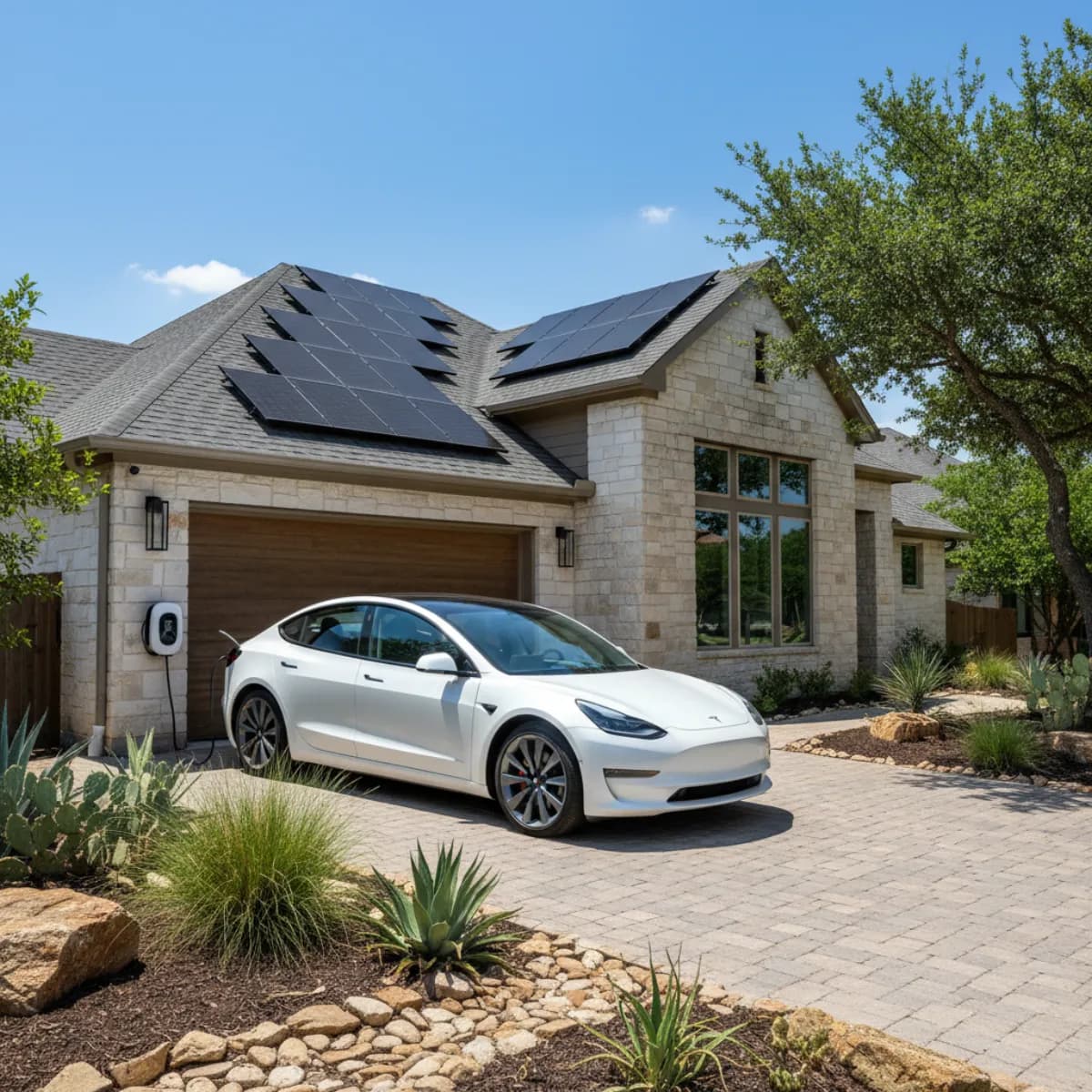
Pairing an electric vehicle with rooftop solar is the single most effective way to reduce transportation costs in Texas. The math is straightforward: eliminate both your electric bill and your gasoline bill with one investment.
The average Texas household drives approximately 12,000-15,000 miles per year. At current gas prices ($2.80-3.40/gallon, 25 MPG average), that costs $1,350-2,040 in fuel annually. An EV driving the same distance uses roughly 3,600-4,500 kWh of electricity. A properly sized solar system generates that electricity for free after the system investment is recovered.
| Cost Category | Gas Vehicle | EV (Grid) | EV + Solar |
|---|---|---|---|
| Average TX gas cost (2026) | $2,400-3,200/year | $0 | $0 |
| Average TX electricity for EV | N/A | $600-900/year | $0 (solar-powered) |
| Annual fuel savings vs gas | — | $1,500-2,300/year | $2,400-3,200/year |
| TCEQ LDPLIP grant | $0 | $2,500 (one-time) | $2,500 (one-time) |
| Federal 30C charger credit | N/A | Expired 6/30/26 | Expired 6/30/26 |
| 10-year total fuel savings | — | $15,000-23,000 | $24,000-32,000 |
A typical Texas household with an EV and solar system eliminates $2,400-3,200 per year in combined fuel and electricity costs. Over 10 years, that is $24,000-32,000 in savings — often exceeding the cost of the solar system itself.
Texas is particularly well-suited for this combination: abundant sunshine (4.5-5.5 peak sun hours per day), high summer electricity rates that reward solar production, and long driving distances that amplify fuel savings.
An 8-10 kW solar system generates roughly 12,000-16,000 kWh per year in Texas — enough to power both your home and your EV. You literally generate your own fuel on your roof.
The Complete Math: TCEQ Grant + Solar + EV Charger
Example for a Dallas-area homeowner: $2,500 TCEQ grant + $250 Oncor bill credit = $2,750 in combined incentives (the federal Section 30C charger credit expired June 30, 2026). Add a 10 kW solar system generating ~15,000 kWh/year to power both home and EV, and your annual fuel + electricity savings reach $3,000-4,000. The total 10-year economic benefit: approximately $32,000-42,000 in combined incentives and ongoing savings versus a gas vehicle on grid power.
Installing a solar system and EV charger together is smarter and cheaper than doing them separately. Here is why Texas homeowners should bundle.
Shared electrical work, single permit application, one crew mobilization. Bundle installation reduces total project cost by $300-500 versus separate installs.
One permitting process, one inspection, one interconnection application. Your solar system and EV charger go live on the same day — typically 4-8 weeks from contract to commissioning.
When we design your solar system knowing you will charge an EV, we add 1-2 kW of extra capacity to cover your vehicle's electricity demand — maximizing your self-consumption and minimizing grid purchases.
The federal Section 30C Alternative Fuel Vehicle Refueling Property Credit (up to $1,000 for residential) expired June 30, 2026, so there is no longer a federal credit for EV charger installation. Texas utility EV-charger rebates and off-peak charging rates remain, and bundling a solar + EV charger install still lets you lock in today's solar pricing and cut charging costs.
Pair your new EV with rooftop solar and a Level 2 charger. Eliminate your gasoline bill AND your electricity bill. NuWatt designs, installs, and permits solar + EV charger bundles across Texas.
The federal Section 30C charger credit expired June 30, 2026. Ask us about Texas utility EV charger rebates.
Last updated: April 2026
Sources: TCEQ TERP/LDPLIP program, IRS Section 30C, OBBBA (P.L. 119-XXX), Austin Energy, CPS Energy, Oncor