
Loading NuWatt Energy...
We use your location to provide localized solar offers and incentives.
We serve MA, NH, CT, RI, ME, VT, NJ, PA, and TX
Loading NuWatt Energy...
NuWatt designs, installs, and manages solar, battery, heat pump, and EV charger systems across 9 states. One company, one warranty, one point of contact.
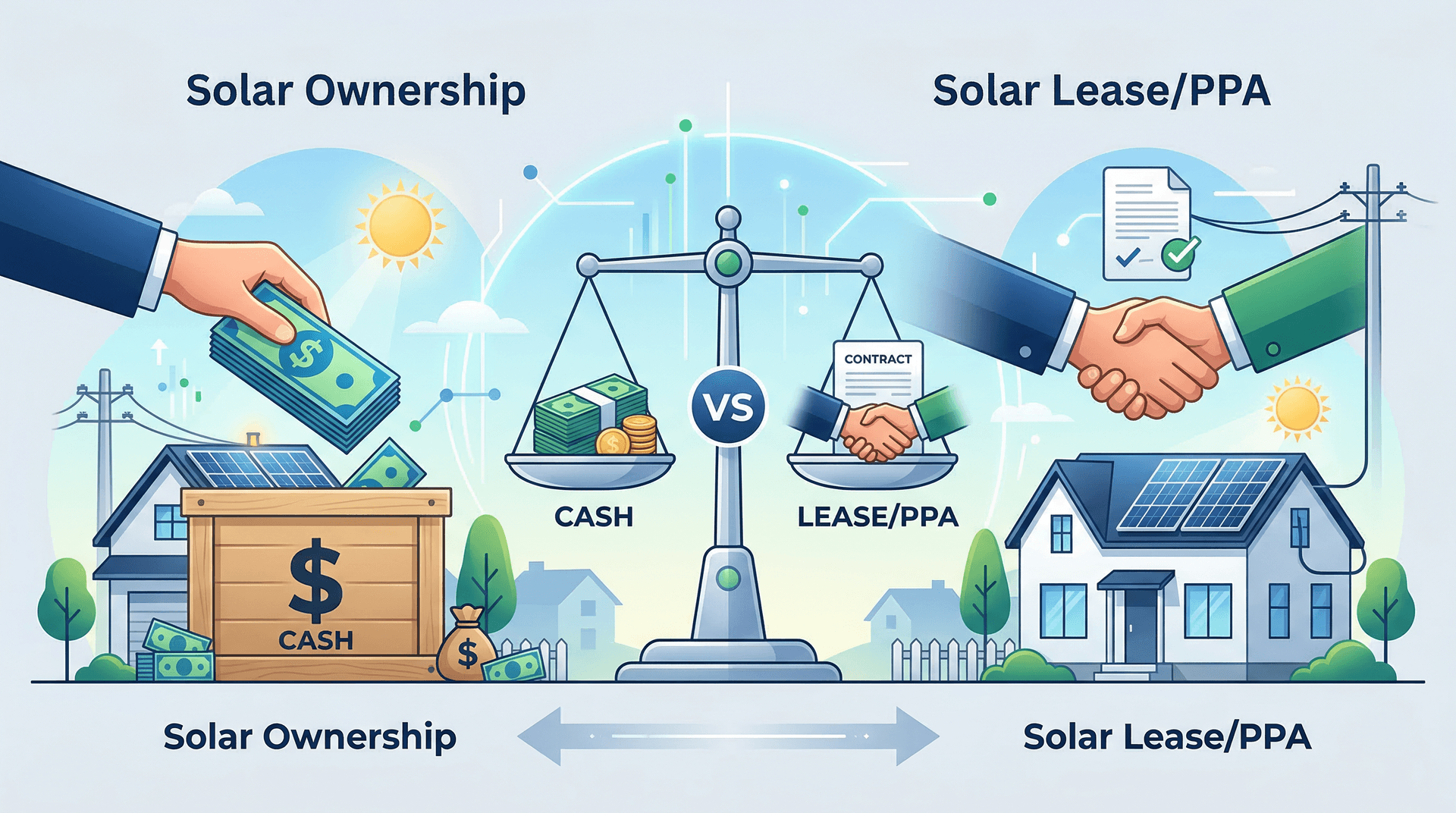
Get a Free QuoteThe ITC is dead for homeowners. Lease and PPA are now more competitive than ever. Here is exactly how each financing option stacks up in the post-ITC landscape.

$0
Federal ITC for Homeowners
30%
Sec 48 for Lease/PPA Companies
$3.08/W
Average MA Solar Cost
Jul 4
2026 Section 48 Deadline
Before 2026, the financing decision was simple: buy with cash or loan, claim the 30% federal tax credit (Section 25D), and enjoy the highest possible savings. That credit is now $0. Meanwhile, third-party lease and PPA companies can still claim the 30% commercial ITC (Section 48/48E) because they own the system. This completely reshuffled the financing math.
The residential solar tax credit expired December 31, 2025. Cash and loan buyers receive $0 in federal credits. On a $25,200 system, that is $7,560 that 2025 buyers received and you will not.
The 30% commercial ITC remains available for third-party system owners (PPA/lease companies). They claim the credit and pass savings to you as a lower rate. Deadline: July 4, 2026.
In 2025, cash buyers got a 30% credit, making ownership clearly superior. Now that buyers get $0, the PPA/lease Section 48 advantage closes the gap significantly. See our solar lease/PPA guide for more details.
SMART 3.0 ($0.03/kWh for 20 years), 1:1 net metering, $1,000 state credit, sales tax exemption (6.25%), and property tax exemption (20 years). Full details in our MA solar incentives guide.
Section 48 deadline: July 4, 2026. PPA/lease projects must begin construction before this date for the system owner to claim the 30% ITC. After this deadline, lease and PPA rates will likely increase.
Four financing paths, each with different advantages in post-ITC Massachusetts.
Best for long-term homeowners with $25K+ liquid.
Best for good credit, want ownership, no cash upfront.
Best for predictable payments, no hassle.
Best for simplest option, pay only for power produced.
| Feature | Cash | Loan | Lease | PPA |
|---|---|---|---|---|
| Upfront Cost | $25,200 | $0 | $0 | $0 |
| Monthly Payment | $0 | $180-220 | $80-120 fixed | Per kWh used |
| Interest Rate | N/A | 6-8% APR | N/A | N/A |
| Federal ITC Benefit | $0 (25D dead) | $0 (25D dead) | 30% via Sec 48 | 30% via Sec 48 |
| System Ownership | You own it | You own it | TPO company | TPO company |
| SMART 3.0 Income | You keep (~$288/yr) | You keep (~$288/yr) | Company keeps | Company keeps |
| State Tax Credit ($1K) | You claim | You claim | Company claims | Company claims |
| Net Metering Credits | 1:1 retail (yours) | 1:1 retail (yours) | 1:1 (company keeps) | 1:1 (company keeps) |
| ConnectedSolutions | You enroll | You enroll | Company enrolls | Company enrolls |
| 25-Year Net Savings | $110K+ | $85K+ | $25-35K | $30-40K |
| Payback Period | 8-10 yr | 10-12 yr | Immediate | Immediate |
| Contract Length | None | 15-25 yr | 20-25 yr | 20-25 yr |
| Maintenance | Your responsibility | Your responsibility | Company handles | Company handles |
| Home Sale Impact | Adds value, easy | Pay off or transfer | Transfer or buyout | Transfer or buyout |
| Best For | Long-term investors | Ownership seekers | Predictable payment | Lowest risk |
* Based on an 8 kW system at $3.08/W in Massachusetts. Actual savings vary by utility, usage, and roof orientation. Utility rates: Eversource $0.2836/kWh, National Grid $0.31/kWh, Unitil $0.2833/kWh.
Highest long-term ROI, largest upfront commitment
Paying cash for a solar system in Massachusetts gives you the highest return on investment over 25 years. You own the system outright, keep all SMART 3.0 income, collect full net metering credits, and claim the $1,000 state tax credit. The downside: you need $25,200 upfront and receive $0 in federal tax credits.
Best for: High net worth homeowners who plan to stay 10+ years and want maximum long-term ROI. If you have $25K+ liquid and a good roof, cash is still the highest-return option.
Ownership without upfront cash
Note: The original MassCEC Mass Solar Loan program (with interest rate buy-downs to 0%) ended in 2020 after successfully funding thousands of installations. Solar loans are now available at market rates through local lenders. See our Mass Solar Loan guide for full details.
Solar loans remain the best option for homeowners who want to own their system without paying cash upfront. At current rates of 6-8% APR through local lenders and credit unions, you get full ownership and keep all benefits: SMART income, net metering credits, and the $1,000 state tax credit.
Based on 15-year term at 7% APR, Eversource territory
Best for: Good credit score, want ownership and all incentive benefits, but cannot pay $25K+ upfront. Most households see near-neutral monthly cash flow.
Fixed monthly payment, $0 down, maintenance included
A solar lease means a third-party company installs, owns, and maintains panels on your roof. You pay a fixed monthly fee ($80-$120) regardless of how much energy the system produces. Most leases include a 0-2.9% annual escalator.
The leasing company owns the system, so they claim the 30% Section 48 ITC. That tax credit savings is what allows them to offer you such a low monthly rate. After July 4, 2026, when Section 48 expires for new projects, expect lease rates to increase.
Best for: Homeowners who want guaranteed savings with no risk, no upfront cost, and no maintenance hassle. Ideal for those on fixed incomes or who prefer predictable monthly expenses.
Pay only for the electricity produced, at a much lower rate
A PPA is similar to a lease, but instead of a fixed monthly payment, you pay per kilowatt-hour of electricity the system actually produces. Typical PPA rates in Massachusetts are $0.10-$0.15/kWh, compared to $0.28-$0.31/kWh from your utility. You only pay for what the system generates.
Like a lease, the PPA company owns the system and claims the 30% Section 48 ITC. The key difference: in cloudy months, your PPA bill is lower because the system produced less. In sunny months, you save more because the system produced more.
Best for: Homeowners who want the simplest option with the fairest pricing. You pay for exactly what you get. National Grid customers benefit most because the spread between utility rate ($0.31) and PPA rate ($0.10-$0.15) is largest.
How third-party ownership passes the 30% ITC savings to you

When you sign a solar PPA or lease, the financing company owns the system, not you. That makes them a “commercial/third-party” system owner who qualifies for Section 48/48E, the 30% commercial ITC. The financing company claims the ITC, NOT the installer.
Financing company installs a $25,200 system on your roof
They claim the 30% Section 48 ITC = $7,560 tax credit
Their net system cost drops to ~$17,640
They pass that savings as a lower rate to you
2025 (ITC Active)
2026 (ITC Dead for Homeowners)
The INSTALLER does not claim the ITC. The THIRD-PARTY SYSTEM OWNER (financing company) claims the ITC. If an installer tells you they claim the credit, verify who actually owns the system. For more detail, see our Section 48 homeowner guide.
Projects must begin construction before July 4, 2026 for the system owner to claim Section 48. If you are considering a PPA or lease, acting before this deadline gets you the best possible rates.
NuWatt's Propel financing program is currently available in Maine and Texas, with plans to expand to additional states. Propel uses Section 48E to offer unique third-party ownership with a path to full ownership. Stay tuned for Massachusetts availability.
Beyond monthly payments, what matters is the total amount you pay over the system lifetime versus the total savings. Here is the full picture for an 8 kW system in Massachusetts.
Estimates assume 3% annual utility rate increase, 0.5% annual panel degradation, Eversource territory. Loan assumes 7% APR, 15-year term. Lease assumes $92/mo avg with 2% escalator. PPA assumes $0.12/kWh with 2% escalator.
ConnectedSolutions is Massachusetts' demand response program that pays you for sharing stored battery energy during peak demand. Here is how eligibility works under each financing option. Read our full ConnectedSolutions guide.
| Utility | Summer Rate | Winter Rate | Eligible? |
|---|---|---|---|
| Eversource | $275/kW | $50/kW | Yes |
| National Grid | $225/kW | $50/kW | Yes |
| Unitil | N/A | N/A | No |
You enroll your battery directly in ConnectedSolutions and keep all revenue. With a 10 kWh battery (e.g., Tesla Powerwall 3), expect $1,375-$1,625/year in Eversource territory or $1,125-$1,375 with National Grid. This significantly shortens your payback period.
If the lease/PPA company owns the battery, they typically enroll it and may share some revenue with you. If you separately purchase a battery (even with leased panels), you can enroll directly and keep all revenue. Check your contract for battery ownership and DR program rights.
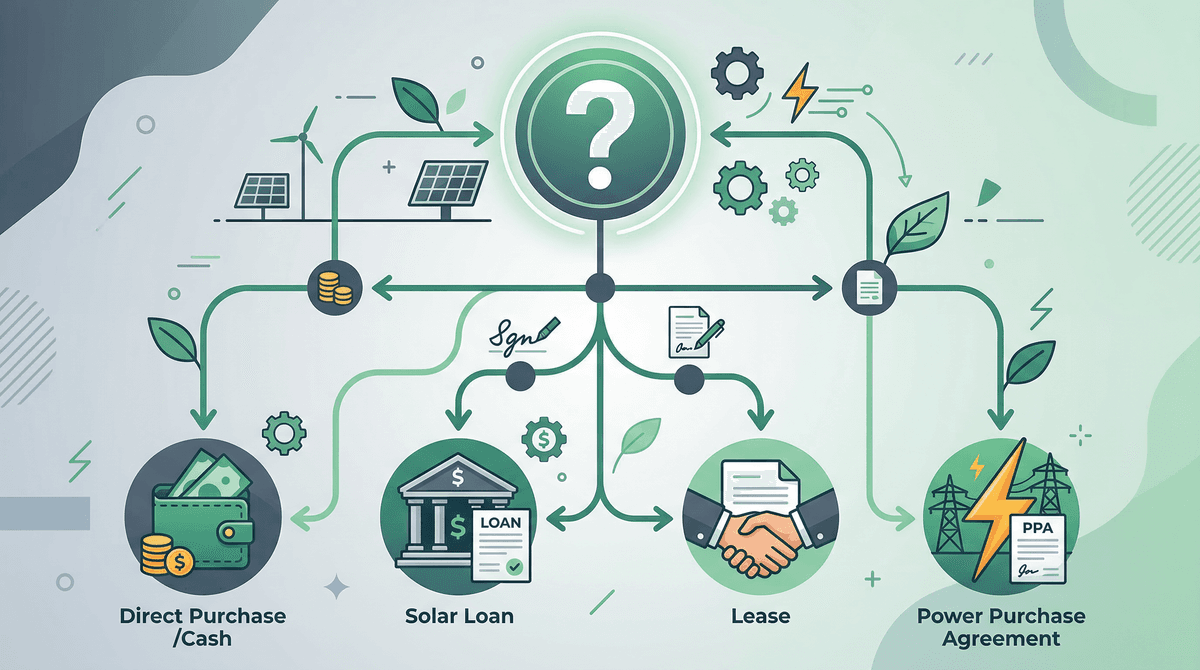
Answer these questions to find your best fit. Every situation is different, but these are the key factors that determine which financing option makes the most sense for your household.
YES
Cash purchase gives the best ROI. Payback in 8-10 years, $110K+ in 25-year savings.
NO
Continue to the next question.
YES
Solar loan at 6-8% APR. You keep SMART, net metering, and $1K state credit.
NO
Continue to the next question.
FIXED PAYMENT
Solar lease. $80-$120/mo, predictable. Best for budgeting.
PAY PER kWh
Solar PPA. $0.10-$0.15/kWh. Only pay for what is produced. Fairer pricing.
Cannot install panels? Subscribe to Massachusetts community solar for 10-20% bill savings with no installation needed.
How you finance your solar system matters when it comes time to sell your home. Owned systems add the most value and are the simplest to transfer. Third-party agreements require the buyer to assume the contract.
Home value impact: +$15,000-$20,000 (Zillow/Appraisal Institute data)
Transfer: System conveys with the home. No contract to transfer.
Buyer appeal: High. Buyers love free electricity with no strings attached.
Home value impact: +$15,000-$20,000 (same as cash, you own it)
Transfer: Pay off loan balance at closing, or some lenders allow assumption.
Buyer appeal: High once loan is paid off. The system is fully owned.
Home value impact: Neutral to slightly positive
Transfer: Buyer must qualify and agree to assume remaining lease. Or you buy out.
Buyer appeal: Mixed. Some buyers dislike assuming a 20-year contract.
Home value impact: Neutral to slightly positive
Transfer: Same as lease. Buyer assumes PPA or you buy out the contract.
Buyer appeal: Mixed. Some buyers appreciate the low rate, others hesitate.
Pro tip: If you plan to sell within 5-7 years, a PPA or lease may actually be the best choice. You save money each month while you live there, and the transfer process is well-established. If you plan to stay 10+ years, ownership (cash or loan) gives the highest return and easiest sale.
Use our interactive calculator to model your specific scenario. Adjust your system size, utility, financing type, and see the impact on your payback and 25-year savings.
Estimate your solar return on investment with SMART income, net metering credits, ConnectedSolutions, and MA tax benefits.
Federal Residential Solar Tax Credit (Section 25D) Expired
Homeowners who purchase solar with cash or a loan receive $0 in federal tax credits. Section 25D expired December 31, 2025.
Eastern MA (Boston, South Shore, Cape Cod, MetroWest, Western MA)
Electric Rate
$0.28/kWh
Net Metering
1:1 retail credit (Class I ≤25 kW)
SMART 3.0 Rate
$0.03/kWh
Interconnection
2-4 weeks typical
20-year exemption — solar adds $0 to your property tax
Payback Period
7
years
25-Year Savings
$114,687
total
Monthly Benefit
$378
per month
Estimates based on average 2026 MA solar pricing, SMART 3.0 $0.03/kWh residential flat rate, 1:1 retail net metering, 6.25% sales tax exemption, 20-year property tax exemption, and 15% state tax credit (max $1,000). Section 25D residential ITC expired Dec 31, 2025 — $0 federal tax credit for cash/loan purchases.
A lease gives you $0 down but you never own the system. A cash purchase gives you ownership but costs $28K–$32K upfront. Propel gives you both — $0 down and full ownership by year 5.
We'll notify you when Propel launches in your state — no spam, no pressure.
Enter your monthly electric bill to compare lease escalators vs. fixed Propel ownership payments in real time.
Compare lease escalators vs. Propel ownership by state
Lease Total
$64,356
over 25 years
Propel Total
$31,824
fixed 25 years, own yr 5
You Save
$32,532
with Propel
Crossover Year
Year 1
Lease > Propel
Auto-sized system: Based on your $200/mo bill in Massachusetts, a ~6.5 kW system would offset your usage, producing ~7,800 kWh/year.
Lease: $141/mo starting (PPA at $0.22/kWh = 70% of utility rate) | Propel: $102/mo fixed for 25 years | System: $20,020 (6.5 kW @ $3.08/W)
Massachusetts is on the Propel waitlist — join the waitlist
Get a personalized quote with real numbers for your utility, system size, and financing option. We compare cash, loan, lease, and PPA side by side.
Complete MA Solar Guide
Everything about solar in Massachusetts 2026
SMART Program 3.0
$0.03/kWh for 20 years
Net Metering Guide
1:1 retail rate credit
MA Solar Cost 2026
$3.00-$3.40/W, typical system sizes
Eversource vs National Grid
Rates and net metering by utility
ConnectedSolutions Battery
$225-$275/kW demand response revenue
Solar Lease/PPA Guide
Deep dive on third-party ownership options
Section 48 Homeowner Guide
How the commercial ITC benefits you
Solar Without the Tax Credit
Is solar still worth it in 2026?
Solar Tax Exemptions
Property and sales tax savings
Is Solar Worth It Without ITC?
The math on whether solar pencils out in MA
Solar Company Red Flags 2026
Spot predatory tactics and inflated quotes