
Loading NuWatt Energy...
We use your location to provide localized solar offers and incentives.
We serve MA, NH, CT, RI, ME, VT, NJ, PA, and TX
Loading NuWatt Energy...
NuWatt designs, installs, and manages solar, battery, heat pump, and EV charger systems across 9 states. One company, one warranty, one point of contact.
Get a Free Quote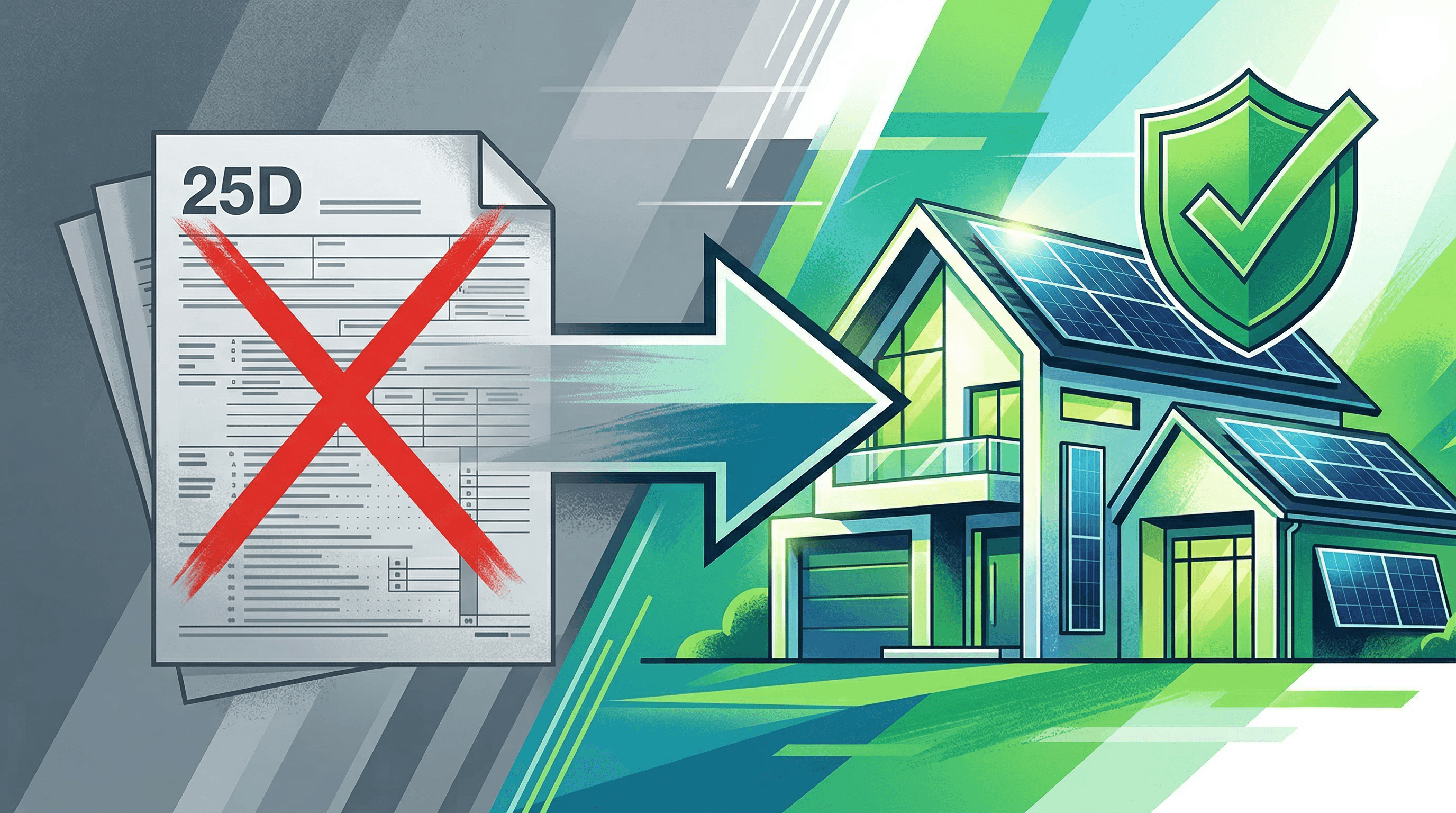
The federal solar tax credit is gone. The financing playbook that worked for 20 years is obsolete. Here is what replaced it — and how to make the best decision for your home in the post-ITC era.

Quick Answer
The residential solar tax credit (Section 25D) expired on December 31, 2025, eliminating the 30% federal credit for homeowners who buy with cash or a loan. In 2026, the best financing option for most homeowners is a PPA or solar lease, where the third-party system owner claims the 30% commercial ITC under Section 48E and passes the savings through lower monthly rates. Cash purchase remains the best long-term investment in states with strong incentives like New Jersey and Massachusetts. Solar loans are the hardest to justify without the ITC offset.
For nearly two decades, the solar financing equation was simple: buy a system, claim 30% back from the federal government, and break even in 6-8 years. The Section 25D Investment Tax Credit was the single most powerful driver of residential solar adoption in U.S. history.
That ended on December 31, 2025, when the One Big Beautiful Bill Act (OBBBA) officially repealed Section 25D. The impact is immediate and quantifiable:
That is a $7,560 gap on a typical 8 kW system. For homeowners paying cash or financing with a loan, the economics shifted overnight.
But here is what most people miss: the commercial ITC did not die. Section 48E still provides a 30% credit for systems owned by businesses — including solar leasing companies, PPA providers, and hybrid financing programs. This single fact reshuffled the entire solar financing deck.
The bottom line: The 30% tax credit is not gone from solar. It is gone from homeowner-owned solar. Third-party ownership structures — leases, PPAs, and hybrid programs like Propel — still access the full 30% credit through Section 48E. The financing company claims it and passes the savings to you.
This is the most important shift in residential solar economics since the IRA was signed in 2022. And if you understand it, you can still go solar in 2026 with the same effective discount that existed before — you just get there through a different vehicle.
Lease/PPA companies
Section 48E gives third-party owners the 30% ITC. They pass savings to homeowners and grow market share while cash/loan competitors struggle.
States with strong incentives
Massachusetts (SMART $0.03/kWh), New Jersey (ADI $85.90/MWh), and Rhode Island (REG $0.27/kWh) still make ownership profitable. State incentives partially fill the federal gap.
Homeowners with high electric bills
If you pay $0.28+/kWh (most of New England, NJ, parts of NY), solar savings are large enough to justify the upfront cost even without federal help.
Hybrid financing (Propel)
Programs that use third-party ownership to capture the 48E credit, then transfer ownership to the homeowner after 5 years. Best of both worlds.
Cash buyers in low-incentive states
In NH, ME, and TX, no state incentives mean you eat the full $21K-$25K cost. Payback stretches to 14-17 years.
Solar loan market
Without the ITC reducing the loan balance, monthly payments jumped 30%. At 7% APR, total cost nearly doubles the system price over 20 years.
Installers who sold on ITC
Companies that led with "30% off with the tax credit" have lost their primary sales pitch. Many have not adapted their financing partnerships.
DIY solar buyers
Without the ITC to recoup, the financial advantage of DIY shrinks. And DIY cannot access the 48E credit (requires a business entity).
Based on first-year economics, long-term value, risk, and accessibility — here is how each option stacks up now that the residential ITC is gone.

Upfront Cost
$0
Monthly
Pay per kWh generated
Federal Credit
30% to system owner
Ownership
Financing company
Best for: Most homeowners — lowest risk, immediate savings, no upfront cost
Advantages
Drawbacks
Upfront Cost
$0
Monthly
$80-$150/mo (fixed)
Federal Credit
30% to system owner
Ownership
Leasing company
Best for: Homeowners who prefer predictable fixed payments over per-kWh billing
Advantages
Drawbacks
Upfront Cost
$21,600-$25,200
Monthly
$0
Federal Credit
$0 (25D expired)
Ownership
You
Best for: Homeowners with capital who plan to stay 10+ years in states with strong incentives
Advantages
Drawbacks
Upfront Cost
$0 down
Monthly
$150-$220/mo
Federal Credit
$0 (25D expired)
Ownership
You
Best for: Only if you find a rate under 5% and your state has strong incentives to offset the balance
Advantages
Drawbacks
Here is how it works. When you sign a solar lease or PPA, the financing company — not you — owns the solar panels on your roof. Because the company is a business, it qualifies for the Section 48E Investment Tax Credit at 30%. The company uses that credit to reduce its cost of providing solar to you, which translates into lower monthly payments or a lower per-kWh rate.
Financing company installs solar on your roof
They pay the full $25,200 for an 8 kW system.
Company claims 30% Section 48E credit
That is $7,560 back from the federal government — the same credit you used to get as a homeowner.
Your rate reflects the credit
Instead of charging you $150/month (what the system would cost without the credit), they charge $100-$120/month.
You save from day one
If your electric bill was $180/month, and your PPA payment is $110/month, you save $70/month ($840/year) immediately.
Critical Deadline: July 4, 2026
The OBBBA requires commercial solar projects to begin construction before July 4, 2026 to qualify for the full 30% Section 48E credit. After that date, the credit begins phasing down. If you want a lease or PPA with the full savings baked in, start the process now. Permitting, interconnection, and installation take 6-12 weeks.
The right financing option depends heavily on your state. Here is our recommendation for each market we serve, based on current incentive programs, electric rates, and installed costs as of March 2026.
Avg rate: $0.28/kWh | Key program: SMART 3.0
SMART program adds $0.03/kWh for 20 years to any solar system. Combined with a PPA at rates below $0.28/kWh, you save from day one while earning SMART incentives. ConnectedSolutions adds $275/kW for battery storage.
See Massachusetts solar costsAvg rate: $0.26/kWh | Key program: ADI SRECs
New Jersey ADI pays $85.90/MWh (rising to $95.23 next year) for 15 years. An 8 kW system earns ~$900/year in SRECs on top of electricity savings. This makes cash purchase profitable despite no federal credit.
See New Jersey solar costsAvg rate: $0.29/kWh | Key program: REG Program
The REG program pays $0.27/kWh guaranteed for 15-20 years. Combined with the REF rebate ($0.65/W, max $5,000), ownership delivers faster payback than a lease. Sales and property tax exemptions further reduce cost.
See Rhode Island solar costsAvg rate: $0.27/kWh | Key program: RSIP (limited)
Connecticut offers a modest $0.04/W state incentive (max $400 on 10 kW). Without strong state programs, a lease or PPA where the company captures the 48E credit delivers better first-year economics.
See Connecticut solar costsAvg rate: $0.27/kWh | Key program: None (repealed)
The state rebate was repealed by SB 303 in 2024. No state incentives plus no federal credit means buying is expensive. A lease/PPA is the clearest path to savings. NEM 2.0 credits ~85% of retail rate.
See New Hampshire solar costsAvg rate: $0.27-$0.32/kWh | Key program: NEB (1:1 net metering)
No state solar rebate. 1:1 net metering helps, but $3.05/W cost with no credits means 15-17 year payback for cash buyers. Lease/PPA or Propel hybrid financing provides immediate savings with zero upfront.
See Maine solar costsAvg rate: $0.15/kWh | Key program: None (utility-specific)
At $2.70/W, Texas has the lowest installed cost in the country. No state incentives, but the low price means cash buyers break even in 10-12 years. Propel hybrid financing is available for $0-down with 48E credit pass-through.
See Texas solar costsAvg rate: $0.22/kWh | Key program: Net metering
Vermont net metering credits at retail rate, but $3.20+/W installed cost and limited state rebates make leasing the safer choice for most homeowners.
See Vermont solar costsThe post-ITC landscape has new traps. These are the most expensive mistakes we see homeowners making right now.
Some PPA contracts include 1-3% annual price escalators. Over 20 years, a 3% escalator turns a $0.18/kWh rate into $0.33/kWh. Always negotiate a 0% escalator or cap at 1%. If a company refuses to budge, walk away.
In Massachusetts, combining SMART ($0.03/kWh) + ConnectedSolutions ($275/kW battery) + net metering can add $15,000+ in value over 20 years. In New Jersey, ADI SRECs add $13,500. These programs change the math completely — do not skip them.
Before 2026, loans won because the ITC reduced your balance by 30%. Now that advantage is gone. A $25,000 loan at 7% APR costs $46,500 over 20 years. A lease at $120/month costs $28,800 over the same period — and includes maintenance. Run the numbers for your situation.
The Section 48E commercial ITC requires projects to begin construction before July 4, 2026. After that, the credit phases down. If you want a lease or PPA with the full 30% savings baked in, you need to sign and have permitting started well before the deadline.
Pricing varies 20-40% between installers. Get at least 3 quotes and compare not just the total price, but the $/W, equipment tier, warranty terms, and financing structure. A $0.50/W difference on an 8 kW system is $4,000.
There is a fifth option that does not fit neatly into the traditional categories. Propel is a hybrid financing structure where a third-party company owns the system for the first 5 years (claiming the 48E credit), then transfers full ownership to you.
Years 0-5: Managed Phase
Year 5+: You Own the System
Propel is currently available in Maine and Texas. It uses FEOC-compliant equipment (Silfab 440W panels) to qualify for the maximum ITC, and the ownership transfer is structured to comply with IRS safe harbor rules.
| Feature | PPA | Lease | Cash | Loan |
|---|---|---|---|---|
| Upfront cost | $0 | $0 | $21K-$25K | $0 down |
| Monthly cost | Per kWh used | $80-$150 fixed | $0 | $150-$220 |
| Federal credit | 30% (to owner) | 30% (to owner) | $0 | $0 |
| System ownership | Company | Company | You | You |
| Maintenance | Included | Included | You | You |
| Home value boost | Minimal | Minimal | +4% | +4% |
| Credit score needed | 650+ | 650+ | N/A | 680+ |
| 25-year total cost | $28K-$36K | $24K-$36K | $21K-$25K | $40K-$47K |
| 25-year total savings | $25K-$40K | $22K-$38K | $45K-$65K | $20K-$30K |
| Best in states | NH, ME, TX | CT, VT | NJ, RI, MA | Only if <5% APR |
* Based on an 8 kW system at $3.15/W average. Actual costs vary by state, installer, and equipment. 25-year savings assume 2% annual utility rate increase and net metering at current state rates. Data as of March 2026.
Every homeowner's situation is different. Use this framework to narrow down which financing option makes the most sense for you.
The residential solar tax credit (Section 25D) expired on December 31, 2025. Homeowners who buy solar with cash or a loan no longer receive any federal tax credit. However, the commercial Investment Tax Credit (Section 48/48E) remains available for third-party-owned systems like leases and PPAs, where the financing company claims the 30% credit and passes savings to homeowners through lower monthly payments.
For most homeowners, yes. A PPA (Power Purchase Agreement) lets the financing company claim the 30% commercial ITC under Section 48E and pass those savings to you through reduced per-kWh rates. You pay only for the electricity the system generates, typically 10-25% less than your utility rate. No upfront cost, no maintenance responsibility, and immediate savings from day one.
Not directly. The 30% residential credit (Section 25D) is gone. However, homeowners can access the 30% commercial ITC indirectly through third-party ownership structures like leases, PPAs, or hybrid financing programs like Propel. The financing company owns the system, claims the 30% Section 48E credit, and passes the savings to you through lower payments.
Section 48E provides a 30% Investment Tax Credit for commercial and third-party-owned solar systems. When a financing company owns your rooftop solar through a lease or PPA, they claim the credit and reduce your monthly cost accordingly. This is not technically a loophole — it is the intended structure of the law. The deadline for projects to begin construction is July 4, 2026.
Cash still delivers the highest long-term return over 25 years because you avoid interest and fees. But without the federal credit, an 8 kW system costs $21,600-$25,200 upfront (depending on state). Payback extends to 10-14 years in most states. Cash is best if you have the capital, plan to stay 10+ years, and live in a state with strong incentives like New Jersey (ADI SRECs) or Massachusetts (SMART program).
Solar loans are harder to justify in 2026. Without the ITC to offset the balance, you finance the full system cost at 6-8% APR. A $25,000 system at 7% APR over 20 years costs $46,500 total. Dealer fees (15-25%) can inflate the financed amount even further. If your loan payment exceeds what a lease or PPA would cost monthly, the loan may not make financial sense.
The One Big Beautiful Bill Act (OBBBA) requires commercial solar projects to begin construction before July 4, 2026 to qualify for the Section 48/48E Investment Tax Credit. After that date, the commercial ITC phases down and eventually disappears. This deadline affects leases, PPAs, and any third-party-owned system. If you are considering a lease or PPA, acting before this deadline ensures the financing company can pass the full 30% savings to you.
Massachusetts and New Jersey offer the strongest incentive stacks. Massachusetts has the SMART program ($0.03/kWh for 20 years) plus ConnectedSolutions ($275/kW for battery storage). New Jersey has ADI SRECs ($85.90/MWh for 15 years). Rhode Island offers the REG program ($0.27/kWh for 15-20 years). States without incentives like New Hampshire, Maine, and Texas favor lease or PPA structures.
Answer a few questions and we will match you with the right financing structure for your home, state, and budget. Personalized comparison in under 2 minutes.
Section 48E Solar Guide
Full guide to the commercial ITC and how it applies to homeowners
Solar Financing Hub
Compare cash, loan, lease, PPA with state-specific recommendations
Solar Lease vs Buy 2026
Deep dive into ownership vs third-party — which wins now?
Solar Without Tax Credit
Is solar still worth it without federal incentives? Full breakdown
Solar PPA Escalator Trap
How to spot and avoid escalator clauses that eat your savings
Solar Lease/PPA Guide
Everything you need to know about third-party solar ownership
Propel Hybrid Financing
Third-party to ownership in 5 years — available in ME and TX
Solar Worth It 2026?
State-by-state analysis of whether solar pencils out without the ITC
Truth About Solar 2026
No-BS guide to what solar costs, saves, and earns in 2026
Elena T. is a BPI-certified residential energy advisor who has helped hundreds of homeowners navigate the post-ITC solar financing landscape. Her analysis is based on current state incentive programs, utility rate data, and real quotes from NuWatt installation partners. Data verified as of March 2026.