Loading NuWatt Energy...

We use your location to provide localized solar offers and incentives.
We serve MA, NH, CT, RI, ME, VT, NJ, PA, and TX
Loading NuWatt Energy...
Use the free estimator for a preliminary layout, or share your preferred response method with the commercial team. Final feasibility still requires site, utility, and engineering review.
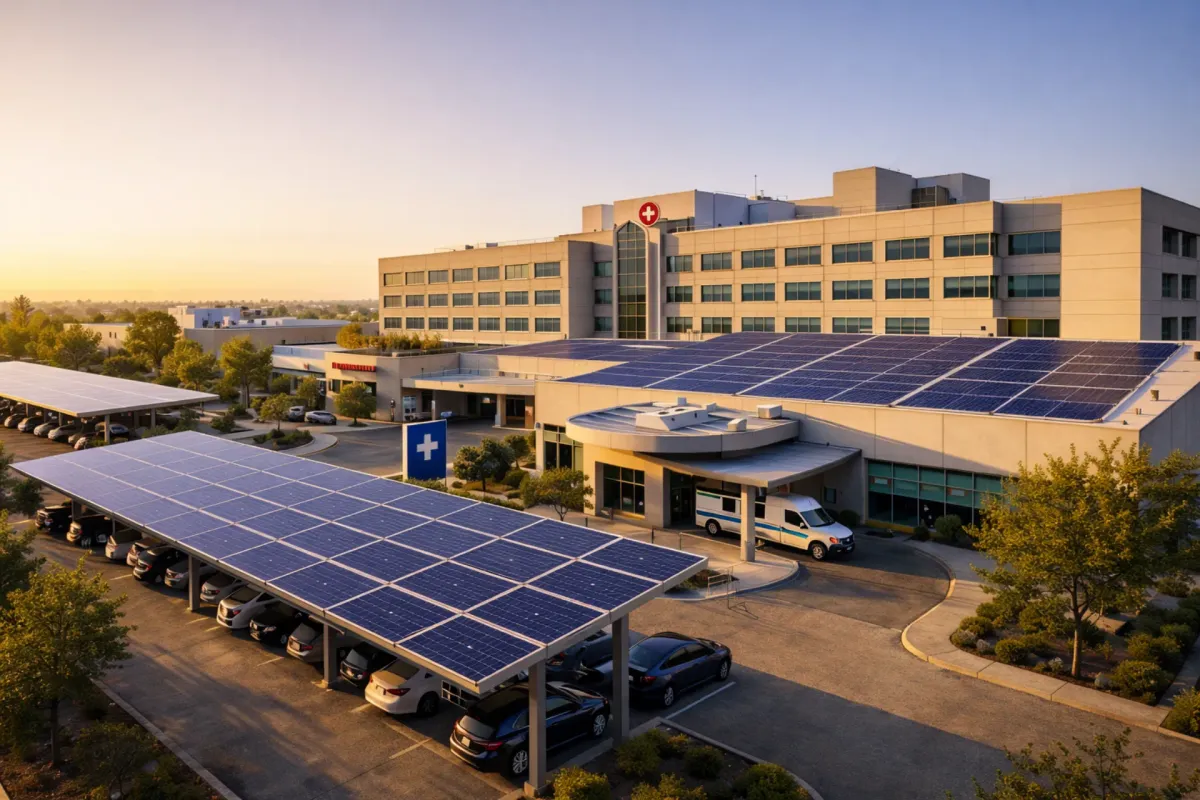
Energy resilience, backup integration, and ESG reporting for healthcare facilities.
System Size
200-1,000 kW
Energy Reduction
30-50%
Demand Charge
Consistent 24/7 load with some daytime p...
Roof Type
Flat membrane, typically with ...
Free address-based tool
Get a preliminary roof layout, panel count, system size, annual production range, and confidence grade before sharing contact details.
No account required to see your roof result
Solar alone cannot provide reliable backup power, but solar + battery storage integrated with existing generators creates a resilient microgrid. This combination reduces generator fuel costs, extends runtime, and provides cleaner backup power for non-critical loads.
Healthcare facilities require reliable, uninterrupted power for patient care and critical equipment. Solar + battery storage systems integrate with existing backup generators to create a resilient energy infrastructure. ESG reporting requirements from investors and regulatory bodies make solar an important sustainability investment for healthcare systems.
Energy resilience for critical patient care systems
Integration with existing backup generators
ESG reporting and sustainability goals
Reduced operating costs for 24/7 facilities
LEED Healthcare certification contribution
Community health benefit from clean energy
Rooftop arrays on flat hospital buildings
Solar carports in parking garages
Ground-mount on campus land
Solar + battery + generator microgrid
Rooftop HVAC and equipment competition
Strict electrical code requirements for medical facilities
24/7 high baseload limits offset percentage
Long procurement cycles for healthcare systems
A typical healthcare & hospitals project is 200-1,000 kW. At the small end of that band it models at $1.55 per watt installed; at the large end it falls to $1.07 per watt, both before project-specific incentives. Scale drives that gap more than sector does: NuWatt's pricing applies a documented volume discount as system size rises.
| System Size | Size Tier | Modeled $/W | Installed Cost | After 30% §48E |
|---|---|---|---|---|
| 200 kW (low end) | Mid-Size Commercial | $1.55/W | $310,200 | $217,140 |
| 1,000 kW (high end) | Large-Scale Commercial | $1.07/W | $1,066,000 | $746,200 |
Installed cost before project-specific incentives, from NuWatt's commercial pricing model (reviewed quarterly). The §48E column assumes the 30% base credit with prevailing-wage and apprenticeship compliance and no bonus adders. Full method, cost per square foot, and $/W by state are in the commercial solar cost guide.
Modeled scenario disclosure
The profiles below are planning scenarios built from current market pricing, utility, incentive, and production assumptions. They are not verified NuWatt customer projects or guaranteed outcomes. A real proposal requires site, structural, utility, interconnection, financing, and tax-eligibility review.
System Size
400 kW rooftop + carport
Net cost after §48E + MACRS
$309,771
Annual Savings
$65,000
Payback Period
4.8 years
Payback is computed, not asserted: 400 kW at the modeled $1.49/W is $594,000 installed, less a 30% §48E credit of $178,200 and a first-year MACRS tax shield of $106,029 at the 21% corporate rate, giving $309,771 net against $65,000 a year. State incentives, SREC or tariff revenue, USDA REAP, and demand-charge savings are all excluded, so a real project in a high-incentive state pays back sooner than this.
Use your facility's quote, production model, and utility-specific energy value. The model will not substitute a state average or an invented price.
Quote $/W
—
Section 48E (6%)
—
Year-one energy value
—
Simple payback
—
What the result includes
No state-average price, electric rate, production factor, escalation, or tax rate is used. Section 48E values follow the IRS source verified 2026-08-31; the depreciation line uses the current 100% first-year rule for eligible property and your entered tax rate. Review the IRS credit page.
Replace placeholders with a facility-specific model
NuWatt will use your interval data, utility tariff, roof or site geometry, and an engineer-reviewed scope.
200-1,500 kW
Large flat roofs and high energy use make warehouses ideal for commercial solar.
100-500 kW
Customer-facing sustainability, parking canopies, and SREC revenue for retail businesses.
250-2,000 kW
Process energy offset, demand charge management, and energy resilience for manufacturers.
100-1,000 kW
Tax-exempt direct pay, educational value, and community benefit for educational institutions.
50-500 kW
Agrivoltaics, irrigation pumping, and USDA REAP grants for agricultural operations.
Solar alone cannot provide reliable backup power, but solar + battery storage integrated with existing generators creates a resilient microgrid. This combination reduces generator fuel costs, extends runtime, and provides cleaner backup power for non-critical loads.
Site-specific pricing with exact incentive calculations. No obligation.