Loading NuWatt Energy...

We use your location to provide localized solar offers and incentives.
We serve MA, NH, CT, RI, ME, VT, NJ, PA, and TX
Loading NuWatt Energy...
NuWatt designs, installs, and manages solar, battery, heat pump, and EV charger systems across 9 states. One company, one warranty, one point of contact.
Get a Free QuoteConnecticut’s life-sciences economy runs on three clusters: Pfizer Groton (the largest employer in Eastern CT), the Yale School of Medicine / Alexandria / BioLabs @ 300 George corridor in New Haven, and the BioCT pharma-manufacturing spine through Branford and the shoreline. Every one of them shares the same engineering problem: lab buildings run 25-40 kWh/sqft — 2.5 to 4 times an office — on a flat 24/7 load dominated by fume hoods, −80 C freezers, vivariums, and 100% outside-air HVAC. This is the engineering guide for solar + battery microgrids on CT lab buildings.
Lab EUI
25-40
kWh/sqft/yr (2.5-4x office)
Pfizer Groton
Largest
employer in Eastern CT
Yale/New Haven
Densest
BSL-2 wet-lab footprint in CT
§48E ITC (2026)
30-50%
Base + bonuses; sunset Jul 4 2026
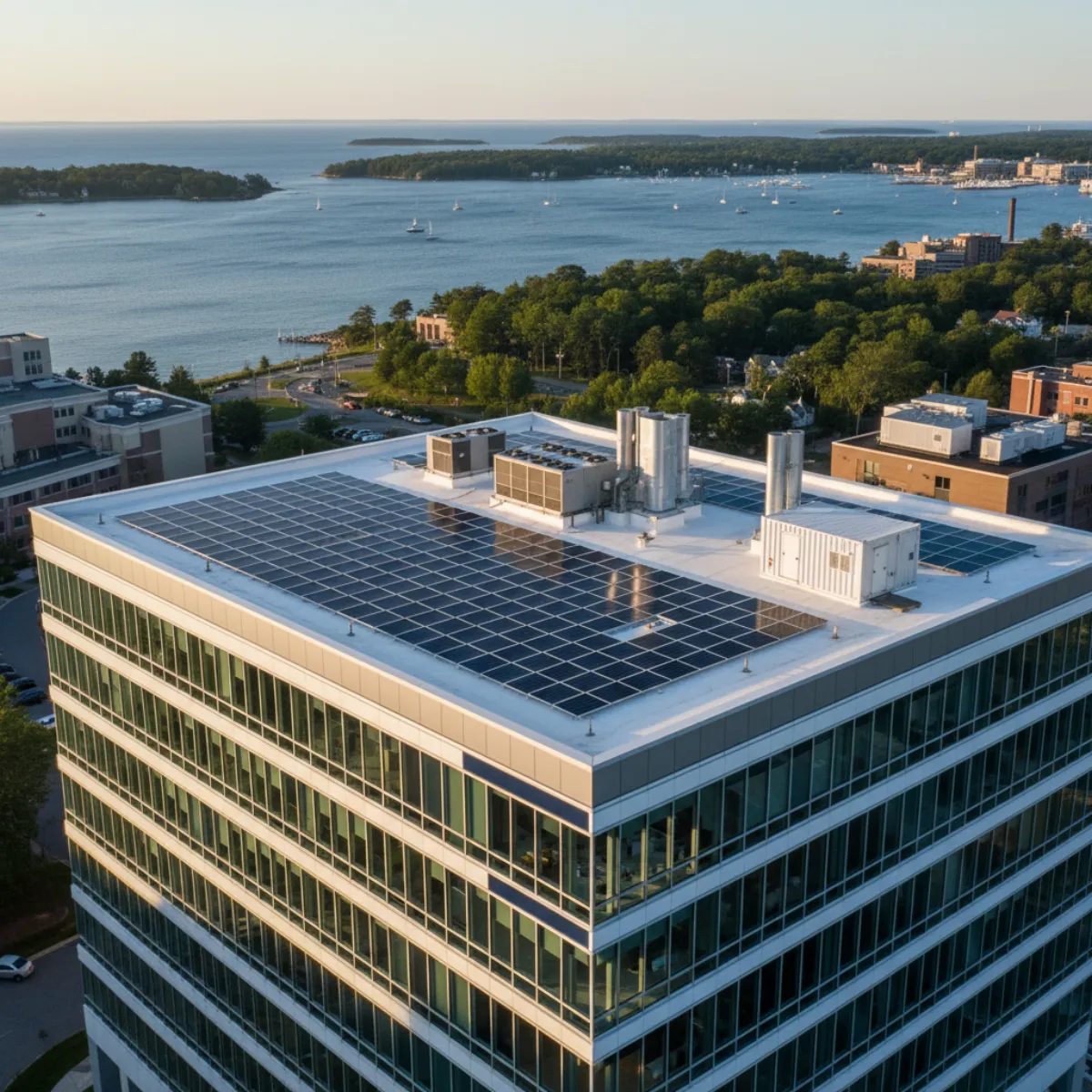
CT biotech labs run at 25-40 kWh/sqft/yr — 2.5 to 4 times an office — on a flat 24/7 load shape dominated by fume hoods, cold rooms, -80 C freezers, and 100% outside-air HVAC required for NFPA 45. Solar alone offsets only 15-30% of annual kWh on a typical lab because the base load is so high, but it still produces strong bill savings and earns a 20-year locked NRES tariff rate. The real resilience comes from N+1 stacking: solar reduces energy cost and earns NRES revenue, a lithium-iron-phosphate battery shaves demand charges (35-50% of a lab bill on Eversource CT rate 56/58 or UI equivalents) and bridges the 10-30 second generator-start gap for critical loads, and a code-compliant generator provides long-duration outage coverage. Cold-chain continuity for biologics and research samples — a single lost GMP batch can exceed $250k — makes the microgrid a risk-management investment, not just an energy-cost investment. On the tax side, §48E (30% base + 10% domestic content + 10% energy community; safe harbor closed July 4, 2026, new starts in service by December 31, 2027), §179D commercial buildings deduction (up to $5.81/sqft in 2026), MACRS 5-year depreciation, and — for Yale-affiliated and nonprofit research institutes — §6417 direct pay stack to cover 50-65% of total system cost. Tenant-heavy buildings use third-party PPAs; owner-occupants typically choose direct ownership or CT Green Bank C-PACE.
A lab is not an office with a few extra freezers. Connecticut’s life-sciences corridor — anchored by the Pfizer Groton R&D and manufacturing campus in Eastern CT, Yale School of Medicine and the Alexandria / BioLabs @ 300 George cluster in New Haven, the BioCT pharma-manufacturing spine through Branford, and the UConn Health / Jackson Labs hub in Farmington — is the densest, highest-energy-intensity commercial real estate in the state. A typical New Haven or Groton wet-lab building runs 25-40 kWh per square foot per year, compared to 10-15 kWh/sqft/yr for a Class A office in the same zip code. BSL-3 space, vivariums, and cleanrooms can push past 50-100 kWh/sqft/yr.
Three things drive the difference. First, labs run 24/7 — fume hoods, cold rooms, −80 C freezers, incubators, and imaging cores never shut down. Second, NFPA 45 and ASHRAE 110 require 100% outside-air makeupfor fume hood exhaust, which means the lab is continuously conditioning fresh New England air (hot-humid summers, cold-dry winters) rather than recirculating it. Third, research continuity has a cost structure unlike any other commercial building: a lost −80 C freezer is $100k-$500k+ in sample destruction, a lost GMP batch can exceed $250k, and a vivarium HVAC failure is a welfare event with regulatory consequences.
That changes what “commercial solar” means on a lab. The PV array alone typically offsets only 15-30% of annual kWh because the base load is so high — but PV still hits peak production during peak demand hours, so the bill-offset is strong and CT’s NRES tariff locks in a 20-year per-kWh compensation on top of that. The real resilience and demand-charge value comes from stacking PV with a lithium-iron-phosphate battery and a code-compliant generator into a true N+1 microgrid. Done right, the stack reduces energy cost, cuts Eversource CT / UI demand charges, smooths the generator-start transition for critical cold-chain loads, and produces a measurable risk-adjusted return that a pure-PV project cannot.
CT biotech is not a single market. Each cluster has a different utility, different building geometry, and a different tenant-vs-owner financing default. Designing the microgrid starts with knowing which cluster you are in.
Eversource CT
Pfizer Groton R&D + manufacturing campus
Pfizer Groton is the largest private employer in Eastern CT and one of the largest Pfizer R&D sites in the world — a multi-million-sqft campus spanning discovery, formulation, and small-batch manufacturing. Load profile is a mix of 24/7 BSL-2 wet lab, pilot plant, vivarium, and GMP fill-finish. Utility: Eversource CT commercial rates (27/56/58 family). Site scale supports behind-the-meter PV + BESS plus potential ground-mount on adjacent parcels.
United Illuminating (UI)
Yale School of Medicine + Alexandria + BioLabs @ 300 George
The New Haven cluster is anchored by Yale School of Medicine and Yale New Haven Hospital, with Alexandria Real Estate Equities developing lab/office towers at 101 College, 100 College, and expanding along George Street. BioLabs @ 300 George operates as a tenant incubator. This is the state’s densest BSL-2 wet-lab footprint. Utility: United Illuminating (UI) commercial rates. Tenant structures dominate — many occupants are tax-inefficient startups or 501(c)(3) affiliated entities, making PPA and §6417 direct pay central to the financing conversation.
Eversource CT
Branford pharma + diagnostics manufacturing
Branford and the shoreline corridor host the BioCT manufacturing spine — pharma manufacturing, diagnostics, and device assembly across purpose-built low-rise flex buildings. Load is a mix of GMP, cleanroom, and dry-lab QA. Roof geometry is typically simpler than a Yale/Alexandria tower (low-slope, fewer fume hood stacks), which raises usable PV footprint. Utility: Eversource CT. Strong candidate for combined rooftop + canopy PV plus a demand-charge-shaving BESS.
Eversource CT
UConn Health + Jackson Labs genomic medicine
UConn Health in Farmington and Jackson Laboratory for Genomic Medicine anchor a secondary research cluster with heavy imaging, sequencing, and vivarium loads. Hospital-affiliated research maps cleanly to §6417 direct pay. Utility: Eversource CT. Microgrid interest is driven by the mission-critical cold-chain and imaging loads rather than pure energy-cost offset.
EUI (energy-use intensity) is the single most important input to sizing a lab microgrid. Ranges below reflect CT and Northeast new-construction and recent-retrofit benchmarks; individual buildings vary materially based on fume-hood density, freezer-farm size, and HVAC recovery efficiency.
Key insight for sizing:The higher the EUI, the lower the PV offset percentage — but the higher the absolute kWh savings and the stronger the case for a paired battery. A 40 kWh/sqft lab with a 20% PV offset saves more electricity than a 15 kWh/sqft office with a 60% offset. Don’t chase offset percentage; chase net-present-value.
The CT Non-Residential Renewable Energy Solutions (NRES) tariff is the successor to net metering for commercial systems. For a biotech lab that self-consumes most of its PV output, the netting structure typically produces the best economics — the lab receives bill credits at retail-equivalent levels for the kWh it consumes directly, plus a 20-year locked NRES export rate for the small fraction that spills back to the grid.
On Eversource CT commercial rates 27, 56, and 58 — and UI equivalents — demand charges ($/kW) often represent 35-50% of the total lab bill. A properly sized BESS charged off solar and dispatched during the on-peak demand window is the single largest revenue lever in a CT biotech microgrid.
| Eversource CT Rate | Demand Component | Typical Lab Peak | BESS Opportunity |
|---|---|---|---|
| Eversource CT Rate 27 (Time-of-Use, medium C&I) | On-peak kW demand charge (summer weekdays 12-8 PM) | ~350-600 kW peak | A 500 kWh/250 kW BESS charging off solar and dispatching during the on-peak window typically shaves 15-22% of billed on-peak demand. On a 500 kW lab, that is $6,500-$10,000/month in avoided demand charges. |
| Eversource CT Rate 56 (large C&I, demand-metered) | Monthly billing demand + on-peak demand | ~600 kW - 1.5 MW peak | Rate 56 is the workhorse rate for New Haven and Groton lab buildings. A 1 MWh/500 kW BESS typically shaves 18-25% of the monthly coincident peak. On a 1 MW lab, that is $11,000-$16,000/month in demand savings before the solar contribution is counted. |
| Eversource CT Rate 58 (large industrial, transmission-voltage) | Multiple demand components including transmission and capacity | ~1.5 MW+ peak (Groton-tier campuses) | Rate 58 adds a capacity-obligation component on top of demand. A properly sized BESS can shave both the monthly demand component and the annual capacity tag, which compounds savings. On a 2 MW Groton-tier campus, combined BESS savings routinely reach $25,000-$40,000/month. |
The financing structure for a CT biotech lab depends on a single question: can the entity actually use §48E and MACRS? Most clinical-stage biotech tenants cannot. That is why the PPA structure dominates New Haven Alexandria-style multi-tenant labs while direct ownership dominates Pfizer-tier owner-occupant campuses.
Lab owns the system outright, captures §48E (30% + bonuses), MACRS, §179D, CT sales/property exemptions, and NRES revenue.
Best for:
Trade-off:
Ties up capital; requires tax appetite.
A tax-equity partner owns the system, captures §48E + MACRS, and sells PV electricity to the lab at a fixed per-kWh rate below retail.
Best for:
Trade-off:
Gives up long-tail tax benefits to the PPA provider.
Long-term (up to 25-yr) property-assessment financing covering 100% of solar + battery cost. Non-recourse; transfers with the property on sale.
Best for:
Trade-off:
Modestly higher rate than senior mortgage debt.
Special case — Yale School of Medicine and hospital-affiliated research: 501(c)(3) research institutes should elect §6417 direct pay. The IRS writes a check equal to the §48E value (30% + bonuses, up to 50%) regardless of tax liability. This is categorically better than a PPA for nonprofits with capital available.
Every lab roof is a negotiation between exhaust engineering and PV engineering. NFPA 45 (Fire Protection for Laboratories Using Chemicals), the CT State Mechanical Code, and the lab’s exhaust dispersion model together dictate where PV modules and electrical equipment can and cannot sit.
The ranges below are general industry rules of thumb. Actual setbacks for any specific project must come from the lab’s mechanical engineer of record, the exhaust dispersion model, and the AHJ (CT State Fire Marshal, local building department, and the lab’s EHS program).
| Rooftop Feature | Typical Setback / Rule of Thumb | Implication for PV Layout |
|---|---|---|
| Fume hood exhaust stacks | Typical 6-10 ft horizontal separation; confirm with NFPA 45 and the facility exhaust dispersion model | PV modules and electrical equipment must sit outside the exhaust plume footprint. Chemical degradation of backsheets and connectors is a multi-year risk even if code-setback is met. |
| Stack discharge height | Stacks typically terminate 10+ ft above any adjacent roof surface or occupied area within the applicable radius | Tall exhaust stacks create shading and reduce usable roof area. PV layout should avoid rows directly adjacent to or downwind of a stack. |
| BSL-2 / BSL-3 HEPA exhaust | Containment exhaust is treated as hazardous discharge; plume dispersion modeling typically required | PV cannot obstruct exhaust fan maintenance corridors. Array design must preserve removal paths for HEPA housing and exhaust fan units. |
| Makeup air / HVAC intakes | Generally >25 ft from any exhaust discharge (confirm with CT State Building Code + ASHRAE 62.1) | PV arrays must not redirect plumes toward intakes. Ballasted racking that changes rooftop airflow can trigger re-validation of the dispersion analysis. |
| Emergency generator exhaust | Separation from intakes and occupied areas per NFPA 110 + CT Mechanical Code | Generator exhaust thermal plumes can discolor and degrade modules. Avoid placing PV in the direct thermal exhaust path. |
| Roof access + fall protection | OSHA 1910 + CT State Building Code fall-protection zones around stacks, hatches, and mechanical wells | Array rows must maintain 3-4 ft clear walkways for stack maintenance, exhaust fan service, and roof drain access. |
A biotech microgrid is four layers working together: PV, BESS, code-compliant generator, and a microgrid controller. Each layer earns its own incentive stack and each layer protects a different failure mode. Skip any layer and you lose either energy savings, demand-charge revenue, or cold-chain continuity.
Rooftop and/or canopy PV sized to the non-critical daytime load (HVAC perimeter, office, lighting). On a typical New Haven or Groton lab, PV rarely exceeds 15-30% of annual kWh because lab base load is so high — but PV still produces the strongest bill offset because it hits peak hours, and on the CT NRES tariff every PV kWh earns a locked-in per-kWh compensation for 20 years.
Typical Size
200-1,500 kW (building dependent)
Role in Stack
Energy-cost reduction, §48E ITC basis, NRES tariff revenue.
Lithium-iron-phosphate (LFP) battery sized for demand-charge shaving and short-duration bridging. Eversource CT commercial rates 58, 56, and 27 all carry meaningful demand ($/kW) charges — on a 500 kW lab peak, shaving 20-25% of billed demand through BESS dispatch is routinely worth $8,000-$14,000/month. Paired with solar, the BESS also bridges the 10-30 second generator-start gap for critical cold-chain loads that cannot tolerate a clean-transfer dip.
Typical Size
500 kWh - 4 MWh
Role in Stack
Demand-charge reduction, generator-start bridging, §48E ITC basis when charged by solar.
Life-safety generator sized per NFPA 110 for code-required emergency and legally required standby loads (egress lighting, fire pumps, BSL-3 exhaust). For critical lab loads — -80 C freezers, vivarium HVAC, cold rooms, GMP process — an optional standby generator covers the gap during a long outage. Generator stays; solar + battery reduce runtime and fuel burn.
Typical Size
250 kW - 2 MW
Role in Stack
Code compliance (NFPA 110), long-duration backup, ride-through of multi-day outages.
The controller sequences all three sources: PV inverters, battery inverter/charger, and generator. During a utility outage the controller disconnects from the grid (IEEE 1547 anti-islanding), starts the battery in grid-forming mode, runs the generator when battery SOC drops below a threshold, and re-synchronizes to the grid on return. This is what turns three separate systems into a microgrid.
Typical Size
Building-scale (single controller)
Role in Stack
Orchestration, black-start, load shedding, utility re-sync.
A −80 C freezer holding 5,000 sample vials represents decades of research value. A single freezer failure during a sustained outage can destroy $250k-$500k in samples. Multiply that by a typical Yale-affiliated research institute with 500-2,600 freezers, and cold-chain continuity becomes the single most valuable line item in the microgrid business case.
A properly sized battery + controller bridges the 10-30 second gap while the generator starts, preventing the freezer thermostats from seeing the voltage sag. Solar during the day reduces the draw on both battery and generator, extending runtime on a fuel reserve.
The equivalent for GMP and vivarium spaces is even starker. A lost batch of a clinical-stage biologic at a Branford or Groton manufacturing site can blow through a quarter’s cost-of-goods budget. A vivarium HVAC failure during a heat wave is a welfare event with IACUC reporting consequences. These are risks the generator alone does not fully cover — the generator starts in 10-30 seconds, but the battery starts in milliseconds.
That’s why biotech microgrids are always N+1 (or N+2 for BSL-3 and GMP): every critical load has at least two independent sources of power, and at least one of them responds in under a second.
Worked example for a 100,000 sqft New Haven or Groton-tier wet-lab building retrofit: 750 kW rooftop PV + 1.5 MWh lithium-iron-phosphate BESS + microgrid controller. Assumes a for-profit C-corp owner at 21% federal tax, project construction begun and placed-in-service in 2026, full §48E prevailing-wage + apprenticeship compliance, and a §179D-qualifying whole-building energy model.
| Line Item | Value |
|---|---|
| Gross system — 750 kW PV + 1.5 MWh BESS + microgrid controller | $3,600,000 |
| Federal §48E ITC (30% base) | -$1,080,000 |
| §48E domestic content bonus (+10%) — if qualifying | -$360,000 |
| §48E energy community bonus (+10%) — if sited in qualifying tract | -$360,000 |
| MACRS 5-yr depreciation — Year 1 (21% corp tax rate, 40% bonus 2026) | -$392,000 tax savings |
| MACRS 5-yr depreciation — Years 2-5 remainder | -$318,000 tax savings |
| §179D Commercial Buildings Energy-Efficient Deduction (up to $5.81/sqft 2026) | Up to -$581,000 deduction (~$122,000 tax savings at 21%) |
| CT sales tax exemption on solar equipment (CGS §12-412) | -$230,000 |
| CT property tax exemption on Class I renewable equipment | ~$15-40k/yr avoided |
| CT NRES tariff — 20-yr locked PV compensation | $55,000-$85,000/yr |
| Eversource CT demand-charge reduction (BESS peak-shaving) | $95,000-$170,000/yr |
| Effective Net Cost (after §48E + bonuses + MACRS + §179D + CT sales tax exemption) | ~$1,455,000 (~60% reduction) |
Annual Ongoing Revenue
The difference between a 6% §48E ITC and a 30-50% §48E ITC is labor-standards compliance. For a $3.6M lab microgrid, that is a ~$864k swing before bonuses — enough to kill a marginal project if missed.
To unlock the full 30% §48E ITC (vs. a 6% base for non-compliant projects >1 MW-AC), all laborers and mechanics on site must be paid at or above applicable Davis-Bacon prevailing wage rates for the CT county during installation AND for any alteration or repair for 5 years after placed-in-service. CT DOL also publishes state prevailing-wage schedules that apply on many public and quasi-public CT projects.
A graduated percentage of total labor hours (15% for projects beginning construction in 2024 or later) must be performed by qualified apprentices from a registered apprenticeship program. Each contractor with 4+ workers must employ at least 1 apprentice. CT has several registered electrical and solar apprenticeship programs that can satisfy this requirement.
The §179D Commercial Buildings Energy-Efficient Deduction requires a licensed engineer or contractor to certify building energy and power cost reduction vs. a reference ASHRAE 90.1 baseline. For labs, the energy model must reflect actual 24/7 process loads, not a generic office profile — otherwise the deduction is systematically understated.
Tax-exempt entities — 501(c)(3) research institutes, hospital-affiliated labs, universities — can elect direct pay under §6417. The IRS writes a check equal to the §48E ITC value rather than the entity using it against tax liability. Yale School of Medicine, Yale New Haven Hospital system, UConn Health, and hospital-affiliated CT research entities typically qualify.
Three illustrative scenarios across the CT life-sciences corridor: a Groton-tier R&D + manufacturing campus, a New Haven Alexandria multi-tenant lab tower, and a Yale-affiliated nonprofit research institute using §6417 direct pay.
A mid-size CT pharma R&D campus on the Groton / Southeastern CT utility footprint (Eversource commercial rate 58). The building runs roughly 34 kWh/sqft/yr — heavily flat load from -80 C freezer farms, cold rooms, fume hoods, vivarium HVAC, and 100% outside-air makeup required for NFPA 45 compliance. The site has multiple low-slope roof blocks plus an adjacent parking area eligible for canopy PV, which pushes total usable PV footprint above what a single lab tower could host.
Facility
180,000 sqft (60% BSL-2 wet lab, 25% pilot plant, 15% office)
Current Electric Bill
$245,000-$320,000/month
System Size
1.1 MW PV + 2 MWh BESS
System Cost
$4,900,000 gross
After Incentives
~$2,280,000 net (after §48E + MACRS + CT sales/property exemptions)
Monthly Savings
$44,000-$62,000/month combined electricity + demand + NRES
Payback Period
~3.5-4.5 years net cost payback
NRES + Demand-Charge Revenue
$80,000-$115,000/yr NRES + demand-charge dispatch
Key Insight
Because lab base load is so flat and so high, solar offsets only about 20-24% of annual kWh — but on the NRES tariff, every PV kWh earns a 20-year locked-in export rate on top of the bill offset. The BESS is the bigger lever: on Eversource CT rate 58, demand-charge reduction alone is worth $10,000-$14,000/month. PV + BESS together also cut generator-runtime hours during outages, extending fuel and reducing NOx emissions.
A purpose-built lab tower on the Alexandria / BioLabs @ 300 George footprint in New Haven, on United Illuminating (UI) commercial rates. Multi-tenant wet lab at roughly 31 kWh/sqft/yr, with ~6 fume-hood stacks and 2 BSL-2 HEPA exhaust points limiting the usable PV roof footprint to about 50%. Many tenants are tax-inefficient startups or §501(c)(3) affiliates — so the financing conversation is landlord-owned PV + BESS under a third-party PPA with tenants, not direct-tenant ownership.
Facility
120,000 sqft (multi-tenant BSL-2 wet lab + incubator)
Current Electric Bill
$185,000-$240,000/month (landlord pass-through to tenants)
System Size
550 kW PV + 1.2 MWh BESS
System Cost
$2,850,000 gross
After Incentives
~$1,360,000 net (under direct landlord ownership + §48E + MACRS)
Monthly Savings
$32,000-$46,000/month combined
Payback Period
~4-5 years net cost payback
NRES + Demand-Charge Revenue
$48,000-$65,000/yr NRES
Key Insight
The business case here is a landlord-tenant split. The landlord captures §48E + MACRS + NRES revenue, and passes a below-utility-rate PPA price to tenants — which lets tax-inefficient biotech startups get solar economics without needing a tax-equity partner. Alexandria-style multi-tenant towers are the single best fit for PPA-structured biotech solar in CT.
A 501(c)(3) nonprofit research institute affiliated with Yale School of Medicine, on UI commercial service. The site carries imaging cores with cryogenic helium recovery, -80 C freezer rooms with ~2,600 freezers, and BSL-2 cell-biology suites. Because the entity is tax-exempt, it cannot use the §48E ITC against tax liability — but §6417 direct pay converts the credit to a direct IRS payment.
Facility
220,000 sqft (mixed BSL-2 labs, imaging cores, -80 freezer rooms)
Current Electric Bill
$325,000-$400,000/month
System Size
1.3 MW PV + 3 MWh BESS
System Cost
$6,200,000 gross
After Incentives
~$3,100,000 net after §6417 direct pay + CT exemptions
Monthly Savings
$58,000-$78,000/month
Payback Period
~5-6 years net cost payback
NRES + Demand-Charge Revenue
$110,000-$150,000/yr NRES + demand-charge dispatch
Key Insight
Nonprofits historically got no value from solar tax credits. §6417 changes that — the IRS pays the institute ~$1.86M in cash (30% of a $6.2M system), which is transformational for mission-driven research budgets. The only watch-out: §6417 requires full §48E prevailing-wage + apprenticeship compliance to get the 30% rate, not the 6% base.
Request 15-minute interval data from Eversource CT or UI. Labs have flat base loads, but demand spikes at shift change, freezer defrost cycles, and morning HVAC warm-up. The 15-minute profile drives battery sizing and Rate 56/58 demand-charge modeling.
Before any PV layout work, the mechanical engineer of record must share the building exhaust dispersion model, stack locations, HEPA service corridors, and rooftop structural loads. NFPA 45 compliance is non-negotiable, and the PV design has to work inside the envelope the lab already committed to.
Work with facilities and EHS to tier every load: life-safety (NFPA 110, generator required), critical cold-chain (battery + generator), critical process (battery + generator), comfort (battery-optional), non-essential (grid-only). This drives battery capacity and generator redundancy.
For-profit entities use §48E + MACRS. Yale-affiliated 501(c)(3) research institutes, universities, and hospital-affiliated labs use §6417 direct pay. PPA structures work for tax-inefficient biotech tenants and multi-tenant Alexandria-style towers. CT Green Bank C-PACE is the cash-preserving alternative for owner-occupants. Confirm with the controller and tax advisor before sizing.
Any §48E project >1 MW-AC requires full prevailing wage + apprenticeship compliance for the 30% rate. Set up certified payroll early, identify CT registered apprenticeship programs, and confirm all subcontractors are compliant. Non-compliance drops the ITC to 6% — a project-killer.
NRES capacity is block-allocated and oversubscribed in recent rounds. The NRES application should move in parallel with the engineering design, not after PTO, because the tariff rate is locked at the time of a successful application.
The last step before placed-in-service is a full microgrid black-start test: utility disconnect, BESS grid-forming, generator start, load pickup, utility re-sync. A commissioning agent familiar with IEEE 1547 and NFPA 110 is essential — this is the hand-off that decides whether the lab actually rides through the next outage.
Sizing tiers, pricing, incentive stacks, and financing structures across CT commercial verticals.
Deep dive on CT Non-Residential Renewable Energy Solutions tariff — rate tables, netting vs buy-all, block allocation.
§6417 direct pay for CT nonprofits and hospitals, plus §6418 transferability for tax-inefficient entities.
CT Green Bank program suite — C-PACE, Smart-E Loan, Green Bank capital for commercial solar + storage.
CT C-PACE mechanics, rates, lender coordination, and project structuring for commercial solar + BESS.
5-year MACRS with 2026 bonus depreciation schedules for solar and storage in CT.
Labor-standards compliance for the full §48E ITC on CT solar + storage projects.
End-to-end CT commercial solar project timeline — design, permitting, interconnection, NRES, PTO.
Wet labs typically run 25-40 kWh/sqft/yr vs. 10-15 for Class A offices — 2.5 to 4 times higher. The drivers are 24/7 operation, 100% outside-air HVAC (required for fume hood makeup air and NFPA 45 compliance), -80 C freezers (each pulling 8-12 kWh/day), cold rooms, walk-in incubators, fume hoods running continuously, and centralized compressed air and vacuum. BSL-3 space, vivariums, and cleanrooms push higher still — 40-100+ kWh/sqft/yr. The load is also flat: a typical lab base load is 60-70% of peak, versus 20-30% for an office.
Free engineering assessment for CT biotech and life-sciences buildings — Groton, New Haven, Branford, and Farmington. We work with your mechanical engineer of record, EHS team, and tax advisor from the first site walk.