Loading NuWatt Energy...

We use your location to provide localized solar offers and incentives.
We serve MA, NH, CT, RI, ME, VT, NJ, PA, and TX
Loading NuWatt Energy...
NuWatt designs, installs, and manages solar, battery, heat pump, and EV charger systems across 9 states. One company, one warranty, one point of contact.
Get a Free QuoteConnecticut's 2021 IECC with CT amendments sets the building energy code for commercial construction. Combined with PA 21-115 benchmarking requirements, CT DEEP's 100% zero-carbon electricity goal by 2040, and solar-ready mandates for new construction, CT building codes are driving commercial solar adoption at an accelerating pace.
Energy Code
2021 IECC
Zero-Carbon Goal
2040
Benchmarking
PA 21-115
Solar-Ready
Required
CT uses the 2021 IECC with CT amendments as its commercial building energy code. Key solar-related provisions include: solar-ready requirements for new commercial construction (designated roof zones, structural capacity, electrical pathways), PA 21-115 benchmarking for buildings over 50,000 sq ft (on-site solar reduces reported EUI), CT DEEP's 100% zero-carbon electricity goal by 2040, and performance compliance pathways where solar directly offsets modeled energy consumption. CT also provides 6.35% sales tax and 100% property tax exemptions for solar installations.
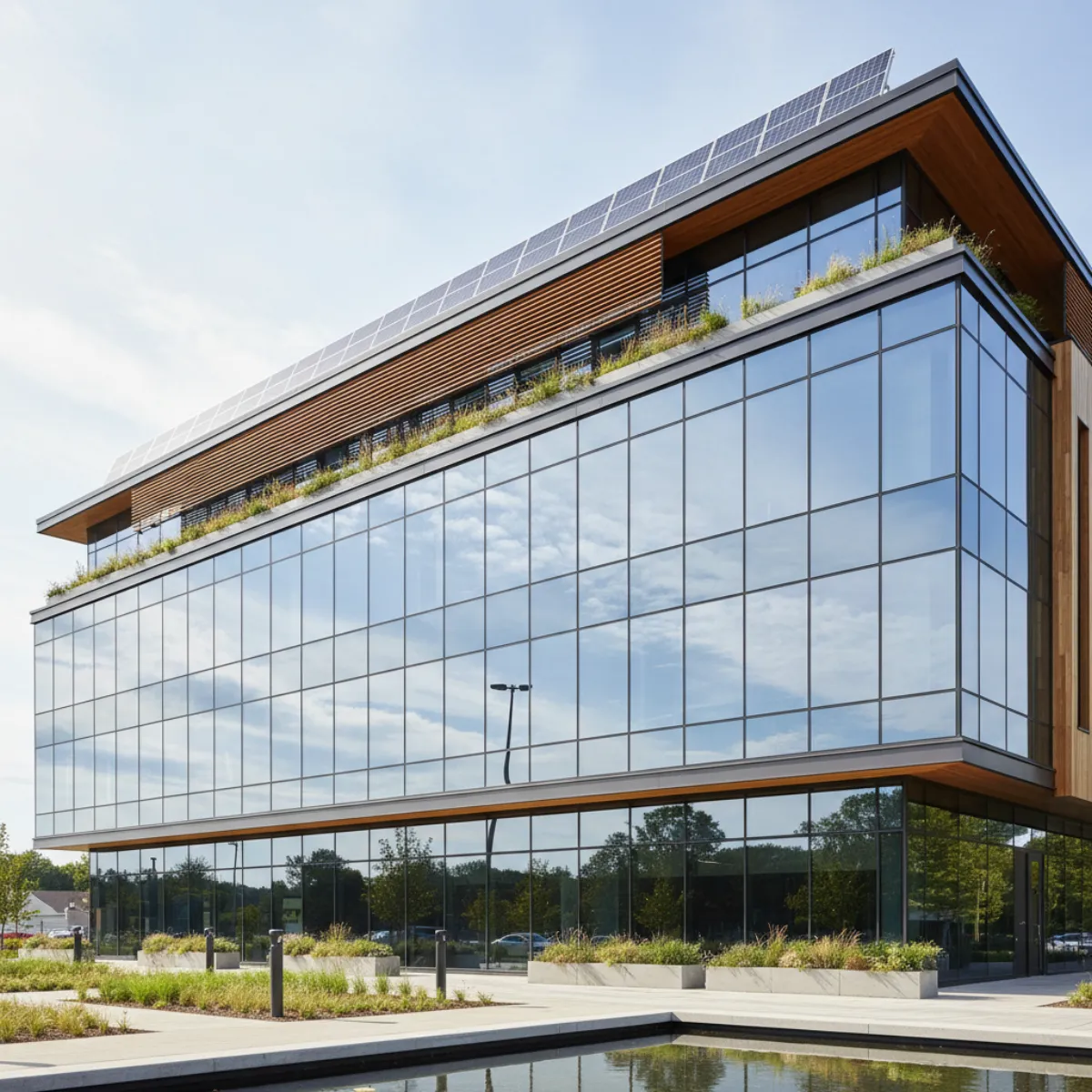
Connecticut's building energy standards create a regulatory environment that increasingly pushes commercial property owners toward on-site renewable energy generation. The convergence of the 2021 IECC commercial energy code, PA 21-115 benchmarking transparency requirements, and CT DEEP's aggressive clean energy targets means commercial solar is transitioning from optional investment to near-necessity for code compliance and market competitiveness.
The 2021 IECC with Connecticut amendments establishes minimum energy efficiency requirements for all new commercial construction and major renovations. While the code does not yet mandate on-site solar for all buildings, it requires solar-ready design — meaning new buildings must be structurally, electrically, and architecturally prepared for future solar installation. CT DEEP is actively evaluating whether future code cycles will include mandatory on-site generation.
Public Act 21-115 adds a transparency layer. Large commercial buildings (over 50,000 square feet) must publicly report their energy consumption annually. Buildings with poor energy performance become visible to tenants, investors, and the public. On-site solar directly reduces reported energy use intensity (EUI), making your building more attractive in a market that increasingly values energy performance.
Connecticut's goal of 100% zero-carbon electricity by 2040 provides the long-term policy direction. Commercial properties that install solar now are ahead of the curve. Those that wait may face mandatory requirements and potentially higher installation costs as demand accelerates toward the 2040 deadline.
Connecticut has progressively adopted stricter energy codes, with each cycle moving closer to mandatory renewable energy requirements.
Baseline commercial energy efficiency requirements. No solar-specific provisions.
Enhanced envelope and HVAC efficiency requirements. Solar-ready provisions encouraged but not mandatory for most commercial.
Current code. Stricter envelope requirements, expanded solar-ready provisions for new commercial construction, EV-ready parking requirements.
Expected adoption of 2024 IECC appendices or custom CT stretch code. May include mandatory on-site renewable generation for new commercial buildings.
CT DEEP goal for 100% zero-carbon electricity supply by 2040. Commercial buildings will need to demonstrate carbon-neutral electricity consumption.
The 2021 IECC as adopted by Connecticut with state amendments establishes comprehensive energy performance requirements for commercial buildings. Connecticut adopted this code through the CT Building Code Council process, incorporating amendments that address CT-specific climate considerations (Climate Zone 5A), utility structures, and state energy policy goals.
Key commercial provisions relevant to solar include enhanced building envelope requirements that reduce heating and cooling loads (making buildings easier to offset with solar), mandatory lighting power density limits (reducing baseline electricity consumption), high-efficiency HVAC requirements (reducing the solar system size needed for full offset), solar-ready provisions for new construction, and EV-ready parking spaces in new commercial buildings.
Enhanced R-value requirements for walls (R-20 continuous insulation or R-13 + R-10 ci), roofs (R-30 ci), and windows (U-0.36 max). Better envelopes reduce HVAC loads, meaning smaller solar systems can achieve higher offset percentages.
Maximum lighting power density (LPD) of 0.64 W/sq ft for offices, 0.84 W/sq ft for retail, 0.72 W/sq ft for warehouses. LED lighting meeting these standards reduces baseline electricity consumption by 30-50% compared to older codes.
Minimum efficiency requirements for packaged rooftop units (14+ SEER2), chillers, boilers, and heat pumps. Higher HVAC efficiency reduces the building energy load that solar must offset.
New commercial buildings must designate solar zones (typically 40% of net roof area), provide structural capacity for solar load, install electrical pathways to main panel, and reserve circuit breaker space for future solar connection.
Connecticut's benchmarking law creates public visibility into commercial building energy performance — and solar dramatically improves your score.
Commercial buildings over 50,000 square feet, state and municipal buildings over 1,000 square feet.
Annual energy use (electricity, gas, oil), building area, occupancy type, and operating hours via ENERGY STAR Portfolio Manager.
Annual reporting by June 1 for the prior calendar year. First reports were due in 2023.
CT DEEP publishes benchmarking data publicly, creating transparency about building energy performance.
Non-compliance can result in civil penalties. CT DEEP provides technical assistance for compliance.
On-site solar generation directly reduces reported energy use intensity (EUI), improving your building's benchmarking score and public profile.
On-site solar generation directly reduces your building's reported Energy Use Intensity (EUI) in ENERGY STAR Portfolio Manager. For a 100,000 sq ft commercial building consuming 1,500,000 kWh/year (EUI of 51), a 300 kW solar system producing 352,500 kWh/year reduces net energy consumption to 1,147,500 kWh/year — an EUI improvement to 39. This moves your building from below-average to above-average performance in most commercial categories. Better benchmarking scores translate to higher property values, easier tenant recruitment, and compliance with PA 21-115 transparency requirements.
The CT building energy code offers multiple compliance pathways. Solar's role differs significantly between prescriptive and performance approaches.
Meet specific component-level requirements for insulation R-values, window U-factors, lighting power density (LPD), HVAC efficiency ratings, and building envelope air leakage. Straightforward but inflexible.
Solar's Role: Solar does not directly help prescriptive compliance — you must meet each individual component requirement regardless of solar installation. However, solar-ready roof zones must be preserved.
Best for: Simple commercial buildings with standard construction.
Demonstrate that the proposed building design uses less energy than a baseline reference building modeled using COMcheck or EnergyPlus. Total building energy performance is what matters, not individual components.
Solar's Role: On-site solar generation directly reduces modeled energy consumption, making it easier to meet the energy cost budget. A 100 kW solar system producing 117,500 kWh/year can offset significant baseline energy costs in the performance model.
Best for: Complex buildings, renovations, buildings where some components cannot meet prescriptive thresholds.
Achieve an ERI score at or below the required threshold. The ERI is a numerical score where 100 represents a 2006 IECC reference home and lower is better. Primarily used for residential but available for some small commercial.
Solar's Role: On-site solar directly reduces the ERI score. Solar generation counts as a significant improvement in the energy rating calculation.
Best for: Small commercial buildings, mixed-use with residential.
Connecticut's climate and energy policy goals create long-term regulatory drivers for commercial solar adoption.
Connecticut aims for 100% zero-carbon electricity supply by 2040. Commercial buildings will increasingly need to demonstrate that their electricity comes from carbon-free sources. On-site solar is the most direct path to carbon-neutral electricity consumption.
Solar Relevance: Direct — on-site solar provides verifiable zero-carbon electricity generation.
Connecticut has committed to reducing economy-wide greenhouse gas emissions by 45% below 2001 levels by 2030 and 80% below 2001 by 2050. Commercial building energy use is a significant contributor to state GHG emissions.
Solar Relevance: Solar reduces building-level GHG emissions, supporting statewide targets.
Public Act 21-115 requires large commercial buildings (>50,000 sq ft) to benchmark and publicly report energy consumption. This transparency creates market pressure to improve energy performance.
Solar Relevance: Solar dramatically reduces reported EUI, improving benchmarking scores and public reputation.
Connecticut state agencies are directed to reduce energy use in state-owned buildings and install renewable energy where feasible. This extends to municipal buildings receiving state funding.
Solar Relevance: Direct mandate for solar on state and state-funded buildings.
Connecticut's adoption of the 2021 IECC includes solar-ready provisions that apply to new commercial buildings. These requirements ensure that buildings constructed today can efficiently add solar panels in the future without costly structural or electrical retrofits.
The solar-ready zone must comprise at least 40% of the net roof area (after excluding HVAC equipment pads, skylights, fire access pathways, and required setbacks). This zone must be oriented to maximize solar potential — typically south-facing sections of the roof with no permanent shading obstructions. The structural design must accommodate the additional dead load of solar panels and mounting hardware (typically 3-5 pounds per square foot for ballasted systems on flat roofs, 2-3 psf for attached systems on sloped roofs).
Electrical solar-ready provisions require a conduit or raceway pathway from the designated solar zone to the main electrical service room, adequate space in the electrical room for future inverter equipment, and reserved circuit breaker positions in the main distribution panel for solar interconnection. These provisions add minimal cost during construction ($2,000-$5,000) but save $15,000-$30,000 in retrofit costs if solar is installed later.
If your new commercial building will need solar eventually — and CT's policy trajectory strongly suggests it will — installing solar during initial construction is significantly more cost-effective than retrofitting later. You avoid duplicate mobilization costs, take advantage of current incentives (Section 48/48E ITC 30-70%, 100% MACRS bonus depreciation), and start generating savings from day one.
A solar system installed during construction can be integrated into C-PACE financing alongside the building itself, and the ITC can be claimed on the full system cost. Projects that began construction on or before July 4, 2026 also locked in the longer Section 48E placed-in-service pathway.
Connecticut has adopted state-level appliance efficiency standards that exceed federal minimums for certain equipment categories. Under CT DEEP authority, these standards apply to equipment sold and installed in the state, directly reducing commercial building energy consumption.
For commercial buildings, CT appliance standards affect commercial lighting systems, HVAC rooftop units and split systems, commercial refrigeration (walk-in coolers, display cases), water heaters and boilers, and building automation controls. As these standards tighten over time, baseline building energy loads decrease — meaning a smaller solar system can achieve the same percentage offset.
When sizing solar for a new commercial building in CT, account for both the 2021 IECC energy code requirements and CT appliance standards. A building designed and equipped to current CT standards will consume 20-35% less energy than an equivalent building from 2010 — significantly reducing the solar system size (and cost) needed for full energy offset. This is why completing Energize CT energy audits and efficiency upgrades before sizing solar is so important for existing buildings.
Connecticut currently uses the 2021 International Energy Conservation Code (IECC) with Connecticut-specific amendments as the commercial building energy code. This was adopted by the CT Building Code Council and became effective for new construction and major renovations. The code covers building envelope insulation, fenestration (windows), lighting power density, HVAC efficiency, and building air leakage. CT amendments add state-specific requirements including solar-ready provisions for new commercial construction and EV-ready parking spaces.
NuWatt helps Connecticut commercial properties exceed building energy code requirements with optimally designed solar systems. Improve your benchmarking score, capture ITC and MACRS incentives, and future-proof your building.