Loading NuWatt Energy...

We use your location to provide localized solar offers and incentives.
We serve MA, NH, CT, RI, ME, VT, NJ, PA, and TX
Loading NuWatt Energy...
NuWatt designs, installs, and manages solar, battery, heat pump, and EV charger systems across 9 states. One company, one warranty, one point of contact.
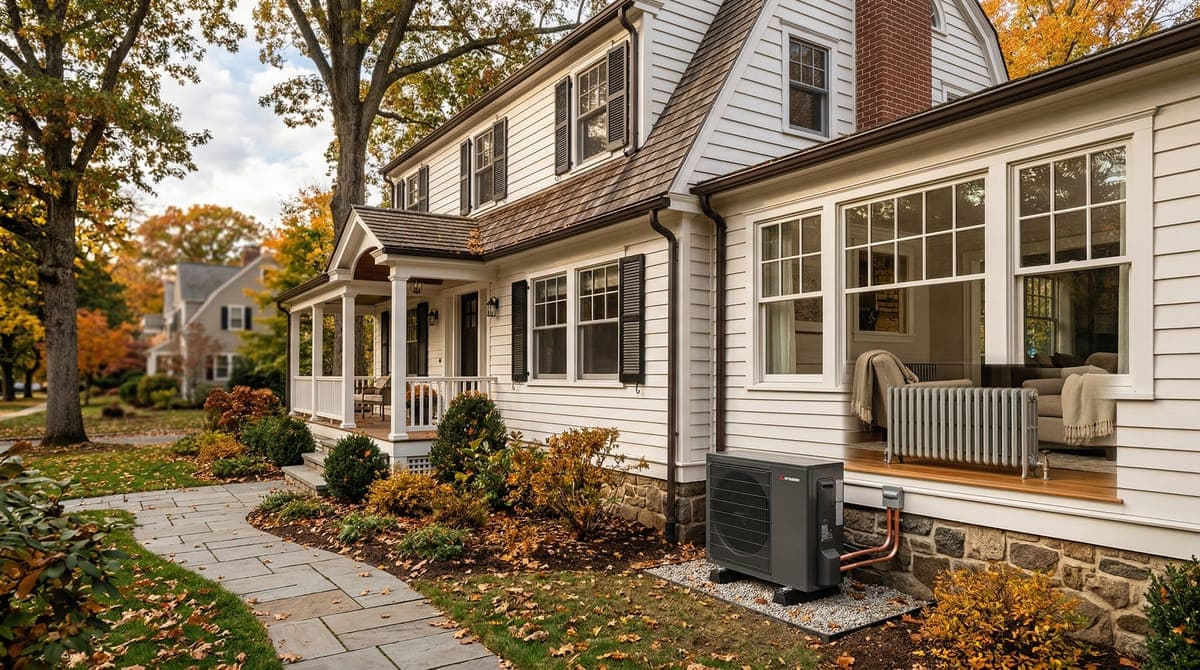
Get a Free QuoteHundreds of thousands of Connecticut homes heat with boilers and radiators — from steam systems in triple-deckers to hot-water baseboards in colonials. Yes, a heat pump can replace your boiler. The approach depends on your system type. Here is the complete guide.
Updated March 2026. Savings ranges vary by fuel type, radiator temperature, insulation, and whether the project is full replacement or hybrid.
Connecticut has some of the oldest housing stock in the country. Understanding your boiler system type determines which heat pump approach works best — and how complex the transition will be.
Common in: Pre-1940 New Haven, Hartford, Bridgeport, and New London homes
Single pipe delivers steam to radiators; steam condenses and returns as water via gravity.
Air-to-air mini-splits (zone by zone). Steam system stays as backup or is decommissioned.
Easy — mini-splits are fully independent of the steam system.
Common in: Larger pre-1960 homes, apartment buildings
Separate supply and return pipes for steam. Better temperature control than 1-pipe.
Air-to-air mini-splits most common. Air-to-water heat pump requires system conversion.
Moderate — 2-pipe system can be converted to hot-water hydronic for air-to-water HP.
Common in: 1960s-1990s ranch, cape, colonial homes
Boiler heats water; pump circulates through baseboard fin-tube radiators.
Air-to-air mini-splits OR air-to-water heat pump feeding existing baseboards.
Good candidate for air-to-water HP if baseboards are in good condition.
Common in: Victorian, Craftsman, older colonials
Gravity or pumped hot water through cast-iron standing radiators.
Best candidate for air-to-water HP — cast-iron radiators work well at lower supply temps.
Excellent match for air-to-water heat pump.
There is no single right answer — the best approach depends on your existing system, budget, and goals. Here is an honest comparison.
Outdoor compressor + wall-mounted indoor air handlers. No connection to existing boiler.
Outdoor unit heats water and circulates through existing radiators or radiant floor.
Mini-splits handle 80-90% of heating load; boiler fires only on coldest days.
Air-to-water heat pumps are the only type that feeds your existing radiators or radiant floor. They work by extracting heat from outdoor air and transferring it to water — just like your boiler does, but at a fraction of the energy cost.
Your boiler heats water to 160-180°F. Air-to-water heat pumps typically deliver water at 100-130°F (some up to 140°F). For your radiators to deliver the same heat output at a lower supply temperature, they need sufficient surface area. Cast-iron standing radiators are often ideal — their large mass compensates for lower temperatures. Fin-tube baseboard may need upgrading. A heat load calculation determines if your existing distribution is sufficient.
Most common in CT. SOLOZONE system works with existing hydronic distribution.
Rated to -40°F. Excellent cold climate performance. Growing CT installer network.
Modular system, high efficiency. Both heating and cooling capability available.
The financial case for replacing your boiler with a heat pump varies significantly depending on what fuel you currently burn. Here is an honest breakdown:
Narrower savings than oil or propane at current CT gas rates. Still compelling when you factor in cooling, aging-equipment replacement, and higher comfort.
Excellent economics. Oil at $3.80+/gal makes mini-split conversion highly profitable.
Strong savings. Propane at $3.50+/gal makes heat pump conversion very attractive.
Connecticut natural gas is relatively affordable compared to oil or propane. At roughly $1.85/therm, a 90%-efficient gas boiler in a 2,000 sq ft home uses about 1,000-1,200 therms/year — around $1,850-2,220 in fuel. A heat pump may use 4,400-7,000 kWh at about $0.27/kWh depending on the home and system design. At standard rates, gas can appear cheaper to operate. However: (1) heat pumps provide air conditioning gas boilers cannot, (2) oil and propane conversions are often dramatically stronger financially, and (3) Energize CT rebates of up to $10,000 improve payback when the project is designed as a true primary-heating replacement. Add in aging boiler replacement costs, and gas-to-heat-pump conversions are financially neutral to positive for most households.
The same Energize CT rebates available for any heat pump installation apply to boiler replacement. Here is the structure:
Get Your Boiler-to-Heat-Pump Assessment
We evaluate your boiler system type, recommend the right approach, and handle Energize CT coordination. No pressure.
For most Connecticut homeowners with gas or oil boilers, the hybrid approach is the recommended starting point. Install mini-splits in the main living areas and bedrooms. Let the heat pump handle the majority of heating. Keep the boiler as backup for the first winter. Then decide whether to decommission it.
Energize CT advisor evaluates your boiler, insulation, and heat load. NuWatt provides system sizing recommendation.
Bedrooms, main living area, office. These zones run 95%+ of the time. Boiler stays in place as backup.
Track when the boiler actually fires. Most homeowners find it runs fewer than 10 days/year below -5°F.
After one season, most homeowners decommission the boiler. Oil homes remove the tank. Gas homes may keep the line active or cap it.
Add mini-splits to remaining rooms over time. The system grows with your comfort level and budget.
Yes, in most cases. There are two main approaches: (1) Air-to-air mini-splits installed zone by zone, fully independent of your existing boiler — the most popular and cost-effective option. (2) Air-to-water heat pumps that feed your existing radiators or radiant floor — excellent for homes with hot-water distribution systems. Both qualify for Energize CT rebates up to $8,000.
Yes, with an air-to-water heat pump. These systems heat water and circulate it through your existing hydronic distribution — radiators, fin-tube baseboard, or radiant floor. The key is that your radiators must be sized to work at lower supply temperatures (100-130°F instead of the 180°F a boiler might use). Cast-iron standing radiators are often well-suited because their large surface area compensates for lower water temperature. A heat load analysis determines if your existing radiators are sufficient.
An air-to-water heat pump extracts heat from outdoor air and transfers it to your home's water-based heating system instead of delivering air directly. Available brands in Connecticut include Spacepak (domestic), Arctic (Canadian), Chiltrix, and NIBE. Some European brands (Vaillant, Viessmann) are also available through specialty contractors. Air-to-water heat pumps are more common in Europe and growing in New England as the technology matures. Expect $15,000-35,000 installed.
It depends on current gas rates and your goals. Gas-to-heat-pump savings are usually narrower than oil-to-heat-pump or propane-to-heat-pump savings, but many Connecticut homeowners still make the switch because they gain cooling, reduce combustion dependence, and avoid replacing an aging boiler with another fossil system. If your boiler is 15+ years old and needs replacement anyway, the all-in economics often make sense even when raw fuel savings are modest.
Yes — oil boiler to heat pump conversions have excellent economics in Connecticut. At $3.80+/gallon, a typical home using 800-900 gallons per year spends $3,000-3,400 annually. A mini-split heat pump delivers equivalent heat for $1,100-1,400/year. Combined with Energize CT rebates of up to $8,000 and 1.99% Smart-E heat pump financing, payback periods are typically 3-6 years. After that, the savings continue for 15-20 years.
A hybrid system installs mini-split heat pumps to handle 80-90% of your home's heating load while keeping the existing boiler as backup for very cold days. This is a lower-cost first step ($8,000-15,000 for mini-splits) that still qualifies for Energize CT rebates. The heat pump runs during mild and moderate weather; the boiler fires only when temperatures fall below -5°F to -10°F. After one full winter, many hybrid homeowners find the boiler almost never runs and decommission it.
Yes. The hybrid approach is recommended for most homeowners switching from gas or oil boilers. Keep the boiler registered and maintained for the first 1-2 heating seasons. Most homeowners find the heat pump handles 90-95% of heating hours. After building confidence, the boiler can be decommissioned. For oil systems, this also delays the oil tank removal decision — you can plan and budget for that separately.
Connecticut uses a two-tier rebate structure. Standard Air Source projects pay $250 per ton up to $2,500. Energy Optimization projects designed as full primary-heating replacements can pay $1,000 per ton up to $10,000 combined incentives. Both air-to-air and air-to-water systems can qualify when the equipment, design, and contractor meet Energize CT requirements. The Smart-E Loan finances heat pump work at 1.99% APR on a 5-year term up to $25,000 for Eversource and United Illuminating electric customers with an approved Energize CT heat pump rebate; larger loans, and loans that bundle other measures, are written at a blended rate.
Steam boilers are the oldest and least controllable heating system. They operate at very high temperatures (over 212°F), making them incompatible with air-to-water heat pumps without complete system replacement. The most practical approach for steam-heated homes is air-to-air mini-splits installed zone by zone, keeping the steam system as backup or decommissioning it over time. Steam boiler conversions in New Haven, Hartford, Bridgeport, and older Connecticut mill-town neighborhoods are very common and well-understood.
Air-to-air mini-splits do add cooling — this is one of their biggest advantages over boilers. In summer, the system reverses and provides air conditioning at high efficiency (SEER 18-30). Air-to-water heat pumps generally do not provide cooling without an additional dedicated cooling system. For most Connecticut homeowners, this A/C benefit is a major factor in the heat pump decision, eliminating the need for separate window units or central AC.
NuWatt Energy assesses your existing boiler system and recommends the right heat pump approach. We handle Energize CT coordination, permits, and installation. Free assessment, no commitment.
Free assessment. Energize CT-approved. NABCEP-certified installers serving all of Connecticut.