Loading NuWatt Energy...

We use your location to provide localized solar offers and incentives.
We serve MA, NH, CT, RI, ME, VT, NJ, PA, and TX
Loading NuWatt Energy...
NuWatt designs, installs, and manages solar, battery, heat pump, and EV charger systems across 9 states. One company, one warranty, one point of contact.
Get a Free QuoteMaine values conservation. When solar panels reach the end of their 25-40 year lifespan, they deserve responsible handling — not a landfill. Here is everything Maine homeowners need to know about panel recycling, DEP guidelines, available programs, and what's actually inside a solar panel.
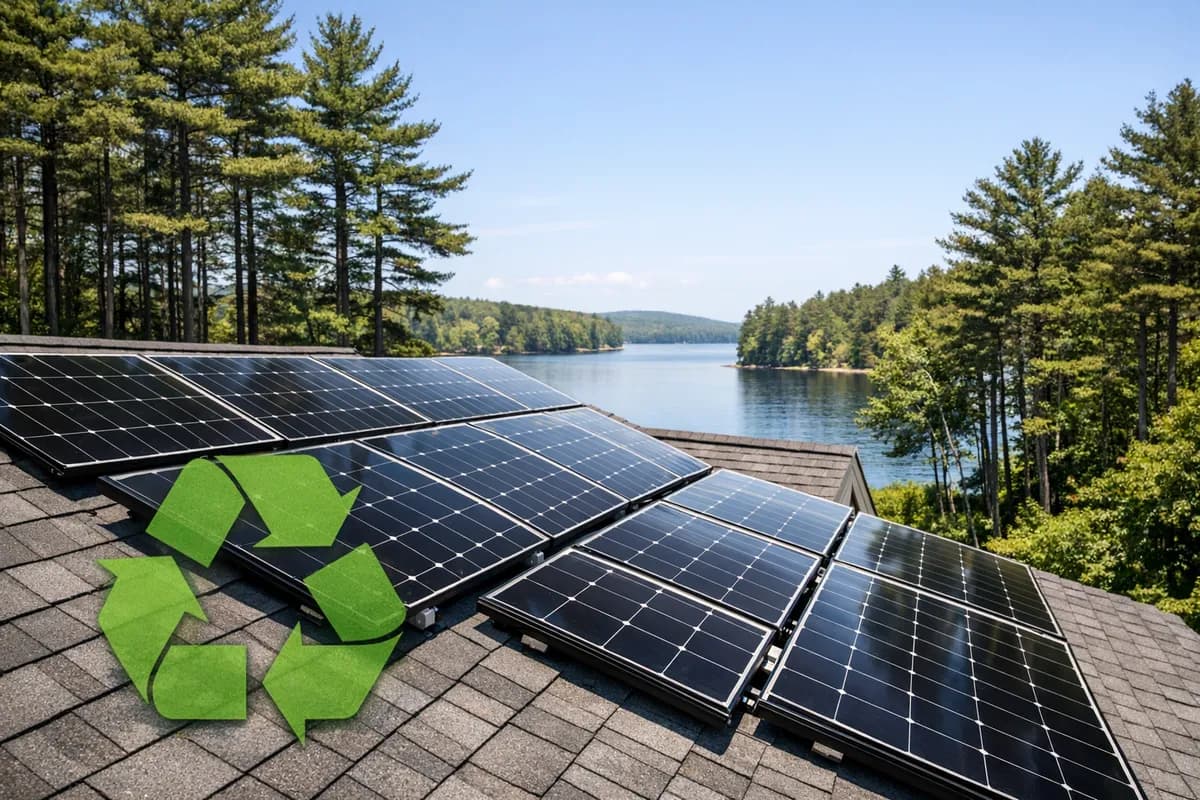
Solar panels installed in Maine today will produce power for 25-40+ years. The recycling infrastructure does not need to be perfect today — it has decades to mature. Most residential solar panels in Maine were installed after 2015, meaning the first significant wave of end-of-life panels will not arrive until 2040-2045 at the earliest. By then, recycling technology and infrastructure will be far more developed. This guide prepares you for the future while providing current options for damaged or replaced panels.
Maine's climate is actually gentle on solar panels. Cold temperatures improve silicon efficiency, moderate UV reduces material degradation, and snow naturally cleans panel surfaces. Panels last just as long in Maine as anywhere else — often longer.
Output: 95-100% of rated capacity
No action needed. Monitor production via app. Clean annually if desired.
Output: 87-95% of rated capacity
Normal degradation (~0.3-0.5%/year). No replacement needed. Inverter may need replacing around year 15-20.
Output: 80-87% of rated capacity
Panels still producing well. Manufacturer warranty typically ends at year 25. Consider inverter replacement if not already done.
Output: 75-85% of rated capacity
Decision point: continue using (still produces meaningful power) or replace with newer, more efficient panels. Recycling applies here.
Output: 65-80% of rated capacity
Panels still work but economics may favor replacement with higher-efficiency new panels. Old panels should be recycled, not landfilled.
Understanding panel composition explains why recycling is both important and achievable. A typical residential panel weighs about 40-45 lbs and contains mostly glass and aluminum — both highly recyclable.
| Material | % of Panel | Weight | Recyclable? | Recovered Use |
|---|---|---|---|---|
| Glass (tempered) | 75% | 15-17 lbs | Yes | Recycled into new glass products, fiberglass insulation |
| Aluminum (frame) | 10% | 2-3 lbs | Yes | Recycled aluminum — infinite recyclability, high market value |
| Silicon (cells) | 5% | 1-2 lbs | Yes | Purified and reused in new panels or electronics |
| Copper (wiring) | 1% | 0.5-1 lb | Yes | Recycled copper — strong commodity market |
| Polymer (backsheet) | 7% | 1.5-2 lbs | No | Typically incinerated or landfilled during recycling |
| Silver (solder) | <1% | ~0.02 lbs (10g) | Yes | Recovered and refined — most valuable material per weight |
| EVA (encapsulant) | 2% | 0.5 lbs | No | Thermally removed during recycling process |
Standard crystalline silicon panels (95%+ of Maine residential installations) contain no hazardous materials. Silicon is the second most abundant element on Earth. The glass, aluminum, and copper are all common, non-toxic materials. The EPA does not classify standard silicon solar panels as hazardous waste. Maine DEP follows this classification.
A small percentage of panels use cadmium telluride (CdTe) thin-film technology. These contain cadmium, which is a regulated substance. First Solar (the primary CdTe manufacturer) operates a free take-back recycling program for their panels. If you have thin-film panels (rare in Maine residential), contact the manufacturer directly for their recycling program.
The Maine Department of Environmental Protection classifies standard solar panels as non-hazardous solid waste. Here is the current regulatory landscape and what it means for Maine homeowners.
Maine consistently ranks among the most environmentally conscious states in the nation. The state's strong bottle deposit law, e-waste recycling requirements, and extended producer responsibility for packaging suggest that solar panel recycling legislation is a matter of when, not if. For Mainers who value the state's natural beauty — the forests, the coast, the lakes — recycling solar panels aligns with the conservation ethic that defines the state.
While Maine does not have a dedicated in-state solar panel recycling facility, several national programs serve Maine homeowners. Here are your current options.
Odessa, TX (national pickup) | Dedicated solar recycler
Pickup from Maine available for 50+ panels. Drop-off at partner locations.
Yuma, AZ (national mail-back) | Dedicated solar recycler
Ship panels via freight. Provides packaging guidelines. Accepts residential quantities.
Multiple locations (national) | Solar recycling network
Coordinates pickups and drop-offs nationwide. Partners with local waste haulers in New England.
Local (Maine) | Installer-managed recycling
Many Maine installers handle panel recycling when replacing old systems with new ones. Ask your installer about their end-of-life program.
When your panels reach 25-30+ years, you have several options. The right choice depends on their condition and your goals.
When: Panels still produce 70%+ of original capacity
There is no requirement to replace panels at warranty expiration. If they are still working, keep using them. A 25-year-old panel producing 80% of its original output is still generating meaningful electricity and saving you money.
When: Output below 70% or roof needs replacement
Panel efficiency has improved dramatically — a 2026 panel produces 25-40% more per square foot than a 2005 panel. If your roof needs replacement anyway, upgrading panels simultaneously makes economic sense. The installer handles old panel recycling.
When: Panels still work but you want to upgrade
Working panels removed during an upgrade can be donated to nonprofits, community projects, or sold to off-grid hobbyists. Even at 80% capacity, they are valuable for someone. Maine has several community solar and nonprofit energy organizations that accept used panels.
When: Panels are damaged, failed, or truly end-of-life
When panels no longer produce useful power (storm damage, severe degradation, or decommissioning), send them to a certified recycler. SolarCycle, We Recycle Solar, and Recycle PV all accept panels from Maine. Your installer can coordinate this.
When evaluating solar panel environmental impact, it is important to consider the complete picture — not just end-of-life.
1-3 years
Energy Payback Time
A solar panel generates the energy used to manufacture it within 1-3 years. Over a 30-year life, it produces 10-20 times more energy than was used to make it.
85-95%
Material Recovery Rate
Modern recycling processes recover 85-95% of panel materials by weight — primarily glass, aluminum, silicon, and copper. These materials re-enter the supply chain.
30-40 years
Useful Lifespan
Solar panels produce clean electricity for decades with no fuel, no emissions, no water use, and minimal maintenance. The environmental benefits far outweigh end-of-life disposal concerns.
A 9 kW solar system in Maine displaces approximately 5,000-7,000 lbs of CO2 emissions per year (compared to grid electricity). Over 30 years, that is 75-100 tons of avoided CO2. The end-of-life environmental impact of recycling or even landfilling 20-25 panels (~500-600 lbs of non-hazardous material) is negligible compared to decades of avoided emissions. Solar is one of the cleanest energy technologies when measured across its full lifecycle.
Maine weather — ice storms, nor'easters, falling trees — can damage solar panels. Here is how to handle them safely.
Never handle damaged solar panels yourself while the system is energized. Even cracked panels can produce dangerous electrical voltage in sunlight. Do not touch exposed wiring or broken glass. Call your installer to de-energize the system and safely remove damaged panels. If a panel is on the ground after a storm, keep people and pets away and cover it with an opaque tarp to stop electrical production.
Do not touch. Call installer. System may still be producing. Cracked panels should be replaced — moisture infiltration will eventually cause electrical failure. Insurance claim if storm damage.
Keep away — it may still produce voltage. Cover with opaque tarp. Call installer and insurance company. Do not attempt to pick up or move the panel yourself.
Call installer. With Enphase microinverters, the rest of the system keeps working while one panel is out. Installer replaces the damaged panel and handles recycling/disposal.
Inspect after hailstorm. Minor surface pitting usually does not affect production significantly. Deep cracks require replacement. Check monitoring app for any production drops after the storm.
Modern solar panels are warranted for 25-30 years and typically produce power for 30-40+ years. After 25 years, panels still produce about 80-85% of their original output. Maine's climate is actually favorable for panel longevity — cold temperatures improve silicon efficiency, and moderate UV exposure causes less degradation than sunbelt states. Snow load is managed by proper racking design.
No. As of 2026, Maine does not have a mandatory solar panel recycling law. Panels are classified as general solid waste under current Maine DEP guidelines. However, Maine's strong environmental ethic and existing extended producer responsibility (EPR) frameworks for electronics suggest that panel recycling legislation may come in the future. Washington State is currently the only US state with a mandatory solar panel recycling law.
Standard crystalline silicon solar panels (which account for 95%+ of residential installations in Maine) are NOT classified as hazardous waste. They contain silicon, glass, aluminum, and copper — all non-hazardous materials. Some older thin-film panels (cadmium telluride) contain small amounts of cadmium and may require special handling, but these are extremely rare in Maine residential systems.
There are no dedicated solar panel recycling facilities in Maine as of 2026. The nearest specialized recyclers are in Massachusetts and New York. However, several national mail-back and pickup programs accept panels from Maine, including SolarCycle, We Recycle Solar, and Recycle PV. Most solar installers in Maine will handle panel disposal/recycling when they replace old panels with new ones.
Recycling recovers approximately 85-95% of panel materials by weight. A typical residential panel yields: 15-17 lbs of glass (75% of panel weight), 2-3 lbs of aluminum frame, 0.5-1 lb of copper wiring, 1-2 lbs of silicon cells, and small amounts of silver and tin from solder connections. Glass and aluminum are the most valuable recovered materials by volume; silver is the most valuable by weight.
Current recycling costs range from $15-$45 per panel for dedicated recycling (drop-off) and $25-$65 per panel for pickup/mail-back services. Some programs offer free recycling if you are also purchasing new panels. Landfill disposal in Maine costs roughly $5-$15 per panel, making recycling 3-5 times more expensive — but the environmental benefit is significant for a state that values conservation.
Technically, yes — standard silicon panels are classified as general solid waste in Maine and can be disposed of at a licensed solid waste facility. However, this is not recommended. Panels contain recyclable glass, aluminum, copper, and silicon. Maine residents who value environmental stewardship should recycle panels through available programs rather than landfilling them.
Panels damaged by ice storms, fallen trees, or severe weather should be handled carefully. Cracked panels may have exposed wiring that can produce electrical current in sunlight. Do not handle damaged panels while the system is energized. Your installer should disconnect and remove damaged panels. Insurance typically covers storm damage, and the installer can arrange recycling or disposal of the damaged units.
Today's panels produce clean electricity for 25-40+ years. When they eventually reach end of life, 85-95% of materials can be recovered. Solar is clean energy from start to finish.