Loading NuWatt Energy...

We use your location to provide localized solar offers and incentives.
We serve MA, NH, CT, RI, ME, VT, NJ, PA, and TX
Loading NuWatt Energy...
NuWatt designs, installs, and manages solar, battery, heat pump, and EV charger systems across 9 states. One company, one warranty, one point of contact.
Get a Free Quote"Free solar panels" is the most searched solar term in Massachusetts. The honest answer: no one gives away solar panels for free. But several legitimate $0-down options exist -- and some are genuinely great deals. This guide separates fact from fiction so you can make an informed decision.
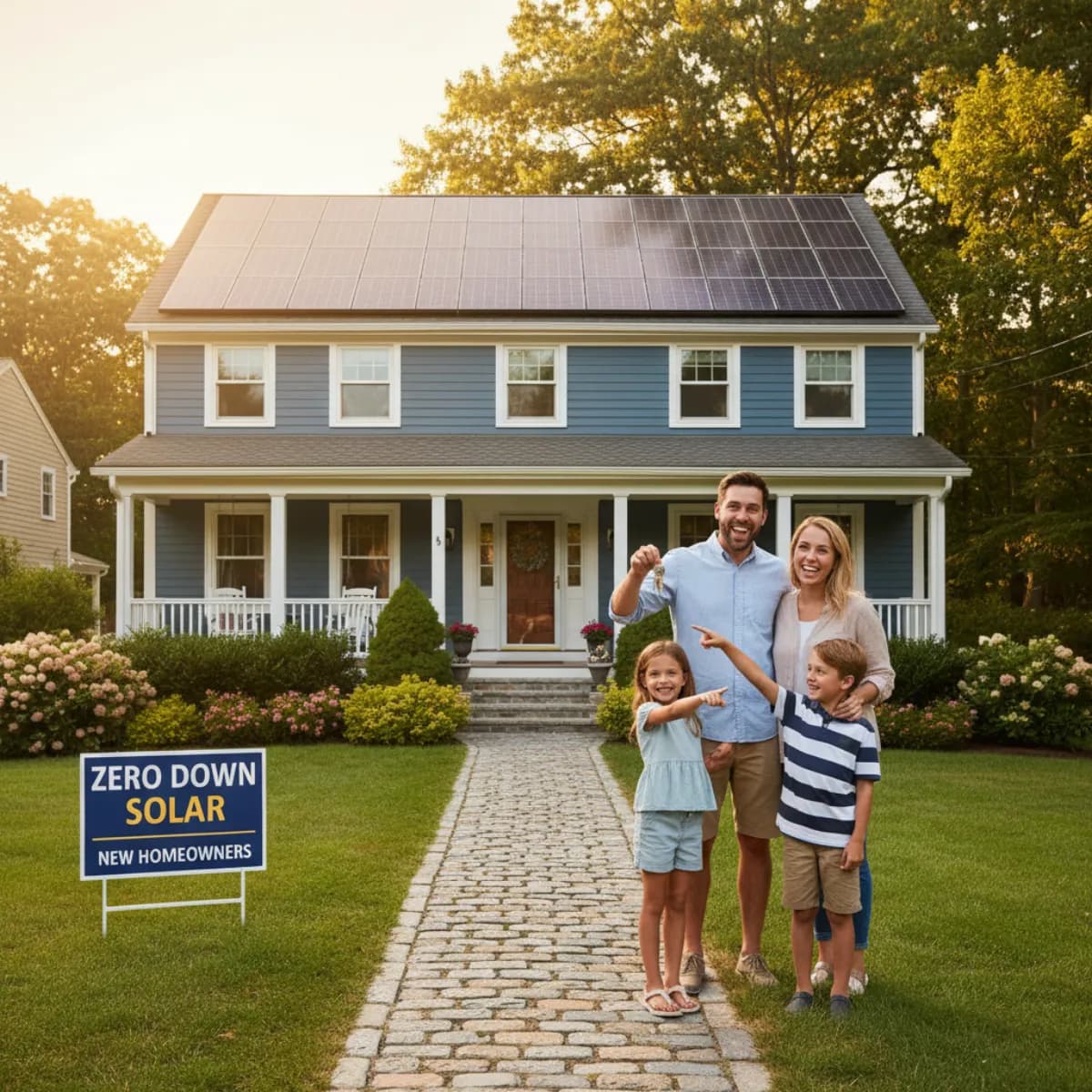
"Free solar panels" are not real -- no one gives away $25,000+ of equipment. But legitimate $0-down options are real and available in Massachusetts. The best options are: Propel ($0 down, fixed payments, you own by Year 5, saves $40K-$70K over 25 years), Mass Solar Loan ($0 down, low-interest, you own from Day 1), and income-eligible programs (deeply subsidized for qualifying households). Solar leases and PPAs are also $0 down but cost more over time because you never own the system and payments escalate annually. Avoid anyone claiming "government free solar" or pushing same-day signatures -- these are scams. Solar IS affordable in Massachusetts; it is just not literally free.
Over 12,000 people in Massachusetts search for "free solar panels" every month. This is not because people are naive -- it is because the solar industry itself created this confusion. For years, solar companies advertised "go solar for $0 down" and "free solar installation" to promote lease and PPA products. The messaging stuck, but the fine print did not.
Here is the truth: solar panels cost $20,000-$35,000 to manufacture and install on a typical Massachusetts home. No company, government agency, or nonprofit gives that away. What does exist are multiple financing structures that eliminate the upfront cost while still requiring payment over time. Some of these are excellent deals. Some are mediocre. And some "free solar" offers are outright scams.
This guide is written to be honest, not to sell you on any particular option. We will walk through every $0-down path available in Massachusetts, show you the true 25-year cost of each, and help you identify the red flags of a scam.
These are the actual ways to go solar with no money down in MA. Each has different trade-offs in ownership, monthly cost, and long-term savings.
Best for: Homeowners who want simplicity, no maintenance responsibility
Best for: Homeowners who prefer pay-per-kWh pricing
Best for: Homeowners who want ownership + $0 down + fixed cost
Best for: Homeowners with good credit who want full ownership
Best for: Households at 80% AMI or below
The most important thing to understand about solar leases and PPAs -- the products most often marketed as "free solar" -- is the escalator clause. A payment that starts low grows significantly over 20-25 years.
Meanwhile, a Propel or Mass Solar Loan customer pays $0 after Year 5-10 and owns the system outright. The lease customer has paid $41,646 and owns nothing.
Lease and PPA escalators of 2.5-2.99% per year assume electricity rates will rise at least that fast. If electricity rates rise slower (or stabilize due to grid improvements), the lease payment could eventually exceed what you would have paid the utility without solar. This has happened in states with stable or declining utility rates. Massachusetts rates have risen 3-4% annually recently, but there is no guarantee that continues for 25 years.
If you encounter any of these warning signs, stop and verify before signing anything.
There is no government program that gives away solar panels. The federal 25D ITC expired December 31, 2025. Anyone claiming a "government free solar program" in 2026 is lying.
If it sounds too good to be true, it is. $0-down options exist, but you will pay monthly (lease, PPA, loan). There is no scenario where panels produce free electricity with zero cost to you, ever.
Legitimate solar companies do not send unsolicited door-to-door salespeople with "today only" offers. This is the most common solar scam delivery method in Massachusetts.
High-pressure same-day signing tactics are a red flag. Reputable installers give you written quotes to review at your pace. Massachusetts law gives you 3 business days to cancel any door-to-door sale.
Even with solar, you will have a utility connection charge ($10-$15/mo). Net metering reduces your bill dramatically but rarely to $0. Honest estimates show 70-90% bill reduction.
Most leases and PPAs increase 1.99-2.99% per year. A $100/mo lease payment becomes $164/mo by Year 20. If the salesperson does not clearly explain the escalator, walk away.
The residential Section 25D ITC expired December 31, 2025. Any company quoting a 30% federal tax credit for a cash or loan purchase in 2026 is either incompetent or dishonest. The Section 48/48E credit is for lease/PPA providers, not homeowners directly.
Massachusetts requires a Home Improvement Contractor (HIC) license for solar installation. Verify at mass.gov/hic-check. Unlicensed contractors leave you with no legal recourse if something goes wrong.
We do not want this guide to discourage you from going solar. The point is to set realistic expectations. Solar is one of the best financial investments a Massachusetts homeowner can make -- it is just not literally free. Here is why solar is still an excellent deal.
Multiple legitimate paths to go solar with no upfront cost. Propel and Mass Solar Loan make ownership accessible to most homeowners without writing a check.
At $0.27-$0.33/kWh, Massachusetts has the 4th highest electricity rates in the country. That means solar savings are bigger here than almost anywhere else.
Owned solar systems add an average of $15,000-$25,000 to Massachusetts home values per Zillow and Appraisal Institute data. The system pays for itself on sale.
The average Massachusetts homeowner who goes solar with Propel or a loan saves $40,000-$70,000 over 25 years compared to doing nothing. Even a solar lease, while not the best deal, saves $5,000-$15,000 over 25 years. Solar is genuinely affordable and genuinely saves money -- just not "free."
If any solar option comes close to "free," it is Massachusetts income-eligible programs. These provide deeply subsidized or fully covered solar installations for qualifying households. You generally qualify if your household income is at or below 80% of the area median income (AMI).
Enhanced rebates that can cover 75-100% of installation costs for qualifying households. Combined with the 0% HEAT Loan, out-of-pocket costs can be near zero.
Eversource-specific program providing additional subsidies on top of Mass Save for customers in Eversource territory at or below 60% AMI.
National Grid offers parallel income-eligible programs with enhanced incentives for qualifying customers.
No-cost subscription to community solar with guaranteed bill savings. No installation, no credit check, no commitment beyond month-to-month.
Find Your Best $0-Down Solar Option
Answer a few questions to see which financing path maximizes your savings -- Propel, Mass Solar Loan, lease, or income-eligible programs.
No one gives away solar panels for free. However, several legitimate $0-down options exist in Massachusetts: solar leases, solar PPAs (Power Purchase Agreements), Propel (own by Year 5 with fixed payments), and the Mass Solar Loan (low-interest financing). Income-eligible households may qualify for deeply subsidized installations through Mass Save and utility programs. The key distinction is between "$0 down" (real) and "free" (misleading). You will always pay something -- the question is how much, to whom, and whether you end up owning the system.
For most homeowners, Propel offers the best $0-down value because you own the system by Year 5 with fixed monthly payments and no escalator. Over 25 years, Propel typically saves $40,000-$70,000 compared to doing nothing, and $25,000-$40,000 more than a lease or PPA. Mass Solar Loan is the second-best option for those who prefer traditional financing. Income-eligible households (at or below 80% AMI) should explore Mass Save income-eligible programs first, as these offer the deepest subsidies.
A solar lease charges a fixed monthly payment that escalates 1.99-2.99% per year -- you pay the same amount regardless of how much electricity the panels produce. A solar PPA charges per kilowatt-hour of electricity produced -- you pay only for what the panels generate, also with an annual escalator. In both cases, the leasing/PPA company owns the panels, handles maintenance, and takes any available tax credits. The homeowner gets reduced electric bills but does not build equity in the system. At the end of the term (typically 20-25 years), you can buy the system at fair market value, renew, or have it removed.
Propel is a $0-down solar ownership program. You make fixed monthly payments (no escalator) that are typically close to or less than your current electric bill. The solar company uses available commercial tax credits (Section 48/48E) to subsidize the upfront cost. By Year 5, ownership of the system transfers to you automatically at no additional cost. From Year 5 through Year 25+, you own the system outright and keep 100% of the electricity savings. This is why Propel delivers significantly more lifetime savings than a lease or PPA.
The Mass Solar Loan provides low-interest financing (0-6% depending on lender and credit score) specifically for solar installations in Massachusetts. It is a real loan -- you own the system from Day 1 and make monthly payments for 10-20 years. The advantage over a lease is full ownership and no escalator. The disadvantage vs Propel is that you may pay interest and your monthly payment during the loan term may be higher. For homeowners with excellent credit who can secure a 0-3% rate, Mass Solar Loan is competitive with Propel.
Massachusetts offers several programs for income-eligible households (generally at or below 80% area median income): (1) Mass Save income-eligible enhanced rebates for solar and heat pumps, (2) Eversource and National Grid income-eligible solar programs with deeply subsidized installations, (3) community solar subscriptions targeted at low-income households with guaranteed savings, and (4) Environmental Justice community solar programs in designated EJ communities. These programs can reduce out-of-pocket costs to near zero with savings of $50-$150/month from Day 1.
The biggest red flags are: (1) claims of "government free solar" programs (no such thing exists), (2) door-to-door salespeople pushing urgent "sign today" offers, (3) any mention of a 30% federal tax credit for cash/loan purchases in 2026 (the 25D ITC expired), (4) no clear explanation of escalator clauses in lease/PPA contracts, (5) no Massachusetts HIC license (verify at mass.gov), and (6) pressure to sign before getting a written quote you can review at home. Legitimate solar companies provide written proposals, explain all costs clearly, and never pressure you to sign on the spot.
For maximum lifetime savings: cash purchase or Propel (own the system). For lowest monthly payment with no commitment: lease or PPA (but you pay more over 25 years and never own). For traditional financing with ownership: Mass Solar Loan. For income-eligible households: explore subsidized programs first. The best choice depends on your credit score, available cash, tax situation, how long you plan to stay in your home, and whether you value ownership or simplicity. A cash purchase saves the most overall, but Propel is the best $0-down option because it combines ownership with fixed payments.
Detailed comparison of lease and PPA terms, escalators, and buyout options.
How Propel works: $0 down, fixed payments, own by Year 5.
How the Mass Solar Loan program works, rates, and eligibility.
Complete guide to identifying and avoiding solar scams in Massachusetts.
Skip the "free solar" hype. Get honest pricing and a personalized comparison of $0-down options available for your Massachusetts home.