Loading NuWatt Energy...

We use your location to provide localized solar offers and incentives.
We serve MA, NH, CT, RI, ME, VT, NJ, PA, and TX
Loading NuWatt Energy...
NuWatt designs, installs, and manages solar, battery, heat pump, and EV charger systems across 9 states. One company, one warranty, one point of contact.
Get a Free Quote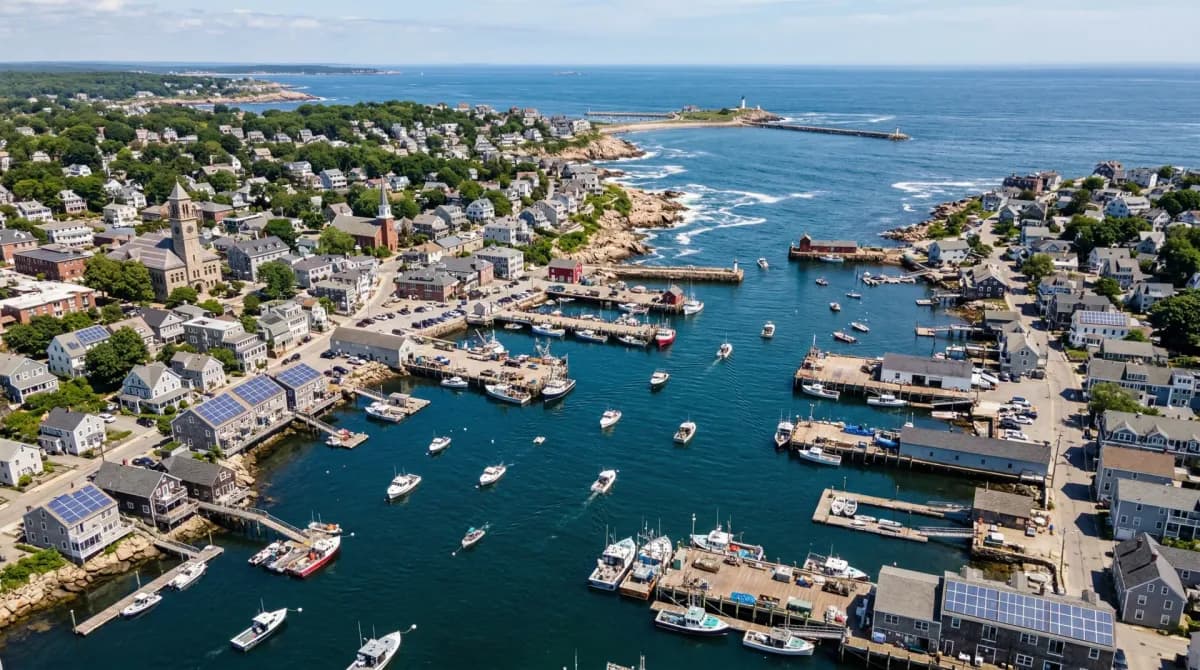
America's oldest fishing port and Cape Ann's cultural heart. 30,300 residents, strong sustainability ethos, and coastal sun exposure. National Grid territory at $0.42/kWh. SMART 3.0 eligible with marine-grade solar options for waterfront properties.
National Grid territory • SMART 3.0 • ConnectedSolutions • Coastal installation expertise
2026 Reality: The 30% federal tax credit (Section 25D) expired for homeowners December 31, 2025. All costs in this guide reflect $0 federal credit. Full details
An 11 kW solar system in Gloucester costs $33,000-$37,400 in 2026. In National Grid territory at $0.42/kWh, with SMART income of ~$396/yr and full retail net metering, the investment pays for itself in 5.6-6.3 years and generates ~$145,795 in savings over 25 years. Coastal properties may add $200-500 for marine-grade hardware.
Cost Range
$3.00-$3.40/W
Fully installed
Avg System
11 kW
Gloucester average
Payback
5.6-6.3 yrs
Cash purchase
25-Year Savings
~$146K
Estimated total value
Gloucester is a historic fishing port on Cape Ann with ~30,300 residents. Known for its maritime heritage, artistic community, and strong environmental consciousness, the city combines coastal living with a growing commitment to renewable energy and climate resilience.
Population
~30,300
Median Home Value
~$530,000
Primary Utility
National Grid
Electric Rate
$0.42/kWh
Typical System Size
9-14 kW
Solar Irradiance
4.3 kWh/m²/day
Gloucester's position on Cape Ann means many properties face direct ocean exposure. Here is what you need to know about solar in a coastal environment.
Marine-grade anodized aluminum racking
Stainless steel mounting hardware (not galvanized)
Enhanced corrosion-resistant panel frames
Sealed junction boxes and marine-rated connectors
Annual salt-spray rinse recommended (rain usually sufficient)
Premium for marine-grade hardware: $200-500 on a typical system. Protects a 25+ year investment.
Standard aluminum racking performs well
Standard galvanized hardware acceptable
No special corrosion treatment needed
West Gloucester and inland areas are standard installs
Same equipment as any MA suburb
No additional cost for coastal considerations. Standard pricing applies.
Coastal advantage: Cape Ann receives slightly higher solar irradiance than inland communities (4.3 vs. 4.1-4.2 kWh/m2/day) due to water reflection and clearer coastal skies. Ocean breezes keep panels cooler, improving efficiency by 2-3% on hot summer days.
Costs for different system sizes in Gloucester at $3.00-3.40/W. Gloucester homes range from seasonal cottages and condos (6-8 kW) to large year-round waterfront properties (14-17 kW).
| System Size | Low Cost | High Cost | SMART 3.0 | Best For |
|---|---|---|---|---|
| 6 kW | $18,000 | $20,400 | ~$216/yr | Condo / seasonal cottage |
| 8 kW | $24,000 | $27,200 | ~$288/yr | Cape / smaller colonial |
| 11 kW | $33,000 | $37,400 | ~$396/yr | Typical Gloucester home |
| 14 kW | $42,000 | $47,600 | ~$504/yr | Large home / EV + battery |
| 17 kW | $51,000 | $57,800 | ~$612/yr | High usage / multi-zone HVAC |
Prices include equipment, labor, permits, and grid interconnection. No federal tax credit included (expired). $1,000 MA state tax credit not deducted. Waterfront properties may add $200-500 for marine-grade hardware.
Gloucester's neighborhoods vary significantly in salt-air exposure and housing stock. Here is what to expect for solar in each area.
Home Types
Historic Colonials, Victorians, waterfront condos
Avg System
8-11 kW
Dense harbor-side neighborhood. Some historic considerations. Maximum salt-air exposure -- marine-grade mounting hardware and corrosion-resistant racking strongly recommended. Excellent sun exposure on south-facing waterfront properties.
Home Types
Colonials, Capes, summer cottages
Avg System
9-12 kW
Coastal village south of downtown. Mix of year-round and seasonal homes. Good roof access, less tree canopy than inland areas. Salt air exposure moderate to high.
Home Types
Capes, Colonials, waterfront properties
Avg System
10-13 kW
North shore of Cape Ann. More open terrain with good solar exposure. Annisquam River properties have excellent south-facing potential. Salt-air considerations for waterfront homes.
Home Types
Newer construction, ranches, split-levels
Avg System
11-14 kW
More inland location with lower salt-air exposure. Larger lots, newer roofs, and less tree canopy. Best solar conditions in Gloucester -- standard equipment performs well here.
Also in Gloucester: East Gloucester, Rocky Neck (artist colony), Bass Rocks, and Good Harbor Beach areas. All are in National Grid territory with the same state incentives. Waterfront properties in these areas should use marine-grade hardware.
Gloucester's Building Department handles solar permits. The process typically takes 2-4 weeks. The city is supportive of residential solar with a straightforward permit process.
Installer evaluates roof condition, orientation, salt-air exposure, and structure. Coastal properties assessed for marine-grade hardware needs.
Application to Gloucester Building Department with electrical and structural plans. Historic district properties may need additional review.
Typical installation 1-3 days. Electrical and building inspection by the City of Gloucester.
National Grid approves grid connection. 2-4 weeks. Net metering activated. True-up in March.
Massachusetts offers one of the strongest solar incentive packages in the country. Here is what Gloucester homeowners can stack.
$0.03/kWh for all electricity produced for 20 years. An 11 kW system generates ~$396/yr in SMART income.
~$396/yr
~$7,500 over 20 years
1:1 credit at full retail rate of $0.42/kWh. Credits roll over monthly. True-up in March.
~$5,515/yr
Annual electricity savings (11 kW)
National Grid demand response. Earn $225/kW summer + $50/kW winter. Battery also provides backup during coastal storms.
$2,750/yr
Typical 10 kW battery
15% of system cost, capped at $1,000. Claimed on your MA state tax return.
$1,000
One-time credit
Solar systems are exempt from the 6.25% MA sales tax. Immediate savings at purchase.
~$2,200
Savings on typical system
Solar-added value is exempt from property tax for 20 years. Gloucester has a 1.074% residential tax rate.
~$378/yr
20-year exemption (~$7,560 total)
Note: SMART 3.0 adders can increase your income: +$0.04/kWh for battery storage, +$0.05/kWh for low-income households. Adders stack on top of the base rate.
Three ways to pay for solar in Gloucester. PPAs offer $0 down because the third-party system owner claims the commercial Section 48 ITC -- and handles ongoing maintenance, which is valuable for coastal properties.
Upfront
~$33,000-$37,400
Monthly
$0
25-yr Savings
~$146K
Ownership
You own it
Best long-term ROI. 5.6-6.3 year payback. Full SMART income + net metering yours.
Upfront
$0 down
Monthly
~$225-315/mo (5.5-8% APR)
25-yr Savings
~$70-95K
Ownership
You own it
10-25 year terms. SMART income + net metering offset payments. Cape Ann Five Cents, Rockport National Bank, and credit unions offer competitive rates.
Upfront
$0
Monthly
Fixed ~$0.14-0.18/kWh
25-yr Savings
~$30-45K
Ownership
Third party owns
Third-party owner claims Section 48 ITC and handles maintenance -- relevant for coastal properties where maintenance matters more.
Section 25D (the 30% residential solar tax credit) expired December 31, 2025 under the OBBBA. Gloucester homeowners buying cash or loan receive $0 in federal credit. However, third-party system owners (PPA/lease) can still claim the commercial Section 48/48E ITC -- which translates to lower PPA rates for you.
Read: What happened to the solar tax creditGloucester's identity as a fishing port has always been tied to the ocean and natural environment. Today, that connection drives strong community support for renewable energy and climate resilience.
Green Communities designation -- municipal energy reduction targets
Cape Ann climate resilience planning for sea-level rise and storms
Strong commercial fishing industry driving sustainability awareness
Artist colony culture that values environmental stewardship
Community Choice Electricity aggregation for green power options
Solar+battery provides backup during coastal nor'easters
Beyond the financial returns, Gloucester homeowners choose solar for energy independence during storms, reducing reliance on aging grid infrastructure, and aligning with the city's maritime environmental values. Solar+battery is especially popular for waterfront properties that lose power during nor'easters.
How Gloucester solar costs compare to nearby North Shore communities. Beverly and Salem are in National Grid territory; Peabody has its own municipal light plant.
| City/Town | Cost/W | Avg System | Utility | Notes |
|---|---|---|---|---|
| Gloucester | $3.00-3.40 | 11 kW | National Grid | Coastal fishing port, marine-grade options |
| Beverly | $3.00-3.35 | 11.5 kW | National Grid | North Shore suburb, standard installs |
| Salem | $3.05-3.40 | 10 kW | National Grid | Dense historic city, some heritage overlay |
| Peabody | $2.95-3.30 | 11.5 kW | PMLP (muni) | Municipal utility, $0.15/kWh, no SMART |
| Rockport | $3.05-3.45 | 9 kW | National Grid | Small coastal town, similar salt-air needs |
Explore the complete library of Massachusetts solar guides, incentive programs, and local energy resources.
MA Solar Guide 2026
Complete guide to going solar in Massachusetts in 2026.
Solar Panel Cost in MA
Statewide cost breakdown: $2.80–$3.50/W by city and utility.
SMART Program Guide
$0.03/kWh for 20 years. National Grid customers are eligible.
Net Metering in MA
1:1 retail credit. Rules, caps, and how to lock in your rate.
Mass Save Heat Pump Rebates
Up to $8,500 back on heat pumps through Mass Save.
ConnectedSolutions Battery
Earn $225/kW summer demand response with National Grid.
Income-Eligible Programs
Free or deeply discounted upgrades for income-qualified homeowners.
Solar Financing Options
Cash, loan, and PPA compared for MA homeowners.
Solar panels in Gloucester cost $3.00-3.40 per watt installed in 2026. A typical 11 kW system costs $33,000-$37,400. The federal Section 25D residential tax credit expired December 31, 2025 -- homeowners receive $0 in federal credit. Massachusetts state incentives (SMART 3.0, net metering, $1,000 state tax credit, and tax exemptions) still make solar a strong investment in Gloucester.
Yes, but modern solar equipment handles coastal conditions well. For Gloucester properties within 500 feet of the water, we recommend marine-grade aluminum racking with stainless steel hardware, anodized or galvanized mounting systems, and panels with enhanced corrosion-resistant frames. Standard equipment performs well in West Gloucester and other inland areas. The slight premium for marine-grade hardware ($200-500) is well worth the 25+ year protection.
SMART 3.0 pays solar system owners $0.03/kWh for all electricity produced, locked in for 20 years. An 11 kW system in Gloucester generates approximately $396/year in SMART income, totaling roughly $7,500 over the program duration. Low-income households qualify for $0.06/kWh (double rate). Battery storage adds $0.04/kWh on top.
Gloucester actually benefits from excellent solar conditions. Cape Ann receives roughly 4.3 kWh/m2/day of solar irradiance -- slightly better than inland areas due to water reflection and fewer overcast days from cloud patterns. Coastal breezes also keep panels cooler, improving efficiency. The fishing port location means many south-facing roofs have unobstructed ocean views (and sun exposure).
Yes. With National Grid rates at $0.42/kWh, SMART 3.0 income of ~$396/yr, full net metering, ConnectedSolutions battery revenue, and state tax exemptions, Gloucester systems pay for themselves in 5.6-6.3 years and save approximately $145,795 over 25 years. The city's strong sustainability ethos and coastal resilience needs (power outages during nor'easters) add practical value beyond pure ROI.
We'll assess your roof, coastal exposure, salt-air considerations, and National Grid rate to show exactly what solar costs and saves for your Gloucester home -- including SMART 3.0 and ConnectedSolutions.
Complete hub for MA solar, heat pumps, and utility resources.
Read moreStatewide solar costs and city-by-city breakdown.
Read more$0.03/kWh for 20 years. How to enroll and earn.
Read moreEarn $225-$1,500/yr per battery. Demand response revenue.
Read more1:1 retail credit. Lock in before potential changes.
Read more5.5-8% APR through local lenders and credit unions.
Read more25D expired. What options remain for homeowners.
Read moreCompare utility rates, net metering, and solar economics.
Read moreTrack rate changes across MA utilities since 2020.
Read moreLive installation data, capacity trends, and market stats.
Read moreCurrent wait times, bottlenecks, and how to get connected faster.
Read morePricing: EnergySage Solar Marketplace (January 2026), NuWatt Energy North Shore installations.
Utility rates: National Grid residential rate schedule, effective February 2026.
SMART 3.0: MassDOER / MassCEC, SMART program guidelines PY2026.
ConnectedSolutions: National Grid demand response program rates, 2026 season.
Coastal considerations: NuWatt Energy Cape Ann installation experience, equipment manufacturer specifications.
Tax exemptions: MA Department of Revenue, Gloucester Assessor data.