Loading NuWatt Energy...

We use your location to provide localized solar offers and incentives.
We serve MA, NH, CT, RI, ME, VT, NJ, PA, and TX
Loading NuWatt Energy...
NuWatt designs, installs, and manages solar, battery, heat pump, and EV charger systems across 9 states. One company, one warranty, one point of contact.
Get a Free QuoteMassachusetts has roughly 75 licensed hospitals and hundreds of ambulatory care centers. Solar + BESS integration for healthcare facilities is materially different from other commercial buildings — NFPA 110 Type 10 essential electrical system rules, Joint Commission continuity standards, and §6417 direct pay for nonprofit systems all shape the economics and architecture.
MA Hospitals
~75
Licensed acute-care facilities
Typical Payback
4-7 yrs
Nonprofit with direct pay
NFPA 110 Fuel Spec
48-96 hrs
Varies by classification
§6417 Refund
30-60%
Of system cost (with bonuses)
No — solar + BESS cannot replace a hospital's NFPA 110 Type 10 / Class X essential electrical system (EES). Hospitals are required by code to maintain an on-site rotating-machinery generator capable of starting within 10 seconds and running for 48-96+ hours. Solar + battery is an additive resilience and economic asset: it shaves demand charges, shifts non-critical loads (MRI, sterilizers, pharmacy compounding), earns Clean Peak certificates and ConnectedSolutions demand-response revenue at $225/kW/year, and provides extended-outage support for equipment-branch loads (for a Boston-jurisdiction campus it also counts toward BERDO 2.0 emissions compliance). For 501(c)(3) nonprofit hospitals (Mass General Brigham, Dana-Farber, Beth Israel Lahey), §6417 direct pay delivers the 30% ITC as a cash refund — a post-2023 benefit that transforms hospital solar from a tax-equity-only structure into straightforward owned capital.
A hospital is not a large commercial building with extra equipment. It is a life-safety facility governed by overlapping federal, state, and accreditation requirements — NFPA 99 (Health Care Facilities Code), NFPA 110 (Emergency and Standby Power Systems), NFPA 70 (National Electrical Code Article 517 for Health Care Facilities), Joint Commission EC.02.05.03 (utility systems), and Massachusetts Department of Public Health hospital licensure under 105 CMR 130. Layering solar + battery onto this architecture requires understanding which parts of the electrical system the code permits to be supplemented, which parts must remain generator-fed, and which parts can be optimized without touching the EES at all.
Massachusetts has approximately 75 licensed acute-care hospitals, plus several hundred ambulatory surgery centers, dialysis centers, imaging centers, medical office buildings, and skilled nursing facilities. The largest academic medical centers (Mass General Brigham, Boston Children’s, Beth Israel Lahey, Tufts Medical Center, Dana-Farber) operate campuses consuming 100-400 GWh/year — comparable to small cities. Community hospitals (Emerson, Baystate Franklin, Harrington, Holyoke) consume 10-30 GWh/year. In every case, electricity is the largest non-labor operating cost after medical supplies.
Three structural realities shape hospital solar in Massachusetts: (1) the essential electrical system is generator-based by code, so solar + BESS is additive, never a substitute; (2) nonprofit status rewrites the tax math — §6417 direct pay finally lets 501(c)(3) systems own the array and still bank the credit, and MA sweetens it with a sub-1-MW exemption from the 2026 domestic-content gate; and (3) two forces no ordinary commercial roof faces collide here— the SMART 3.0 storage co-location rule under 225 CMR 28.00 for arrays over 1,000 kW, and Boston’s BERDO 2.0 emissions ordinance bearing down on large hospital buildings.
NFPA 110 classifies emergency power systems by Type (allowable transfer time) and Class (minimum runtime). Hospitals are almost universally Type 10 (load transfer within 10 seconds) and Class X (runtime specified by other codes or authorities having jurisdiction). In practice, Class X for MA hospitals typically translates to on-site fuel for 48-96 hours, though specific requirements vary by facility classification, local AHJ, and whether the hospital serves as a regional disaster-response hub. Individual hospitals may have longer runtime requirements set by state DPH or Joint Commission expectations.
NFPA 99 and NEC Article 517 further subdivide the essential electrical system into distinct branches with different code expectations. Solar and BESS can participate in some branches but not others:
Typical Loads
Egress lighting, fire alarm, medical gas alarms, exit signs
Transfer Time
Within 10 seconds
Solar + BESS Role
No role here — the diesel EES generator stays the sole NFPA 110 source
Typical Loads
Task illumination in OR/ICU/ED, patient care areas, nurse call, select outlets
Transfer Time
Within 10 seconds
Solar + BESS Role
BESS can add ride-through, but MA code still mandates the generator on this branch
Typical Loads
HVAC for critical areas, medical air compressors, vacuum, sterilizers
Transfer Time
Within 60 seconds (automatic)
Solar + BESS Role
Solar + BESS can carry delayed HVAC and medical-air compressor loads through an extended outage
Typical Loads
Non-critical HVAC, general lighting, administrative loads, food service
Transfer Time
Manual or delayed
Solar + BESS Role
Best fit for solar + BESS — the branch where ConnectedSolutions load-shifting and Clean Peak revenue live
The Joint Commission Environment of Care standard EC.02.05.03 requires hospitals to maintain, test, and inspect their emergency power systems on a documented schedule. Key elements include:
Solar + BESS does not discharge any of these obligations. A well-designed hybrid architecture must integrate cleanly with the existing transfer-switch scheme, provide clear demarcation between code-required sources and supplemental sources, and be invisible to Joint Commission surveyors reviewing the EES.
Healthcare energy intensity varies by an order of magnitude across facility types. An academic medical center consumes 10-15x more energy per square foot than a medical office building. Sizing solar and battery correctly starts with honest load characterization.
Note: Ranges reflect typical MA healthcare facilities and include direct-pay (§6417) assumptions where applicable. Individual hospital requirements vary based on age of infrastructure, existing CHP plants, Joint Commission tier, trauma designation, utility territory (Eversource vs. National Grid vs. municipal light plant), and specific clinical service mix. A feasibility study is the only way to produce facility-specific numbers.
A hospital rooftop is the most constrained commercial rooftop in the built environment. Before committing to a system size, every hospital solar project needs a physical constraint inventory. The six most common constraints on MA hospital rooftops:
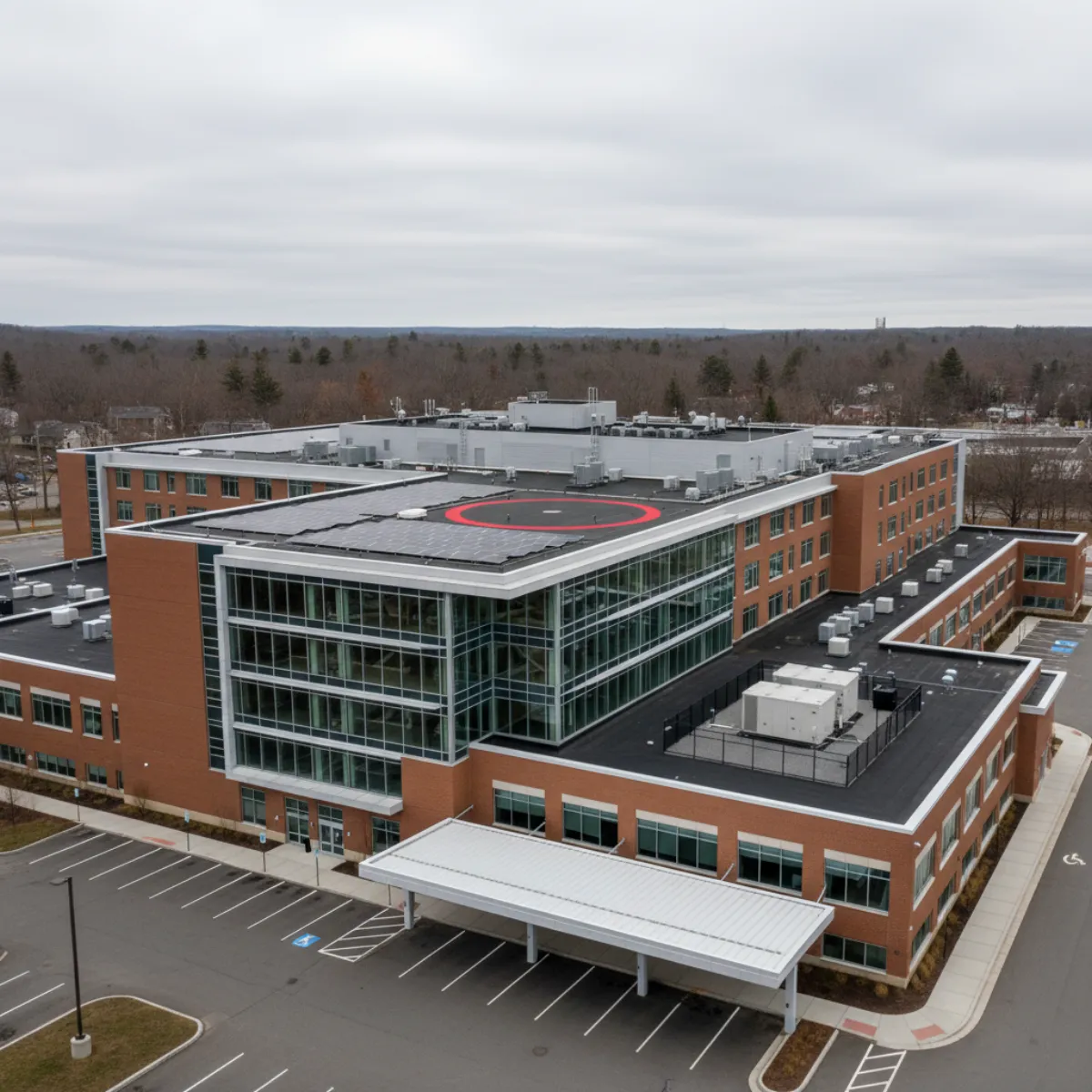
FAA Advisory Circular 150/5390-2C governs the approach/departure surfaces and Final Approach and Takeoff Area (FATO) around a rooftop helipad. At a verified Massachusetts Level I trauma campus — UMass Memorial, Baystate Medical Center, or a Boston teaching hospital with an elevated helideck — the FATO plus its transitional safety margins can sterilize a modeled 30-50% of the primary roof plate for PV. The exact loss is a function of helideck elevation, orientation, and the state-approved instrument approach.
Mitigation
Move the array onto lower medical-office wings, the central utility plant roof, or ballasted carport canopies over staff decks — the multi-roof pattern nearly every large MA campus ends up using.
Acute-care HVAC in Massachusetts is engineered N+1 for isolation-room pressurization, OR air changes, and central sterile processing. Air handlers, chillers, cooling towers, and dedicated outdoor-air units routinely claim 25-40% of the roof plate on 1960s-1980s MA hospital stock, and the code-required service clearances around each unit erode still more usable PV area.
Mitigation
Commission a 3D LiDAR + drone shade study before layout, and evaluate raised-canopy PV spanning the mechanical deck so maintenance access to the air handlers is preserved.
Medical-vacuum, WAGD (waste anesthetic gas disposal), and bulk-oxygen vent terminations carry NFPA 99 clearances — generally 10 ft horizontally and 10 ft above any opening or PV string — plus intake/exhaust separation. On a dense hospital roof those keep-out cylinders cascade and fragment otherwise contiguous PV zones.
Mitigation
Bring the medical-gas engineer into the PV layout at concept stage; relocating a vent stack is feasible but carries real capital and shutdown-permitting cost.
The diesel EES generator stack throws a particulate-laden, high-temperature plume that fouls modules and microinverters. NFPA 110 clearance plus the module manufacturer buffer typically brackets a 15-25 ft PV exclusion radius, and the plume footprint shifts with prevailing wind across a Massachusetts campus.
Mitigation
Orient the array upwind of the stack relative to prevailing winter northwesterlies, and budget for more frequent cleaning on any strings nearest the generator yard.
This is where Massachusetts diverges sharply from milder-climate states. The MA building code (780 CMR, adopting ASCE 7) reserves roughly 40-50 psf of ground snow load across inland Worcester and Franklin county hospital sites, so mid-century MA hospital roofs often show under 5 psf of spare dead-load once the snow reserve is booked. Ballasted PV adds 3-5 psf; mechanically attached PV adds less but must clear combined snow-plus-wind uplift analysis.
Mitigation
Sequence PV with the 20-25 year re-roof cycle and favor rail-less or mechanically attached, low-ballast systems where the snow reserve is thin. See our commercial roof structural assessment guide before sizing.
The Joint Commission and the Massachusetts Department of Public Health (hospital licensure under 105 CMR 130) require an Infection Control Risk Assessment (ICRA) for any work touching occupied clinical areas. Rooftop activity above ORs, ICUs, or NICUs escalates to Class III/IV ICRA — negative-pressure barriers, HEPA filtration, and tightly bounded work windows that lengthen an MA hospital PV schedule.
Mitigation
Phase the install into low-census windows and seat the hospital infection-prevention lead at the design table from day one, not at mobilization.
The single most important economic question in hospital solar is the entity structure of the owner. Nonprofit 501(c)(3) hospitals use §6417 direct pay. For-profit healthcare systems use §48E ITC + MACRS, with §6418 transferability as a liquidity option. REIT-owned hospital real estate follows its own path. The three routes differ in mechanism but now reach broadly comparable economics under the post-2023 IRA framework.
Examples
Mass General Brigham, Dana-Farber, Beth Israel Lahey, Boston Children’s, UMass Memorial
Primary Mechanism
§6417 Elective Payment (Direct Pay)
Core Benefit
IRS pays 30% base ITC directly to the hospital as a refund (no tax liability needed)
Stackable Bonuses
Domestic content (10%), Energy community (10%), Low-income (10-20%) — up to 50-60% combined
Limitations
Domestic content phase-down for pre-filing projects; must pre-register with IRS; prevailing wage compliance required for bonuses
Examples
HCA Healthcare, Steward Health Care, CHA, specialty ASCs
Primary Mechanism
§48E ITC + MACRS 5-yr depreciation
Core Benefit
30% base ITC against tax liability + accelerated depreciation recovers ~25-30% of basis
Stackable Bonuses
Same bonus adders as nonprofits; ITC is transferable to unrelated buyers under §6418 if hospital has insufficient tax appetite
Limitations
Must have taxable income or use transferability; MACRS basis reduced by 50% of ITC per IRS rules
Examples
Medical Properties Trust, Healthpeak, Welltower ground-lease MOBs
Primary Mechanism
§48E ITC + MACRS or third-party PPA
Core Benefit
REIT landlord captures ITC + depreciation; tenant sees reduced pass-through utility costs
Stackable Bonuses
All §48E bonuses available; PPA structure used when REIT is restricted from direct ownership
Limitations
Lease structure must be reviewed; health system tenant typically unable to claim federal benefits
§48E follows a dual-pathway timeline: projects that began construction on or before July 4, 2026 locked in the full credit timing, while later starts still qualify if placed in service by December 31, 2027. The base 30% credit stacks with bonus adders and the separate §179D deduction. For-profit entities also capture MACRS depreciation, including 100% first-year bonus depreciation (permanently restored by OBBBA).
30% investment tax credit for energy property under §48E. Projects that began construction on or before July 4, 2026 locked in the full credit timing; projects that start later still qualify if placed in service by December 31, 2027.
501(c)(3) hospitals, public hospitals, and tribal hospitals elect a cash refund in lieu of the credit. In Massachusetts, facilities under 1 MW AC are exempt from the 2026 domestic-content phaseout entirely, so a sub-1-MW hospital rooftop keeps the full refundable credit regardless of where its components are sourced.
A for-profit healthcare owner can sell the ITC to unrelated tax-equity buyers for cash when internal tax appetite is thin. Massachusetts nonprofit hospital systems do not use this path; they take the §6417 direct-pay refund instead.
Additional 10% ITC when steel, iron, and a set share of manufactured-product components are US-made. For a sub-1-MW Massachusetts hospital array this is pure upside, since the 2026 direct-pay domestic-content gate does not bind below 1 MW AC.
Additional 10% ITC for projects in energy-community census tracts (former coal/brownfield sites or fossil-employment statistical areas). Several Massachusetts Gateway Cities — the state’s former mill and manufacturing centers — carry qualifying tracts, putting many community hospitals squarely in-adder.
Additional 10-20% ITC for qualifying sub-5 MW projects sited in low-income communities or serving low-income residents; competitively allocated each program year through the §48E(h) Low-Income Communities Bonus.
Separate deduction (up to ~$5.81/sqft in 2026) for efficient envelope, HVAC, and lighting work — meaningful on the energy-dense floor plates of a Massachusetts hospital, and it stacks on top of the §48E solar/BESS credit rather than reducing it.
For-profit MA healthcare systems recover roughly 25-30% of basis through 5-year accelerated depreciation, including the 100% first-year bonus permanently restored under OBBBA — the depreciable basis is first reduced by half the ITC claimed.
Systems over 1 MW AC must satisfy IRA prevailing wage and apprenticeship requirements to receive the full 30% ITC (and eligibility for bonus adders). Non-compliance reduces the base credit to 6%. Most hospital-scale projects exceed 1 MW, so contractor selection must include proven IRA compliance programs. Key elements:
See our detailed MA prevailing wage + apprenticeship compliance guide for documentation templates and common pitfalls.
State-level incentives stack on top of federal credits. Clean Peak and ConnectedSolutions are particularly valuable for hospital-scale BESS because the battery can discharge during utility peak events without impacting any code-required EES function.
The DPU approved the SMART 3.0 tariff (D.P.U. 25-175) on May 19, 2026; company-specific Eversource, National Grid, and Unitil tariffs followed in July 2026, and DOER is now issuing Final Statements of Qualification. Under 225 CMR 28.00, a solar unit larger than 1,000 kW that does not qualify for a Locational Compensation Rate Adder must be co-located with qualifying energy storage (at least 100 full cycle-equivalents/year) — a threshold most hospital-scale arrays cross, so paired BESS is effectively written into the tariff math rather than an option.
A paired hospital BESS earns Clean Peak Energy Certificates by discharging into the defined seasonal peak windows (roughly 3-9 PM summer, 4-10 PM winter in MA). Clean Peak revenue stacks on top of solar self-consumption and ConnectedSolutions without touching any code-required EES branch.
Eversource, National Grid, and Unitil pay $225/kW/year (Daily Dispatch) for the summer program plus roughly $50/kW through the winter pilot, dispatching enrolled batteries during system peak events (June-September, ~30-60 events/year). A hospital-scale battery captures this revenue while the diesel plant remains the sole NFPA 110 source.
Utility-funded audits, custom HVAC/controls incentives, and retro-commissioning. MA hospitals routinely bundle envelope and mechanical efficiency with solar + BESS to hit utility strategic-electrification targets and shrink the array they need.
Solar and storage equipment is exempt from the 6.25% MA sales tax at purchase, for both for-profit and nonprofit healthcare buyers — a direct line-item reduction on a multi-million-dollar hospital array.
Added solar equipment value carries a 20-year property-tax exemption. This matters most for taxable REIT-owned or for-profit healthcare real estate; a 501(c)(3) hospital campus is typically already property-tax exempt.
Massachusetts is the rare state where the incentive tariff itself pushes hospital arrays toward paired storage. The DPU approved the SMART 3.0 tariff (D.P.U. 25-175) on May 19, 2026; company-specific Eversource, National Grid, and Unitil tariffs followed in July 2026, and DOER is now issuing Final Statements of Qualification for a 20-year term.
The provision that matters most for a hospital campus is the storage rule in 225 CMR 28.00: a solar generation unit larger than 1,000 kW that does not qualify for a Locational Compensation Rate Adder must be co-located with qualifying energy storage (at least 100 full cycle-equivalents per year). Most acute-care rooftop-plus-canopy programs clear 1 MW, so the battery a hospital would already want for demand-charge control and ConnectedSolutions revenue is, in practice, written into the tariff math rather than bolted on later.
That storage requirement lines up cleanly with the NFPA 110 reality: the BESS never sits on the code-required life-safety or critical branches, but it is exactly the asset SMART 3.0 wants co-located and exactly the asset that earns ConnectedSolutions at $225/kW/year and Clean Peak certificates. One battery, three jobs.
For any hospital building inside Boston, solar + BESS is not only an economic play — it is a compliance instrument. Boston’s Building Emissions Reduction and Disclosure Ordinance (BERDO 2.0), enacted in 2021 and since expanded, applies to non-residential buildings of 20,000 gross sq ft or larger and to residential buildings with 15 or more units, hospitals explicitly among them. Covered buildings must report annual greenhouse-gas emissions and meet emissions-intensity limits that ratchet down every five years to zero in 2050.
Hospitals are among the most energy-intense buildings in the city, and BERDO reflects that: the Healthcare standard is 15.4 kgCO2e per sq ft per year for 2025–2029, falling to 10.0 from 2030. A building over its limit can make an Alternative Compliance Payment of $234 per metric tonof CO2e — a compliance mechanism, not a fine — or, if it neither reduces nor pays, face fines assessed per day rather than per ton. On-site solar reduces reported emissions directly, and paired storage plus efficiency work compounds the reduction, which is why a Boston teaching hospital often evaluates solar against its BERDO exposure and not just its utility bill.
New hospital construction and major renovations in Massachusetts increasingly land in municipalities that have adopted the Stretch Energy Code (300+ communities) or the more stringent Specialized Opt-in Code(a growing list of 50+). Both push new commercial buildings toward solar-ready roofs — reserved structural capacity, conduit pathways, and panel space — plus EV-ready parking, and the Specialized Code adds all-electric new construction.
For a healthcare facility director, that changes the calculus of a replacement tower or a new ambulatory building: the roof is being engineered solar-ready by code anyway, so the incremental cost of actually installing the array — and capturing §48E, SMART 3.0, and (for nonprofits) §6417 direct pay — is far lower than a retrofit on a 1970s deck with a 5 psf snow-load reserve. Aligning the PV plan with the code-driven design phase is the cheapest solar a hospital will ever buy.
A 200-bed community hospital in Worcester County operating as a 501(c)(3) nonprofit models a 1.5 MW AC rooftop-plus-parking-canopy solar array paired with a 500 kW / 2 MWh battery. Because the solar block exceeds 1,000 kW, the SMART 3.0 storage co-location rule under 225 CMR 28.00 effectively requires the paired battery to qualify. The campus sits in Eversource territory at a modeled $0.24/kWh blended retail with $22/kW demand charges on its primary service, and its existing 2 MW diesel plant provides NFPA 110 Type 10 Class X coverage with 72 hours of on-site fuel.
Facility
200 beds, ~350,000 sqft
Annual Consumption
~18,000 MWh
Current Annual Spend
$4.2M-$4.8M
Solar Size
1,500 kW AC (rooftop + canopy)
Battery
500 kW / 2 MWh (4-hour)
Gross Cost (solar+BESS)
~$4.5M-$5.2M
§6417 Direct Pay (30% base)
~$1.4M-$1.6M refund
Domestic Content Bonus (10%)
~$450K-$520K
Energy Community Bonus (if applicable)
~$450K-$520K
Net Capital After Direct Pay
~$2.1M-$2.8M
Year 1 Energy Savings
~$380K-$450K
Demand Charge Reduction
~$90K-$140K/yr
ConnectedSolutions ($225/kW) + Clean Peak
~$90K-$150K/yr (modeled)
Estimated Simple Payback
4-6 years
Key Insight
Direct pay is what makes this pencil for a nonprofit that once had no way to monetize the ITC: it takes roughly 30-50% of project cost as a Treasury refund, and because only the >1 MW portion carries domestic-content-gate exposure, array phasing genuinely matters. The BESS does double duty — it satisfies the 225 CMR 28.00 co-location requirement for the >1,000 kW solar block AND earns ConnectedSolutions at $225/kW plus Clean Peak, converting a pre-IRA 12-15 year payback into a modeled 4-6 years. For a Boston-jurisdiction hospital the same array also chips away at BERDO 2.0 emissions obligations. None of this touches the diesel plant, which remains the sole code-compliant NFPA 110 source.
Illustrative only. Actual numbers depend on utility territory, rate class, current interconnection capacity, domestic-content sourcing decisions, energy-community qualification, roof condition, and BESS dispatch strategy. Individual hospital requirements vary; treat these figures as rough bracketing, not a quote.
Confirm filing status (501(c)(3), public, for-profit, REIT-owned). Determine whether §6417 direct pay, §48E + MACRS ownership, §6418 transferability, or third-party PPA is the appropriate economic structure. Involve CFO and outside tax counsel early.
Inventory critical, equipment, and normal branches. Identify non-clinical loads suitable for BESS-driven shifting (MRI precooling cycles, sterilizer schedules, pharmacy compounding, central plant operations). Confirm generator plant specs and runtime capability.
Commission drone-based and LiDAR site surveys documenting helipad FATO boundaries, HVAC/vent clearances, structural capacity, roof warranty status, and infection-control access corridors. Evaluate adjacent buildings, parking canopies, and ground-mount locations.
Engage Eversource or National Grid interconnection planning early. Hospital campuses typically have dedicated substations or primary services; hosting-capacity analysis and system impact studies can take 6-12 months for projects over 1 MW.
Select EPC contractor with documented IRA compliance programs. Establish labor documentation workflows before groundbreaking. Plan apprentice hour capture mechanisms aligned with MA Chapter 149 obligations.
Schedule infection control risk assessment (ICRA). Coordinate construction phasing with clinical operations and low-census windows. Confirm generator load-test schedule is not impacted by PV commissioning.
Integrate solar + BESS into hospital SCADA and building automation. Establish Clean Peak dispatch logic, ConnectedSolutions enrollment, and demand-response playbooks. Train facilities staff on supplemental vs. code-required systems.
Timeline note: A hospital-scale project from feasibility through commissioning typically runs 12-24 months. With the §48E begin-construction window now closed (July 4, 2026), new projects must be placed in service by December 31, 2027, so initial feasibility and engineering should be underway now to hold the full credit stack.
Complete guide to commercial solar in Massachusetts — sizing tiers, pricing, incentive stacks, financing.
How commercial BESS earns ConnectedSolutions revenue alongside Clean Peak and demand-charge reduction.
§6417 direct pay for 501(c)(3) entities — churches, schools, community organizations alongside hospitals.
Battery backup strategies for MA commercial facilities during storm-related grid outages.
How §48E investment tax credits flow through lease and PPA structures for healthcare real estate.
Insurance considerations for large rooftop arrays, carport canopies, and battery energy storage systems.
Compliance guide for the IRA prevailing wage and apprenticeship requirements on systems over 1 MW.
Cities, towns, school districts, and nonprofits using direct pay for publicly owned solar assets.
No. Under NFPA 110, hospitals require a Type 10, Class X (or equivalent duration) essential electrical system (EES) that starts and transfers load within 10 seconds and runs for 48-96+ hours depending on the specific facility classification and state requirements. The code explicitly contemplates an on-site rotating-machinery source (typically a diesel or natural-gas generator) for the life safety and critical branches. Solar + BESS is an additive resilience and economic asset — it provides ride-through, peak shaving, demand response revenue, and extended-outage support for non-essential and equipment-branch loads, but it does not replace the code-required generator plant. The Joint Commission EC.02.05.03 standard for continuity of operations reinforces this: hospitals must demonstrate tested, reliable emergency power compliant with NFPA 110, not a substitute architecture.
Feasibility study covers NFPA 110 integration, §6417 direct pay (nonprofits) or §48E + MACRS (for-profits), rooftop constraint mapping, and utility interconnection path. No obligation.