Loading NuWatt Energy...

We use your location to provide localized solar offers and incentives.
We serve MA, NH, CT, RI, ME, VT, NJ, PA, and TX
Loading NuWatt Energy...
NuWatt designs, installs, and manages solar, battery, heat pump, and EV charger systems across 9 states. One company, one warranty, one point of contact.
Get a Free Quote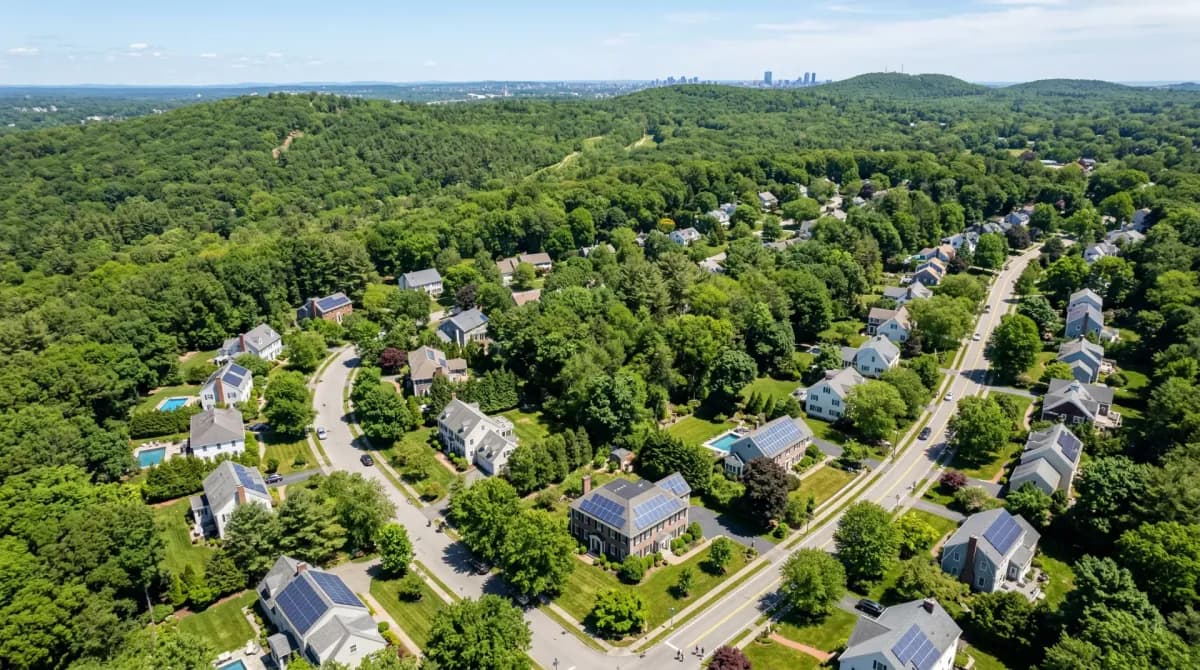
Affluent suburb at the foot of the Blue Hills with ~28,600 residents. Tree-lined streets, strong schools, and high property values. Eversource territory at $0.37/kWh. SMART 3.0 + ConnectedSolutions deliver excellent solar economics.
Eversource territory • SMART 3.0 • ConnectedSolutions eligible • Blue Hills area
2026 Reality: The 30% federal tax credit (Section 25D) expired for homeowners December 31, 2025. All costs in this guide reflect $0 federal credit. Full details
A 12 kW solar system in Milton costs $37,200-$41,400 in 2026. In Eversource territory at $0.37/kWh, with SMART income of ~$432/yr and full retail net metering, the investment pays for itself in 6.4-7.1 years and generates ~$143,140 in savings over 25 years.
Cost Range
$3.1-$3.45/W
Fully installed
Avg System
12 kW
Milton average
Payback
6.4-7.1 yrs
Cash purchase
25-Year Savings
~$143K
Estimated total value
Milton is an affluent residential suburb of ~28,600 residents bordering the Blue Hills Reservation. Known for its excellent schools, tree-lined streets, and mix of colonial, Cape, and estate-style homes. High property values and energy-conscious residents make it a strong solar market.
Population
~28,600
Median Home Value
~$850,000
Primary Utility
Eversource
Electric Rate
$0.37/kWh
Typical System Size
10-15 kW
Solar Irradiance
4.2 kWh/m²/day
Costs for different system sizes in Milton at $3.10-3.45/W. Milton homes range from modest Capes (7-9 kW) to estate properties near Brush Hill (15-18+ kW).
| System Size | Low Cost | High Cost | SMART 3.0 | Best For |
|---|---|---|---|---|
| 7 kW | $21,700 | $24,150 | ~$252/yr | Smaller colonial / ranch |
| 9 kW | $27,900 | $31,050 | ~$324/yr | Mid-size Cape or colonial |
| 12 kW | $37,200 | $41,400 | ~$432/yr | Typical Milton single-family |
| 15 kW | $46,500 | $51,750 | ~$540/yr | Large home / EV + battery |
| 18 kW | $55,800 | $62,100 | ~$648/yr | Estate home / high usage |
Prices include equipment, labor, permits, and grid interconnection. No federal tax credit included (expired). $1,000 MA state tax credit not deducted.
Milton's neighborhoods vary in housing stock, lot size, and proximity to the Blue Hills -- all of which affect solar potential. Here is a breakdown of the main residential areas.
Home Types
Large colonials, Victorians, Georgians
Avg System
12-16 kW
Affluent hilltop neighborhood with expansive roof areas and generous lot sizes. Strong solar adoption among eco-conscious families. Some mature trees require assessment but most homes have excellent southern exposure.
Home Types
Colonials, Capes, multi-family
Avg System
10-12 kW
Mixed residential area near East Milton Square. Slightly denser than other Milton neighborhoods. Good mix of single-family and two-family homes with accessible roofs. Walkable village character.
Home Types
Ranches, splits, colonials (1950s-70s)
Avg System
10-13 kW
Near Blue Hills Reservation. Some homes face tree canopy challenges from the reservation border. Mid-century homes often have ideal low-pitch roofs for solar. Generally good access on south-facing lots.
Home Types
Larger colonials, newer builds
Avg System
13-17 kW
Upscale area with larger homes and higher energy consumption. Estate-style lots provide excellent roof access with minimal neighbor shading. Ideal for larger solar arrays with battery storage.
Blue Hills note: Homes on the southern and western edges of the Blue Hills Reservation may have seasonal shading from the treeline. A professional shade analysis will identify exact production impacts. Most Milton homes well away from the reservation boundary have excellent solar access.
Milton has one local wrinkle worth planning for: the Building Department requires solar permits to be submitted in person rather than online, and a separate electrical permit is filed alongside the building permit. A complete packet still clears in about 10 business days at a $75-$125 fee -- the in-person step mostly affects scheduling, not approval time. With Eversource interconnection at ~22 business days afterward, plan on roughly 6-12 weeks from contract to permission to operate. Your installer handles the Town Hall filing.
Roof, orientation, and structural capacity checked. For homes near the Blue Hills, a shade study quantifies any tree-canopy impact before sizing.
Building permit plus a separate electrical permit submitted in person at Milton Town Hall. Fee $75-$125; allow a few extra days versus online towns.
Typical installation 1-3 days, followed by electrical and building inspection by the Town of Milton.
Eversource approves grid connection in ~22 business days. Net metering and SMART enrollment then activate.
Two things shape almost every Milton solar quote: the town's large colonial homes, which offer some of the best usable roof area in the inner suburbs, and the mature tree canopy along the Blue Hills Reservation, which can shade homes on its southern and western edges. The right system size depends on how those two factors line up on your specific roof.
Milton's housing skews toward large colonials and estate-style homes with broad, simply-pitched roof planes. That gives many homes the unobstructed surface to host 12-16 kW arrays -- larger than the regional norm -- which is part of why Milton's average system runs around 12 kW and climbs in the Milton Hill, Columbine, and Brush Hill areas.
Homes bordering the Blue Hills Reservation -- particularly on the southern and western edges, where the treeline sits across the productive faces -- often benefit from a shade study before the system is sized. Modern production modeling using satellite imagery and LIDAR quantifies the exact seasonal impact, so the array is sized to what the roof will actually produce rather than an optimistic estimate.
Practical takeaway: homes well away from the reservation boundary (much of Milton Centre and East Milton) usually have clear southern exposure and can be sized straight to roof capacity. Closer to the Blue Hills, insist on a documented shade analysis so your production -- and therefore your savings and payback -- are modeled honestly before you sign.
Massachusetts offers one of the strongest solar incentive packages in the country, and Milton residents qualify for the full statewide stack. Figures below are sized to a typical 12 kW Milton system; the linked MA guides cover the program mechanics.
$0.03/kWh on every kWh produced for 20 years. A 12 kW Milton system earns ~$432/yr. Full SMART guide.
~$432/yr
~$8,200 over 20 years
1:1 credit at full retail rate of $0.37/kWh. Credits roll over monthly and true up in April.
~$5,380/yr
Annual electricity savings (12 kW)
Eversource battery demand response: $275/kW summer + $50/kW winter. Full breakdown in the section below.
$3,250/yr
Typical 10 kW battery
15% of system cost, capped at $1,000. Claimed on your MA state tax return (Form 1, Schedule EC).
$1,000
One-time credit
Solar systems are exempt from the 6.25% MA sales tax. Immediate savings at purchase.
~$2,456
Savings on typical system
Solar-added value is exempt from property tax for 20 years. Milton's $1.38 tax rate means significant annual savings.
~$543/yr
20-year exemption (~$10,860 total)
Note: SMART 3.0 adders can increase your income: +$0.04/kWh for battery storage, +$0.05/kWh for low-income households. Adders stack on top of the base rate.
Section 25D (the 30% residential solar tax credit) expired December 31, 2025. Milton homeowners buying cash or loan receive $0 in federal credit, so every price on this page already reflects no federal credit. The commercial Section 48/48E ITC remains active for third-party owners on a PPA or lease, which is what keeps those PPA rates low. That commercial ITC is not a hard cliff: projects that began construction on or before July 4, 2026 locked in the full timing, and projects that begin later still qualify as long as they are placed in service by December 31, 2027.
Read: What happened to the solar tax creditMilton is in Eversource territory, which offers the highest ConnectedSolutions rates in MA. Battery storage provides both backup power and significant annual revenue for Milton homeowners.
Summer Revenue
$2,750
$275/kW x 10 kW battery
Winter Revenue
$500
$50/kW x 10 kW battery
Total Annual Revenue
$3,250
10 kW battery in Eversource
Milton tip: With SMART 3.0 battery adder (+$0.04/kWh) + ConnectedSolutions ($3,250/yr), the battery can pay for itself in 3-4 years. The SMART adder and ConnectedSolutions stack.
Three ways to pay. Cash delivers the best long-term return and fastest payback; loans at 5.5-8% APR keep $0 down with SMART income offsetting payments; a PPA stays $0 down because the third-party owner claims the commercial Section 48 ITC. Compare all three in detail.
Upfront
~$37,200-$41,400
Monthly
$0
25-yr Savings
~$143K
Ownership
You own it
Best long-term ROI. 6.4-7.1 year payback. Full SMART income + net metering yours.
Upfront
$0 down
Monthly
~$255-355/mo (5.5-8% APR)
25-yr Savings
~$85-110K
Ownership
You own it
10-25 year terms through local lenders and credit unions. SMART income offsets monthly payments.
Upfront
$0
Monthly
Fixed ~$0.14-0.18/kWh
25-yr Savings
~$35-50K
Ownership
Third party owns
Third-party owner claims Section 48 ITC. You buy power at a discount. Immediate savings.
Homes near the Blue Hills with heavy tree canopy or those that cannot install rooftop solar have an excellent alternative: community solar subscriptions.
Savings
10-20%
On electricity bill
Upfront Cost
$0
No installation
Contract
Flexible
Cancel anytime
Subscribe to a local MA solar farm and receive credits on your Eversource bill. No credit check, no long-term commitment. Especially relevant for Milton homes with shading from the Blue Hills Reservation treeline.
How Milton solar costs compare to neighboring communities on the South Shore and inner suburbs.
| Town | Cost/W | Avg System | Utility | Notes |
|---|---|---|---|---|
| Milton | $3.10-3.45 | 12 kW | Eversource | Blue Hills area, affluent, strong solar market |
| Quincy | $3.05-3.40 | 10.5 kW | Eversource | Denser city, more multi-family |
| Canton | $3.05-3.40 | 11.5 kW | Eversource | Similar suburban profile, slightly lower prices |
| Dedham | $3.05-3.40 | 11.5 kW | Eversource | Route 1 corridor, Legacy Village area |
| Braintree | $3.00-3.35 | 11 kW | BELD (muni) | Municipal utility, different incentives |
Solar panels in Milton cost $3.10-3.45 per watt installed in 2026. A typical 12 kW system costs $37,200-$41,400 before MA state incentives. The federal Section 25D residential tax credit expired December 31, 2025 -- homeowners receive $0 in federal credit. Massachusetts incentives (SMART 3.0, net metering, state tax credit, and tax exemptions) still make solar highly profitable in Milton.
Homes directly bordering the Blue Hills Reservation may have tree canopy shading from the reservation edge, particularly on the western and southern borders. However, most Milton homes have sufficient southern exposure for effective solar production. Modern shade analysis using satellite imagery and LIDAR can identify any issues before installation. Homes further from the reservation boundary (Milton Centre, East Milton) typically have excellent solar access.
Milton requires solar permit applications to be submitted in person rather than through an online portal, and a separate electrical permit is filed alongside the building permit. In practice that means your installer hands the paperwork in at Town Hall during business hours, so it is worth building a few extra days into the schedule versus a fully online town. A complete Milton packet typically clears in about 10 business days at a fee of $75-$125. With Eversource interconnection running roughly 22 business days afterward, a typical Milton project runs about 6-12 weeks from signed contract to permission to operate. A reputable installer handles the in-person filing for you.
Generally yes. Milton has a high share of large colonial homes, which tend to have substantial, simply-pitched roof planes -- exactly the kind of unobstructed roof area that hosts a larger array efficiently. That roof capacity is part of why Milton systems average around 12 kW and run larger in the Milton Hill, Columbine, and Brush Hill areas. The main thing to confirm is roof orientation and any shading, since a generously sized roof only helps if the productive faces are clear.
Yes. Milton has a fast payback period of 6.4-7.1 years thanks to high Eversource electricity rates ($0.37/kWh), SMART 3.0 income, and MA state incentives. With Milton median home values around $850K and a $1.38 property tax rate, the 20-year property tax exemption saves approximately $543/year. Over 25 years, a typical system saves around $143,140.
Milton has no separate municipal solar program, but residents qualify for the full statewide stack: SMART 3.0 ($0.03/kWh for 20 years), Eversource 1:1 retail net metering, ConnectedSolutions for batteries ($275/kW summer, $50/kW winter), the $1,000 MA state tax credit, the 6.25% sales-tax exemption, and the 20-year property-tax exemption -- worth more here than in most towns given Milton’s higher home values. The linked MA SMART, net metering, and tax-exemption guides cover the mechanics.
Statewide pricing and incentive overview
Complete SMART program details and enrollment
Eversource demand response program
Compare financing options for MA solar
Sales and property tax benefits
Nearby city comparison
Compare utility rates, net metering, and solar economics.
Track rate changes across MA utilities since 2020.
Live installation data, capacity trends, and market stats.
Current wait times, bottlenecks, and how to get connected faster.
We will assess your specific roof, Blue Hills proximity, tree canopy, and Eversource rate to show you exactly what solar costs and saves for your Milton home -- including SMART 3.0 and ConnectedSolutions.