Loading NuWatt Energy...

We use your location to provide localized solar offers and incentives.
We serve MA, NH, CT, RI, ME, VT, NJ, PA, and TX
Loading NuWatt Energy...
NuWatt designs, installs, and manages solar, battery, heat pump, and EV charger systems across 9 states. One company, one warranty, one point of contact.
Get a Free QuoteMost MA homes land between 7 kW and 13 kW DC — but the right size depends on your real Eversource or National Grid kWh, your roof, and what you plan to electrify next. Here is the math, with real MA sun-hour and panel-watt numbers.
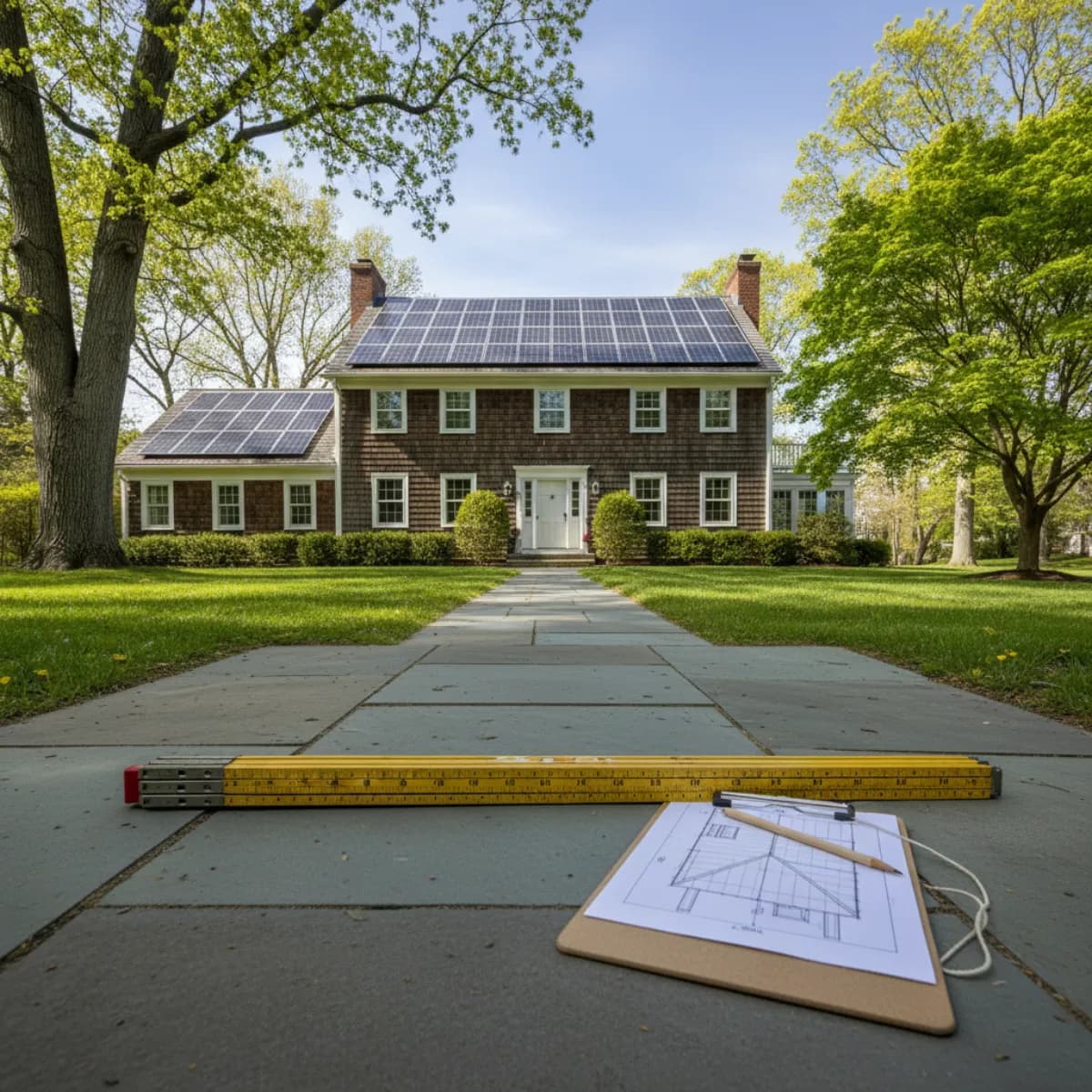
A typical 2,000–2,500 sq ft Massachusetts single-family home using 7,500–10,000 kWh per year needs about 7–10 kW DC of solar — roughly 18–24 panels at 410W or 16–22 panels at 440W. Use 4.0–4.4 peak sun hours per day for MA (NREL TMY3 data), apply a 0.80–0.85 system derate, and target 90–100% of your annual kWh to maximize net-metering value. Critically: size for future load too. Adding a heat pump or EV in the next 5 years can raise consumption 25–100%, and adding panels later costs far more than oversizing now.
Every reliable solar sizing decision starts with one number: how many kilowatt-hours your home actually used over the last 12 months. Not a single bill, not a summer peak, not an estimated average — the full year, because Massachusetts loads swing dramatically between January heating and July air conditioning.
The average single-family Massachusetts home runs around 600–700 kWh per month, for a 7,200–8,400 kWh annual baseline. Heated with a gas furnace, no EV, no pool. That is the starting point — your number may be very different.
Why net metering changes the math: Massachusetts net metering settles on an annual basis, not monthly. You can overproduce in July and bank credits against January consumption. The sizing target is 90–100% of your annual kWh, not your peak month. Building much larger than 100% wastes capacity because excess credits compensate at a lower rate.
This is where most homeowners under-build. The system that fits your 2026 bill will be undersized by 2030 if you electrify heating or buy an EV. Adding panels later means a new interconnection application, a new permit, and another truck roll — typically 30–50% more expensive per watt than the original install. Oversize now.
Heat pump (oil displacement)
+2,500–4,000 kWh/yr
25–40% over baseline electric use
Heat pump (gas-to-electric)
+4,000–8,000 kWh/yr
60–100% over baseline electric use
EV (12k mi/yr, 1 vehicle)
+3,500–4,500 kWh/yr
~3 mi/kWh, home charging
Heat-pump water heater
+800–1,200 kWh/yr
Replaces gas or electric tank
Induction range
+200–400 kWh/yr
Replaces gas range
Pool pump (seasonal)
+1,200–1,800 kWh/yr
In-ground, May–September
Eversource, National Grid, and Unitil treat 25 kW AC as the cutoff for simplified residential interconnection. Stay under it and your application is fast and cheap. Cross it and you move into expedited review — longer timelines, sometimes utility-side upgrades, occasionally a detailed system impact study.
Most homes do not get close. But if you are sizing for a large home with two EVs, a heat pump, and a pool — a 28 kW DC array paired with a 24 kW AC inverter (DC/AC ratio of 1.17) keeps you under the threshold while preserving most of the production. SMART 3.0 also has system-size tier breaks at 25 kW AC; ask your installer how that affects your block rate.
Once you know your target annual kWh (current usage plus future load), you size the system using the local peak sun-hour figure and a performance derate. Sun-hours are the number of hours per day a location gets the equivalent of full 1,000 W/m² insolation. Massachusetts sits in a 4.0–4.4 peak-sun-hour band depending on the region, drawn from NREL TMY3 climate data.
| MA Region | Avg Peak Sun Hours | Notes |
|---|---|---|
| Boston / Metro West | 4.1 | Coastal, moderate cloud cover |
| North Shore (Salem, Beverly) | 4.1–4.2 | Slightly better than inland Boston |
| South Shore / Cape Cod | 4.2–4.4 | Best in MA — fewer cloudy days |
| Worcester County | 4.0 | More winter snow cover |
| Pittsfield / Berkshires | 4.0 | More winter cloud cover and snow |
| Springfield / Pioneer Valley | 4.1 | Mid-state average |
System size (kW DC) = Annual kWh ÷ 365 ÷ Sun-hours × (1 ÷ Derate)
The derate captures real-world losses: inverter conversion, wiring, soiling, panel temperature, shading, mismatch, and module degradation. A clean MA roof typically lands at 0.80–0.85. Use 0.82 as a default if you have nothing more specific.
Worked example
Target: 10,000 kWh/yr in eastern MA (4.2 sun-hours, 0.82 derate).
10,000 ÷ 365 ÷ 4.2 × (1 ÷ 0.82) ≈ 7.95 kW DC. At 410W panels: ~20 panels. At 440W panels: ~18 panels.
Reality check on roof orientation. The formula assumes ideal exposure. In MA:
The math says one thing; the roof says another. A typical Massachusetts colonial can host 8–15 panels per face; a Cape or ranch may be lower because of dormers and shorter roof runs. A 410W panel measures roughly 22 sq ft, but with required spacing and setbacks you should plan on 25–30 sq ft of roof per installed panel.
When ground-mount makes more sense: if your roof is small, complex, or shaded — and you have a flat, sunny lot — a ground-mount is often cheaper per watt and produces more per panel because of optimal tilt and orientation. See our ground-mount solar guide for MA for when this is worth the conversation.
Let's build a real sizing decision end-to-end. The home: a 2,400 sq ft 4-bedroom colonial in Newton, gas heat, no EV today. Eversource bills show 9,800 kWh consumed over the last 12 months. The owner is planning a whole-home heat pump in 2027 to displace the gas furnace; no EV planned yet.
1. Baseline annual kWh
9,800 kWh from the Eversource 12-month download.
2. Add future load — gas-to-heat-pump conversion
Gas displacement adds 60–100% to baseline. Use 65% midpoint: +6,400 kWh. New target: ~16,200 kWh/yr.
3. Apply MA sun-hours and derate
Eastern MA: 4.1 sun-hours, 0.82 derate.
16,200 ÷ 365 ÷ 4.1 × (1 ÷ 0.82) ≈ 13.2 kW DC.
4. Convert to panel count
At 440W panels: 13,200 ÷ 440 = 30 panels.
5. Roof-area check
South face holds 16 panels; east face holds 12; total 28 viable. Two-panel shortfall.
6. Final design decision
Install 13 kW DC, 28 panels (16 south + 12 east). Accept ~5% production shortfall against the 16,200 kWh target. Alternative: add 2 panels on a north-facing dormer at ~70% production — usually not worth the labor and string-design penalty.
Inverter sizing: 13 kW DC paired with an 11.4 kW AC inverter (DC/AC ratio 1.14) stays well under the 25 kW AC interconnection threshold and clips minimal production. SMART 3.0 base-rate sizing tier is unaffected.
Your kWh today does not include the heat pump, EV, or HPWH you will install in the next 5 years. Add expected loads before sizing.
Crossing 25 kW AC pushes you into expedited review with longer timelines and possible utility-side upgrades. Inverter sizing matters here.
NREL summer peak hours are ~5.5/day in MA; annualized is 4.0–4.4. Using the summer figure overstates production by ~25%.
A maple casting partial morning shade in 2026 may shade your whole array by 2034. Walk the property with the installer for sun-path modeling.
Section 25D expired December 31, 2025. Cash-purchase and loan systems get $0 federal. Size for net metering and SMART 3.0 — not a credit that is gone.
SMART block compensation rates step down as state capacity fills. The block your system enters is locked for 10 years, so timing and final sizing both matter.
Quick mental-math anchors when you don't have a calculator handy. Each is calibrated to Massachusetts climate and grid rules.
10 kW DC
~12,000 kWh/yr in eastern MA
32–40 panels
fit per 1,000 sq ft of usable south roof
+25–100%
add for heat-pump conversion (oil vs gas)
~3,800 kWh/yr
per EV at 12k mi/yr
90–100%
of annual kWh — net-metering target
Plug in your address, current kWh, and any planned electrification load. The MA solar savings calculator returns a target kW, panel count, expected production, and a bill-offset estimate using current Eversource and National Grid rates.
Use the MA solar savings calculatorA typical 2,000–2,500 sq ft Massachusetts single-family home using 7,500–10,000 kWh per year needs roughly 7–10 kW DC of solar — about 18–24 panels at 410W or 16–22 panels at 440W. The exact number depends on your real annual kWh from Eversource, National Grid, or Unitil, your roof orientation and shading, and any planned heat-pump or EV load.
NuWatt builds your system size off your real Eversource or National Grid kWh, your roof, and your electrification plan — not a generic national average. Free quote, no pressure.