Loading NuWatt Energy...

We use your location to provide localized solar offers and incentives.
We serve MA, NH, CT, RI, ME, VT, NJ, PA, and TX
Loading NuWatt Energy...
NuWatt designs, installs, and manages solar, battery, heat pump, and EV charger systems across 9 states. One company, one warranty, one point of contact.
Get a Free Quote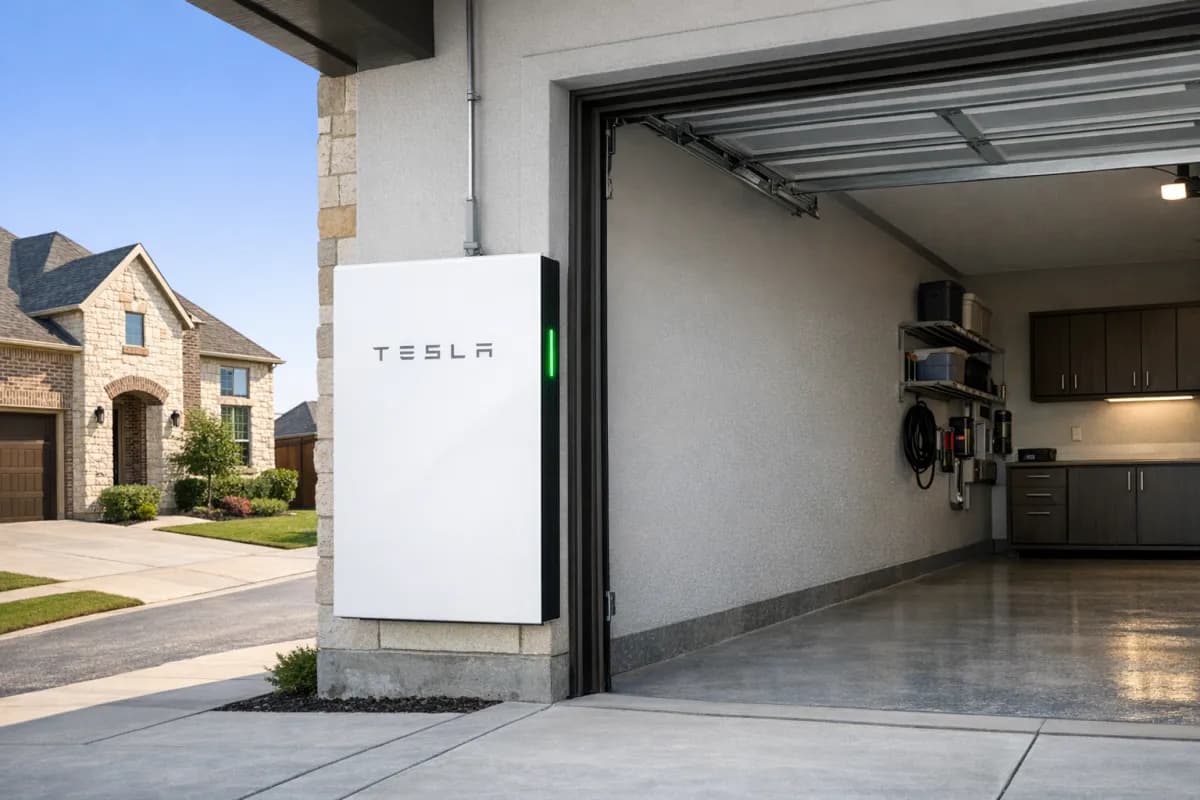
The Texas grid runs on ERCOT — independent and vulnerable to extreme weather. Home battery storage provides backup power during outages, TOU arbitrage in the deregulated market, and maximizes the value of every kWh your solar panels produce. No federal 25D credit in 2026.
Free backup assessment. We size your battery to your home and outage risk.
ERCOT grid instability, no demand response payments, and a deregulated market with volatile pricing make battery storage a different value proposition in Texas than in other states.
Winter Storm Uri (2021) left millions without power for days. Texas grid operates independently from the national grid. Battery storage provides self-reliance when ERCOT fails during extreme heat or cold events.
In the deregulated ERCOT market, electricity prices spike during peak hours (2-7 PM summer). Batteries charge from solar during the day and discharge during peak pricing, maximizing the value of your solar production.
Without net metering, exported solar in Texas earns $0.05-$0.10/kWh via buyback plans. Storing that energy in a battery and using it during peak hours saves $0.15-$0.25/kWh instead — 2-3x more value from every kWh.
Texas homes need AC in 100+ degree summers and heating in rare but dangerous freezes. A 13.5 kWh battery can power essential loads (AC, refrigerator, lights, wifi) for 8-12 hours during outages.
Unlike Massachusetts or Rhode Island, Texas has no utility demand response program that pays battery owners. Your battery value comes from self-consumption optimization, TOU arbitrage, and backup power.
ERCOT wholesale prices are increasingly volatile. Battery storage locks in your energy costs by maximizing solar self-consumption. As rates continue rising, stored solar becomes more valuable each year.
NuWatt installs Tesla, Enphase, and Franklin batteries. Each offers different capacity, power, and pricing for Texas homes.
Best for: Whole-home backup, highest power output, seamless solar integration
Best for: Modular expansion, Enphase ecosystem, partial-home backup
Best for: Whole-home backup, indoor/outdoor mounting, integrated smart panel
Best for: All-in-one unit, Enphase ecosystem, moderate backup needs
Prices include installation. Federal 25D tax credit is $0 in 2026. Multi-battery configurations available for larger homes.
Backup duration depends on what you power. Here are real-world scenarios for Texas homes.
| Scenario | Loads Powered | Backup Duration | Battery Required |
|---|---|---|---|
| Essential Loads Only | Fridge, lights, wifi, phone charging | 24-36 hours | 1x Tesla Powerwall 3 |
| Essentials + AC | Above + mini split or window AC | 8-12 hours | 1x Tesla Powerwall 3 |
| Whole-Home Backup | All loads including central AC | 6-10 hours | 2x Tesla Powerwall 3 |
| Extended Backup | All loads, multi-day coverage | 24-48 hours | 2-3x Powerwall + Solar |
Durations assume fully charged battery, no solar recharging. With solar panels, batteries recharge daily and can provide indefinite backup for essential loads. Central AC draws 3-5 kW — the largest single load in most Texas homes.
In the ERCOT deregulated market, electricity prices vary by time of day. A battery exploits this price spread to reduce your bill.
Your solar panels produce power. Excess goes to your battery instead of being exported at low buyback rates ($0.05-$0.10/kWh).
During peak pricing ($0.15-$0.30/kWh), your battery discharges to power your home. You avoid buying expensive grid power.
After solar production ends, battery continues providing power. Off-peak grid rates ($0.08-$0.12/kWh) refill any remaining capacity overnight.
Typical TOU savings: $30-$80/month
Savings depend on your retail electricity plan, usage pattern, and solar system size. Homes with high afternoon usage see the largest benefit.
Full comparison guide
Detailed Powerwall 3 review
Which backup is best?
Grid outage preparation
Pair with battery storage
NABCEP-certified team
Solar + battery + HP
Optimize export value
Answers to common questions about battery storage in Texas.
Home battery storage in Texas costs $6,000-$16,000 per unit depending on the battery. A Tesla Powerwall 3 (13.5 kWh) costs $12,000-$14,000 installed. Enphase IQ 5P units start at $6,000-$8,000 each (5 kWh per unit). Franklin aPower2 (13.6 kWh) costs $13,000-$16,000. The federal Section 25D residential tax credit expired December 31, 2025 — there is no federal credit for battery storage in 2026.
No. The Section 25D residential tax credit expired December 31, 2025, so home battery purchases receive $0 in federal credits when bought by homeowners — whether the battery is standalone or paired with solar. Under a third-party ownership structure such as Propel financing, the system owner may claim the 30% Section 48E credit; energy storage technology is its own qualifying category under Section 48E(c)(2), so that credit is not conditioned on pairing the battery with solar. Either way, the credit belongs to the owner, not to you.
A single Tesla Powerwall 3 (13.5 kWh) can power essential loads (refrigerator, lights, wifi, phone charging) for 24-36 hours. With AC running, expect 8-12 hours. For whole-home backup including central AC, you need 2+ Powerwalls (6-10 hours). Paired with solar panels, batteries recharge daily and can provide indefinite backup for essential loads during extended outages.
Time-of-use (TOU) arbitrage means charging your battery when electricity is cheap (midday with solar, or overnight) and discharging during expensive peak hours (2-7 PM summer). In the ERCOT deregulated market, peak rates can be 2-3x off-peak rates. A battery optimizes this spread, saving $30-$80/month depending on your plan and usage pattern. Some retail plans specifically reward battery owners with favorable TOU rates.
Texas does not have a statewide demand response program like ConnectedSolutions in Massachusetts or Rhode Island. There is no utility program that pays battery owners for grid services. However, some virtual power plant (VPP) programs are emerging in the ERCOT market, and certain retail plans offer credits for battery-backed load flexibility during peak events.
Batteries are better than generators for most Texas homes. Batteries are silent, require zero maintenance, produce no emissions, and work automatically during outages. Generators require fuel (which runs out during extended events), regular maintenance, and produce noise and fumes. Paired with solar, a battery recharges itself daily. The main advantage of generators is cost for very large backup loads. For most homes, a battery system provides better resilience.
Yes. All major battery brands (Tesla Powerwall 3, Enphase IQ, Franklin aPower2) can be retrofitted to existing solar systems. If you have Enphase microinverters, the Enphase IQ batteries integrate seamlessly. Tesla Powerwall works with any inverter type. NuWatt performs a site assessment to determine the best battery option for your existing system configuration.
The Tesla Powerwall 3 is the most popular choice for Texas homes due to its 13.5 kWh capacity, 11.5 kW continuous power output, and whole-home backup capability. For homes with Enphase microinverters, the Enphase IQ Battery 5P or 10C integrates natively. Franklin aPower2 offers the highest capacity per unit (13.6 kWh) with an integrated smart panel. NuWatt installs all three brands and recommends based on your solar system, backup needs, and budget.
Free backup assessment sized to your home and outage risk. Tesla Powerwall, Enphase, Franklin — we install them all. Honest 2026 pricing.