Loading NuWatt Energy...

We use your location to provide localized solar offers and incentives.
We serve MA, NH, CT, RI, ME, VT, NJ, PA, and TX
Loading NuWatt Energy...
Use the free estimator for a preliminary layout, or share your preferred response method with the commercial team. Final feasibility still requires site, utility, and engineering review.
Step-by-step guide from site assessment to permission to operate. Texas offers faster permitting (2-4 weeks), year-round construction, and no historical district delays. Navigate Oncor, CenterPoint, and AEP interconnection timelines and ERCOT registration for your TX commercial solar project.
Total Timeline
4-12 mo
Assessment to PTO
Permitting
2-4 wk
Faster than NE states
Interconnection
3-12 wk
Varies by TDU
Construction
4-10 wk
Year-round in TX
A typical TX commercial solar project takes 4-12 months from initial site assessment to permission to operate (PTO). The timeline includes 7 phases: site assessment (1-3 weeks), engineering and design (2-4 weeks), permitting (2-4 weeks), utility interconnection (3-8 weeks), equipment procurement (4-8 weeks), construction (4-10 weeks), and inspection to PTO (1-4 weeks). Texas projects are significantly faster than Northeast states due to streamlined permitting, no historical district reviews, year-round construction capability, and generally solar-friendly regulations. The Section 48/48E ITC begin-construction window closed July 4, 2026; projects that began on or before that date locked in the full timing pathway (30% base plus adders), while projects starting now generally must be placed in service by December 31, 2027. 100% first-year MACRS bonus depreciation is permanent under OBBBA.
Commercial solar projects in Texas benefit from a regulatory and geographic environment that significantly compresses project timelines compared to states in the Northeast. While a Massachusetts or Connecticut commercial solar project might take 6-18 months from assessment to operation, a comparable Texas project typically completes in 4-12 months. This difference is not marginal — it can mean the difference between capturing or missing critical 2026 incentive deadlines.
Several Texas-specific factors drive this advantage. First, TX cities have adopted solar-friendly permitting processes, with many offering online permit submission and typical turnaround times of 2-4 weeks — compared to 4-12 weeks in many NE municipalities. Second, Texas has virtually no historical district solar review requirements, eliminating a bottleneck that can add 4-16 weeks in states like Massachusetts. Third, Texas construction proceeds year-round with no winter shutdowns — while NE projects may face 3-4 months of weather delays from November through February, TX crews work continuously.
The Texas building stock also favors commercial solar. TX commercial buildings are disproportionately single-story warehouses, distribution centers, strip malls, and big-box retail stores with massive flat roofs and minimal shading. These straightforward installations avoid the structural complexity of multi-story NE buildings and the tight urban lots common in Boston or Hartford. The result is faster engineering, faster permitting, and faster construction.
For a comprehensive overview of commercial solar economics in Texas, see our Commercial Solar in Texas 2026 guide, which covers ITC adder stacking, MACRS depreciation, and C-PACE financing. This timeline guide focuses on the practical project phases and how to navigate each efficiently.
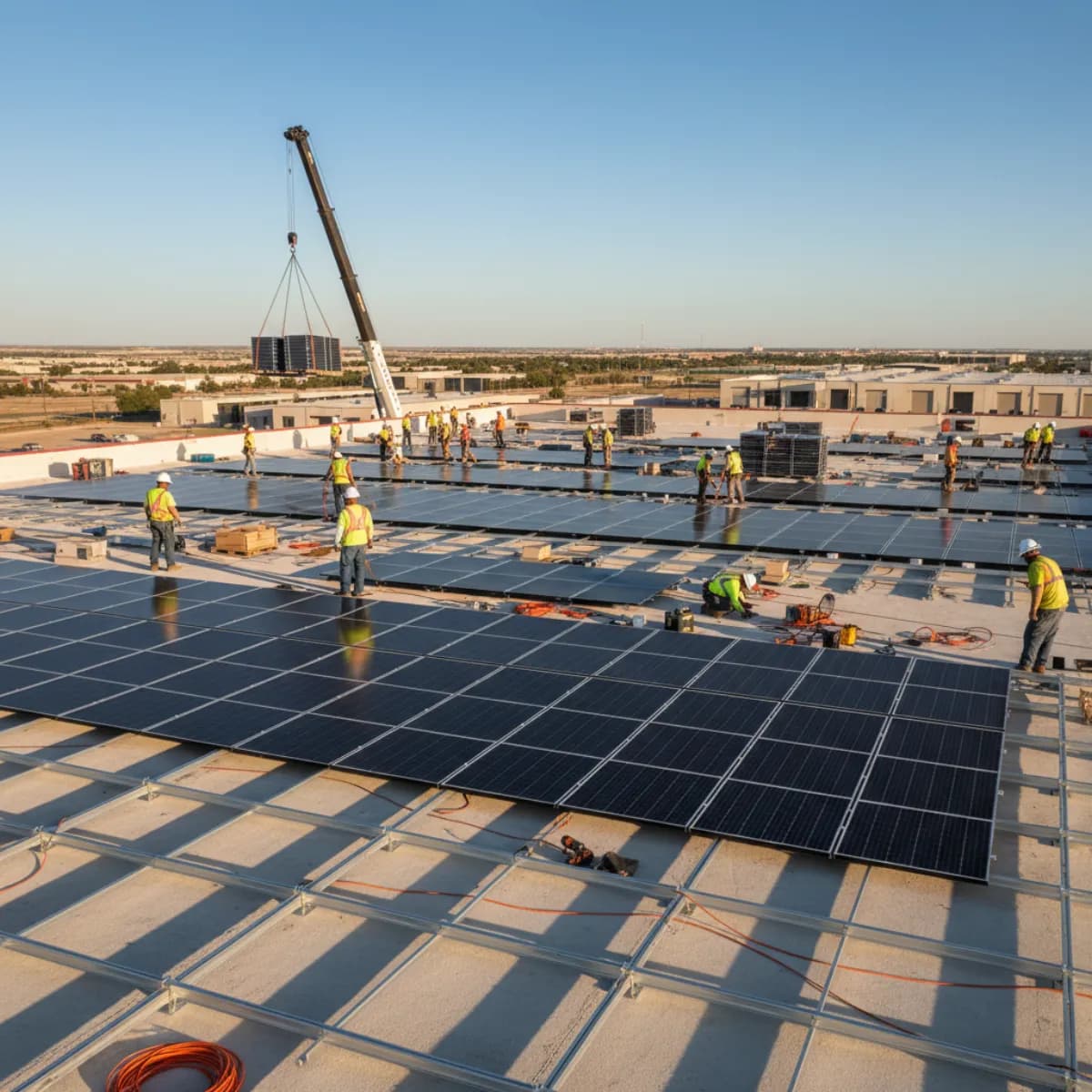
A commercial solar installation in progress on a TX warehouse. Texas construction proceeds year-round with no winter delays.
Every commercial solar project in Texas follows a predictable sequence of seven phases. While the durations vary by project size, TDU territory, and site complexity, the order remains consistent. Texas eliminates the separate state incentive application phase that NE states require (such as SMART in Massachusetts or RCSA in Connecticut), streamlining the overall process.
Initial site visit, roof/ground survey, shading analysis, structural assessment, and preliminary financial modeling. TX buildings often feature large, unshaded flat roofs ideal for solar.
Detailed engineering drawings, electrical single-line diagrams, structural calculations, and equipment specifications. TX projects benefit from standardized building types.
Building and electrical permits. TX cities have solar-friendly regulations with no historical district delays common in NE states. Many cities offer online permitting.
Application to the local TDU (Oncor, CenterPoint, or AEP Texas). ERCOT DRRS registration required for systems exceeding 1 MW.
Order panels, inverters, racking, and electrical equipment. Lead times vary with tariff conditions and domestic content requirements.
Physical installation — year-round in TX with no winter shutdowns. Heat management required for summer crews. Hurricane season considerations for Gulf Coast.
Final municipal inspections, TDU witness test, meter installation, and permission to operate.
Every Texas commercial solar project begins with a comprehensive site assessment. An experienced solar engineer visits the property to evaluate roof condition, structural capacity, available area, electrical infrastructure, and shading. Texas commercial buildings offer distinct advantages during this phase — the state's building stock is heavily weighted toward single-story warehouses, strip malls, and big-box retail stores with large, unobstructed flat roofs. These properties often have 20,000-100,000+ square feet of roof area with minimal HVAC penetrations and no parapet shading issues.
The feasibility analysis includes a detailed review of your commercial electric bills — at least 12 months of data including energy charges, demand charges, and any 4CP (four coincident peak) charges from ERCOT that affect transmission costs. Texas commercial electricity rates range from $0.06 to $0.11 per kWh depending on market conditions and REP (Retail Electric Provider) contract terms, with an average around $0.098/kWh. The financial pro forma models ITC value (30-50%), MACRS depreciation (federal only — Texas has no state income tax), energy savings, and payback period.
For Gulf Coast properties, the site assessment also evaluates hail zone classification and hurricane wind exposure. These factors affect panel selection (hail-rated Class 3 or 4 panels may be recommended) and structural design requirements. See our Commercial Solar IRR Calculator for detailed financial modeling specific to TX projects.
Once the feasibility assessment confirms a viable project, the engineering team produces detailed construction documents. These include PE-stamped structural calculations, electrical single-line diagrams, and a detailed panel layout optimizing production while meeting code requirements. Texas designs must account for high ambient temperatures (panel derating can reduce output by 10-15% during peak summer) and, for Gulf Coast installations, enhanced wind loading per ASCE 7 wind speed maps.
For projects exceeding 1 MW, the engineering phase also includes prevailing wage and apprenticeship compliance documentation required to maintain the full 30% ITC base rate. The design must account for NEC 2020 rapid shutdown requirements, local fire department setback rules, and TDU-specific interconnection requirements. Equipment selection is finalized during this phase, with particular attention to hail rating for TX applications — IEC 61215 testing with 35mm or 45mm hailstone impact resistance is strongly recommended for hail-prone regions like DFW and Central Texas.
Permitting is where Texas commercial solar projects gain the most significant timeline advantage over Northeast states. Texas cities have embraced solar-friendly regulations, and the permitting process is straightforward: building permit, electrical permit, and fire department review. There are no historical district reviews, no conservation commission approvals for rooftop systems, and zoning is generally permissive for commercial solar.
Major Texas cities have invested in online permitting portals that significantly accelerate the process. Austin's Development Services Department processes commercial solar permits in 10-15 business days. Dallas Building Inspection Division takes 10-14 business days through their Posse PLS online system. Houston Public Works processes permits in 15-20 business days through HoustonPermits.org. These timelines are a fraction of the 4-12 weeks typical in Northeast municipalities.
The key strategy is to submit complete, accurate permit packages the first time. Incomplete applications are the most common cause of permitting delays in any jurisdiction. Work with your solar developer to ensure all PE-stamped drawings, structural calculations, and electrical diagrams are included with the initial submission.
Utility interconnection in Texas works differently from NE states because of the deregulated ERCOT market structure. Instead of applying to a single investor-owned utility, you apply to your local Transmission and Distribution Utility (TDU) — Oncor (DFW and Central TX), CenterPoint (Houston metro), AEP Texas (South TX), or TNMP (various areas). The TDU owns the wires and handles the physical interconnection, while your Retail Electric Provider (REP) handles billing and buyback plans.
For systems under the TDU's screening threshold (typically 25-50 kW), a simplified interconnection process takes 3-6 weeks. Larger systems require a detailed distribution impact study that evaluates transformer capacity, voltage regulation, and fault current contribution. This detailed study adds 3-6 additional weeks. If infrastructure upgrades are identified, the timeline extends further — though TX distribution infrastructure is generally newer and more robust than NE, making major upgrades less common.
Systems exceeding 1 MW must also register with ERCOT through the Distributed Resource Registration System (DRRS). This is a parallel process that can add 3-8 weeks. For large commercial projects considering wholesale market participation, coordination with a Qualified Scheduling Entity (QSE) is required. Municipal utility territories (Austin Energy, CPS Energy in San Antonio) handle interconnection directly through the municipal utility rather than through a TDU.
Texas's year-round construction capability is a major timeline advantage. While Northeast states lose 3-4 months of productive construction time from November through February due to snow, ice, and short daylight hours, Texas crews work throughout winter. December and January in most of Texas feature mild temperatures (50-65F) that are actually ideal for outdoor construction work — more comfortable than the extreme summer heat that can require crew rest breaks and hydration protocols.
The primary construction concern in Texas is hurricane season (June-November) for Gulf Coast projects. Tropical storms and hurricanes can shut down outdoor work for days or weeks. For Houston, Corpus Christi, and Beaumont-area projects, experienced developers schedule construction to avoid peak hurricane season (August-October) or build buffer time into the schedule. Interior TX projects (DFW, Austin, San Antonio, Midland-Odessa) are not significantly affected by hurricanes, though severe thunderstorms with hail can temporarily halt work in spring and early summer.
Texas cities vary in their commercial solar permitting processes, but all are significantly faster than NE counterparts. The following timelines reflect current 2026 conditions for complete, accurate permit applications.
Austin Development Services Department. Online portal available. Austin Energy handles interconnection for municipal territory. Solar-ready roof requirements for new construction.
Houston Public Works Department. Online permitting through HoustonPermits.org. CenterPoint handles interconnection. No mandatory solar requirements but commercial energy benchmarking growing.
Dallas Building Inspection Division. Online portal via Posse PLS. Oncor handles interconnection. Dallas Climate Action Plan supports commercial solar adoption.
San Antonio Development Services. CPS Energy handles interconnection for municipal territory. Relatively straightforward process for commercial systems.
Fort Worth Development Services. Online permitting growing. Oncor territory for interconnection. Generally solar-friendly regulations.
El Paso Development Services. El Paso Electric handles interconnection (non-ERCOT territory). Excellent solar resource with highest irradiance in TX.
Each Texas TDU has its own interconnection process, screening thresholds, and typical timelines. Understanding your TDU's process is critical for accurate project scheduling.
Simplified Review
3-6 weeks
Detailed Study
6-12 weeks
Study Threshold
>50 kW
Largest TDU in Texas. Streamlined process for systems under 50 kW. Detailed study required for larger systems. Online interconnection portal available.
Simplified Review
3-5 weeks
Detailed Study
5-10 weeks
Study Threshold
>50 kW
Generally faster processing than other TDUs. Houston metro has significant solar adoption driving process improvements. Hurricane hardening may be required for coastal facilities.
Simplified Review
4-6 weeks
Detailed Study
6-10 weeks
Study Threshold
>25 kW
South Texas territory. Lower screening threshold at 25 kW. Some areas qualify for energy community ITC bonus (+10%). Less congested distribution grid than urban TDUs.
Simplified Review
3-5 weeks
Detailed Study
5-8 weeks
Study Threshold
>25 kW
Texas-New Mexico Power. Smaller service territory. Generally shorter queues and faster processing. Some areas in West Texas with excellent solar resource.
Even in Texas, commercial solar projects can encounter delays. Knowing the most common sources — and their mitigation strategies — can save weeks on your timeline.
Oncor and CenterPoint interconnection queues can be backed up for larger commercial systems. Systems exceeding TDU screening thresholds (25-50 kW) require detailed engineering studies that add time.
Mitigation Strategy
Submit interconnection applications as early as possible. Consider sizing just under TDU screening thresholds where feasible. Work with an experienced interconnection consultant.
If the local distribution transformer cannot handle the solar export, the TDU may require an upgrade. Costs range from $10,000 to $100,000+ depending on scope. Less common in TX than NE due to newer infrastructure.
Mitigation Strategy
Run a pre-application screening with the TDU before finalizing system size. Consider battery storage or export limiting to avoid transformer triggers.
Gulf Coast projects (Houston, Corpus Christi, Galveston, Beaumont) face potential construction delays during active hurricane season. High winds may shut down crane operations and outdoor installation work.
Mitigation Strategy
Schedule construction to avoid peak hurricane season (August-October) for Gulf Coast projects. Ensure all equipment is properly secured during storm events. Have a hurricane preparedness plan.
Systems exceeding 1 MW must register with the ERCOT Distributed Resource Registration System. This is an additional step beyond TDU interconnection that requires coordination with ERCOT directly.
Mitigation Strategy
Begin ERCOT registration process concurrent with TDU interconnection application. Work with a Qualified Scheduling Entity (QSE) for systems participating in wholesale markets.
Tariff impacts and high demand can create equipment shortages, especially for US-manufactured panels needed for the domestic content ITC bonus and hail-rated panels for TX applications.
Mitigation Strategy
Place equipment orders early. Work with distributors who maintain buffer inventory. Consider multiple panel manufacturer options in the design phase.
Texas commercial solar projects in 2026 face federal timing milestones that directly affect project economics. Because Texas has no state income tax and no state-level solar incentive programs (unlike MA SMART or CT RCSA), the federal ITC and MACRS are the primary financial drivers. The key date is the Section 48/48E begin-construction milestone; MACRS bonus depreciation is now permanent and not tied to a year-end deadline.
A project that began construction on or before July 4, 2026 locked in the full Section 48/48E timing pathway (placed in service through roughly 2030). A project that begins construction after that date can still qualify for the ITC, but generally must be placed in service by December 31, 2027. The IRS recognizes two methods for establishing that construction has begun: (1) the Physical Work Test — physical work of a significant nature has begun at the project site, or (2) the 5% Safe Harbor — at least 5% of the total project cost has been paid or incurred. Most developers used the 5% safe harbor, which for a $300,000 system meant paying $15,000 to a qualified equipment supplier on or before July 4, 2026. Either pathway preserves the full 30% base ITC plus any applicable bonus adders (domestic content +10%, energy community +10%, low-income +10-20%).
Under OBBBA (IRC §168(k), IRS Notice 2026-11), 100% first-year bonus depreciation is permanently restored for solar property placed in service after January 19, 2025 — there is no year-end MACRS deadline. For a $300,000 commercial solar system with a 30% ITC, the depreciable basis is approximately $255,000. With 100% bonus, the entire $255,000 is deducted in Year 1, worth approximately $53,550 in federal tax savings at the 21% corporate rate. A business may instead elect the regular 5-year schedule. Note: Texas has no state income tax, so MACRS benefits are federal only — but still substantial.
With the July 4, 2026 begin-construction window now closed, the operative federal timing target for new TX projects is the December 31, 2027 placed-in-service deadline, and the 4-12 month TX project timeline leaves comfortable runway to reach it. The faster TX permitting (2-4 weeks vs. 4-12 weeks in NE) and year-round construction provide additional buffer. Even a mid-size 200 kW system can move from start to PTO in a matter of months with good execution. For detailed ROI analysis, use our Commercial Solar IRR Calculator.
Cost Range
$1.80-$2.20/W
Interconnection
Simplified (3-6 weeks)
Construction
4-6 weeks
Most straightforward projects. Usually qualify for simplified interconnection. Standard rooftop permitting. Equipment readily available. Typical buildings: retail stores, small offices, restaurants.
Cost Range
$1.40-$1.70/W
Interconnection
Detailed study likely (5-10 weeks)
Construction
6-8 weeks
Detailed interconnection study often required. May require transformer assessment. Larger permitting packages. Equipment procurement takes longer for domestic content panels. Typical buildings: warehouses, office parks, schools.
Cost Range
$1.10-$1.35/W
Interconnection
Detailed study + ERCOT DRRS for >1MW (8-16 weeks)
Construction
8-10 weeks
Complex interconnection with potential infrastructure upgrades. ERCOT registration required for >1 MW. Prevailing wage compliance mandatory for >1 MW to maintain 30% ITC. Ground-mount possible for facilities with land. Typical: industrial facilities, distribution centers.
The best strategy for accelerating your Texas commercial solar project is running independent phases in parallel. Texas is uniquely suited for this because the permitting timeline is short enough that permits often arrive before interconnection approval, and equipment can be ordered concurrently.
By running phases in parallel, a 10-month sequential timeline for a mid-size TX project can be compressed to 6-7 months. Combined with the inherent TX speed advantages (fast permitting, year-round construction), this means Texas commercial solar projects consistently achieve PTO faster than comparable NE projects.
A typical TX commercial solar project takes 4-12 months from initial site assessment to permission to operate (PTO). Small systems (25-100 kW) on straightforward sites can be completed in 4-6 months. Mid-size projects (100-500 kW) typically take 6-9 months. Large-scale projects (500 kW+) or those requiring TDU infrastructure upgrades can take 9-12 months. Texas timelines are significantly faster than Northeast states due to streamlined permitting, no historical district delays, and year-round construction capability.
Our team manages the entire timeline — from site assessment through PTO. Start now to hit the December 31, 2027 placed-in-service deadline for new §48E projects and capture 100% MACRS bonus depreciation.