Loading NuWatt Energy...

We use your location to provide localized solar offers and incentives.
We serve MA, NH, CT, RI, ME, VT, NJ, PA, and TX
Loading NuWatt Energy...
NuWatt designs, installs, and manages solar, battery, heat pump, and EV charger systems across 9 states. One company, one warranty, one point of contact.
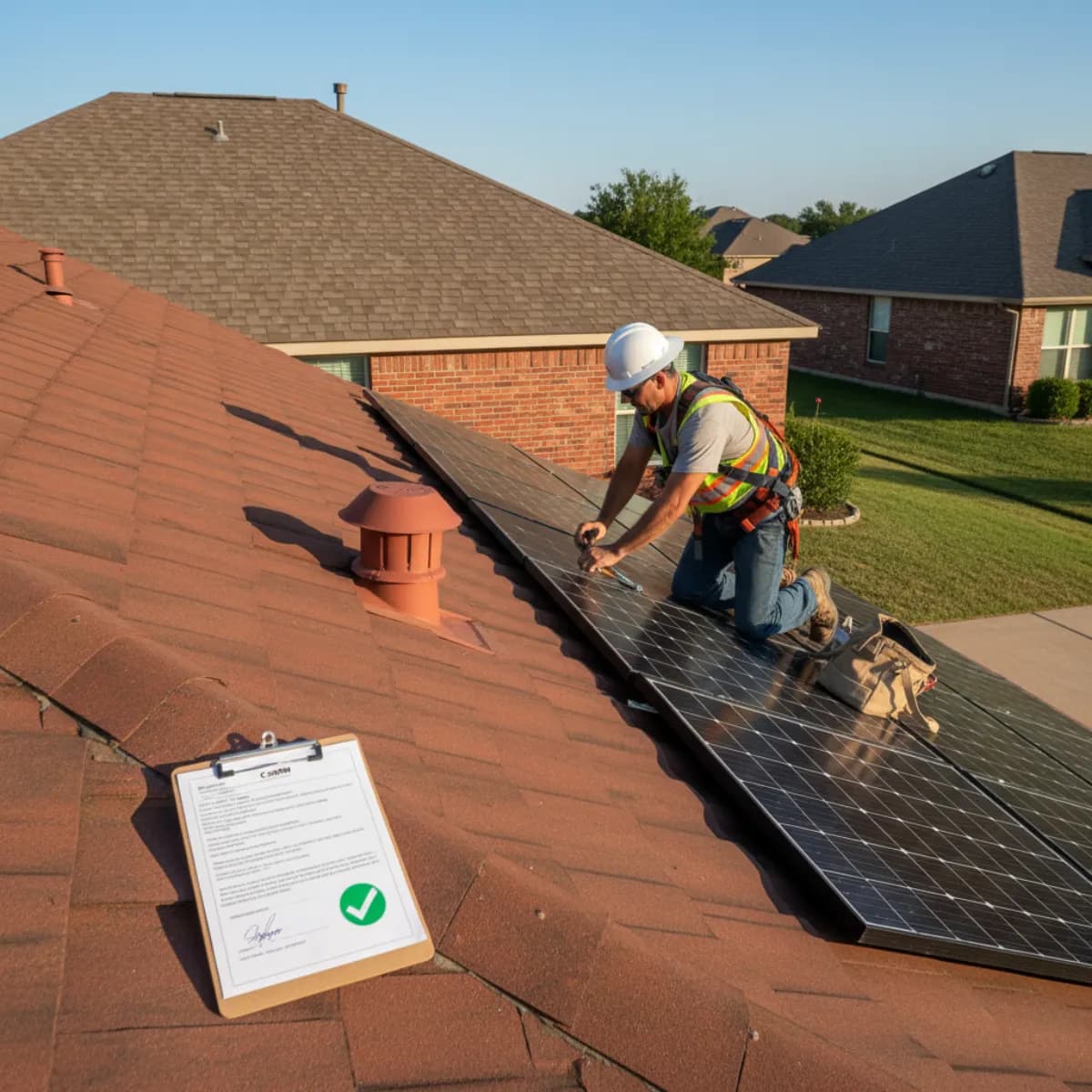
Get a Free QuoteBefore SB 1202, getting a solar permit in Texas could take 2 to 6 weeks depending on which city you lived in. Some municipalities had multi-month backlogs. SB 1202, effective September 1, 2025, allows licensed engineers and third-party reviewers to approve solar and DER permits — with a mandatory 2-business-day issuance requirement. No inspection fees allowed.
2 Days
Max Permit Time
$0
Inspection Fees
85%
Faster Permitting
Sept 2025
Effective Date
Federal Tax Credit Update 2026: The Section 25D residential clean energy credit expired December 31, 2025. Homeowners installing solar in 2026 receive $0 in federal tax credits. SB 1202 helps offset this by reducing permitting soft costs by $300-$1,500 per project. Third-party-owned systems (leases/PPAs) may still access Section 48/48E.
SB 1202 fundamentally restructures how solar and DER permits are processed in Texas by shifting technical review from overburdened city departments to licensed professionals.
Texas has over 1,200 municipalities and 254 counties, each with its own building department and permitting process. Solar permitting was a patchwork: Austin might process a permit in 5 business days, while a smaller city with one plan reviewer could take 6 weeks. Some rural counties had no established solar permitting process at all.
The National Renewable Energy Laboratory (NREL) has documented that permitting and inspection represent a significant component of residential solar "soft costs" — the non-hardware expenses that make up roughly 60% of total system cost. Slow permitting directly increases these soft costs through carrying costs, scheduling inefficiency, and multiple truck rolls.
With Texas installing more residential solar than any state except California, the permitting bottleneck was increasingly untenable. SB 1202 is the legislative solution.
SB 1202 creates a parallel permitting pathway. Instead of submitting plans to a city building department and waiting for their staff to review, solar installers can engage a licensed professional engineer (P.E.) or qualified third-party plan reviewer to perform the technical review.
The P.E. verifies code compliance, structural adequacy, and electrical safety — the same work a city plan reviewer would do, but without the multi-week queue. Once the P.E. approves the plans, the installer submits the application with the P.E. approval, and the regulatory authority must issue the permit within 2 business days.
This is not a voluntary program — the 2-day timeline is a legal mandate. Municipalities cannot refuse to accept third-party-reviewed applications or impose longer review periods once the P.E. approval is attached.
SB 1202 was passed during the 89th Texas Legislature and signed into law with an effective date of September 1, 2025. It builds on the momentum of SB 1252 (battery permitting standardization) and SB 1036 (solar consumer protection) from the 88th Legislature, collectively creating the most installer-friendly regulatory environment in Texas history for distributed energy resources.
Four core provisions transform the solar permitting landscape across Texas.
Licensed professional engineers (P.E.) and qualified third-party reviewers can approve solar and DER permit applications, bypassing traditional municipal plan review. This eliminates the bottleneck of understaffed city building departments.
When a third-party reviewer is used, the permit must be issued within 2 business days of application submittal. This is the fastest mandatory solar permitting timeline in any US state.
SB 1202 prohibits regulatory authorities from charging inspection-related fees for DER permit reviews. This eliminates the $150-$500+ solar-specific inspection fees that some Texas cities had been charging.
The law covers all distributed energy resources (DER) — not just solar panels. Battery storage systems, inverters, and all electrical equipment operating at or below 600 volts are included in the streamlined pathway.
Does not eliminate the permit requirement — permits are still required
Does not address utility interconnection timelines (still 2-6 weeks)
Does not override HOA solar restrictions (separate law: Property Code 202.010)
Does not waive standard building permit application fees (only inspection fees)
A side-by-side comparison of solar permitting in Texas before and after SB 1202.
| Category | Before SB 1202 | After SB 1202 |
|---|---|---|
| Permit Review Time | 2 to 6 weeks depending on municipality. Some cities had multi-month backlogs. | 2 business days maximum when using a licensed engineer or third-party reviewer. |
| Who Reviews | Municipal building department staff — often understaffed and unfamiliar with solar. | Licensed professional engineers (P.E.) and qualified third-party plan reviewers. |
| Inspection Fees | Cities charged $150-$500+ for solar-specific inspection fees on top of standard permit costs. | No inspection-related fees allowed for DER permit reviews under SB 1202. |
| Technology Scope | Only solar PV was sometimes fast-tracked. Batteries and other DER required separate reviews. | Covers all distributed energy resources: solar PV, battery storage, and equipment under 600V. |
| Rural Counties | Some rural jurisdictions had no established solar permitting process at all. | Third-party review pathway available statewide, bypassing local capacity limitations. |
| Total Soft Cost Impact | Permitting delays added $500-$2,000 in soft costs per residential project (carrying costs, truck rolls, scheduling gaps). | Reduced soft costs by an estimated $300-$1,500 per project due to compressed timelines. |
85%
Average permit time reduction
From 15-30 business days to 2 business days
$300 - $1,500
Soft cost savings per project
Eliminated carrying costs, reduced truck rolls
2-3 weeks
Installation timeline reduction
Total contract-to-PTO compressed significantly
$150 - $500+
Fee elimination
No more solar-specific inspection fees
Here is how SB 1202 compresses the entire solar installation timeline from contract to permission to operate (PTO).
Total: 6-12 weeks typical
Total: 3-6 weeks typical
SB 1202 does not address utility interconnection timelines. After installation and final inspection, you still need your transmission and distribution utility (TDU) — Oncor, CenterPoint, AEP Texas, TNMP — to install a bidirectional meter and grant permission to operate (PTO). This process takes 2-6 weeks depending on the utility. Interconnection reform remains an industry priority for future legislative sessions.
If you are considering solar in 2026, SB 1202 directly benefits you in three ways.
The single biggest frustration for Texas homeowners going solar was waiting. You sign a contract, you are excited, and then... nothing happens for weeks while the permit sits in a city queue. SB 1202 eliminates that dead time. Your solar panels get on your roof 2-3 weeks faster than before, which means you start saving on electricity sooner.
For a homeowner paying 14 cents/kWh with a 10 kW system producing 1,500 kWh/kW annually, every month of delay costs approximately $175 in electricity that solar could have offset. Three weeks faster means roughly $130 in avoided electricity costs just from the accelerated timeline.
Permitting delays create real costs that get passed to homeowners. When an installer has crews sitting idle waiting for permits, those carrying costs get baked into pricing. When a truck has to roll to a job site three times instead of once because of scheduling gaps, the homeowner pays for that inefficiency.
SB 1202 eliminates inspection-specific fees ($150-$500+ in some cities) and reduces overall soft costs by an estimated $300-$1,500 per residential project. In a post-ITC world where every dollar matters, this is meaningful. On a $25,000 system, $1,000 in soft cost savings represents a 4% price reduction.
Before SB 1202, your solar experience depended heavily on where you lived. A homeowner in a well-staffed city like Austin had a fundamentally different (and faster) permitting experience than someone in a smaller municipality or unincorporated county area with limited building department resources.
SB 1202 equalizes the experience. The third-party review pathway is available statewide, which means a homeowner in a rural Texas county gets the same 2-day permitting access as someone in downtown Houston. This is especially impactful for the 3+ million Texans living in unincorporated areas.
For solar companies operating in Texas, SB 1202 transforms operational efficiency and competitive positioning.
With 2-day permitting, installers can confidently schedule crew deployment within days of contract signing instead of hedging against multi-week permit delays. This reduces crew idle time by an estimated 15-25% and allows more installations per crew per month.
Fewer truck rolls, less administrative follow-up with city offices, and eliminated permit tracking labor. Installers report saving 2-4 staff hours per project on permit management alone, which translates to significant overhead reduction across hundreds of annual installations.
Lower soft costs allow installers to sharpen pricing without sacrificing margins. In a post-ITC market where price sensitivity is at an all-time high, the ability to pass through even $500-$1,000 in soft cost savings gives SB 1202-optimized installers a meaningful edge.
Instead of maintaining different permitting playbooks for every municipality, installers can use a single third-party review pathway across all Texas jurisdictions. This simplifies operations for companies that serve multiple metro areas and rural territories.
NuWatt was among the first Texas installers to integrate the SB 1202 third-party review pathway into our standard workflow. Here is what that means for your project.
Our P.E. partnership network reviews plans the same day we submit. Most permits are issued within 1-2 business days — often beating the 2-day legal maximum.
With the permitting bottleneck eliminated, our average contract-to-installation timeline is now 7-14 days for standard residential projects across Texas.
We pass the soft cost savings through to homeowners. Our SB 1202-optimized pricing reflects the real cost reductions from streamlined permitting.
NuWatt uses the SB 1202 third-party review pathway in every Texas jurisdiction we serve — from the DFW Metroplex and Houston metro to San Antonio, Austin, and rural areas. The statewide consistency of SB 1202 means we deliver the same fast permitting experience regardless of your location. Call (877) 772-6357 to get started.
Research
You just did this
Calculate
See your savings
Save
Lock in your price
SB 1202 cleared the permitting bottleneck. See how much you can save with solar — get a personalized quote for your Texas address.
Get My Free Solar QuoteTalk to an expertNo credit card required. 100% free. Takes about 2 minutes.
Everything Texas homeowners and solar professionals ask about SB 1202 and the new 2-day permitting pathway.
SB 1202 is a Texas law passed during the 89th Legislature that streamlines solar and distributed energy resource (DER) permitting. It allows licensed professional engineers and qualified third-party reviewers to approve solar permit applications, with a mandatory 2-business-day permit issuance timeline. The law took effect September 1, 2025, and applies to all solar and DER installations across Texas.
Yes. SB 1202 covers all distributed energy resources (DER), not just solar panels. This includes battery energy storage systems, inverters, and all electrical equipment operating at or below 600 volts. If you are installing a solar + battery system, both components benefit from the streamlined 2-day permitting pathway. This complements SB 1252, which separately standardized battery permitting statewide.
When a solar installer submits a permit application through a licensed professional engineer (P.E.) or qualified third-party plan reviewer, the regulatory authority must issue the permit within 2 business days of receiving the complete application. The P.E. or third-party reviewer performs the technical plan review — not the city building department — which eliminates the traditional multi-week municipal review backlog. If the application is complete and code-compliant, the city issues the permit based on the third-party review.
Cities can still charge standard building permit fees (typically $50-$200), but SB 1202 specifically prohibits inspection-related fees for DER installations. This eliminates the $150-$500+ solar-specific inspection surcharges that some Texas municipalities had been imposing. The net effect is a meaningful reduction in total permitting costs for homeowners.
No. SB 1202 addresses government permitting processes — not private HOA covenants. HOA solar protections in Texas are governed by Texas Property Code Section 202.010, which prevents HOAs from completely banning solar panels but allows reasonable aesthetic restrictions. SB 1202 and Property Code 202.010 are separate laws that work together to protect solar rights from both government and HOA barriers.
Yes. SB 1202 does not eliminate the permit requirement — it streamlines the review process. You still need a building/electrical permit for solar and battery installations. The difference is that instead of waiting 2-6 weeks for a municipal plan reviewer to evaluate your application, a licensed P.E. or third-party reviewer can approve it in 1-2 days, and the city must issue the permit within 2 business days of that approval.
SB 1202 compresses the total installation timeline by approximately 2-3 weeks. Before the law, permitting was the single largest bottleneck in the residential solar installation process — often taking longer than the physical installation itself. With 2-day permitting, a typical residential project now goes from contract signing to installation in 1-2 weeks instead of 4-6 weeks. The only remaining timeline variable is utility interconnection, which SB 1202 does not address.
No. The Section 25D residential clean energy credit expired December 31, 2025, under the One Big Beautiful Bill Act (OBBBA). Homeowners installing solar in 2026 receive $0 in federal tax credits. However, third-party-owned systems accessed through leases or PPAs may still benefit from the Section 48/48E commercial ITC if the financing company begins construction before applicable deadlines. SB 1202 helps offset this loss by reducing permitting soft costs.
Explore more guides on Texas solar installation, costs, and timelines.
Complete step-by-step timeline guide
Current pricing and payback analysis
How to choose a quality installer
Companion law for battery permitting
Know your rights under TX solar law
Complete guide to solar in Texas
SB 1202 eliminated the permitting bottleneck that frustrated Texas homeowners for years. Get a free quote and see how quickly NuWatt can get solar on your roof.
Call (877) 772-6357 for a free consultation
Last updated: April 2026
Sources: Texas SB 1202 (89th Legislature), NREL soft cost research, PUCT, Texas building code