Loading NuWatt Energy...

We use your location to provide localized solar offers and incentives.
We serve MA, NH, CT, RI, ME, VT, NJ, PA, and TX
Loading NuWatt Energy...
NuWatt designs, installs, and manages solar, battery, heat pump, and EV charger systems across 9 states. One company, one warranty, one point of contact.
Get a Free QuoteTexas adopts the 2015 IECC for commercial buildings — with local amendments in Austin, Dallas, and other cities. No statewide solar mandate. Solar helps meet code through the performance path. Understand how TX energy codes affect your commercial solar project and how solar improves code compliance.
Statewide Code
IECC 2015
Commercial minimum
Solar Mandate
None
Voluntary incentives
Property Tax
100% Exempt
TX Tax Code 11.27
Local Amendments
Austin, Dallas
Solar-ready + benchmarking
No. Texas does not have a statewide mandate requiring solar on commercial buildings. The state adopts the 2015 IECC as its minimum commercial energy code, which does not include solar requirements. However, some cities have local amendments: Austin requires solar-ready roofs on new commercial construction, and Dallas has a commercial energy benchmarking ordinance for buildings over 50,000 sq ft. Solar can help meet energy code through the IECC performance path (Section C407), where on-site generation offsets building energy consumption. Texas relies on economic incentives (30% ITC, MACRS, 100% property tax exemption) rather than mandates to drive commercial solar adoption.
Texas energy code compliance for commercial buildings operates on a two-tier system: a statewide minimum code and optional local amendments. The statewide minimum is the 2015 International Energy Conservation Code (IECC), which establishes baseline requirements for building envelope, HVAC systems, lighting, and electrical power. This code has been in effect since 2016 and is notably older than the codes adopted by many other states — particularly Northeast states that have moved to the 2021 or 2024 IECC.
Texas municipalities have the authority to adopt local amendments that exceed the statewide minimum, and several major cities have done so. Austin leads with solar-ready roof requirements and comprehensive green building programs. Dallas has implemented commercial energy benchmarking for large buildings. Houston, despite being the state's largest city, follows the statewide minimum without significant solar-related amendments. This patchwork approach means commercial solar requirements vary significantly depending on where in Texas your building is located.
The Texas approach is fundamentally different from states that mandate solar installations. California's Title 24 requires solar on most new commercial buildings. Massachusetts and Connecticut stretch energy codes include increasingly stringent efficiency and renewable energy requirements. Texas instead relies on economic incentives — the 30% federal ITC, MACRS depreciation, 100% property tax exemption (TX Tax Code Section 11.27), and competitive market economics — to drive voluntary commercial solar adoption. This approach results in lower regulatory compliance costs but also less regulatory push toward solar.
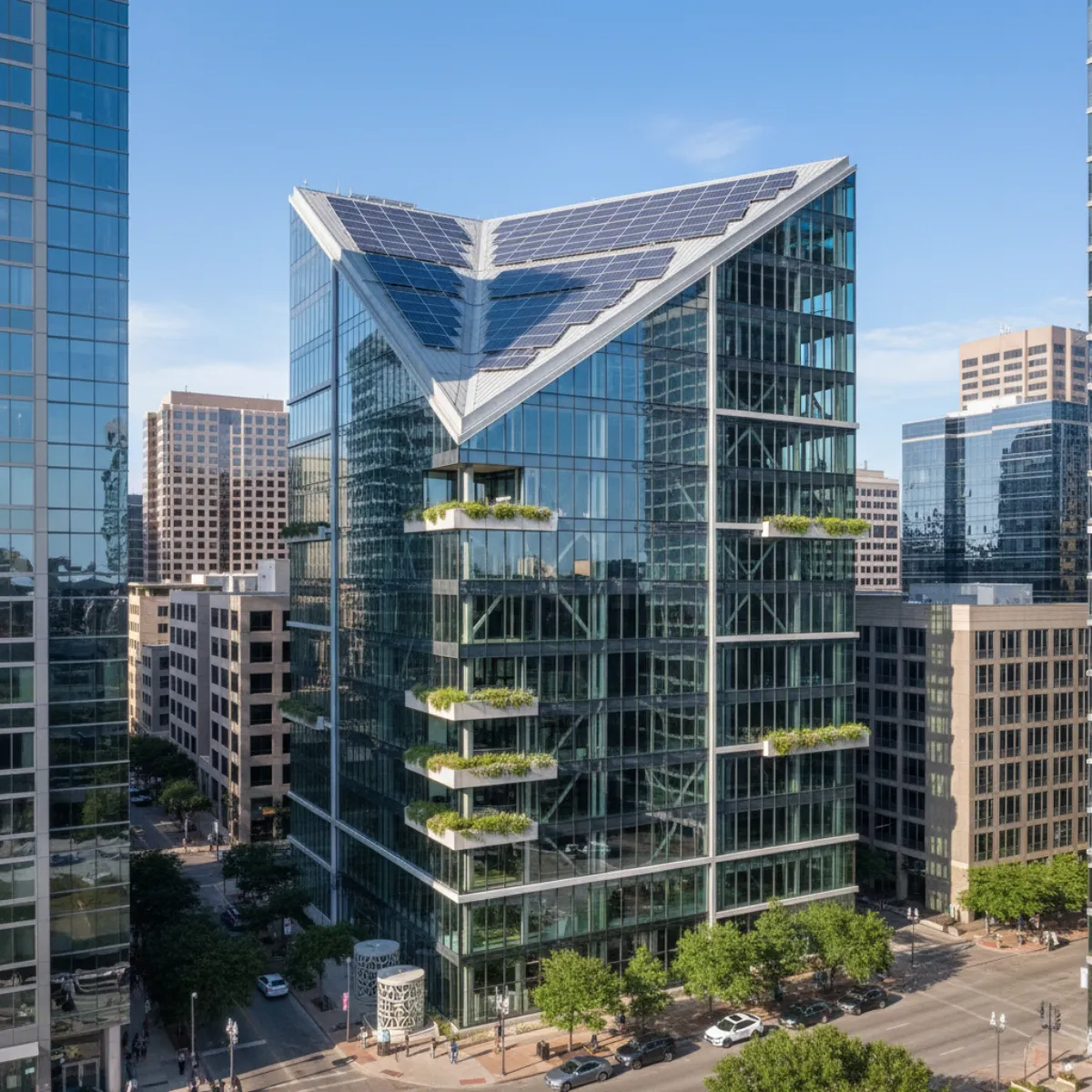
TX commercial solar installations are market-driven rather than code-mandated, supported by strong federal incentives and the state property tax exemption.
Texas energy code adoption has moved more slowly than many states. Understanding this history provides context for where the code stands today and where it may go.
Texas adopts IECC 2000 as statewide minimum energy code
Commercial code updated to IECC 2009
Commercial code updated to IECC 2015 (current statewide minimum)
Attempted update to IECC 2021 stalled in legislature
HB 3215 maintains IECC 2015 as commercial minimum; cities can adopt more stringent codes
Austin, Dallas adopt local amendments with solar-ready and sustainability provisions
Each major Texas city has its own approach to energy codes and solar. Some have adopted local amendments with solar-ready provisions; others follow the statewide minimum with no solar-specific requirements.
IECC 2015 with local amendments
Solar-ready roof required for new commercial construction. Austin Energy Green Building Program offers incentive tiers for solar inclusion. Austin Climate Equity Plan targets 100% renewable by 2035.
Key Provisions
Solar Impact Assessment
Strong — Austin has the most progressive solar requirements in TX. New commercial buildings must be solar-ready, reducing future retrofit costs by $5,000-$15,000.
IECC 2015 with Dallas amendments
No mandatory solar, but Dallas Comprehensive Environmental & Climate Action Plan (CECAP) sets aggressive emissions reduction targets. Commercial energy benchmarking ordinance requires annual energy reporting for large buildings.
Key Provisions
Solar Impact Assessment
Moderate — No mandates, but benchmarking ordinance and sustainability goals drive voluntary commercial solar adoption.
IECC 2015 (no significant amendments)
No mandatory solar requirements. Houston Climate Action Plan targets carbon neutrality by 2050, but implementation through voluntary measures rather than mandates. Growing commercial energy benchmarking.
Key Provisions
Solar Impact Assessment
Low regulatory impact — Houston takes a market-driven approach. Commercial solar adoption driven by economics rather than code requirements.
IECC 2015 with CPS Energy amendments
CPS Energy sustainability goals include expanding distributed solar. SA Climate Action & Adaptation Plan (CAAP) targets carbon neutrality by 2050. No mandatory commercial solar requirements.
Key Provisions
Solar Impact Assessment
Low-moderate — Voluntary incentives rather than mandates. CPS Energy low buyback rate limits oversizing potential.
IECC 2015 (minimal amendments)
No mandatory solar requirements. Fort Worth follows statewide minimum code. Climate action planning in early stages.
Key Provisions
Solar Impact Assessment
Low — No regulatory drivers. Commercial solar adoption purely economics-driven.
While Texas does not mandate solar, commercial solar can play a strategic role in energy code compliance through the performance path. Understanding the three compliance paths helps developers and building owners leverage solar as a code compliance tool and reduce the cost of meeting energy requirements.
Meet specific minimum requirements for envelope, HVAC, lighting, and power. This is the standard approach and does not directly require or credit solar energy. Buildings must meet all prescriptive component requirements.
Role of Solar
Solar is not required and does not help meet prescriptive requirements. Each building component must independently meet the code minimum. However, solar can be installed alongside prescriptive-compliant buildings for additional savings.
Demonstrate that the proposed building uses equal or less energy than a baseline code-compliant building using whole-building energy simulation (typically EnergyPlus or eQUEST). This path allows tradeoffs between building components.
Role of Solar
Solar energy directly reduces the modeled energy consumption, helping the building meet or exceed the performance target. On-site solar generation can compensate for building components that do not meet prescriptive requirements — for example, a building with less insulation can comply through the performance path by adding solar to offset the additional energy use.
Texas also accepts ASHRAE 90.1-2013 as an alternative to the IECC for commercial buildings. ASHRAE 90.1 has its own prescriptive and performance compliance paths with similar structure.
Role of Solar
ASHRAE 90.1 Section 10 (Other Equipment) and Appendix G (Performance Rating Method) both allow on-site renewable energy to contribute to compliance. Solar can offset calculated energy costs in the performance approach.
Texas and Northeast states represent fundamentally different philosophies for driving commercial solar adoption. Understanding these differences helps businesses and developers appreciate the Texas market dynamics and opportunities.
The Texas approach has advantages for commercial solar developers: lower regulatory compliance costs, faster permitting, and no mandate-driven market distortions. The disadvantage is less regulatory push, meaning commercial solar adoption depends entirely on economic viability and business owner initiative. In practice, the strong TX solar resource (1,500-1,700 kWh/kW), the 30% federal ITC, MACRS, and the 100% property tax exemption make commercial solar economically compelling without mandates.
For a detailed look at the commercial solar economics driving TX adoption, see our Commercial Solar in Texas 2026 guide. For information on the project timeline, see our Commercial Solar Project Timeline.
While Texas energy codes currently lag behind NE states, several trends suggest gradual tightening in the coming years. The state legislature has considered updating to the 2021 IECC, and major cities continue to adopt local amendments with sustainability provisions. Building Energy Performance Standards (BEPS) are being discussed, though adoption remains years away.
For commercial property owners, this outlook suggests that installing solar now positions your building ahead of future requirements. If BEPS are eventually adopted, buildings with existing solar installations will already be in compliance with reduced energy use intensity (EUI) targets. If the statewide code is updated to the 2021 or 2024 IECC, buildings with solar will more easily meet the performance path requirements.
More immediately, Section 48/48E timing matters more than any code requirement. A project that began construction on or before July 4, 2026 locked in the full ITC timing pathway (placed in service through roughly 2030); a project starting now can still qualify but generally must be placed in service by December 31, 2027. The 30% ITC (up to 70% with adders) plus 100% first-year MACRS bonus depreciation — now permanent under OBBBA — represent tens of thousands of dollars in tax benefits. Code compliance can be achieved at any time, but the December 31, 2027 placed-in-service date is now the key timing constraint. See our Commercial Energy Audit & Solar Sizing Guide for sizing analysis.
Texas commercial buildings must comply with the 2015 International Energy Conservation Code (IECC) as the statewide minimum. Cities can adopt more stringent local amendments but cannot go below the 2015 IECC baseline. Austin has the most progressive local amendments including solar-ready requirements. Dallas has commercial energy benchmarking. Houston follows the statewide minimum with no significant solar-related amendments. The code applies to all new commercial construction and major renovations.
Our team helps you meet energy code through the performance path while capturing 2026 ITC and MACRS incentives.