
Loading NuWatt Energy...
We use your location to provide localized solar offers and incentives.
We serve MA, NH, CT, RI, ME, VT, NJ, PA, and TX
Loading NuWatt Energy...
NuWatt designs, installs, and manages solar, battery, heat pump, and EV charger systems across 9 states. One company, one warranty, one point of contact.
Get a Free Quote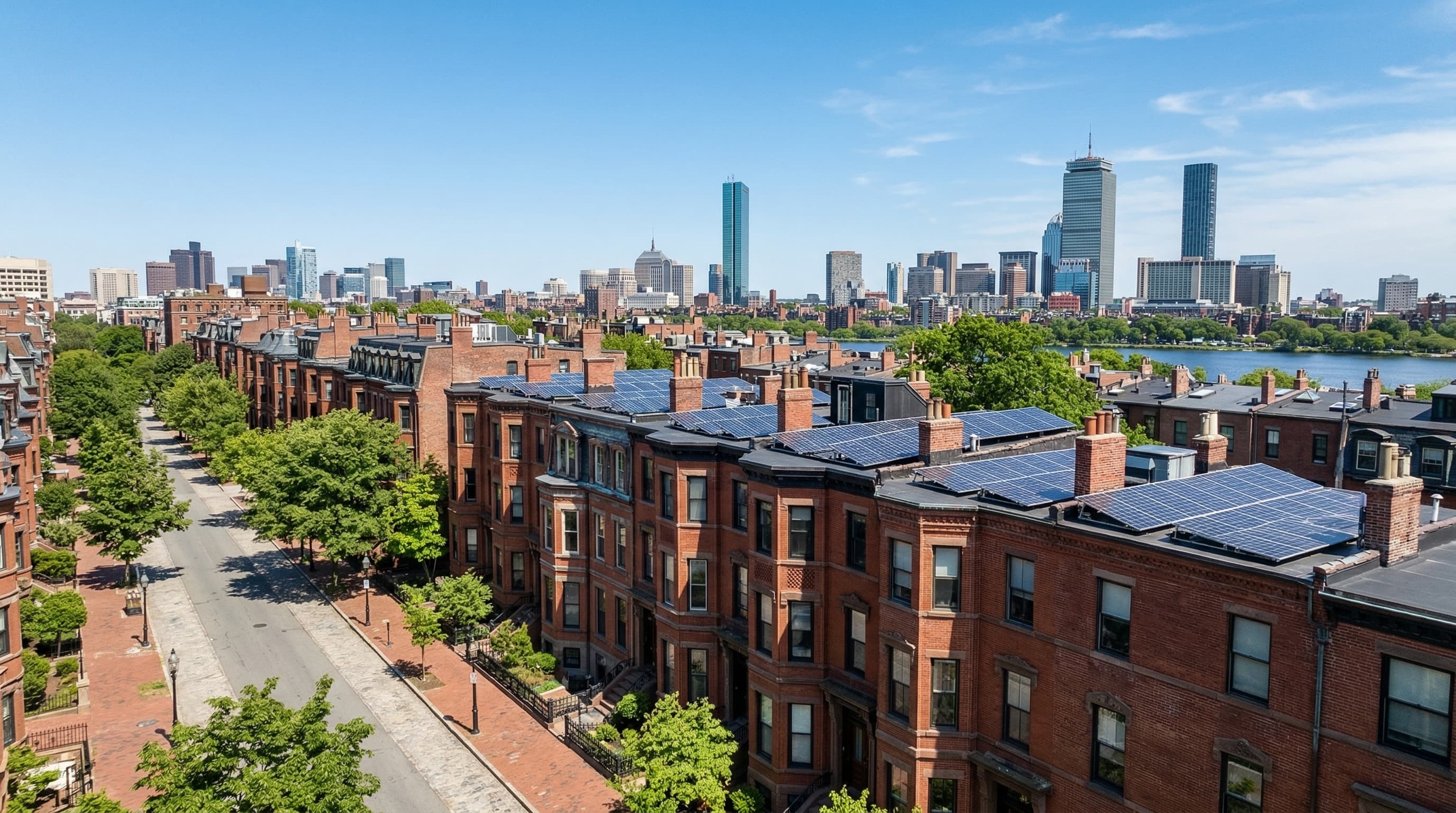
Boston is not like the suburbs. Triple-deckers, flat roofs, historic districts, narrow streets, and utility-specific programs make choosing the right solar installer critical. This guide covers the 7 criteria that matter most, Boston-specific installation challenges no other guide addresses, and the exact questions to ask before signing a contract.

Choose a Boston installer based on 7 criteria: SMART 3.0 enrollment expertise, ConnectedSolutions battery registration, Eversource/NGrid interconnection experience, urban installation capability (flat roofs, triple-deckers), historic district navigation, multi-family experience, and transparent pricing. Avoid any installer who references a 30% residential federal tax credit (expired Dec 31, 2025) or uses high-pressure door-to-door sales tactics. Get at least 3 quotes and compare cost per watt, not just total price.
Key certifications to verify: NABCEP PV Installation Professional certification (check at nabcep.org), MassCEC Solar Installer Directory listing (masscec.com), and BBB rating with complaint history (bbb.org). A qualified Boston-area installer should also have 5+ years in business, 100+ Massachusetts installations, and a 10+ year workmanship warranty.
Not all solar companies are created equal. In Greater Boston, where installations involve urban complexities that suburban installers rarely encounter, the difference between a good installer and a great one can mean thousands of dollars and months of delays. Here are the six traits that separate qualified Boston-area solar companies from the rest.
NABCEP (North American Board of Certified Energy Practitioners) is the gold standard certification for solar installers. A NABCEP-certified installer has passed a rigorous exam covering system design, code compliance, and safety practices. While not legally required in Massachusetts, it distinguishes serious professionals from fly-by-night operators.
Ask for the installer's NABCEP certification number and verify it at nabcep.org. A company should have at least one NABCEP PV Installation Professional on staff — ideally the person who will actually be on your roof.
Only ~15% of solar installers nationwide hold NABCEP certification
Industry standard
The Massachusetts Clean Energy Center maintains a list of approved solar installers who meet specific qualifications. Being listed with MassCEC means the company has submitted proof of licensing, insurance, bonding, and satisfactory track record.
Check the MassCEC Solar Installer Directory at masscec.com. Unlisted installers are not necessarily bad, but listing provides an additional layer of verification. MassCEC-listed installers are also eligible to participate in state programs that non-listed companies cannot.
200+ installers currently listed in MassCEC directory
Verified companies
The Better Business Bureau rating reflects a company's complaint resolution history, not customer satisfaction scores. An A+ rating means the company responds to and resolves complaints. More importantly, look at the complaint count and pattern — a company with 50 complaints that resolved all of them may be better than a company with 3 unresolved ones.
Search the company at bbb.org/us. Look for: (1) BBB rating (A+ to F), (2) number of complaints in the last 3 years, (3) whether complaints were resolved, and (4) customer review patterns. Also check Google reviews, Yelp, and the Massachusetts Attorney General consumer complaint database.
Check complaints filed in the last 3 years, not just the letter grade
Due diligence
Solar panels last 25-30 years. Your installer's warranty is only worth something if they are still in business when you need it. The solar industry has seen waves of companies enter during boom years and disappear during downturns. A company that has been installing in Greater Boston for 5+ years has weathered market cycles.
Look for: (1) How many years they have been doing business in Massachusetts specifically, (2) whether the ownership has changed (some companies are acquired by nationals and lose their local team), (3) whether they have an actual office in the Boston area (not just a P.O. box), and (4) how many total installations they have completed in your city/town.
5+ years in business is a reasonable baseline
Longevity indicator
Volume matters for several reasons. A company that has completed hundreds of installations in Massachusetts has navigated the permitting process in multiple towns, handled different utility territories, managed SMART enrollment at scale, and dealt with the full range of roof types. They have seen problems before and know how to solve them.
Ask how many installations they have completed in (1) Massachusetts total, (2) your specific city/town, and (3) on your specific roof type (flat, pitched, tile, slate, etc.). A company doing 100+ MA installations per year is operating at a scale where they have dedicated permitting and utility interconnection staff.
100+ MA installations per year indicates dedicated operations
Operational maturity
You should receive four separate warranties: panel manufacturer warranty (25-30 years), inverter warranty (12-25 years depending on brand), workmanship warranty from the installer (covers roof penetrations, wiring, mounting — 10-25 years), and racking warranty (25 years). The workmanship warranty is the most important because it is the only one from your installer, not a manufacturer.
The key distinction: manufacturer warranties cover defective equipment. Workmanship warranties cover installation quality — leaky roof penetrations, loose wiring, improper grounding, and racking failures. A 25-year workmanship warranty from a 5-year-old company is less valuable than a 10-year warranty from a 15-year-old company. Ask what happens to the workmanship warranty if the company is acquired or closes.
Insist on 10+ year workmanship warranty minimum
Protection baseline
Follow this systematic process to evaluate and compare solar installers in the Boston area. Each step builds on the previous one, helping you narrow down your options from a long list to a confident choice.
Visit nabcep.org and search for the company's certified professionals. NABCEP PV Installation Professional certification confirms the installer has passed a rigorous industry exam. At minimum, the company should have one NABCEP-certified person overseeing every installation. Ask for their certification number and verify it yourself.
Go to masscec.com and check the Solar Installer Directory. MassCEC-listed companies have submitted proof of MA electrical contractor license, general liability insurance ($1M+), workers compensation insurance, and a clean complaint history. This is not a guarantee of quality, but it is a minimum bar of legitimacy.
Search the company at bbb.org. Look beyond the letter grade — read actual complaint texts and see if the company responded professionally. Also check Google reviews (sort by "newest" to spot recent patterns), Yelp, and the MA Attorney General's consumer complaint database. A handful of complaints is normal for a busy company; a pattern of identical complaints is a warning.
Get quotes from 3-5 different installers including NuWatt. Each quote should show: system size (kW), number of panels, panel brand/model, inverter brand/model, total installed price, cost per watt, estimated annual production (kWh), SMART 3.0 enrollment details, net metering credit estimate, and payback period. Make sure all quotes are for the same system size so you can compare apples to apples.
Compare the specific panels, inverters, and batteries each installer offers. Look for Tier 1 panels (Silfab, REC, Q.CELLS, Canadian Solar, Hyundai) with 25-year warranties and degradation guarantees of 0.4-0.5% per year or better. For inverters, Enphase microinverters (IQ8+) or SolarEdge optimizers are industry standards. For batteries, Enphase IQ 10C, Tesla Powerwall 3, or Franklin aPower2 are top choices.
Get written warranty documentation from each installer. Compare workmanship warranty length (10-25 years), what it covers (roof penetrations, wiring, mounting), and what happens if the company is sold or closes. Manufacturer warranties are fairly standard across Tier 1 brands. The workmanship warranty is where installers differentiate themselves — it is the only warranty that covers the quality of the actual installation work.
Boston-area permitting timelines vary dramatically by municipality. Boston proper requires building permit, electrical permit, and fire department sign-off (2-3 weeks). Cambridge is streamlined with SolarApp+ (1-2 weeks). Some suburban towns take 4-6 weeks. Ask each installer: "What is your average permitting timeline in [your specific city/town]?" An experienced Boston-area installer should answer this immediately without checking.
Utility interconnection (connecting your system to the grid and getting Permission to Operate) is one of the most frustrating parts of going solar. Your installer should handle the entire process: filing the interconnection application, scheduling utility inspection, obtaining PTO, and enrolling you in net metering. Eversource and National Grid have different processes and timelines — an experienced installer knows both. Ask: "Do you handle interconnection through PTO, or is that my responsibility?"
NuWatt handles all 8 steps for you: we are NABCEP certified, MassCEC listed, A+ BBB rated, and provide transparent per-watt pricing with Tier 1 equipment. Get a free quote that includes SMART enrollment, ConnectedSolutions registration, all permitting, and full utility interconnection through PTO.
These are the Boston-specific criteria that separate qualified local installers from national companies that treat every market the same.
The SMART program adds $0.03/kWh for 20 years to your system value. Not every installer enrolls customers in SMART — some skip it because the paperwork takes effort. Your installer should handle SMART Statement of Qualification, enrollment, and tariff assignment as a standard part of every project. Ask: "How many SMART enrollments have you completed this year?"
Red flag: Installer does not mention SMART or says "you can do that yourself."
If you are adding a battery, your installer should register it with Eversource or National Grid ConnectedSolutions. This earns you $225-$275/kW per year in demand response revenue. Some installers install the battery but leave ConnectedSolutions enrollment to you — which means months of lost revenue while you figure out the paperwork.
Red flag: Installer sells batteries but does not mention ConnectedSolutions.
Boston metro is primarily Eversource territory, with National Grid serving some western suburbs. Each utility has different interconnection processes, timelines, and quirks. An experienced Boston-area installer knows the specific requirements, has relationships with utility interconnection teams, and can expedite PTO (Permission to Operate).
Red flag: Installer has never worked in your specific utility territory.
Boston presents unique installation challenges: flat roofs on brownstones, triple-decker multi-family buildings, narrow streets with limited truck access, street parking permits for equipment delivery, and historic district restrictions in Back Bay, Beacon Hill, South End, and Cambridge. A Boston-experienced installer knows how to handle all of these.
Red flag: Installer primarily works in suburbs and has few Boston metro projects.
Greater Boston has thousands of triple-deckers and multi-family properties in Somerville, Cambridge, Dorchester, Jamaica Plain, and surrounding neighborhoods. Solar on multi-family buildings requires understanding of virtual net metering, shared metering, and allocation of credits among units. Not every installer can handle this.
Red flag: Installer has no multi-family or triple-decker portfolio.
Back Bay, Beacon Hill, parts of Cambridge, Charlestown, and many suburban towns have historic commissions that review solar installations. Your installer should know which towns require review, what panels/mounting systems pass aesthetic requirements (typically all-black panels), and how to present to historic commissions. This can add 2-6 weeks if not handled properly.
Red flag: Installer is unfamiliar with your town historic commission process.
A good solar installer provides a clear, itemized quote with cost per watt, expected production, SMART income, net metering savings, and payback period — without the federal ITC (which expired December 31, 2025). Be wary of any installer who references a 30% federal tax credit for residential purchases — that has not existed since 2025.
Red flag: Installer quotes a 30% federal tax credit or refuses to provide per-watt pricing.
This is the content that competitors like directory sites and review platforms cannot provide. Boston has installation challenges unique to its geography, architecture, regulations, and urban density. A qualified installer navigates all of these — an unqualified one learns them at your expense.
Greater Boston has an estimated 15,000-20,000 triple-deckers, concentrated in Somerville, Cambridge, Dorchester, Jamaica Plain, Roxbury, Medford, and Malden.
Shared roof ownership: All three unit owners (or the building owner) must agree to the solar installation. This requires a written agreement on how electricity credits are split.
Virtual net metering (VNM) allows solar credits to be allocated across multiple utility accounts. Your installer must understand how to file a VNM allocation schedule with Eversource or National Grid.
Metering complexity: Each unit has its own electric meter. The solar system connects behind one meter and credits are distributed. Some triple-deckers have a common meter for hallways/basement — this needs to be accounted for.
Roof loading: Many triple-deckers have flat or low-slope roofs built in the early 1900s. A structural engineer assessment is essential to confirm the roof can support solar panel weight (3-4 lbs/sq ft for panels plus ballast weight on flat roofs).
Fire department access: Boston Fire requires a minimum 3-foot perimeter setback from all roof edges and a clear path to roof access points. On a triple-decker with a 20x40 ft roof, this can reduce usable area significantly.
Boston has 9 Local Historic Districts (LHDs) where the Boston Landmarks Commission (BLC) reviews exterior alterations including solar panels. Back Bay, Beacon Hill, Bay Village, Mission Hill, South End (parts), Charlestown, St. Botolph, Fort Point Channel, and Aberdeen Architectural Conservation District.
Beacon Hill is the most restrictive: solar panels are generally only approved on rear-facing roof surfaces not visible from any public way. Expect the approval process to take 4-8 weeks including a formal hearing.
Back Bay and South End typically approve all-black panels (black frames, black backsheets) on flat roofs where panels are not visible from street level. Silver-framed panels are usually rejected.
Cambridge has its own Historical Commission (CHC) separate from Boston. Mid-Cambridge and parts of Harvard Square require CHC review.
The approval process: Submit panel specifications, mounting details, visual simulations (showing how panels look from street level), and a site plan. Your installer should handle the entire submission and attend the hearing with you.
Tip: Some historic commissions fast-track solar applications if the installer has worked in the district before and knows the requirements. Ask your installer how many historic district installations they have completed.
Boston's narrow streets — especially in Charlestown, North End, South End, and Back Bay — create real logistical challenges for solar installation trucks and equipment.
Boom trucks (used to lift panels to the roof) require a clear overhead area and stable ground surface. On narrow residential streets, this often means temporarily blocking the road.
Your installer may need to obtain a street occupancy permit from the City of Boston Public Works Department. This can take 1-2 weeks and costs $25-$100 depending on duration.
Resident parking permits do not reserve spots for contractors. In high-density neighborhoods, your installer may need to coordinate arrival at early morning hours to secure loading access.
In some cases, panel delivery and roof staging happen on a separate day from installation to minimize street disruption. An experienced urban installer plans for this.
NuWatt tip: We survey every job site for access constraints during the initial site visit so there are no surprises on installation day. We handle all city permits.
Many neighborhoods south and west of downtown — Dorchester, Mattapan, Roxbury, Hyde Park, Roslindale — have large concentrations of flat-roof buildings (both multi-family and single-family).
Flat roofs use either ballasted racking (weighted down, no roof penetrations) or mechanically attached (penetrating) racking. Ballasted systems are preferred because they do not create potential leak points, but they are heavier.
Ballasted flat roof systems add 3-5 lbs/sq ft of dead load to the roof. A structural assessment is required. Older buildings (pre-1960) may need roof reinforcement.
Tilt angle matters: On flat roofs, panels are mounted on angled frames (typically 15-25 degrees) aimed south. This increases energy production by 15-20% compared to laying panels flat, but also increases wind loading.
Wind zone consideration: Boston is in ASCE 7 Wind Zone II (115 mph basic wind speed). Flat roof solar systems must be engineered for wind uplift. Rooftop parapets help — they reduce wind load on panels behind them.
Flat roof membrane compatibility: EPDM, TPO, and modified bitumen roofs each require different attachment methods. Your installer should identify the membrane type and use compatible mounting hardware. Installing solar on a roof that needs replacement within 5 years is a waste — re-roof first, then install solar.
Massachusetts Building Code (780 CMR) requires residential roofs in the Boston area to support a ground snow load of 40-60 psf (pounds per square foot), depending on specific municipality.
Solar panels add 3-4 lbs/sq ft of dead load. On pitched roofs this is rarely an issue, but on flat roofs where snow can accumulate, the combined snow + panel + racking load must be calculated.
Panel tilt angle on flat roofs helps: Snow slides off tilted panels more easily than off flat-mounted panels. A 20-degree tilt reduces snow accumulation significantly.
Panel spacing: Adequate row spacing (typically 2-3 feet between rows) prevents snow piles from building up between panel rows and allows for drainage.
Insurance consideration: Your homeowner's insurance should be updated to reflect the solar installation. Most insurers in Massachusetts cover solar panels under the standard dwelling policy, but some require a rider for roof-mounted equipment. Ask your installer for an installation certificate that your insurance company may require.
Several Boston-area cities have strong tree protection ordinances that can affect solar production. Newton, Brookline, Cambridge, and Somerville all have tree removal review processes.
Newton's tree ordinance requires a permit to remove any tree with a trunk diameter over 10 inches. Denial is common, especially for mature trees. If shading reduces your solar production by 30%, you may not be able to remove the offending tree.
Brookline's tree bylaw protects trees with 6-inch or greater diameter on public property and within 10 feet of a public way. A tree warden makes removal decisions.
Cambridge has a "No Net Loss" tree canopy policy. Removing a tree for solar may require planting 2-3 replacement trees of equivalent canopy potential.
Solution: A good installer uses shade analysis tools (satellite imagery + LiDAR) to map shading patterns hour-by-hour, month-by-month. Sometimes repositioning panels or accepting a smaller system avoids tree conflicts entirely. Microinverters (like Enphase IQ8+) help maximize production when partial shading is unavoidable.
MA Solar Access Law (G.L. c. 40A, s. 9B): Massachusetts law prohibits local zoning from unreasonably restricting solar access. However, this applies to zoning regulations, not tree ordinances. Trees and solar access are separate issues legally.
Boston has thousands of condominiums — from converted triple-deckers to large complexes. Installing solar on a condo building requires condo association approval, which typically means a vote of unit owners (often 2/3 majority per the condo docs).
Common area vs. exclusive use: Who owns the roof? In most MA condos, the roof is a common area. Individual unit owners cannot install solar without association approval, even on their designated portion.
Cost allocation: How are the costs and benefits split? Options include (1) all owners share costs and credits equally, (2) interested owners form a sub-group and split costs/credits, or (3) the condo association installs as a building improvement and allocates credits through virtual net metering.
Insurance and liability: The condo association's master policy must cover the solar system. Individual unit owners' HO-6 policies typically do not cover roof-mounted common-area equipment.
Alternative: SMART Community Solar — If your condo association will not approve a rooftop installation, community solar through the SMART 3.0 program is an excellent alternative. You subscribe to a portion of a solar farm and receive credits on your electric bill. No roof required, no condo vote required, same financial benefit.
Print this list. Bring it to every sales consultation. The quality of the answers will tell you more about the installer than any review site.
NABCEP PV Installation Professional is the highest industry credential. It means the installer has verified knowledge of electrical codes, system design, safety, and Massachusetts-specific regulations.
"Yes, our lead installer [name] is NABCEP certified. Here is the certification number: [number]."
"We have experienced installers who don't need certification." or "We're working on getting certified."
Some solar companies are sales organizations that subcontract the actual installation to third parties. This means the people selling you the system are not the people on your roof. If something goes wrong, accountability becomes murky.
"No, we use our own W-2 installation crews for every project."
"We work with a network of qualified subcontractors." (This means they are a sales company, not an installer.)
An installer who works regularly in your area should know the permitting timeline without looking it up. If they hesitate, it means they have not done many projects in your municipality.
"In [your city], permits typically take [X] weeks. We submit electronically and follow up on day [Y]. We currently have [N] active permits in [your city]."
"It depends" or "Usually 2-4 weeks" (generic answer that suggests they have not worked in your area).
Interconnection — connecting your system to the grid and getting Permission to Operate (PTO) — is one of the biggest sources of delays and frustration in residential solar. Your installer should handle the entire process, not hand it off to you.
"Yes, we handle interconnection start to finish — application, inspection coordination, meter exchange, PTO, and net metering enrollment. We currently average [X] weeks from install to PTO with [utility]."
"We file the application. After that, it is between you and the utility."
SMART 3.0 has annual capacity limits. If the cap is reached while your project is in the queue, you may not receive the $0.03/kWh incentive for 20 years. A knowledgeable installer tracks SMART capacity utilization and can advise on timing.
"SMART PY2026 has [X] MW of capacity remaining. We file your Statement of Qualification as soon as we have your signed contract to secure your spot. If capacity is tight, we will notify you before you commit."
"Don't worry about that" or "What is SMART?"
Many older Boston-area homes have 100-amp or 150-amp electrical panels. Solar systems typically require 200-amp service. If your panel needs upgrading, your installer should coordinate this — ideally with their own electrician, not a separate contractor you have to find and schedule yourself.
"Yes, we assess your panel during the site survey. If an upgrade is needed, our licensed electrician handles it as part of the project. The cost is typically $2,000-$4,000 and we include it in your quote."
"You'll need to hire an electrician for that before we can install."
These warning signs apply to any solar market, but some are especially common in the Boston area. Door-to-door solar sales are rampant in MetroWest suburbs (Framingham, Natick, Wellesley) and South Shore communities.
The 25D ITC expired Dec 31, 2025. Any installer citing it is either uninformed or dishonest.
Legitimate solar companies do not need high-pressure tactics. The best installers have waitlists, not door knockers.
NABCEP certification is the gold standard for solar installation professionals. Ask for certification numbers.
Any installer worth hiring has dozens of happy customers willing to share their experience. Ask for 5+ references in your area.
Even without the ITC, MA solar pays back in 6-8 years with SMART and net metering. A 25-year payback means something is wrong.
You should receive panel warranty (25 years), inverter warranty (12-25 years), workmanship warranty (10+ years), and racking warranty (25 years).
Door-to-door salespeople in MetroWest suburbs
Legitimate solar companies do not send door knockers through Framingham, Natick, Wellesley, and Newton. National companies with high customer acquisition costs use this tactic — and you pay for it in a higher per-watt price.
Pressure to sign same-day or "lock in" pricing
Solar equipment prices change quarterly, not hourly. Any company that pressures you to sign today is using a high-pressure sales tactic. Take your time, get multiple quotes, and compare carefully.
Claims about "federal 30% tax credit" for homeowners
The Section 25D residential ITC expired December 31, 2025. It is zero for homeowner cash or loan purchases in 2026. Any installer who references it is either dishonest or dangerously uninformed. The only way to access the ITC in 2026 is through a Section 48E lease/PPA where a third-party commercial entity claims it.
Unrealistic production estimates
Boston averages 4.5-5.0 peak sun hours per day (annual average). If an installer claims your 10 kW system will produce 18,000+ kWh/year, their estimate is inflated. Realistic production for a well-positioned 10 kW system in Boston is 11,000-13,500 kWh/year. Ask for PVWatts or Aurora modeling output to verify.
No local office or MA electrician license
Massachusetts requires a licensed electrician to connect solar systems to the grid (527 CMR). Your installer should hold or directly employ a MA-licensed electrician — not subcontract this critical step. Also verify they have a physical office in Massachusetts, not just a P.O. box.
Will not show you their installation crews
Ask: "Will the people who come to my home be your employees or subcontractors?" If the installer uses subcontracted crews, they have less control over quality and your warranty claim goes through an intermediary.
Use this table as a checklist when comparing your 3+ quotes. Print it out and fill in each column with the details from each installer's proposal.
What to look for
Tier 1 panels (Silfab, REC, Q.CELLS, Canadian Solar, Hyundai) with 25+ year warranty. Enphase IQ8+ microinverters or SolarEdge optimizers. For batteries: Enphase IQ 10C, Tesla Powerwall 3, Franklin aPower2.
Red flag
Unknown/cheap panel brands with no US warranty support. String inverters on roofs with any shading.
NuWatt offers
Silfab 440W (FEOC-compliant), Hyundai 440W, or REC 460W panels. Enphase IQ8+ microinverters. Enphase IQ 10C or Franklin aPower2 batteries.
What to look for
Panel: 25-30 years. Inverter: 12-25 years. Workmanship: 10-25 years (this is the one from YOUR installer). Racking: 25 years. Get all warranties in writing before signing.
Red flag
5-year workmanship warranty (industry minimum, not a good sign). Verbal warranty promises not backed by written documents.
NuWatt offers
25-year panel + racking, 25-year Enphase microinverter, 25-year workmanship warranty.
What to look for
Cash purchase, solar loan (6-8% APR typical in 2026), or lease/PPA through a Section 48E third-party owner. Each has different ownership implications. Ask how financing affects your SMART income and net metering credits.
Red flag
Only offering one financing option (usually a loan with high APR). Claims about 0% interest with inflated system price to cover the cost.
NuWatt offers
Cash, competitive solar loan rates, and Propel lease/PPA (Section 48E financing — the financing company claims the commercial ITC, lowering your cost by 30%).
What to look for
Installer handles ALL permits: municipal building permit, electrical permit, fire department sign-off, historic commission application (if applicable), and utility interconnection. Cost should be included in the quoted price.
Red flag
Extra fees for permitting. Asking you to pull your own permits. Not mentioning historic review when your property is in an LHD.
NuWatt offers
All permitting included. We handle Boston, Cambridge, and all suburban town permitting. Historic district applications included at no extra charge.
What to look for
Real-time monitoring through a phone app. Panel-level production data (requires microinverters or optimizers). Automated alerts for underperforming panels. Lifetime monitoring included.
Red flag
No monitoring offered, or monitoring is a paid add-on. System-level monitoring only (cannot see individual panel performance).
NuWatt offers
Enphase Enlighten app with panel-level monitoring. Real-time production, consumption tracking, and automated alerts. Free for life of the system.
What to look for
8-16 weeks from signed contract to PTO (Permission to Operate). Typical breakdown: engineering (1-2 weeks), permitting (2-4 weeks), installation (1-2 days), utility inspection and PTO (2-6 weeks). Ask for milestone dates in writing.
Red flag
Promising installation in "2-3 weeks" (unrealistic — permitting alone takes longer). No clear timeline with milestone dates.
NuWatt offers
8-12 weeks typical in Boston metro. We provide a written timeline with milestone dates at contract signing.
| Factor | What to Look For | Red Flag | NuWatt Offers |
|---|---|---|---|
| Equipment | Tier 1 panels (Silfab, REC, Q.CELLS, Canadian Solar, Hyundai) with 25+ year warranty. Enphase IQ8+ microinverters or SolarEdge optimizers. For batteries: Enphase IQ 10C, Tesla Powerwall 3, Franklin aPower2. | Unknown/cheap panel brands with no US warranty support. String inverters on roofs with any shading. | Silfab 440W (FEOC-compliant), Hyundai 440W, or REC 460W panels. Enphase IQ8+ microinverters. Enphase IQ 10C or Franklin aPower2 batteries. |
| Warranty | Panel: 25-30 years. Inverter: 12-25 years. Workmanship: 10-25 years (this is the one from YOUR installer). Racking: 25 years. Get all warranties in writing before signing. | 5-year workmanship warranty (industry minimum, not a good sign). Verbal warranty promises not backed by written documents. | 25-year panel + racking, 25-year Enphase microinverter, 25-year workmanship warranty. |
| Financing Options | Cash purchase, solar loan (6-8% APR typical in 2026), or lease/PPA through a Section 48E third-party owner. Each has different ownership implications. Ask how financing affects your SMART income and net metering credits. | Only offering one financing option (usually a loan with high APR). Claims about 0% interest with inflated system price to cover the cost. | Cash, competitive solar loan rates, and Propel lease/PPA (Section 48E financing — the financing company claims the commercial ITC, lowering your cost by 30%). |
| Permitting | Installer handles ALL permits: municipal building permit, electrical permit, fire department sign-off, historic commission application (if applicable), and utility interconnection. Cost should be included in the quoted price. | Extra fees for permitting. Asking you to pull your own permits. Not mentioning historic review when your property is in an LHD. | All permitting included. We handle Boston, Cambridge, and all suburban town permitting. Historic district applications included at no extra charge. |
| Monitoring | Real-time monitoring through a phone app. Panel-level production data (requires microinverters or optimizers). Automated alerts for underperforming panels. Lifetime monitoring included. | No monitoring offered, or monitoring is a paid add-on. System-level monitoring only (cannot see individual panel performance). | Enphase Enlighten app with panel-level monitoring. Real-time production, consumption tracking, and automated alerts. Free for life of the system. |
| Timeline | 8-16 weeks from signed contract to PTO (Permission to Operate). Typical breakdown: engineering (1-2 weeks), permitting (2-4 weeks), installation (1-2 days), utility inspection and PTO (2-6 weeks). Ask for milestone dates in writing. | Promising installation in "2-3 weeks" (unrealistic — permitting alone takes longer). No clear timeline with milestone dates. | 8-12 weeks typical in Boston metro. We provide a written timeline with milestone dates at contract signing. |
Understanding the financial picture helps you evaluate installer quotes more critically. Here are the key numbers any honest installer should be working with in 2026 — and the numbers a dishonest one might try to inflate.
Avg. Cost Per Watt
$2.60-$3.20
Installed, before incentives. Varies by system size, panel tier, and roof complexity.
Typical System Size
8-12 kW
Covers 80-100% of usage for a 3-bedroom Boston home with gas heat.
10 kW System Cost
$26,000-$32,000
Before SMART, net metering, and state tax credit. No federal ITC.
SMART 3.0 Income
$0.03/kWh x 20 yrs
Adds ~$7,200-$8,100 in revenue over 20 years for a 10 kW system.
Eversource Rate
$0.2836/kWh
Among the highest in the US. Higher rates = faster solar payback.
National Grid Rate
$0.32/kWh
Even higher than Eversource. NGrid territory has the best solar ROI in MA.
Payback Period
6-8 years
Without federal ITC. With SMART, net metering, and state incentives.
MA State Tax Credit
$1,000
One-time credit on MA income tax. Small but confirmed and available.
25-Year Savings
$40,000-$60,000
Net savings after system cost. Assumes 3% annual utility rate increase.
With the Section 25D residential ITC expired, financing dynamics have changed. Here are the three options available to Boston homeowners and what to ask your installer about each.
Best ROI because you avoid interest costs. The full system cost is your investment, and SMART income + electricity savings are your return. Typical payback: 6-7 years. After payback, you get 18-19 years of essentially free electricity.
Best for: Homeowners with available capital
$0 down, you own the system and all incentives. Typical rates: 6-8% APR, 12-20 year terms. Monthly loan payment is often similar to your current electric bill, but the loan ends — your electric bill without solar never does. Payback: 7-9 years including interest.
Best for: Homeowners who prefer $0 down
A third-party commercial entity owns the system and claims the Section 48E commercial ITC (30%+). They pass some savings to you through lower electricity rates. You do not own the system or SMART income. Lower savings than cash/loan, but $0 down and $0 maintenance.
Best for: Renters, condo owners, risk-averse buyers
Each Boston-area neighborhood has its own solar personality — shaped by architecture, utility territory, permitting rules, and tree cover. Here is what to know about the areas we serve most frequently.
Historic district review required. Flat roofs common. Street access challenges. All-black panels typically required.
Strict historic commission. Panels must be invisible from street. Rear-facing installations only in most cases.
Triple-deckers dominate. Multi-family virtual net metering. Cambridge has its own historic commission. Very solar-friendly permitting.
Mix of historic and modern homes. High property values = high solar ROI. Some local historic districts.
Suburban south of Boston. Easier permitting. Good roof access. Braintree Electric (MLP) has different net metering.
National Grid territory. Suburban with good roof access. Newer construction. Standard permitting.
We have detailed solar cost and installation guides for 16 Boston-area cities and towns. Each guide includes local pricing data, permitting details, utility territory information, and neighborhood-specific tips.
Pricing, ROI, permitting details
SolarApp+ permitting, MIT area
Historic areas, tree ordinances
Tree protection, village centers
Triple-deckers, multi-family
Eversource territory, coastal
Suburban, Eversource territory
NGrid territory, mixed housing
Small lots, good sun exposure
Municipal electric option
Municipal light plant (WLP)
Blue Hills area, Eversource
MetroWest, NGrid territory
South Shore, mixed roofs
Historic homes, mature trees
MLP (Belmont Light)
Clear cost per watt, total system price, no hidden fees. We show you the real numbers without a phantom 30% ITC discount.
SMART 3.0 Statement of Qualification, net metering application, and ConnectedSolutions registration — all included.
Site survey, engineering, permitting, installation, inspection, interconnection, and PTO. One company, one point of contact.
Answers to the most common questions Boston homeowners ask when choosing a solar installer.
The best solar company for your Boston-area home depends on your specific needs: location (urban vs suburban), roof type (flat vs pitched), utility (Eversource vs National Grid), and whether you want batteries. Look for an installer with SMART 3.0 enrollment expertise, ConnectedSolutions registration capability, and experience with Boston-area permitting challenges. NuWatt serves all of Greater Boston with in-house engineering and dedicated SMART/ConnectedSolutions enrollment.
Boston-area solar costs $2.60-$3.20 per watt installed in 2026, depending on system size, panel tier, and roof complexity. A typical 10 kW system costs $26,000-$32,000. There is no federal 25D residential tax credit (expired Dec 31, 2025), but SMART 3.0 ($0.03/kWh for 20 years), net metering, sales tax exemption, property tax exemption, and the $1,000 MA state tax credit reduce the effective cost significantly. Payback is typically 6-8 years.
Yes. Triple-deckers are excellent candidates for solar because they typically have flat or low-slope roofs with good sun exposure. The key challenge is metering: each unit usually has its own electric meter. Virtual net metering allows the solar output to be allocated among units. An experienced Boston installer knows how to structure multi-meter solar projects and handle the utility interconnection for each meter.
It depends on your neighborhood. Back Bay, Beacon Hill, Bay Village, Mission Hill, South End (parts), and Charlestown have Local Historic Districts where the Boston Landmarks Commission reviews exterior changes including solar panels. Other neighborhoods do not require historic review. Cambridge, Somerville, and most suburbs have their own historic commissions with varying requirements. Your installer should research this before you sign a contract.
Yes. Flat roofs are actually ideal for solar because you can use tilted racking to aim panels south at the optimal angle (25-35 degrees). Flat roof installations are common on Boston brownstones, triple-deckers, and commercial buildings. The panels are typically not visible from street level, which makes them easier to approve in historic districts.
Yes. NuWatt serves all of Greater Boston and the entire state of Massachusetts. We handle everything from site assessment to permitting to SMART enrollment to ConnectedSolutions registration. Our team has experience with Boston urban installations, historic districts, triple-deckers, and both Eversource and National Grid territories.
Get at least 3 quotes from different installers. Compare them on cost per watt (not just total price), panel and inverter brands, SMART enrollment inclusion, ConnectedSolutions registration, warranty terms, and production guarantees. Make sure each quote reflects the same system size and components so you are comparing apples to apples. Be wary of quotes that include a 30% federal tax credit — the 25D ITC expired in 2025.
Boston solar installations require a building permit, electrical permit, and fire department sign-off (rapid shutdown compliance). If you are in a Local Historic District, you also need Landmarks Commission approval. Your installer handles all permitting. Boston permits typically take 2-3 weeks to process. The total timeline from contract to power-on is 8-12 weeks.
Yes. Even without the 25D federal ITC (expired Dec 2025), Boston solar pays back in 6-8 years thanks to high Eversource/National Grid electricity rates ($0.28-$0.32/kWh), SMART 3.0 incentives ($0.03/kWh for 20 years), net metering credits, MA sales tax exemption, property tax exemption (15 years), and the $1,000 MA state income tax credit. After payback, you get 17-19 more years of free electricity. A typical 10 kW system saves $40,000-$60,000 over 25 years.
The physical installation takes 1-2 days for a typical residential system. However, the total timeline from signed contract to generating electricity is 8-12 weeks. The breakdown: engineering and design (1-2 weeks), permitting (2-4 weeks, longer in historic districts), installation (1-2 days), utility inspection and interconnection (2-4 weeks), PTO from Eversource or National Grid (1-2 weeks after inspection). Your installer should provide a written timeline with milestone dates.
For triple-decker solar installations, you need an installer experienced with multi-family projects in Greater Boston. Key requirements: understanding of virtual net metering credit allocation, experience filing multi-meter interconnection applications with Eversource, ability to navigate flat roof structural assessments, and knowledge of fire department setback requirements. Ask how many triple-decker installations they have completed — a good installer should have dozens in their portfolio.
It depends. If you own your roof and it has good sun exposure, rooftop solar gives you the best financial return. If you are a renter, condo owner, or your roof is shaded or too old, SMART 3.0 community solar is an excellent alternative — you subscribe to a share of a local solar farm and receive credits on your Eversource or National Grid bill. Community solar typically saves 10-20% on your electric bill with no installation, no upfront cost, and no long-term commitment.
Boston gets about 200 sunny days per year and receives 4.5-5.0 peak sun hours daily (annual average). Modern solar panels perform well in Boston's climate — they actually produce slightly more in cold temperatures than hot. For Boston's snow conditions, look for panels with good low-light performance and a frameless or low-profile frame that sheds snow more easily. Tier 1 panels like Silfab 440W, REC 460W, and Hyundai 440W are all excellent choices for the Boston climate.
Knowing the timeline helps you hold your installer accountable. A qualified Boston-area installer should provide these milestone dates in writing at contract signing. If they cannot commit to dates, that is a red flag.
A crew visits your home for detailed roof measurements, electrical panel assessment, shade analysis, and structural evaluation. An engineer creates the final system design including panel layout, electrical diagram, and structural attachment details.
Milestone: You receive final system design and engineering drawings.
Your installer submits the building permit, electrical permit, and (if applicable) historic commission application to your city or town. Boston proper: 2-3 weeks. Cambridge (SolarApp+): 1-2 weeks. Some suburban towns: 3-6 weeks.
Milestone: All permits approved. You receive copies.
Panels, inverters/microinverters, racking, and batteries are ordered and delivered. Most Tier 1 equipment is in stock domestically. Custom orders (e.g., all-black panels for historic districts) may take longer.
Milestone: Equipment delivered to staging area or your home.
The physical installation takes 1-2 days for a standard residential system. Day 1: racking and panels. Day 2 (if needed): electrical, inverter, battery, and final connections. Your installer should coordinate street access, parking, and neighbor notification in advance.
Milestone: System physically installed on your roof.
Municipal building inspector and electrical inspector verify the installation meets code. Then your installer files the utility interconnection application with Eversource or National Grid. The utility schedules their inspection and meter exchange.
Milestone: Inspections pass. Utility meter exchanged.
Permission to Operate (PTO) is granted by the utility. Your system is turned on and starts generating electricity. Your installer files your SMART Statement of Qualification, net metering application, and ConnectedSolutions registration (if battery).
Milestone: System is live. You are generating electricity.
What can delay this timeline?
Historic commission review (+2-6 weeks), 200-amp panel upgrade (+1-2 weeks), utility transformer upgrade for large systems (+4-8 weeks), HOA/condo board approval (+variable), and SMART program capacity issues (+variable). A good installer identifies potential delays during the site survey, not after you have signed.
NuWatt serves all of Greater Boston — from Back Bay to Braintree, Cambridge to Cape Cod. Get a transparent, no-pressure quote with SMART enrollment and ConnectedSolutions included.
NABCEP certified. MassCEC listed. In-house crews. 25-year workmanship warranty. No door knockers. No fake tax credits. Just honest solar.