Loading NuWatt Energy...

We use your location to provide localized solar offers and incentives.
We serve MA, NH, CT, RI, ME, VT, NJ, PA, and TX
Loading NuWatt Energy...
NuWatt designs, installs, and manages solar, battery, heat pump, and EV charger systems across 9 states. One company, one warranty, one point of contact.
Get a Free QuoteEngineering commercial flat-roof PV on TPO, EPDM, and PVC single-ply membranes in Connecticut. Ballasted vs penetrated mounts, manufacturer joint-warranty pass-through, ASCE 7-22 snow loads from the shoreline to the Litchfield hills, and CT freeze-thaw considerations.
Membrane Types
3
TPO / EPDM / PVC
Flat-Roof Premium
$0.05-$0.15/W
Vs pitched roof
CT Snow Load
30-50 psf
ASCE 7-22 ground snow
Freeze-Thaw Cycles
70-110
CT winter
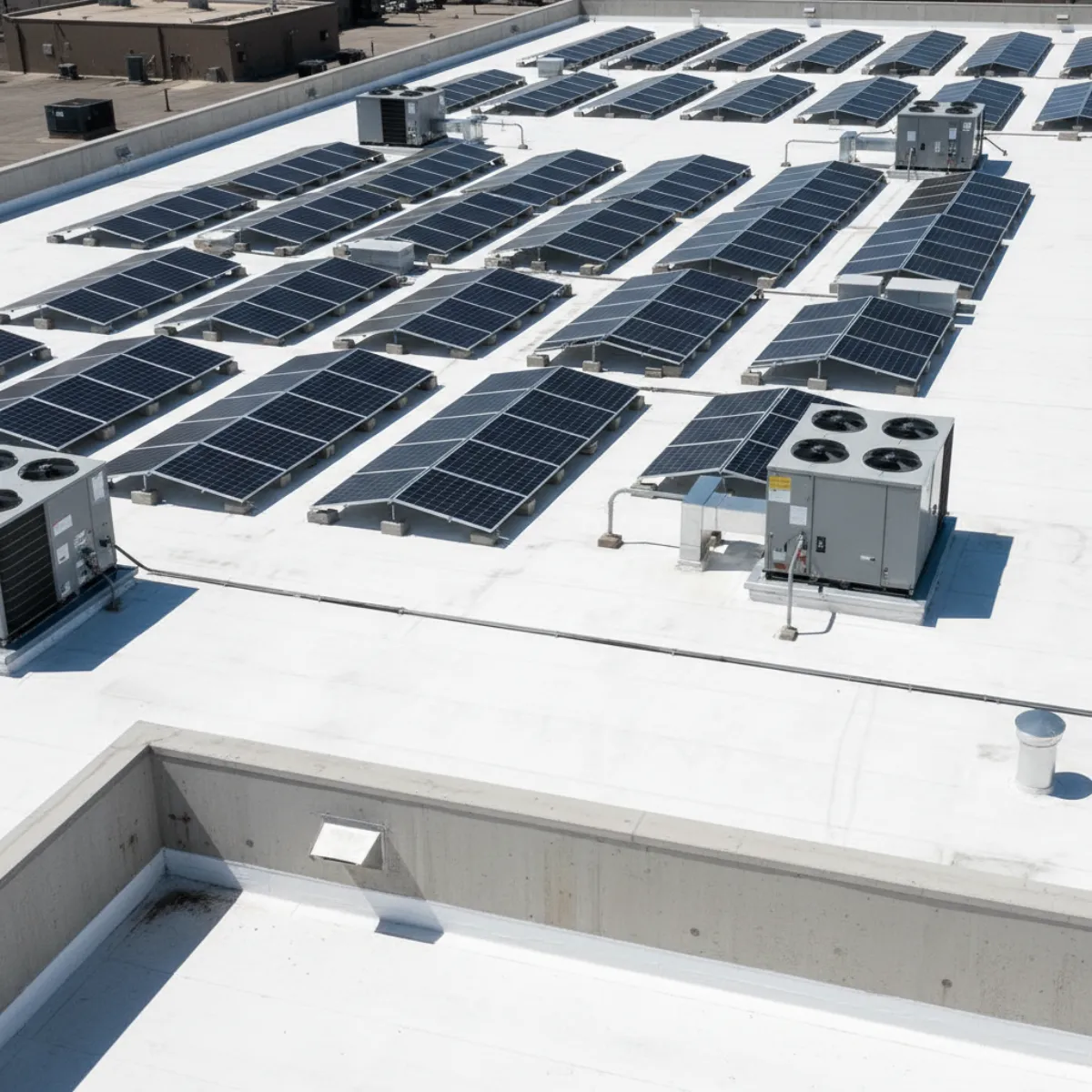
Start with the roof's condition, remaining service life, warranty documents, drainage, and structural records. Then compare ballasted, attached, and hybrid concepts using project-specific wind, snow, deck, and membrane constraints. Obtain written roof-warranty requirements before procurement and closeout confirmation after installation. The Section 48E begin-construction window closed July 4, 2026: projects that began construction on or before that date may use the longer continuity pathway. Commercial solar projects starting now generally must be placed in service by December 31, 2027. The statutory credit is 6%; it can increase to 30% when the applicable prevailing-wage and registered-apprenticeship requirements are met.
Commercial flat-roof solar in Connecticut is a multi-discipline engineering problem: roofing, structural, photovoltaic, and code-compliance work all converge on the same 50,000 square feet of membrane. The most common failure mode on CT projects is not a technical limitation of the panels, the racking, or the inverters. It is a breakdown in coordination between the roofing manufacturer, the racking manufacturer, the structural engineer, and the solar developer — and that breakdown is entirely preventable with the framework laid out in this guide.
Single-ply membrane roofs dominate modern Connecticut commercial construction. Walk through the industrial parks along I-84 in Southington and Plainville, the warehouse districts off I-91 in Cromwell and Wallingford, the flex-industrial corridors in Shelton and Milford, the retail centers in Manchester and West Hartford — the overwhelming majority of those roofs are TPO, EPDM, or PVC. Each family has distinct handling requirements for ballast blocks, protection mats, penetration flashing, and manufacturer warranty coordination. Treating a TPO roof the same as a built-up or modified bitumen roof is a textbook warranty-voiding mistake.
The stakes are practical and financial: solar work can change responsibility for leaks, repairs, roof access, and future array removal. The owner should not accept a verbal promise that the existing warranty remains intact. Written pre-install direction and written closeout confirmation are the proof that matters.
TPO, EPDM, and PVC are the three single-ply membrane families used on Connecticut commercial buildings. Each has distinct material properties, seam construction, and compatibility characteristics with rooftop solar. Understanding the differences drives better racking, ballast, and warranty decisions — and narrows the pool of manufacturer pass-through programs that will accept your project.
TPO is the dominant single-ply membrane on Connecticut commercial new construction — the default specification on warehouses along I-84, flex-industrial buildings in the Hartford and New Haven corridors, and most retail centers built after 2010. Heat-welded seams deliver strong mechanical integrity under ballast load, and the white reflective surface helps limit summer heat gain beneath modules. Every major TPO manufacturer (GAF, Carlisle, Holcim Elevate, JM, Sika) maintains a pre-approved solar racking partner list for CT projects. TPO scuffs easily during install — hot-air welded patch kits and onsite protection mats are mandatory for warranty retention.
Seam Method
Heat-welded
Chemical Resistance
Moderate
Typical Color
White (reflective)
Installed Cost
$5-$9
Lifespan
20-25 years
EPDM was the workhorse CT commercial membrane from the mid-1980s through the early 2010s and still covers a large share of existing Connecticut flat roofs — especially older industrial buildings in Waterbury, Bridgeport, Norwich, and the I-91 corridor. EPDM accepts ballasted solar when seams are intact, but adhesive seams degrade faster than heat-welded TPO or PVC and must be inspected before loading. Black EPDM runs 10-20 deg F hotter than TPO under summer sun, which can nudge nearby module temperatures up slightly. Protection mats under every ballast block are mandatory for EPDM warranty retention.
Seam Method
Adhesive tape or glue
Chemical Resistance
Poor (petroleum)
Typical Color
Black (absorbs heat)
Installed Cost
$4-$8
Lifespan
20-30 years
PVC is the preferred membrane for Connecticut buildings with chemical or grease exposure — food processors in the Naugatuck Valley, restaurant rooftops, pharmaceutical and laboratory facilities in the New Haven biotech corridor, and any building with heavy kitchen or industrial exhaust. Heat-welded seams match TPO for ballast compatibility, and chemical resistance is the strongest of the three single-ply families. Slightly higher installed cost than TPO but routinely justified where longevity and exhaust exposure matter. Compatible with essentially every major ballasted and penetrated racking brand.
Seam Method
Heat-welded
Chemical Resistance
Excellent
Typical Color
White (reflective)
Installed Cost
$7-$12
Lifespan
20-30 years
The single biggest design decision on a Connecticut commercial flat-roof solar project is ballasted versus penetrated racking. This matrix summarizes the trade-offs across every axis that matters — roof warranty, install speed, structural load, freeze-thaw exposure, and long-term maintenance.
| Category | Ballasted | Penetrated |
|---|---|---|
| How it is secured | Distributed weight holds the array on a low-slope roof; some designs use limited anchors. | Engineered attachments transfer forces into the roof structure. |
| Roof openings | Few or none, depending on the final wind and load design. | Requires project-specific flashed or manufacturer-approved attachment details. |
| Added roof load | Usually the highest distributed dead load; the amount varies across roof zones. | Usually lower dead load, with concentrated forces transferred to the structure. |
| Warranty coordination | Still requires membrane protection, access paths, and written manufacturer review. | Requires approved flashing and installation details plus manufacturer coordination. |
| Often considered when | The low-slope roof has adequate capacity and the wind design permits ballast. | Dead-load capacity is limited, wind forces are high, or the roof assembly favors attachment. |
| Owner question to resolve | Can the structure carry the stamped zone-by-zone ballast plan without harming the membrane? | Who owns the flashing detail, inspection, leak coverage, and future roof work? |
This is preliminary planning guidance, not a structural or warranty approval. Final mounting, ballast, attachment, wind, snow, and load values must come from the project-specific stamped design and the roofing manufacturer’s written requirements.
How to make the decision
Compare complete project-specific concepts rather than treating either mounting path as the default. The selected design must satisfy structural, wind, snow, drainage, membrane-protection, access, and written warranty requirements together.
Roof is in good condition and the structural review confirms adequate reserve capacity
A ballasted layout can limit new roof attachments, but the engineer still has to verify dead load, wind zones, snow drift, drainage, setbacks, and the membrane manufacturer's protection details.
Roof has useful remaining life but its condition is not fully documented
Have a qualified roofer document seams, flashings, drains, repairs, and signs of trapped moisture. Use those findings with the structural and warranty reviews before choosing ballasted, attached, or hybrid racking.
The structural review identifies limited reserve capacity or high wind-zone loads
Mechanically attached or hybrid concepts may reduce ballast demand, but attachment locations, flashings, deck capacity, uplift forces, and warranty requirements must be coordinated as one project-specific design.
The building uses a lightweight metal deck or existing drawings are incomplete
Do not infer capacity from the building type. Verify deck gauge, joist spacing, framing condition, and attachment access. The resulting engineer-stamped plan determines whether reinforcement, attached racking, hybrid racking, or a smaller array is appropriate.
The roof may reach end of life well before the planned solar system
Compare the roof's documented remaining service life with the solar operating term. Coordinating the projects can avoid an early array removal and lets the roofer, structural engineer, racking designer, and solar contractor align details before construction.
Roof has active leaks, blistering, or large ponding areas regardless of age
Resolve active roof defects and confirm the repair or replacement path before final solar design. A preliminary solar concept can continue, but construction documents should not treat a compromised membrane as solar-ready.
Roof-warranty coordination is one of the most commonly mishandled parts of commercial flat-roof solar. The exact requirements depend on the active warranty and proposed assembly. Identify the warrantor early, obtain written pre-install direction, and retain the inspection and closeout record.
What Is At Stake
Solar work can change who is responsible for roof leaks, repairs, access, and removal. Do not rely on a salesperson's verbal assurance. Read the actual warranty and obtain written project approval before procurement.
Membranes: Eligibility depends on the exact roof assembly and guarantee.
Project approval requirement
Confirm the exact product and compatibility in the current written project approval.
Pass-Through Path
Request the current solar guarantee requirements, complete the required pre-installation review, and document the post-installation inspection.
GAF’s published guidance requires compatible protection or slip sheets at ballasted-rack contact areas and project-specific load review.
Review GAF photovoltaic installation guidance guidanceMembranes: Warranty impact and compatible protection depend on the installed Carlisle system.
Project approval requirement
Confirm the exact product and compatibility in the current written project approval.
Pass-Through Path
Consult Carlisle and the authorized roofing contractor before design is finalized, especially on an existing or aging roof.
Carlisle’s published recommendations call for a protection layer beneath ballasted racking and warn against installing over a roof approaching replacement.
Review Carlisle roof-mounted solar recommendations guidanceMembranes: Requirements vary by brand, assembly, warranty, contractor certification, and project.
Project approval requirement
Confirm the exact product and compatibility in the current written project approval.
Pass-Through Path
Obtain written requirements directly from the manufacturer or warranty administrator before approving the solar mounting design.
Do not rely on a generic approved-racking list or an installer’s verbal assurance; keep the current written approval in the project closeout package.
Every manufacturer uses a slightly different submission form, but the core deliverable package is consistent across GAF, Carlisle, Firestone/Holcim Elevate, JM, Sika, and Versico. Include all of the following when submitting a Connecticut project for solar-ready approval.
A public brand list cannot prove that a specific roof, assembly, or warranty is approved. Use these five project records to turn a product proposal into a decision the building owner can verify.
Record the manufacturer, model, tilt, module, attachment or ballast components, and protection layers. Approval of a brand family is not approval of every configuration.
Ask the current warrantor to review the proposed assembly and state the required roofer, protection, flashing, inspection, and closeout steps in writing.
The stamped plan should address site-specific wind, snow drift, dead load, deck and framing capacity, attachment forces, setbacks, and any reinforcement.
Show drains, scuppers, overflow paths, service routes, roof equipment, fire access, and manufacturer-required walk pads on the same coordinated drawing.
Keep pre-work roof photos, repair records, approved drawings, inspection reports, as-built locations, and the warrantor's final written confirmation with the building file.
Most single-ply membranes in Connecticut are rated for a 20-30 year service life, with 25 years being the most common warranty term. The guiding principle is straightforward: if the roof has more than 10 years of life left, ballast over; if less, re-roof first. The detailed age-band triage below converts that principle into an actionable CT-specific decision matrix.
Owner checkpoint
Verify warranty and condition
Membrane is in its prime. A visual walk-through plus seam and drain inspection is sufficient. Both the roof and solar warranties should remain valid across the full 25-year solar term with no scheduled intervention.
Owner checkpoint
Document inspection and repairs
Commission a CT roofing contractor walk-through and photograph seam condition, drains, flashings, and parapets. Repair any minor deficiencies before solar mobilization. Remaining roof life should match or exceed the solar warranty term.
Owner checkpoint
Compare remaining life with solar term
This is the last financially defensible window for ballasting over an existing membrane in Connecticut. Schedule a professional roof assessment, commission an infrared moisture scan to rule out trapped water (critical after repeated CT freeze-thaw cycles), and document membrane state for the warranty file. If remaining life is clearly 10+ years, proceed; if closer to 7-8 years, shift to re-roof-first.
Owner checkpoint
Price lifecycle alternatives
A roof in this band needs a documented condition and remaining-life assessment. Compare repair, re-roof, and install-over scenarios, including array removal and reinstallation obligations, before final solar approval.
Owner checkpoint
Resolve roof scope before solar
A Connecticut roof this old has exhausted its manufacturer-supported life. No membrane manufacturer will extend warranty coverage to a solar overlay on a roof in this state. Replace the roof with a new TPO or PVC system spec-matched to the planned racking, then proceed with solar under aligned 25-year warranties.
If the roof is likely to need replacement during the solar operating term, the owner may have to de-energize, remove, store, and reinstall equipment before the roof work can proceed. Price that lifecycle scenario before deciding to install over the existing membrane.
Ask each proposal to show the assumed roof service life and who pays for removal, storage, reinstallation, and leak investigation. That comparison is more useful than an unsupported generic savings range.
Connecticut commercial flat-roof solar faces four climate-driven constraints that most national racking manufacturers underweight in their base engineering: freeze-thaw cycling, ponding-water drainage, combined snow plus dead load under ASCE 7-22, and wind uplift on parapet roofs. Each deserves a dedicated analysis pass by a CT-licensed PE.
Connecticut experiences roughly 70-110 freeze-thaw cycles each winter, with the NW hills (Litchfield County, Norfolk, Cornwall) at the high end and the Long Island Sound shoreline at the low end. Every penetration on a flat roof — every stanchion, every flashing, every counterflashing — is a potential freeze-thaw failure site where water enters a micro-gap, freezes, expands, tears the seal, then the cycle repeats the next night. This is the single strongest argument for ballasted systems on CT flat roofs. A properly ballasted array introduces zero new penetrations and therefore zero new freeze-thaw failure sites.
Connecticut flat roofs are designed with a minimum 1/4 inch per foot slope toward drains. When a solar array sits on top of that slope, racking feet, ballast blocks, and walkway pads can disrupt drainage paths and create localized ponding — especially during CT spring snow-melt events. Engineers must lay out the array so that no racking component sits across a drainage channel or within 18 inches of a drain. Chronic ponding accelerates membrane degradation and voids warranty coverage from every major manufacturer.
ASCE 7-22 ground snow loads across Connecticut range from roughly 30 psf on the Long Island Sound shoreline to 50 psf in the Litchfield NW hills, with Hartford and central CT typically at 30-35 psf. Ballasted solar adds 4-8 psf of dead load across the array and 10-12 psf at wind-zone corners. The combined dead-plus-snow case is almost always the governing load combination for CT flat roofs carrying solar. A Connecticut-licensed PE must run ASCE 7-22 combinations including drift snow at module edges, parapet walls, and mechanical penthouses.
Many CT commercial flat roofs have parapet walls — particularly in Hartford, New Haven, and Stamford. Parapets reshape wind flow over the roof, concentrating uplift pressure at leeward corners where ballast must typically run 2-3x the field value. Engineers apply ASCE 7-22 pressure coefficients (GCp) tailored to parapet height and building exposure category (B in most urban CT, C at the Sound and in exposed industrial parks, D in limited coastal zones). Skipping this analysis is the single most common cause of ballasted-system wind failures in Connecticut.
Long Island Sound Shoreline
30 psf
Stamford / Bridgeport / New Haven coast
Greater New Haven
30-35 psf
Inland shoreline corridor
Hartford / Central CT
30-35 psf
I-91 corridor baseline
New London / Eastern CT
30-35 psf
Mystic / Groton / Norwich
Tolland County
35-40 psf
Storrs / Vernon / I-84 east
Windham County
35-45 psf
Quiet Corner / Putnam / Woodstock
Lower Litchfield Hills
40-45 psf
Torrington / Watertown
Upper Litchfield NW Hills
45-50 psf
Norfolk / Cornwall / Salisbury
Northern Hartford County
35-40 psf
Granby / East Granby / Suffield
Values reflect ASCE 7-22 ground snow loads as adopted by the 2022 Connecticut State Building Code. Commercial flat-roof design loads (Pf) are computed from ground snow (Pg) using ASCE 7-22 Chapter 7 with site-specific exposure, thermal, importance factors, and unbalanced drift cases. A CT-licensed PE must perform the stamped analysis for each project.
Commercial flat-roof solar in Connecticut is subject to OSHA 1926 Subpart M fall protection rules during installation and OSHA 1910 Subpart D rules during ongoing maintenance. The CT Department of Labor enforces these federal standards, with additional construction-site requirements under the Connecticut Occupational Safety and Health Act. Fall protection planning is a project-cost and roof-warranty consideration that must be designed in from day one — especially on CT roofs where prevailing-wage projects carry additional compliance overhead.
The Section 48E begin-construction window closed July 4, 2026: projects that began construction on or before that date may use the longer continuity pathway. Commercial solar projects starting now generally must be placed in service by December 31, 2027. The statutory credit is 6%; it can increase to 30% when the applicable prevailing-wage and registered-apprenticeship requirements are met. Integrated racking, ballast blocks, protection mats, and roof reinforcement may affect eligible basis; owners should have their tax adviser confirm project-specific treatment. A roof replacement is not automatically part of the solar credit basis.
The residential Section 25D credit and the Section 25C efficiency credit both expired December 31, 2025 and do not apply to any Connecticut commercial flat-roof project. Consult your tax advisor for project-specific allocation of ITC-eligible versus non-eligible costs.
For new construction or re-roofs planned alongside solar in Connecticut, TPO is the default recommendation. It is cost-competitive at $5-$9 per square foot, offers heat-welded seam strength for ballasted solar, has the deepest roster of CT-approved racking partners (GAF, Carlisle, Firestone/Holcim Elevate, JM, Sika, Versico), and its white reflective surface reduces summer heat gain under modules. PVC is the better choice when the CT building has chemical or grease exposure — food processors in the Naugatuck Valley, restaurants, pharmaceutical and lab facilities in the New Haven biotech corridor. EPDM remains acceptable for ballasted solar over existing well-maintained rubber roofs but is rarely specified for new CT commercial construction because its adhesive seams are a step down from heat-welded TPO and PVC under ballast load.
Owner checklist plus a roof-readiness decision tool for ballasted, attached, and hybrid mounting.
Full overview of Connecticut commercial solar incentives, pricing, and project planning — the parent guide to every CT commercial sub-topic.
Large-footprint flat-roof solar strategy for Connecticut warehouses, distribution centers, and logistics buildings along I-84 and I-91.
Full Connecticut commercial solar project schedule — from feasibility and interconnection study through utility PTO.
When to bundle a re-roof with solar in Connecticut, warranty coordination, and cost savings from simultaneous projects.
How cluster studies, ISO-NE coordination, and Eversource / UI queue dynamics affect CT commercial flat-roof projects.
Long-term cleaning, snow-shed, and ice-load management for Connecticut commercial and residential arrays.
How federal and CT prevailing-wage rules interact with the commercial ITC bonus structure on Connecticut flat-roof projects.
Mission-critical flat-roof solar and resilience design for Connecticut hospitals, medical campuses, and healthcare facilities.
Our CT-licensed commercial engineers coordinate your TPO, EPDM, or PVC membrane with racking, ballast, and manufacturer joint-warranty pass-through.