Loading NuWatt Energy...

We use your location to provide localized solar offers and incentives.
We serve MA, NH, CT, RI, ME, VT, NJ, PA, and TX
Loading NuWatt Energy...
NuWatt designs, installs, and manages solar, battery, heat pump, and EV charger systems across 9 states. One company, one warranty, one point of contact.
Get a Free QuoteA mill conversion is a real-estate transaction that happens to involve a roof. The financing that survives the sale, the tariff election that cannot be undone, and the review path that owns your schedule matter more than the panel count — and in Connecticut all three work differently than they do one state north.
CT historic credit
25%
Of qualified expenditures; 30% with affordable housing
NRES election
20 yrs
Made once, at application
ESS performance
$325/kW
Years 1-5, under 500 kW peak
Bonus depreciation
100%
First year, permanent
Three Connecticut-specific decisions drive it. C-PACE finances the work as a benefit assessment that transfers with the deed instead of being defeased at sale. The state historic credit under C.G.S. Section 10-416c pays 25% of qualified rehabilitation expenditures, or 30% with affordable housing, capped at $4.5 million per project. And the NRES tariff election between Netting and Buy-All is made once and governs for 20 years, so it has to follow the metering plan rather than precede it.
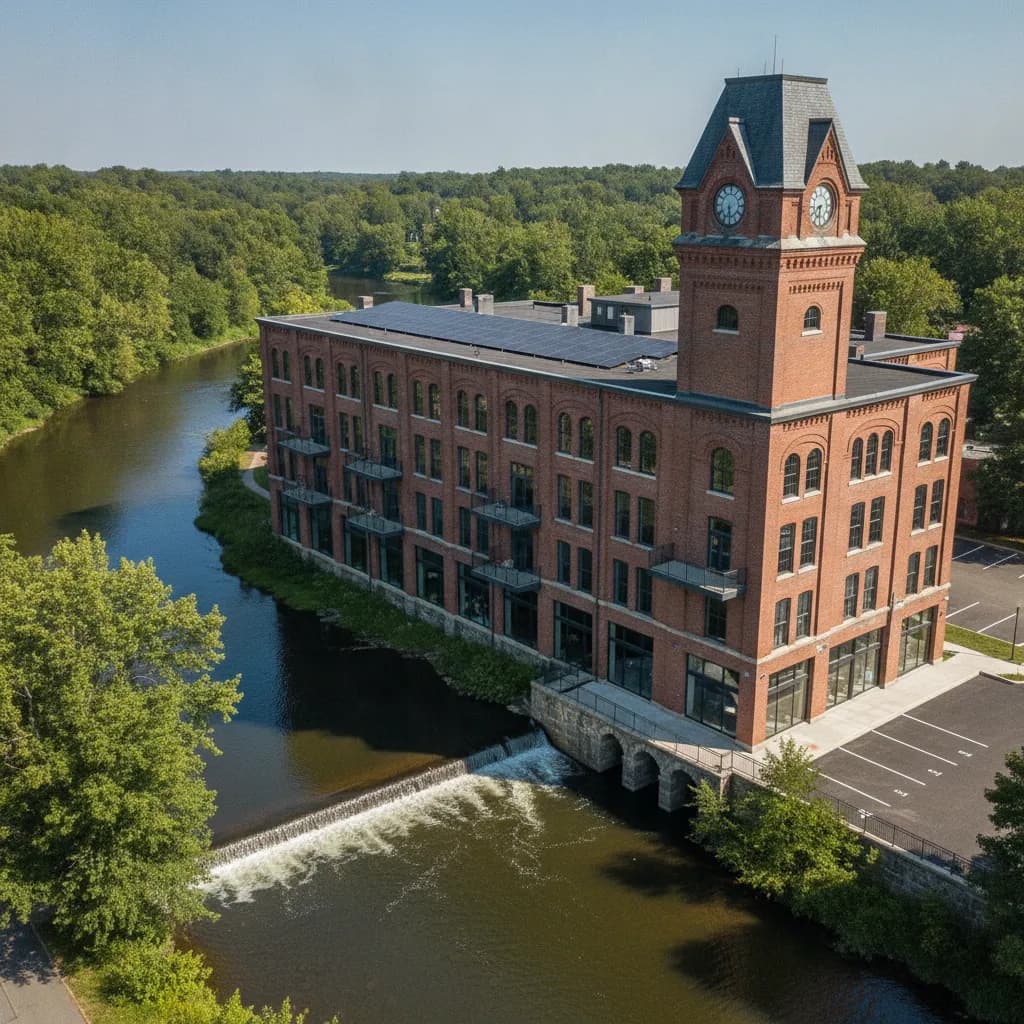
Verified August 5, 2026 against the Connecticut DECD State Historic Preservation Office tax-credit and environmental-review pages, the PURA Non-Residential Renewable Energy Solutions program materials, and — for storage — the Energy Storage Solutions program manual as of August 3, 2026, Docket No. 25-08-05.
Because of what happens at the closing table. Most adaptive-reuse sponsors are not long-term holders: they acquire a distressed mill, carry it through construction and lease-up, and sell the stabilised asset. Every dollar of conventional debt on that building has to be retired at the sale. A C-PACE benefit assessment does not — it is recorded against the property, collected on the property-tax bill, and inherited by the buyer along with the energy savings that service it. In a merchant-build deal that structural difference outweighs the interest rate, which is the opposite of how most financing comparisons are written.
The obligation follows the property, not the sponsor. There is no payoff to negotiate into the purchase and sale agreement, and the incoming owner takes the savings with the payment.
A default makes the past-due installment collectible in the same way property-tax arrears are. The remaining term is not called due at once, which is a materially different risk profile from a mortgage covenant.
Repayment rides on the assessment rather than on a corporate or personal guarantee — which is why it reaches single-purpose entities that a bank would ask a sponsor to guarantee.
The comparator below runs Connecticut C-PACE terms against cash and a conventional loan. Every rate is yours to enter — the defaults are illustrative only, and a mill project should be run at its own cost and its own first-year savings.
Drop in the numbers from your solar proposal and your quoted rates.
Installed system cost before incentives.
From your solar proposal.
How fast utility rates rise (default 3%).
Example only — enter the rate on your term sheet.
Example only — enter your bank offer.
Federal ITC (30%): $102,000 — applied identically to all three options. The ITC is ownership-based, not financing-based: with cash, C-PACE, or a loan you own the system and claim the same credit. MACRS depreciation is an additional owner benefit, also identical across the three (see the MACRS section below).
Savings + ITC − payment − full cost
No financing — paid upfront
Positive operating cash flow, but requires full cost upfront
Yr 5
+$38,075
Yr 10
+$358,122
Yr 25
+$1,657,882
Full project cost paid upfront — no financing cost, but ties up capital.
Savings + ITC − payment
Cash-flow positive from day one — savings cover the payment
Yr 5
+$229,861
Yr 10
+$401,694
Yr 25
+$1,405,027
100% financed at 6% over 20 yr, repaid on the property-tax bill.
Savings + ITC − payment
Cash-flow positive from day one — savings cover the payment
Yr 5
+$158,303
Yr 10
+$258,577
Yr 25
+$1,470,428
Modeled at 100% financed, 7.5% over 12 yr. Most commercial loans also require 10-25% down and a personal or corporate guarantee.
Cumulative net cash flow — running total of energy savings plus the one-time ITC, minus payments (and, for cash, the upfront cost).
Transfers on sale
The assessment stays with the property, not with you. When you sell, the new owner inherits the remaining payments and the solar savings.
Non-accelerating
A default cannot accelerate the full balance. Only the past-due assessment installment is collectible, exactly like a property-tax arrears — the remaining term is never called due at once.
Assessed on the property
Repayment is a benefit assessment on the property-tax bill, secured by the real property rather than a personal or corporate guarantee.
Estimates only, built from the rates YOU enter — they are not quotes and not tax advice; confirm terms with your capital provider and a tax professional. All three options assume the owner claims the ITC; financed options amortize the full project cost at a fixed rate. C-PACE availability requires your municipality to have opted in — check CT Green Bank's list of participating municipalities. C-PACE terms run 5-25 years (25-year maximum) and are administered by the CT Green Bank.
Connecticut's industrial inheritance runs along four watersheds rather than one — the Quinebaug and Shetucket in the east, the Willimantic and Hockanum in the centre, the Naugatuck in the west. Each corridor built a different industry, and the industry decides the structure. The column that matters most in a first pass is the last one: which utility serves the parcel, because that determines whether the statewide programs reach the site at all.
Willimantic River
Cotton thread — the American Thread Company works gave the borough its Thread City name.
Long multi-storey brick blocks with deep floor plates. Conversions here tend to be residential-over-commercial, which is exactly the mixed-use post-rehabilitation use the state credit was written to reach.
Shetucket and Yantic Rivers
Cotton and textile finishing in the Falls and Taftville villages of the Thames watershed.
The single most consequential fact about a Norwich mill: it is not an Eversource or United Illuminating customer. Confirm compensation and interconnection with the municipal utility before any pro forma assumes a statewide tariff.
Hockanum River
Silk — the Cheney Brothers complex is a National Historic Landmark District.
Landmark-district status raises the visibility question early. Interior courtyard roofs and rear elevations are where an array survives review; street-facing primary elevations are not the place to argue.
Naugatuck River
Brass, needles and machine works rather than textiles — a different structural vocabulary.
Metalworking buildings often carry heavier crane rails and steel framing than a spinning mill of the same age. That is a planning advantage worth testing, not a load rating you can assume.
Quinebaug River
Cotton milling through the Quinebaug and Shetucket corridor.
Smaller complexes, lower rents and thinner deal margins. C-PACE matters most here because it is the financing that does not need the sponsor to carry the balance sheet through stabilisation.
Hockanum River
Woolen mills clustered tightly along a short, steep drop in the river.
Tight valley siting means neighbouring buildings shade each other at low winter sun angles. Shade study before roof study, not after.
Willimantic River
Woolen manufacturing on the upper Willimantic.
Rural circuits. Ask the utility about hosting capacity at the point of interconnection before sizing the array to the roof rather than to the grid.
Naugatuck River
Copper and brass rolling through the lower Naugatuck Valley.
UI runs its own NRES intake and its own commercial rate schedule. A pro forma built on Eversource rate codes does not transfer across the territory line.
This is a planning list, not a survey. It carries no building counts and no square footages, because those numbers are property-specific and the ones that circulate in marketing material are usually somebody's estimate. Pull the assessor record and the Register listing for the actual parcel before anything is underwritten.
Usually yes, and the eligibility test is written in the shape of a mill. The Connecticut Historic Rehabilitation Tax Credit at C.G.S. Section 10-416creaches certified historic structures whose post-rehabilitation use is residential of five or more units, mixed residential and nonresidential, or nonresidential — which covers essentially every serious mill conversion. It is administered by the State Historic Preservation Office at DECD.
25%
Base credit
Of qualified rehabilitation expenditures
30%
Enhanced credit
Opportunity zone or affordable housing
$4.5M
Per-project cap
Maximum reservation for one project
$31.7M
Annual program cap
Reservations available each fiscal year
The annual cap is the part that changes behaviour. With $31.7 million of reservations available across the whole state each fiscal year and $4.5million available to any one project, a small number of large conversions can consume a meaningful share of a year's capacity. The reservation calendar therefore belongs on the development schedule next to the interconnection application, not in a separate tax workstream discovered late.
What this page will not do is tell you that your photovoltaic scope is a qualified rehabilitation expenditure. Whether a given cost qualifies is a determination for the program and your tax counsel against your actual scope of work, and a guide that asserts otherwise is guessing with your basis. Ask the question early; the answer changes how the array is bid and scheduled.
When there is a federal or state hook. Connecticut's SHPO sits inside the Connecticut Department of Economic and Community Development and conducts environmental review where a project involves federal or state funding, permitting or licensing. It adopts Section 106 of the National Historic Preservation Act as the framework for its reviews and supports compliance with the Connecticut Environmental Policy Act. The practical translation for a mill developer: a privately financed re-roof with no public money and no state permit is a different animal from a project claiming a historic credit or drawing on public funds, and conflating the two is how schedules get built on the wrong assumption.
85%
Conclude at identification
A no-historic-properties-affected finding ends most reviews
<5%
Reach mitigation
Of roughly 2,500 reviews a year
30 days
Target response
From initiation of consultation
Those proportions are the useful part. The common fear — that historic review is an open-ended veto on any visible change — does not match the published pattern of outcomes. What it does mean is that visibility from the public way is the variable worth designing around from day one: set the array back behind parapets, favour rear and courtyard elevations, and leave the primary street facade and any tower or ornamental roof alone. Submissions run through the ConnCRIS environmental review portal, which walks a submitter through the review-authority questions before anything is filed.
The one that matches where the load ends up — and you get to decide once. The Non-Residential Renewable Energy Solutions tariff makes a project elect Netting or Buy-All at application, and the election governs for the full 20-year term. A mill conversion is the hardest case for that election because the building's metering plan is usually still moving while the incentive application is being prepared. Settle the metering first; elect second.
| Consideration | Netting | Buy-All |
|---|---|---|
| What the mill looks like on the meter | A conversion with a large common-area and commercial load on a single house meter — elevators, corridor lighting, shared HVAC, a ground-floor tenant — has real behind-the-meter consumption to offset. | A conversion where nearly all consumption sits behind individually metered residential units leaves the house meter with little load for an array to offset. |
| Where the value comes from | Self-consumed generation offsets retail supply and delivery at the house meter; the exported balance is credited. | The utility purchases one hundred percent of generation at the awarded tariff price, and the building keeps buying its power on its normal rate. |
| How the master-metering decision interacts | Master metering the residential units concentrates load on one account, which is what makes netting work — but it is a leasing, billing and regulatory decision, not a solar one. | Buy-All is indifferent to how the building is metered downstream, which is why it suits condominium conversions and sub-metered rentals. |
| How reversible it is | It is not. The election is made at application and governs for the full tariff term. | Equally fixed. Choosing before the leasing and metering plan is settled is choosing blind. |
Projects at or below 200 kW are awarded first-come, first-served. Above that, projects go through competitive solicitation with bid windows roughly February and August each year. Mill roofs are large, so a serious mill array usually lands on the solicitation side — which turns the incentive from a form into a date on the construction schedule.
The tariff is administered by Connecticut's regulated electric distribution companies, Eversource Energy and The United Illuminating Company. A mill served by a Connecticut municipal electric utility is not their customer. Norwich is the case that catches people: Norwich Public Utilities handles its own interconnection, and a pro forma that assumes the statewide tariff there is wrong before it starts.
Cheapest question first, licensed professional last. Nothing below asserts a load capacity for any building, because nothing can: what a specific nineteenth-century frame will carry is a function of that frame, its alterations, its condition and its snow-drift geometry, and only a Connecticut-licensed structural engineer can evaluate it. What a sequence can do is make sure the engineering money is spent once, on a scope that already knows the answers to the cheap questions.
A nineteenth-century mill has usually been re-roofed several times. What matters is the current assembly and its remaining life, not the original one. A roofing consultant taking cores answers this in days and costs a fraction of a structural study.
Deliverable: Core samples, assembly section, remaining service life estimate.
Mounting an array on a membrane with less life left than the system warranty is the most expensive avoidable mistake in adaptive reuse. If the roof is being replaced as part of the conversion, the array belongs in that scope and that construction schedule.
Deliverable: One roof scope covering membrane and racking together.
Only a licensed structural engineer can tell you what a specific timber, iron or steel frame will carry with a new dead load, new snow drift patterns behind parapets, and a century of alterations. No guide, this one included, can substitute for that assessment or predict its result.
Deliverable: Stamped structural evaluation covering dead load, drift and attachment.
If the project is claiming the state or federal historic credit, or touching state or federal money or permits, the review path is a schedule item with its own clock. Running it alongside design rather than after it is the difference between a delay and a dead quarter.
Deliverable: Known review path, known submittal, known clock.
Which utility serves the parcel decides which programs exist for it. Hosting capacity at the point of interconnection decides how much of the roof is worth building. Both are answerable before design, and both change the array size.
Deliverable: Utility of record, hosting-capacity read, realistic array ceiling.
More naturally than in most commercial buildings, for a reason specific to old industrial districts. Energy Storage Solutions restructured for enrolment applications on or after April 1, 2026 under Docket No. 25-08-05, and the Construct 5 design pays commercial performance incentives across 10 years. Two of its priority categories reach mill sites unusually often.
$325/kW
Years 1-5
Annual peak demand under 500 kW
$275/kW
Years 1-5
Annual peak demand of 500 kW or more
$175/kW
Years 6-10
Both commercial classes
Priority customers earn an enrolment incentive of $10/kWh of rated energy capacity; non-priority commercial customers earn $0. There is a $350commercial application fee. The two categories that are worth testing for a mill are the small-business threshold and Grid Edge — siting on the top ten percent of circuits by storm-outage count or duration since July 1, 2012. The programme publishes a circuit map, so whether a specific riverfront industrial feeder qualifies is a lookup rather than an assumption.
The Section 48E begin-construction window closed July 4, 2026: projects that began construction on or before that date may use the longer continuity pathway. Commercial solar projects starting now generally must be placed in service by December 31, 2027. The statutory credit is 6%; it can increase to 30% when the applicable prevailing-wage and registered-apprenticeship requirements are met.
Commercial solar is five-year MACRS property, and first-year bonus depreciation is 100% (IRS Notice 2026-11). For a mill conversion this is normally the layer that decides whether the sponsor holds the asset directly or brings in a tax-equity partner, because the deduction is only worth what the owner can use.
Energy storage technology is not subject to the December 31, 2027 placed-in-service deadline or the July 4, 2026 begin-construction trigger — both apply to applicable wind and solar facilities only, and Section 48E(e)(4)(C) expressly excepts energy storage technology (IRS Notice 2025-42, section 2.02). A standalone commercial battery remains eligible for the statutory 6% Section 48E credit, increased to 30% when the applicable wage and apprenticeship requirements are met, under the standard clean-electricity phase-out that starts at the later of 2032 or when U.S. greenhouse gas emissions from electricity are 25% of 2022 emissions or lower. Energy storage technology is its own qualifying category under Section 48E(c)(2). There is no requirement that a commercial battery be paired with solar or charged from a renewable source to claim the credit.
For a mill conversion the placed-in-service runway is the constraint that binds. A historic rehabilitation is a long construction programme with a review path attached, and interconnection on a constrained urban feeder adds its own months. Projects that start now are not late — they are on a schedule where the sequencing has to be deliberate from the first design meeting rather than discovered at the end of it.
C-PACE transfers with the deed. In a build-stabilise-sell deal that structural fact outweighs the interest rate, because there is nothing to defease at closing.
The Connecticut historic credit reaches mixed residential and nonresidential use at 25% of qualified expenditures, 30% with affordable housing, and it is capped both per project and per fiscal year.
The NRES election is made once for 20 years. It has to follow the metering and leasing plan, not precede it.
Above 200 kW the incentive moves from first-come to competitive solicitation, which puts a date on the construction schedule rather than a form in a drawer.
Establish the utility of record first. A mill in municipal-utility territory is outside the statewide tariff and the ratepayer-funded programs.
Historic review is a schedule item with published outcome proportions, not an open-ended veto. Design for low visibility from the public way and it usually resolves at the identification step.
Sequence the array into the re-roof. Mounting on a membrane with less life left than the system warranty is the most expensive avoidable mistake in adaptive reuse.
No guide can tell you what a nineteenth-century frame will carry. A Connecticut-licensed structural engineer can, and the cheap questions should be answered before that engagement starts.
It can. The Connecticut Historic Rehabilitation Tax Credit (C.G.S. Section 10-416c) reaches certified historic structures whose post-rehabilitation use is residential of five or more units, mixed residential and nonresidential, or nonresidential — which is the ordinary shape of a mill conversion. The credit is 25% of qualified rehabilitation expenditures, rising to 30% for projects in an opportunity zone or carrying an affordable-housing component. Reservations are capped at $4.5 million per project against $31.7 million of credit available each fiscal year, so the reservation calendar matters as much as the eligibility test. The building must be listed on the National or State Register. Solar itself is not automatically a qualified rehabilitation expenditure; confirm the treatment of any specific scope with the program before you underwrite it.
The full program mechanics: eligibility, the savings-to-investment ratio, lender consent and the CT Green Bank process.
Size tiers, tranche cadence and the full comparison behind the election this page summarises.
The Construct 5 restructure, the new dispatch obligation and the closed legacy incentives.
Drift, parapets and the structural questions a Connecticut roof raises before an array is designed.
The cluster hub: programs, tariffs, financing and rate structures across the state.
Bring us in while the roof scope and the metering plan are still open — that is when solar changes the deal rather than just adding to it.