Loading NuWatt Energy...

We use your location to provide localized solar offers and incentives.
We serve MA, NH, CT, RI, ME, VT, NJ, PA, and TX
Loading NuWatt Energy...
NuWatt designs, installs, and manages solar, battery, heat pump, and EV charger systems across 9 states. One company, one warranty, one point of contact.
Get a Free QuoteConnecticut commercial solar lives or dies at the structural review. Shoreline 30 PSF, Northwest hills 50+ PSF, ballast dead load riding on top of seasonal snow — this is the engineering math that decides whether your flat-roof PV array clears permit review or gets sent back for reinforcement.
30–50
PSF CT Ground Snow Range
4.5–7
PSF Ballasted Array Dead Load
70–110
Freeze-Thaw Cycles / Winter
$1.5k–$12k
Typical Structural Letter Cost
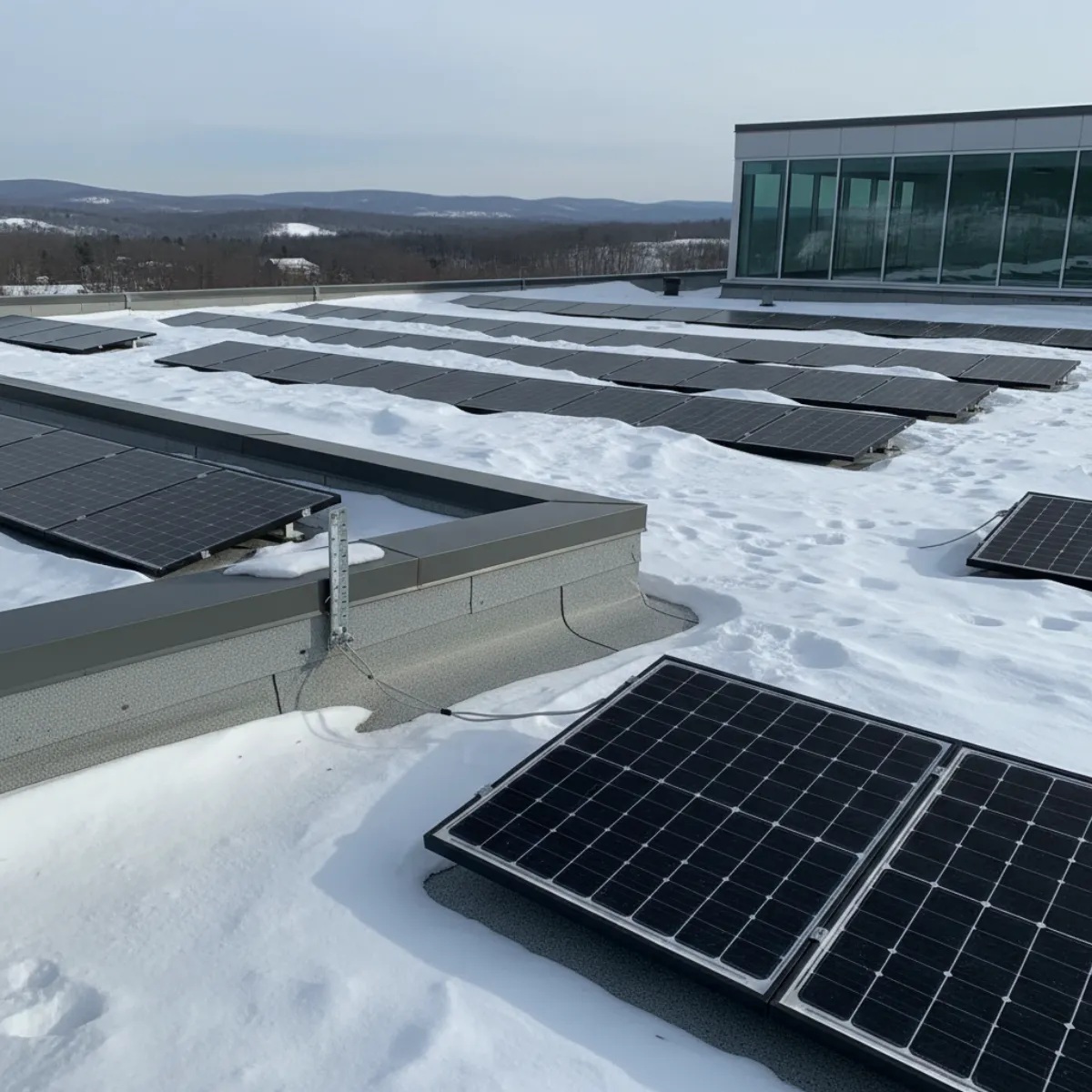
TL;DR for CT property owners: Your commercial flat-roof PV array adds roughly 4.5–7 PSF of ballasted dead load on top of a CT design snow load that varies from 30 PSF on the shoreline to 50+ PSF in the Northwest hills. Under the 2022 CT State Building Code, the governing case is always D + S, not dead alone. Expect a $1,500–$12,000 structural engineering scope, and on pre-1990 steel joist roofs expect some localized reinforcement on top of that.
Commercial flat-roof PV is a different engineering problem from residential. On a flat roof, ballast — not the modules — is usually the dominant dead-load contributor, and CT’s snow load is what governs the combined case.
To put 5 PSF of ballasted PV in context, here is what other loads look like on a typical CT commercial flat roof:
The punchline: 5 PSF of ballasted solar is small relative to CT snow design, but the governing case is D + S combined, and in the Northwest hills that combined demand is where many older steel-joist roofs run out of reserve.
CT permit reviewers do not evaluate the array weight in isolation. They evaluate it combined with snow, wind, and maintenance loads under IBC Chapter 16 load combinations — and on most CT commercial flat roofs, D + S is the governing case.
The constant weight of the PV system itself — modules, racking, ballast blocks, attachments, wire management, and rooftop combiners or inverters. On a commercial flat roof in CT, ballast is the dominant dead-load contributor because ballasted tilt frames trade roof penetrations for concrete pavers, and those pavers can approach 4–6 PSF spread across the array footprint.
Typical Values / Components
Under ASCE 7-22, ground snow load in Connecticut ranges from about 30 PSF along the shoreline to 50 PSF in the Northwest hills — and drift snow against parapets, tilt-frame upstands, or adjacent building sections can push local loads to 70–90 PSF. The governing load combination on a CT flat roof is almost always D + S (dead + snow), not dead alone, which is why the engineer has to know which ASCE 7-22 snow zone the site sits in.
Typical Values / Components
The 2022 CT State Building Code (2021 IBC with CT amendments) does not evaluate array dead load in isolation — it evaluates it combined with snow, wind, and seismic per IBC Chapter 16 load combinations. Adding 4 PSF of ballasted PV to a roof that already has a 35 PSF snow design load is not a 4 PSF question, it is a combined-case question where the ballast rides on top of the snow design.
Typical Values / Components
Why this matters in plain English
Your CT commercial roof was designed to hold itself up under the worst design snowstorm plus a small margin. Ballasted solar does not just add its own weight — it rides on top of that snow load for decades. If the original steel-joist design had only a thin reserve above the 35 PSF flat-roof snow case, adding 5 PSF of ballast consumes most of the margin. That is why two otherwise identical CT warehouses — one in Stamford, one in Torrington — can get very different structural outcomes with the same exact array.
CT ground snow load varies from 30 PSF on the Long Island Sound shoreline to 50 PSF in the Northwest hill towns. Under ASCE 7-22 (adopted through the 2022 CT State Building Code), flat-roof snow load is typically ~0.7x ground snow plus drift and slide effects. A project in Litchfield County is literally designing for 65–70% more snow than a Stamford project.
| Region / Representative Towns | Ground Snow | Flat Roof (0.7x) | Freeze-Thaw | Structural Notes |
|---|---|---|---|---|
| Fairfield County — Shoreline (Stamford, Norwalk, Bridgeport, Milford) | 30 PSF | ~21 PSF | ~70 cycles/winter | Lowest design snow in CT; moderated by LI Sound. Wind exposure from the Sound often governs uplift on parapet corners before snow governs. |
| New Haven County — Shoreline & Central (New Haven, West Haven, Branford, Wallingford) | 30 PSF | ~21 PSF | ~75 cycles/winter | Standard CT shoreline loading. Urban heat-island effects in New Haven reduce sustained snowpack compared to inland towns at same elevation. |
| New London County — Shoreline (New London, Groton, Norwich) | 30 PSF | ~21 PSF | ~75 cycles/winter | Low snow design load but significant coastal wind exposure. Ballast-only arrays near the shore often require additional mechanical attachment at array corners. |
| Middlesex County (Middletown, Cromwell, Old Saybrook) | 30–35 PSF | ~21–25 PSF | ~80 cycles/winter | Transition zone between shoreline and central. Most commercial flat-roof solar projects here clear structural review with standard ballast design. |
| Hartford County — Central Valley (Hartford, East Hartford, Windsor, Glastonbury) | 35 PSF | ~25 PSF | ~85 cycles/winter | Connecticut River Valley; moderate snow plus older industrial and warehouse building stock frequently triggers existing-roof structural review before PV is allowed. |
| Tolland County (Vernon, Manchester, Ellington) | 35–40 PSF | ~25–28 PSF | ~90 cycles/winter | Rising terrain increases snow load over the Hartford basin. Drift conditions on industrial parks with mixed roof heights are a common review flag. |
| Windham County (Willimantic, Putnam, Plainfield) | 35–40 PSF | ~25–28 PSF | ~90 cycles/winter | Northeastern CT; similar loading to Tolland. Older mill buildings dominate the industrial stock and almost always require a structural letter. |
| Litchfield County — Northwest Hills (Torrington, Winsted, Norfolk, Cornwall) | 45–50 PSF | ~32–35 PSF | ~100–110 cycles/winter | Highest snow loads in CT. Norfolk and the surrounding hill towns see sustained snowpack into late March. Any pre-1990 commercial roof here should expect a structural letter request. |
Ranges shown are approximate and should be confirmed against the current ASCE 7-22 ground snow map and any CT-specific amendments for the project location. Drift and sliding snow loads on irregular CT commercial roofs can exceed flat-roof design values by 2–3x, and parapet drift zones often govern structural capacity near the array edges.
On a tilted ballasted array, yes — in two specific ways. First, the tilt-frame upstand creates a local drift zone that can carry 1.5–2x the open-roof snow load. Second, snow that slides off the module face lands and piles in the row gap between arrays, creating a concentrated line load. Good CT commercial design accounts for both effects in the initial engineering, not as an afterthought. See our guide to CT solar panel snow removal for operational handling of heavy-snow winters.
These are the six building and site conditions that most consistently trigger structural reinforcement — not just a letter — on CT commercial solar projects. If any apply to your property, plan the engineering scope into the project timeline from day one.
Open-web steel-joist (OWSJ) flat roofs built before 1990 — common on CT warehouses, manufacturing facilities, and strip retail — were often designed with a 20–25 PSF roof live load and minimal reserve for added point loads. Ballast pavers of 4–6 PSF plus local snow drift can push combined demand above original joist capacity. Always flag for structural review.
Connecticut commercial buildings often have parapets 3–8 ft tall, and many manufacturing facilities step from a tall clear-span to a lower office section. Both geometries create ASCE 7-22 drift loads that can exceed 70–90 PSF locally. Any array placed within ~30 ft of a parapet or upper-roof line has to be engineered for drift, not just flat-roof snow.
Ballasted tilt frames between 5 and 10 degrees shed snow well and track flat-roof snow design cleanly. Tilt frames at 10–15 degrees — common on south-facing CT commercial arrays to boost winter production — create their own drift and upstand conditions that ASCE 7-22 requires the engineer to evaluate as a separate snow case.
Older CT mill buildings in Hartford, Willimantic, Danielson, and Torrington were framed with heavy-timber or early pre-engineered wood trusses. These structures can carry significant load but their original design documentation is frequently incomplete, which forces the engineer to perform a field-survey-based calc rather than rely on as-built drawings.
Some 1950s–1970s CT commercial roofs used lightweight insulating concrete or gypsum deck systems with marginal point-load capacity. Ballast pavers concentrated on a gypsum deck have been known to cause localized crushing without proper load-spreading pads. Always trigger structural review for these decks.
The Northwest hills see the highest sustained snowpack in the state. Even a relatively new commercial building in Torrington, Winsted, or Norfolk can have a structural reserve consumed by the combined D + S case once ballasted PV is added. Assume a structural letter regardless of building age.
Tilt angle is where production and structural design trade against each other. Higher tilt sheds snow faster and boosts winter output, but it also increases ballast mass, drift upstand height, and wind uplift demand. For CT commercial arrays, 10 degrees is the most common answer — but the right tilt varies by snow zone.
| Tilt Angle | Production Impact | Snow Shedding | Structural Impact | CT Verdict |
|---|---|---|---|---|
| 0° (flush / flat-lay) | Lowest winter production (~85% of tilted output) | Poor — snow sits on modules until it melts | Simplest case; dead load alone plus flat-roof snow | Rare in CT commercial design; unsuitable for high-snow Litchfield County. |
| 5° (low-tilt ballasted) | Good annual; modest winter gain | Slow — shedding typical above 7° angle of repose for wet snow | Standard ballast design; minimal drift from upstand | Common CT choice for shoreline / central counties with 30–35 PSF ground snow. |
| 10° (standard tilt) | Strong annual + better winter shed | Good — wet CT snow starts to slide above ~10° on glass | Upstand creates a minor drift zone; ASCE 7-22 requires drift check | Most common tilt for CT commercial arrays balancing output and ballast mass. |
| 15° (high-tilt) | Best winter production, ~5–8% annual gain over 5° | Best — modules shed quickly on warm-up days | Significant drift upstand; higher wind uplift; more ballast required | Worth it in Litchfield and Windham counties where winter output matters most. |
| 20°+ (rarely used commercial) | Marginal annual gain over 15° | Excellent — snow sheds before accumulating | Large upstand drift; major wind uplift; may need mechanical attachment | Structurally disproportionate; ground mount is usually better at this tilt. |
In the Northwest hills — Torrington, Winsted, Norfolk, Cornwall — sustained snowpack into March is common, and the winter production gain from 15-degree tilt can be significant. On a 500 kW Litchfield County array, going from 5 to 15 degrees can add 4–8% annual production, which over 25 years is material. The structural cost (more ballast, more drift check) is real but usually justified in the NW zone in a way it is not on the shoreline.
Winter output is the month-by-month reality of owning a CT commercial solar array. Here is how production actually plays out between the shoreline and the Northwest hills, and how many snow-cover days reduce output in each month.
| Month | Shoreline Output | NW Hills Output | Snow-Cover Days | Note |
|---|---|---|---|---|
| December | ~4–5% annual | ~3% annual | 3–6 (shoreline) / 6–10 (NW) | Lowest sun angle of the year; NW hills also see most frequent snow coverage. |
| January | ~4–5% annual | ~3–4% annual | 4–8 (shoreline) / 8–14 (NW) | Peak snow month statewide; Litchfield and Windham see multi-day snowpack. |
| February | ~6–7% annual | ~4–5% annual | 4–7 (shoreline) / 7–12 (NW) | Production rises with sun angle; NW hills still hold sustained snowpack. |
| March | ~8–9% annual | ~7% annual | 2–4 (shoreline) / 4–8 (NW) | Strong shed-off on warm days above freezing; 10°+ tilt makes a visible difference. |
Output percentages reflect share of annual production by month for a typical south-facing fixed-tilt commercial array in CT. Actual production varies by system orientation, shading, soiling, and winter cloud cover.
December through February represents only about 14–17% of annual CT solar production, but commercial demand charges often peak in winter for heating-load buildings (manufacturing, hospitals, cold storage). Every kilowatt-hour that lands during a demand peak is disproportionately valuable. That is one reason 10–15 degree tilt, rather than flat-lay, pays off in CT even when the annual production math looks close. See our guide to CT solar winter performance for the full production picture.
If the structural review flags your CT commercial roof, these are the real-world remediation paths and their typical cost ranges. Most flagged projects land in the middle of this table, not at the extremes.
When it applies: Handful of joists exceed capacity under combined D + S with ballast. Most common CT mid-scope fix.
When it applies: Older pre-1990 OWSJ roof where most joists need reinforcement under a large array. Common on Litchfield or Windham pre-1990 warehouses.
When it applies: Gypsum decks, lightweight concrete, or roofs with thin reserve where ballast point loads are the concern rather than global capacity.
When it applies: Removes ballast dead load entirely in exchange for roof penetrations. Often chosen on marginal roofs in Litchfield County where 45–50 PSF snow plus ballast is too much.
When it applies: Roof is adequate as-built but AHJ requires stamped documentation. Typical on post-2000 buildings with clean as-built drawings.
When it applies: Rare. Only triggered on severely deficient older industrial buildings or when array is repositioned over a weak area.
Budget the engineering into the project plan
On a typical CT commercial solar project in the 200 kW–1 MW range, plan for $3,000–$15,000 of structural engineering scope (letter plus any field survey) and, on older steel-joist buildings, $15,000–$50,000 of localized reinforcement as a reasonable base case. Projects that come in cheaper are on newer buildings with clean as-builts; projects that come in meaningfully more expensive usually have a drift condition or a gypsum-deck issue driving the cost. A good engineer surfaces the number before you commit to a design.
For property owners, GCs, and engineers who want to understand the paper trail behind the structural review — here is the code stack CT building officials are enforcing on commercial solar projects.
Connecticut adopts the 2021 International Building Code family with CT-specific amendments as the 2022 CT State Building Code. This is what governs every commercial solar permit issued by a Connecticut AHJ, from New Haven to Hartford to Torrington.
The CT code pulls its design loads from IBC 2021 Chapter 16, which references ASCE 7-22 (Minimum Design Loads and Associated Criteria for Buildings and Other Structures). This is where the specific CT ground snow map, wind zones, and load combinations live.
A typical CT commercial PV permit submission includes: site plan and array layout, electrical single-line diagram, module and inverter datasheets, racking manufacturer engineering (pre-stamped for standard configurations), ballast layout drawings with PSF heat-map, a stamped CT-licensed structural engineer letter evaluating the specific roof, and any required reinforcement drawings. The racking manufacturer’s letter covers the hardware; the project-specific PE letter covers whether your individual building can accept it.
NuWatt’s commercial engineering team handles the structural analysis before the permit — ASCE 7-22 snow and wind evaluation, ballast layout design, structural letter coordination with a CT-licensed PE, and reinforcement scoping when the roof is marginal. No surprises at the AHJ desk.
We work across all eight CT counties — from Fairfield through Litchfield — and know which building departments flag which conditions.
Last updated: April 2026
Sources: 2022 Connecticut State Building Code (2021 IBC + CT amendments), ASCE 7-22 (Minimum Design Loads for Buildings), AISC 360 Steel Construction Specification, module and racking manufacturer engineering reports, NOAA climate normals for CT stations (shoreline through Northwest hills)