Loading NuWatt Energy...

We use your location to provide localized solar offers and incentives.
We serve MA, NH, CT, RI, ME, VT, NJ, PA, and TX
Loading NuWatt Energy...
NuWatt designs, installs, and manages solar, battery, heat pump, and EV charger systems across 9 states. One company, one warranty, one point of contact.
Get a Free Quote
The federal residential solar tax credit (Section 25D) died on December 31, 2025. But Connecticut still has 6 active state-level solar incentive programs worth over $50,000 in lifetime value. This is the definitive guide to every program that still works, what each one is worth, and how to stack them.
The federal residential solar tax credit (Section 25D) expired December 31, 2025. Connecticut homeowners who buy solar with cash or a loan receive $0 in federal tax credits. However, Connecticut still has 6 active state-level programs that make solar a strong financial investment:
Bottom line: An 11 kW system at $2.98/W costs $32,780 gross. After tax exemptions, your net cost is about $30,698. Over 25 years, total value from all programs exceeds $72,000. Payback: 8-10 years without any federal credit; 7-8 years with a battery.
Before we cover what still works, let's be honest about what's gone. Other solar websites still reference these programs. They are wrong.
Homeowners who purchase solar with cash or a loan receive $0 in federal tax credits. This was 30% in 2025. Now it is zero. The OBBBA, signed July 4, 2025, ended this program.
The $2,000 heat pump tax credit and $1,200 insulation/efficiency credit are both dead. These were separate from the solar ITC and also expired under OBBBA.
RSIP hit its 350 MW installed capacity target and closed to new applications in 2021. It has been replaced by the RRES program, which uses a different tariff-based approach instead of upfront rebates.
Unlike Massachusetts, Connecticut does NOT have a state income tax credit for solar. Some websites incorrectly list one. CT offers tax exemptions (sales and property), not a tax credit.
The federal credit was the big loss. But every Connecticut state program survived. One important change: the Solar Energy Adjustment increased 8x for new enrollees.
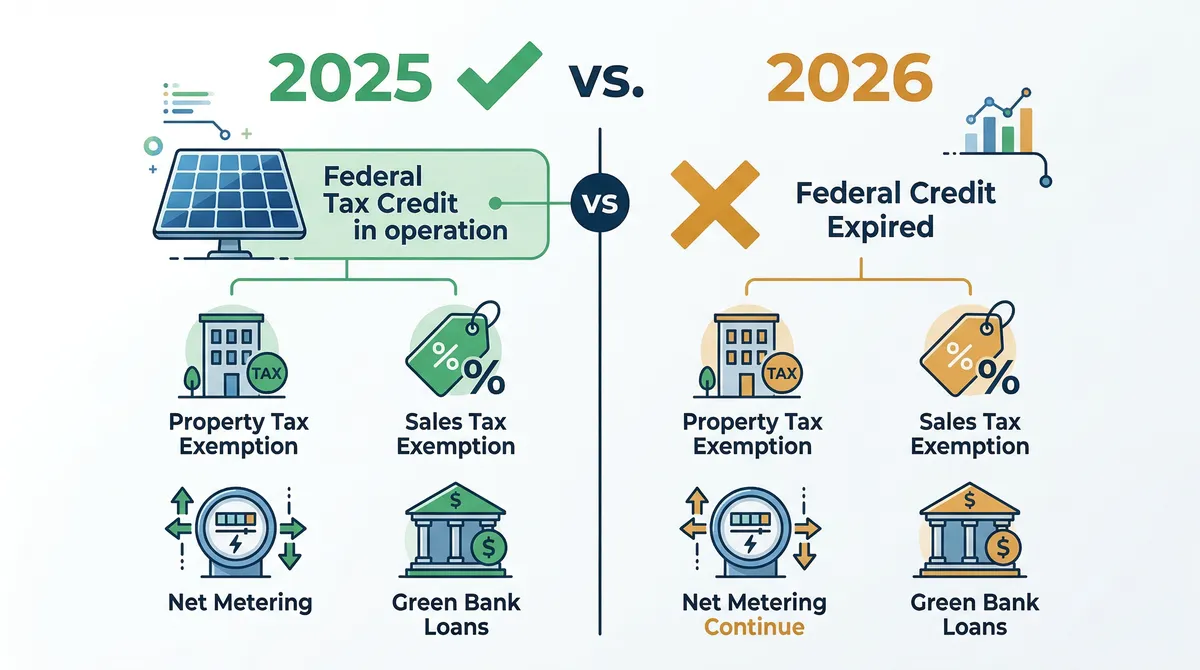
| Incentive Program | 2025 | 2026 | Status |
|---|---|---|---|
| Federal Tax Credit (25D) | 30% of system cost (~$9,834) | $0 — Expired Dec 31, 2025 | Expired |
| RRES Net Metering | Retail-rate credit | Retail-rate credit (same) | Active |
| Solar Energy Adjustment | $0.005/kWh (low) | $0.0402/kWh (8x higher) | Changed |
| ESS Battery Incentive | $250-$600/kWh upfront (legacy, closed Mar 31 2026) | $30/kWh enrollment ($130/kWh Grid Edge) + $300-$550/kW-yr for 10 yrs | Active |
| Property Tax Exemption | 100% permanent | 100% permanent | Active |
| Sales Tax Exemption | 6.35% saved | 6.35% saved | Active |
| Smart-E Loan (Solar) | 6.99-7.99% APR | 6.99-7.99% APR | Active |
| Section 48E (Lease/PPA) | 30%+ for third-party owner | 30%+ (July 4, 2026 safe harbor) | Changed |
| RSIP State Rebate | Already closed (2021) | Closed — replaced by RRES | Expired |
| 25C Energy Efficiency | $2,000 heat pump credit | $0 — Expired Dec 31, 2025 | Expired |
The federal 25D credit was worth about $9,834 on a typical 11 kW system. That is a real loss. But the 6 remaining Connecticut programs still generate over $72,000 in lifetime value for the same system. The math still works in your favor, especially with a battery.
The RRES (Residential Renewable Energy Solutions) program replaced RSIP in 2022 and is now the primary framework for residential solar in Connecticut. Under the Netting Tariff (Option A), your solar powers your home first, and excess electricity earns retail-rate bill credits. This is the single largest value driver for Connecticut solar.
Solar powers your home first. Excess exported to grid earns retail-rate credits. Credits roll over monthly — indefinitely until you terminate service. For an 11 kW system on Eversource ($0.29/kWh), annual gross savings are approximately $3,248 before the Solar Energy Adjustment.
All solar electricity exported to grid. The 2026 rate is $0.3289/kWh locked for 20 years. For an 11 kW system producing 12,925 kWh/year, that is about $4,252/year or $85,040 over 20 years. Primarily used by third-party PPA/lease providers.
New 2026 RRES enrollees face a $0.0402/kWh charge on ALL solar production — an 8x increase from the prior $0.005/kWh. For an 11 kW system, this costs about $520/year, reducing net savings by roughly 15%. Legacy customers (pre-2026) keep the $0.005/kWh rate through December 31, 2039.
Mitigation: Adding a battery to increase self-consumption from ~35% to ~55% reduces the effective impact because you use more solar directly rather than exporting to the grid.
Read our complete RRES program guide | CT net metering deep dive
Netting Tariff, Eversource ($0.29/kWh), after $0.0402 adjustment
Based on 1,175 kWh/kW/year CT production. 35% self-consumption. Eversource rates. Gross = retail value. Net = after Solar Energy Adjustment.
Connecticut's ESS program through EnergizeCT / CT Green Bank pays a one-time Enrollment Incentive plus a performance incentive every year for ten years. Solar pairing is not required — standalone batteries qualify. It is especially valuable in 2026 because a battery reduces the impact of the increased Solar Energy Adjustment by keeping more solar production on-site.
Capped at $16,000 or 50% of cost. Paid at commissioning, separate from the ten-year performance incentive.
Grid Edge is a circuit-leveldesignation — the top 10% of circuits by storm-outage frequency and the top 10% by storm-outage duration since July 1, 2012. It is never a town-level designation, so two homes in the same town can differ. Homes on a Grid Edge circuit enroll at $130/kWh instead of $30/kWh, which takes a 13.5 kWh battery from $405 to $1,755. The performance rate is unchanged by Grid Edge status.
PURA restructured ESS in Docket No. 25-08-05, decided December 17, 2025. Every application submitted since April 1, 2026 follows the enrollment plus performance model above; the old declining-block upfront incentive and the Passive Dispatch track were both eliminated for new enrollments. Homeowners who enrolled earlier keep their original terms for the full 10-year commitment. Source: CT Energy Storage Solutions Program Manual revised February 11, 2026. Verified August 3, 2026.
Connecticut's Energize CT programs offer significantly higher incentives for income-qualifying households. If your household income is at or below 80% of Area Median Income (AMI), you may access enhanced tiers across multiple programs — making solar and battery storage substantially more affordable even without the federal ITC.
Income thresholds vary by program and household size. Generally, households at or below 80% of Area Median Income qualify for enhanced tiers. For a family of 4 in Hartford County, this is approximately $82,950/year. Some programs have additional tiers at 60% AMI with even higher incentives. Municipal employees, military families, and residents of economically distressed communities may also qualify for enhanced ESS tiers.
Complete guide to CT income-eligible solar and energy programs | Solar-specific income-eligible pathways in CT
Connecticut exempts solar from both sales tax and property tax. These are automatic and permanent — no application, no expiration.
Solar equipment and installation are 100% exempt from Connecticut's 6.35% sales and use tax. Provide Form CERT-140 to your installer at purchase.
Permanent exemption — no expiration date. Automatic at point of sale.
Solar installations are fully excluded from property tax assessment — adding solar does NOT increase your assessed home value for tax purposes. This is especially valuable in CT because property tax rates average ~2.04%, among the highest in the US.
File by November 1 of the assessment year. Permanent — no renewal or expiration.
Connecticut's ~2.04% effective property tax rate makes this exemption one of the most valuable in the country. Compare: MA ~1.35% ($405/yr), NH ~1.86% ($564/yr), CT ~2.04% ($669/yr). Over 25 years, this difference adds up to thousands more in savings for CT homeowners.
The CT Green Bank offers Smart-E loans for solar installations with below-market rates and $0 down. This is one of the few state-backed solar financing programs left in New England. You own the system and keep all RRES and tax benefits.
| Term | APR | Monthly (11 kW) |
|---|---|---|
| 5 years | 6.99% | ~$650 |
| 7 years | 6.99% | ~$490 |
| 10 years | 6.99% | ~$380 |
| 12 years | 7.49% | ~$340 |
| 15 years | 7.99% | ~$310 |
Many websites and salespeople incorrectly quote the discounted 1.99% Smart-E rate for solar. That rate applies only to heat pump projects. Solar Smart-E rates are 6.99-7.99% APR. Still below most personal loans and credit cards, but significantly higher than the heat pump rate.
Read our complete Smart-E loan guide for solar | EnergizeCT Smart-E overview
The federal residential ITC (25D) is dead, but the commercial ITC (Section 48/48E) is still available. Projects that began construction on or before July 4, 2026 locked the longer §48E timing pathway; projects that start later still qualify if placed in service by December 31, 2027. When you lease solar panels or sign a PPA, the third-party financing company that owns the system claims this 30%+ credit. They pass savings to you through lower monthly payments or a lower PPA rate.
Because the third-party owner can still claim 30%+ under Section 48E, Connecticut lease and PPA rates remain competitive. These rates reflect the subsidy being passed through. Locking in while the longer §48E timing pathway is available — and ahead of rising tariffs and equipment costs — protects today's pricing.
| Option | CT Rate (2026) | Eversource Retail | Day-1 Savings |
|---|---|---|---|
| Solar PPA ($/kWh) | $0.14-$0.18/kWh | $0.29/kWh | 38-52% |
| Solar Lease ($/mo) | $95-$145/mo | $165-$225/mo | 30-45% |
| PPA Escalator (typical) | 1.5-2.9%/yr | ~5-7%/yr historical | Locked below utility |
Rates based on 11 kW system, RRES Buy-All tariff. PPA providers use $0.3289/kWh locked Buy-All rate for revenue projections. Your PPA rate stays well below retail.
July 4, 2026 was the Section 48E begin-construction safe-harbor date, not an expiry. Projects that began construction on or before then locked the longer §48E timing pathway (placed in service through roughly 2030). Projects that begin construction later still qualify, but generally must be placed in service by December 31, 2027. If you are considering a lease or PPA, the tighter post-2027 window plus rising tariffs and equipment costs reward acting sooner.
Read our Section 48 homeowner guide | CT solar lease & PPA guide
This is not a solar incentive — but it matters for total project economics. If you are adding solar and a heat pump together, Energize CT offers up to $10,000 for Energy Optimization heat pumps ($1,000/ton) or $2,500 for standard ($250/ton). Plus the Smart-E heat pump rate really is 1.99% APR on a 5-year term, up to $25,000 — but note that bundling the heat pump and the solar into a single loan moves it off the flat rate and onto a blended one, so ask your lender to price the two separately.
Here is what all 6 active programs are worth combined for an 11 kW system with a 13.5 kWh battery on Eversource. Every dollar below is real, bankable value.
No hand-waving. Here are the actual numbers for a typical Connecticut homeowner buying an 11 kW solar system with cash in 2026, without any federal tax credit.
Adjust your system size, utility, and battery option to see exactly what each Connecticut incentive is worth for your specific situation.
See exactly how Connecticut solar incentives stack up for your system. Adjust size, utility, and battery to see your personalized numbers.
Federal Solar ITC (Section 25D): EXPIRED
$0 for homeowner cash or loan purchases. Expired December 31, 2025.
Hartford, most of CT (north, east, central)
System Cost
$32,780
Annual Production
12,925 kWh
Electric Rate
$0.29/kWh
Cost per Watt
$2.98/W
Permanent exemption — solar adds $0 to your property tax bill
First-Year Value
$5,980
total
Payback
7.9
years
25-Year Savings
$134,343
lifetime
Estimates based on CT avg pricing ($2.98/W), RRES netting tariff at Eversource CT retail rate ($0.29/kWh), $0.0402/kWh Solar Energy Adjustment for 2026 enrollees, 6.35% sales tax exemption, permanent property tax exemption (~2.04% effective rate), and ESS incentive under the post-April 2026 framework ($30/kWh enrollment non-Grid Edge, $300–$550/kW/yr performance over 10 yr). Section 25D residential ITC expired Dec 31, 2025 — $0 federal tax credit for cash/loan purchases.
Not all financing options access the same incentives. Here is what you qualify for depending on how you pay for solar in 2026.
You own the system
Best for: Maximum long-term ROI
You own the system
Best for: $0 down, keep all incentives
Company owns the system
Best for: $0 down, lower monthly bill
Connecticut has some of the highest residential electricity rates in the country. This means every kWh your solar panels offset saves you 2x more than the same kWh would save in most other states.
Connecticut electricity rates have increased significantly over the past 3 years and show no sign of declining. Every rate increase makes your solar investment more valuable because it increases the value of your net metering credits. Your locked-in RRES Buy-All rate ($0.3289/kWh), by contrast, only gets better relative to rising retail rates.
Compare Eversource vs. United Illuminating rates | CT electricity rate trends
Despite losing the federal ITC, Connecticut remains a top-10 state for solar ROI. Here is how CT compares to other leading solar states on the metrics that actually drive your return.
| Factor | Connecticut | Massachusetts | New York | US Average |
|---|---|---|---|---|
| Electric Rate | $0.29/kWh | $0.30/kWh | $0.24/kWh | $0.134/kWh |
| Solar Cost ($/W) | $2.98 | $3.14 | $3.22 | $2.85 |
| Net Metering | Retail-rate (RRES) | Retail w/ SMART | Value of DER | Varies widely |
| State Battery Incentive | $30/kWh enrollment + $300-$550/kW-yr, 10 yrs | ConnSol DR only | $150-$350/kWh | Rare |
| Property Tax Exemption | 100% permanent | 100% (20 yrs) | 100% (15 yrs) | ~30 states |
| Property Tax Rate | ~2.04% | ~1.35% | ~1.62% | ~1.10% |
| Sales Tax Exemption | 6.35% saved | 6.25% saved | 8% saved | ~25 states |
| State Solar Rebate | None (RSIP closed) | None (expired) | $0.20/W (NYSERDA) | Varies |
| State-Backed Loan | Smart-E 6.99% | None active | NYSERDA loans | Rare |
| Payback (No Federal) | 8-10 years | 7-9 years | 9-12 years | 12-16 years |
Connecticut's combination of extremely high electric rates ($0.29/kWh), high property tax rates (which make the exemption more valuable), generous battery incentives, and state-backed financing creates a strong incentive stack even at $0 federal credit. Most states with lower electricity rates cannot make the math work without federal help. Connecticut can — and does. The 8-10 year payback is still faster than 38 other states that had the ITC in 2025.
Connecticut has 6 active solar incentive programs in 2026: RRES net metering (retail-rate bill credits), Energy Storage Solutions battery incentives ($30/kWh enrollment plus $300-$550/kW-yr performance for 10 years), permanent property tax exemption (100% exclusion), sales tax exemption (6.35%), Smart-E loans through CT Green Bank (6.99-7.99% APR for solar), and Section 48E commercial ITC for lease/PPA systems (30%+; July 4, 2026 was the begin-construction safe-harbor date, not an expiry). The federal residential 25D credit is $0.
No. The federal residential solar tax credit (Section 25D) expired December 31, 2025. Homeowners who buy solar with cash or a loan receive $0 in federal tax credits. However, lease/PPA companies that own the system can still claim Section 48E (30%+). Projects that began construction on or before July 4, 2026 locked the longer §48E timing pathway; later starts still qualify if placed in service by December 31, 2027 — and either way the owner passes savings to you via lower monthly payments.
RRES (Residential Renewable Energy Solutions) replaced the RSIP program, which closed in 2021 after hitting its 350 MW target. Under RRES, homeowners choose between a Netting Tariff (powers your home first, excess earns retail-rate credits) or Buy-All Tariff ($0.3289/kWh locked for 20 years). New 2026 enrollees face a $0.0402/kWh Solar Energy Adjustment on all production.
The Solar Energy Adjustment is a per-kWh charge applied to all solar production for RRES participants. For new 2026 enrollees, it is $0.0402/kWh — an 8x increase from the prior $0.005/kWh for legacy customers. For an 11 kW system producing 12,925 kWh/year, this costs about $520/year, reducing net savings by roughly 15% compared to legacy customers. Adding a battery to increase self-consumption helps offset this impact.
Effective April 1, 2026 the CT ESS program pays a one-time enrollment incentive of $30/kWh at commissioning — $130/kWh for homes on a Grid Edge circuit — so a 13.5 kWh battery earns $405, or $1,755 on Grid Edge, capped at $16,000 or 50% of cost. Grid Edge is a circuit-level designation, never a town-level one, so confirm it for your service address. On top of that, a performance incentive is paid annually for ten years: $300 per kW-year standard, $450 for DECD distressed municipalities, and $550 for income-qualified households — all paid on measured average kW-AC contribution during Active Dispatch events, not on nameplate capacity. The pre-April upfront incentive ($250/$450/$600 per kWh) closed to new applications on April 1, 2026. Source: ESS Program Manual revised Feb 11, 2026, Tables 9 and 16; PURA Docket 25-08-05.
No. The discounted Smart-E rate through CT Green Bank — currently 1.99% APR on a 5-year term, up to $25,000 — applies to heat pump projects only. For solar installations, Smart-E rates are 6.99% APR for 5-10 year terms, 7.49% for 12 years, and 7.99% for 15 years. Up to $50,000 with $0 down. Up to 25% of the loan can cover non-energy improvements like roof repairs.
Most Connecticut homeowners see payback in 8-10 years with cash purchase. This is driven by high electric rates ($0.33-$0.29/kWh), RRES netting credits, and significant tax exemptions. For Eversource customers, an 11 kW system at $2.98/W pays back in about 9 years. Adding a battery raises the up-front cost but brings in the ESS performance incentive every year for a decade, which keeps combined payback in a similar range.
Yes. Connecticut permanently excludes solar installations from property tax assessment. Adding solar does NOT increase your assessed home value for tax purposes. With CT average effective property tax rate of approximately 2.04% (among the highest in the US), this saves roughly $669/year on an 11 kW system — about $16,700 over 25 years.
Indirectly, yes. When you lease solar or sign a PPA, the third-party financing company owns the system and claims Section 48/48E (30%+ commercial ITC). They pass savings to you through lower monthly payments or a lower PPA rate. July 4, 2026 was the begin-construction safe-harbor date for the longer §48E timing pathway; projects that begin construction after that still qualify if placed in service by December 31, 2027. You file nothing on your tax return.
No. The RSIP (Residential Solar Investment Program) closed in 2021 after fully subscribing its 350 MW target. It has been replaced by the RRES (Residential Renewable Energy Solutions) program, which uses a net metering and tariff-based approach rather than upfront rebates.
Massachusetts has stronger state incentives overall, with SMART 3.0 performance payments and ConnectedSolutions battery revenue that Connecticut lacks. However, CT has higher property tax rates (2.04% vs 1.35%), making the property tax exemption more valuable. CT also has the ESS battery incentive ($30/kWh enrollment plus $300-$550/kW-yr performance for ten years), which is more generous than most states. Both states have strong net metering and tax exemptions.
Under the RRES Netting Tariff, excess credits roll over monthly and are only cashed out at service termination. If you sell your home, the solar agreement typically transfers to the new owner. Legacy RRES customers and pre-2022 net metering customers keep their prior rates through December 31, 2039. The system adds significant home resale value — studies show $15,000-$30,000 increase.
Deep dive into Netting vs Buy-All tariffs, Solar Energy Adjustment, and income-qualified adders.
Complete guide to battery incentives, Grid Edge circuits, and the current ESS structure.
Complete guide to going solar after the 25D ITC expired.
How RRES netting works, credit rollover, and legacy customer protections.
Sales tax (6.35%) and property tax (permanent) exemptions with Form CERT-140.
Current pricing ($2.60-$3.10/W), installer costs, and city-by-city comparison.
Complete Connecticut solar guide — everything in one place.
How 2026 tariff changes affect CT solar panel pricing and availability.
Historical and projected CT electric rates — why solar keeps getting better.
How financing choice affects your incentives and total ROI in Connecticut.
How the commercial ITC works for lease/PPA customers, including the July 4, 2026 safe harbor.
CT Green Bank rates, terms, and why the discounted rate is for heat pumps only.
PPA rates, lease terms, escalators, and how the 48E timing pathways work.
Full CT Green Bank Smart-E overview for all project types.
MACRS depreciation for CT commercial solar — 100% first-year bonus depreciation (permanent under OBBBA).
Enhanced rebate tiers, HES-IE, and qualification requirements for income-eligible households.
Solar-specific pathways for low-to-moderate income CT homeowners.
Shared solar for renters, condos, and shaded homes — 5-15% bill savings.
When community solar is better than rooftop, and when it is not.
Combine solar with a heat pump for maximum incentive stacking.
Stack solar with 30C EV charger credit (through June 30, 2026).
Time-of-use optimization for solar + battery on Eversource.
$130/kWh enrollment rate for outage-prone Grid Edge circuits.
Commercial solar guide with 48E, MACRS, and FEOC for CT businesses.
How to spot misleading solar sales tactics in CT.
Compare incentive value by utility territory.
$0-down, fixed-payment solar for Connecticut homeowners.
How to choose a solar installer in CT — what to look for.
The federal credit is gone, but the 6 Connecticut programs still deliver an 8-10 year payback. Get a free, no-pressure estimate showing exactly what each incentive is worth for your home.