Loading NuWatt Energy...

We use your location to provide localized solar offers and incentives.
We serve MA, NH, CT, RI, ME, VT, NJ, PA, and TX
Loading NuWatt Energy...
NuWatt designs, installs, and manages solar, battery, heat pump, and EV charger systems across 9 states. One company, one warranty, one point of contact.
Get a Free Quote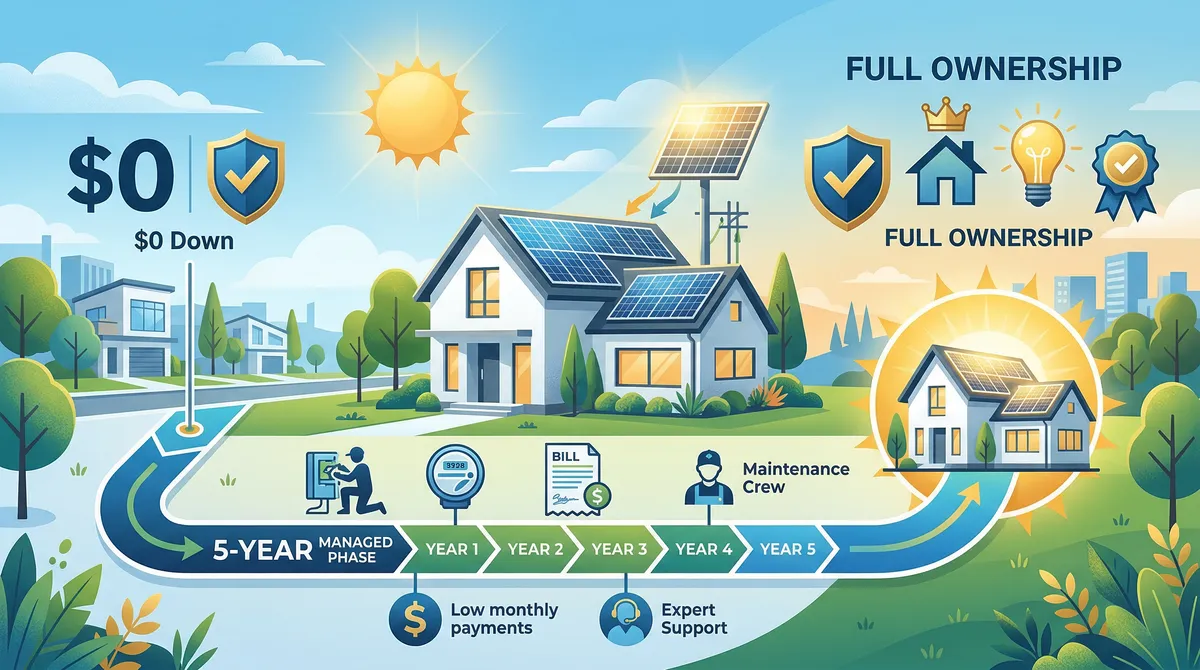
A clear, complete explanation of every step in the Propel solar financing process — from initial qualification through 25 years of ownership. No jargon, no sales pitch, just how it actually works.

Quick Answer
Propel solar works in 8 steps: (1) Prequalify online with a 660+ FICO in a live Propel state (ME, TX, MA, RI, CT) — a soft credit check with no impact to your score, (2) Get a custom system design with Silfab 440W panels, (3) Concert Finance originates a 25-year loan at 8.49–10.49% APR, (4) A third-party owner takes title and claims the 30% Section 48E ITC, (5) System is installed on your roof, (6) Years 1-5 you pay fixed monthly with an 85% performance guarantee and free maintenance, (7) At year 5 the Early Buyout Option is exercised on your behalf and ownership is designed to transfer to you, subject to the agreement terms, (8) After the transfer, the system is yours for the remaining years. $0 down, no dealer fees, no escalator. Domestic Content is required for all Propel projects.
From your first inquiry to 25 years of ownership — here is exactly what happens at each stage.
The first step runs entirely online, before you talk to anyone. Get an instant solar design for your address, choose Propel to see your fixed monthly payment, then run the soft-credit prequalification. You need a FICO score of 660 or higher (TransUnion), a single-family home or multi-unit property (up to 4 units) in Maine, Texas, Massachusetts, Rhode Island, and Connecticut, and a system in the typical residential size range — fit is confirmed when your design is prepared. The prequalification is a soft inquiry that will not affect your credit score, your Social Security number is never stored, and a decision typically returns in seconds.
NuWatt designs a custom solar system for your home using Silfab 440W FEOC-compliant panels. We analyze your roof orientation, shading, electricity usage, and utility rate to optimize system size. You receive a detailed proposal showing system size, estimated production, monthly payment by credit tier, and 25-year savings projection.
Once you accept the proposal, Concert Finance processes the full loan application. This is where the hard credit inquiry occurs. The loan is originated by Medallion Bank (Member FDIC) with 0% dealer fees, no prepayment penalty, and a 25-year term. Your APR is locked based on the credit tier Concert assigns you: 8.49% (Excellent), 9.49% (Very Good), 10.49% (Good). Those rates assume ACH auto-payments; paying another way adds 0.50 percentage points.
This is the step that makes Propel unique. A third-party business entity takes legal title to the solar system. This entity is the "owner" for federal tax purposes, which allows it to claim the Section 48/48E commercial Investment Tax Credit (30% base). Because the system uses FEOC-compliant Silfab panels, an additional 10% domestic content bonus may apply. If your property is in an energy community census tract, another 10% bonus is possible — up to 50% total ITC.
NuWatt installs the solar system on your roof. Installation typically takes 1-3 days depending on system size. We handle all permitting, utility interconnection paperwork, and inspections. Once the utility approves interconnection, your system goes live. Your first monthly payment begins after activation. From day one, you start offsetting your electric bill with solar production.
During the managed phase, the third-party owner holds title and provides a performance guarantee (85% of estimated kWh annually), free maintenance, and system monitoring. You pay one fixed monthly amount to Concert Finance — no escalator, no surprises. The loan includes three reamortization dates (after payments 12, 24, and 36) that can lower your payment if you make extra principal payments.
At month 60, the Early Buyout Option (EBO) is exercised by Concert Finance on your behalf. No additional paperwork, no extra payment, no negotiation: the pre-set buyout price was established at loan origination and built into your monthly payments. Legal title is designed to transfer from the third-party owner to you at that point, subject to the agreement terms. Once it does, the system is your asset — it adds value to your home, you can modify it, and you keep 100% of the electricity savings.
Once ownership has transferred, you own the system outright. Your monthly payment continues at the same fixed rate for the remaining 20 years, or you can pay off the balance early with no penalty. You retain the 25-year Silfab panel warranty, access to the Enphase Enlighten monitoring portal, and the 10-year roof penetration warranty. If you added a battery, the manufacturer app continues tracking battery health. All electricity savings are yours — no sharing with a third-party owner.
Propel involves three parties working together. Understanding who does what helps demystify the process.
Your monthly payment goes to Concert Finance, which manages the entire structure. Concert Finance pays the third-party owner for the ESA services. The third-party owner captures the ITC from the IRS. The savings from that ITC are what allow your payment to be 30-40% lower than it would be under a traditional loan for the same system.
NuWatt is the installer — we design, permit, install, and monitor the system. We are the face of the project and your point of contact for any questions or issues. Concert Finance is the financial engine, and the third-party owner is the tax structure that makes the ITC accessible.
Why can't homeowners claim the ITC directly?
The residential solar tax credit (Section 25D) expired December 31, 2025. Individual homeowners can no longer claim any federal tax credit for solar installations. The commercial ITC (Section 48/48E) is only available to business entities. By using a third-party business owner, Propel accesses this commercial credit and passes the savings to you through the loan structure. You do not need to do anything on your tax return — the benefit is already built into your lower payment.
Section 48E is the successor to Section 48 for clean energy projects. It provides a base credit of 30% of the installed cost for qualifying energy property. Because Propel uses a business entity as the system owner, the installation qualifies as commercial energy property regardless of the fact that it sits on a residential roof.
The credit can be enhanced with two bonuses:
The Federal Energy Oversight Committee (FEOC) sets domestic content requirements. If the solar installation uses panels manufactured in the United States, the ITC increases by 10 percentage points. Propel requires Silfab 440W panels precisely because they are made in the USA and meet FEOC requirements. This bonus is effectively guaranteed for every Propel installation.
The Section 48E begin-construction window closed July 4, 2026. Projects that began construction on or before that date locked in the full timing pathway; projects starting now still qualify for the 30% credit but generally must be placed in service by December 31, 2027. NuWatt manages construction scheduling, so this is handled on our end — your deadline is the September 30, 2026 application deadline for Concert Finance.
If your property is located in a qualifying energy community census tract (areas with historical fossil fuel employment or recent coal plant/mine closures), the ITC increases by another 10 percentage points. NuWatt checks your address against the current energy community map during the proposal stage. This bonus brings the total potential ITC to 50% of system cost.
| Scenario | ITC % | Credit Value | Effective Cost |
|---|---|---|---|
| Base ITC only | 30% | $9,000 | $21,000 |
| Base + FEOC (typical) | 40% | $12,000 | $18,000 |
| Base + FEOC + Energy Community | 50% | $15,000 | $15,000 |
| Traditional loan (no ITC) | 0% | $0 | $30,000 |
The ITC value is captured by the third-party owner and embedded in your lower monthly payment. You do not receive a check or file anything with the IRS.
Propel also includes a post-signing REC assignment process: the system owner issues a waiver so you, the homeowner, retain your renewable-energy-certificate (REC) value and any applicable local incentives.
Propel has specific requirements. Not every homeowner will qualify, and that is by design — the financing structure requires certain conditions to work.
What if my state is on the waitlist?
Concert Finance is still expanding Propel. NuWatt now offers it in Maine, Texas, Massachusetts, Rhode Island, and Connecticut, and New Hampshire, New Jersey, Vermont, and Pennsylvaniaremain on the waitlist. If you are in a waitlist state, you can submit your information for early notification. Availability depends on Concert Finance's state-by-state regulatory approvals and utility agreements. Massachusetts homeowners can go straight to the Massachusetts Propel page to prequalify.
There are two key deadlines you need to know about. Missing either one could mean losing access to Propel financing or the full ITC.
July 4, 2026 — Section 48E Begin-Construction Window (Closed)
The begin-construction window for the full Section 48/48E ITC with the FEOC domestic content bonus closed July 4, 2026. Projects that began construction on or before that date locked in the full timing pathway (placed in service through roughly 2030). Projects starting now still qualify for the 30% credit, but generally must be placed in service by December 31, 2027. The One Big Beautiful Bill Act (OBBBA) set this framework. NuWatt manages construction scheduling, so this is handled on our end.
September 30, 2026 — Propel Application Deadline
This is your deadline. Propel applications through Concert Finance must be submitted by September 30, 2026. After this date, the current rate structure and program terms are not guaranteed. The application involves a soft credit pull, so there is no risk in checking your eligibility early.
Given permitting and utility timelines, it pays to start soon: the Section 48E benefit is time-bound, and projects starting now must be placed in service by December 31, 2027. NuWatt manages construction and interconnection scheduling, and an earlier start gives us more flexibility and helps you avoid municipal permitting delays.
Myth: Propel is just a solar lease with a different name.
Reality: Propel is built around an ownership option at year 5 that the loan pre-funds; leases never transfer ownership at all. Propel payments are fixed; lease payments escalate 1.99-2.99% annually. Once ownership transfers, you hold the system and all savings — lease customers never do.
Myth: The 8.49–10.49% APR means Propel is a bad deal.
Reality: The APR only tells part of the story. Traditional loans may have lower rates (4-7%), but in 2026 they offer $0 federal tax credit. Propel captures a 30-50% ITC that reduces your effective cost by $9,000-$15,000. The total cost of ownership over 25 years is competitive with or better than a traditional loan when you account for the ITC.
Myth: I can get the same tax credit by buying solar myself.
Reality: Not since January 1, 2026. The residential ITC (Section 25D) expired at the end of 2025. Only business entities can claim the commercial ITC (Section 48/48E). Propel uses a third-party business owner to access this credit on your behalf. There is no way for an individual homeowner to claim it directly.
Myth: The third-party owner can take back my solar system.
Reality: The third-party owner exists solely to own the system and claim the tax credit. The ESA and loan contracts are binding — the owner cannot remove the system as long as you make your payments. On the Concert loan path, the loan pre-funds the Early Buyout Option, so ownership is designed to transfer to you at year 5, subject to the agreement terms, and the owner does not retain the system beyond that if you are current on your loan.
Myth: Propel and the SolSource/TriBeam "Propel" are two different products.
Reality: They are the same program seen from different points in the chain. SolSource (a TriBeam company) owns the system and provides the performance guaranty; TriBeam's Concert Finance program originates the financing (loans by Medallion Bank); Greentech Renewables distributes it; and NuWatt installs it in ME, TX, MA, RI, CT. The hardware is Enphase microinverters and battery paired with FEOC-compliant Silfab panels — one program, not two.
Once ownership has transferred at year 5, your relationship with Propel changes. Here is what continues, what changes, and what you can expect for the remaining 20 years of the loan term.
After year 5, solar systems require minimal maintenance — occasional cleaning and a glance at your Enphase Enlighten app to confirm production is on track. The Silfab panels are warranted for 25 years, so equipment failure is unlikely. Most homeowners find that years 5-25 are the most rewarding period: you own the system, your payment is the same as it has always been, and rising utility rates make your solar savings grow every year.
The typical timeline from initial application to system activation is 6-12 weeks. This includes the credit check (1-2 days), system design and proposal (1-2 weeks), permitting (2-4 weeks depending on your municipality), installation (1-3 days), and utility interconnection (1-4 weeks). NuWatt handles the entire process and keeps you updated at each stage.
A Prepaid ESA is a contract where a third-party business entity owns and operates the solar system on your roof for a set period. You prepay for the energy services (production, maintenance, monitoring) through your monthly loan payment to Concert Finance. The ESA allows the third-party owner to claim the Section 48/48E commercial ITC because they are the legal system owner. After year five the ESA winds down and ownership is designed to transfer to you, subject to the agreement terms.
On the Concert loan path, no extra step is required from you: the loan pre-funds the Early Buyout Option (EBO), which Concert Finance exercises on your behalf at the pre-set price already built into your payments. You do not sign additional paperwork, make an extra payment, or negotiate a buyout price, and the EBO price set at loan origination does not change. Ownership is an option beginning after year five and is subject to the agreement terms, so review your own documents for the exact mechanics that apply to you.
During years 1-5, the third-party owner is responsible for the solar system, including any maintenance or repairs related to the solar installation. If your roof needs unrelated repairs (storm damage, age-related issues), you would coordinate with NuWatt to temporarily remove and reinstall panels. The 10-year roof penetration warranty covers any leaks caused by the solar mounting system.
During the 5-year managed phase, you cannot modify the system because the third-party owner holds title. Once ownership has transferred to you after year five, you can add panels, upgrade inverters, or add a battery. Any additions at that point would need separate financing since they would not be covered by the original Propel loan.
You can do the whole first step online. Get an instant solar design for your address, choose Propel to see your fixed monthly payment, then run the soft-credit prequalification. It is a soft pull only, so there is no impact to your credit score, your Social Security number is never stored, and a decision typically comes back in seconds. Propel requires a minimum 660 FICO score and a homeowner who lives at the installation address in a live Propel state (ME, TX, MA, RI, CT). The full requirement list is on the Propel eligibility guide.
You should notify your homeowners insurance company about the solar installation. Most policies cover rooftop solar under the dwelling coverage with no premium increase. During the managed phase, the third-party owner carries their own insurance on the equipment. If you exercise the ownership option (available beginning after year five, subject to the agreement terms), the system becomes your asset and is covered under your homeowners policy like any other home improvement.
Results-based pricing means your APR is determined by your credit profile, not a one-size-fits-all rate. Concert Finance evaluates your FICO score (TransUnion) and assigns one of three rate tiers named for credit quality: 8.49% (Excellent), 9.49% (Very Good), 10.49% (Good). Concert does not publish score cutoffs for the tiers, so no score band can be quoted in advance — the soft inquiry returns your actual tier, and it does not affect your credit score. There is also a separate Standard RBP4 product at 9.69%, which is not one of the credit tiers. Every APR here assumes ACH auto-payments are enrolled; paying another way adds 0.50 percentage points. Rates effective May 25, 2026.
Propel loans have three reamortization dates — after the 12th, 24th, and 36th monthly payments. At each date, if you have made extra principal payments, your loan is recalculated with a lower balance, which reduces your monthly payment going forward. This gives you flexibility: make extra payments when you can, and your required payment drops at the next reamortization date. There is no penalty for extra payments.
Prequalify online in a few minutes: an instant design for your roof, then a soft credit pull that will not affect your score. Available in Maine, Texas, Massachusetts, Rhode Island, and Connecticut. The full requirement list is on the Propel eligibility guide.
Propel financing provided by Concert Finance. Loans originated by Medallion Bank, Member FDIC.
Propel Solar Financing Review 2026
Independent review with pros, cons, and rating.
Propel Solar Financing Guide
The complete guide to Propel financing terms and state analysis.
Propel Cost Calculator
Estimate your payment by system size and credit tier.
Propel vs Sunrun Lease
Head-to-head comparison with Sunrun solar lease.
Propel Eligibility Guide
Detailed qualification requirements and tips.
Propel Main Page
Qualifier tool, rate calculator, and state routing.
Elena helps homeowners plan whole-home electrification projects — solar, heat pumps, batteries, and EV charging. She focuses on financing strategies and long-term energy savings.