Loading NuWatt Energy...

We use your location to provide localized solar offers and incentives.
We serve MA, NH, CT, RI, ME, VT, NJ, PA, and TX
Loading NuWatt Energy...
NuWatt designs, installs, and manages solar, battery, heat pump, and EV charger systems across 9 states. One company, one warranty, one point of contact.
Get a Free Quote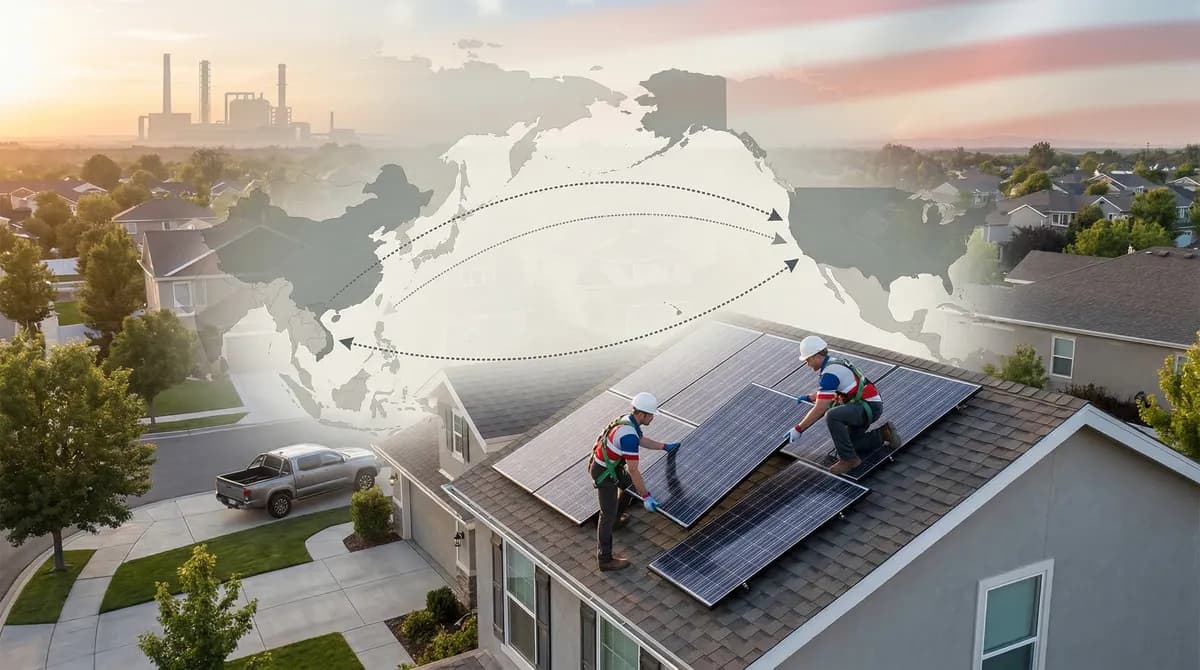
Tariffs add $0.05-0.15/W to imported solar panels. FEOC rules determine which panels qualify for the 10% domestic content bonus. Here is what homeowners need to know as of March 2026.
Quick Answer
Solar panel tariffs in 2026 add $0.05-0.15 per watt to imported panels, primarily affecting Chinese-made and Southeast Asian modules. FEOC (Foreign Entity of Concern) rules mean panels from Chinese-owned companies cannot qualify for the 10% domestic content bonus under Section 48E. NuWatt offers three tariff-free, FEOC-compliant panel options: Hyundai 440W (entry, -$0.07/W), Silfab 440W (American-made, required for Propel financing), and REC 460W (premium, +$0.19/W). The 48E begin-construction safe harbor closed July 4, 2026 — projects that began construction by then locked in the full timing pathway, and projects starting now still qualify for the 30% ITC if placed in service by December 31, 2027.
The United States has layered multiple trade protections on solar panel imports over the past decade. As of March 2026, there are three primary tariff mechanisms affecting solar panel prices:
These duties target solar cells and modules sold below fair market value or subsidized by foreign governments. Originally imposed on Chinese manufacturers in 2012, they were expanded in 2024-2025 to cover Southeast Asian assembly operations that used Chinese cells.
A Section 232 proclamation signed August 6, 2026 adds a 15% duty on imported polysilicon-based solar products, including solar cells and modules, plus minimum import prices of $0.22 per watt for cells and $0.38 per watt for modules, for goods entered on or after December 4, 2026. For imports from the EU, Japan, South Korea, Taiwan, Switzerland, and Liechtenstein, the Section 232 duty is set so the combined rate with normal U.S. duties equals 15%; U.K. imports pay 10%. It follows the Section 201 safeguard tariff, which expired February 6, 2026 after reaching its 8-year legal limit. Panels assembled in the US from imported cells carry the duty on those cells.
These broader trade tariffs target Chinese goods across many industries. For solar panels, Section 301 adds 25% on top of any AD/CVD duties. Combined with anti-dumping rates, Chinese-origin panels face total duties that can exceed 250%, making direct import from China economically unviable.
| Manufacturing Region | Duty Type | Rate | Price Impact | Status |
|---|---|---|---|---|
| China (Direct) | AD/CVD + Section 301 | 30-250% | Effectively blocked from US market | Active |
| Southeast Asia (Vietnam, Thailand, Malaysia, Cambodia) | AD/CVD (2024-2025 determinations) | 14.25-271.28% | +$0.05-0.15/W depending on manufacturer | Active |
| South Korea | None (allied nation) | 0% | No tariff premium | Exempt |
| Canada / USA | Domestic manufacturing | 0% | No tariff + domestic content bonus eligible | Exempt + Bonus |
| Norway / Europe | None (allied nation) | 0% | No tariff premium | Exempt |
Bottom line: Tariffs have compressed the price gap between imported and domestic panels. In many cases, choosing a tariff-free domestic manufacturer like Silfab costs the same as — or less than — an imported panel after duties are applied.
FEOC stands for Foreign Entity of Concern. Under IRS guidance implementing Section 48 and 48E of the Internal Revenue Code, solar equipment from companies owned by or headquartered in designated countries cannot qualify for the 10% domestic content bonuson the Investment Tax Credit.
Companies headquartered in these countries, or with 25%+ ownership by entities in these countries, are classified as FEOC under Treasury guidance.
FEOC does NOT ban the equipment — it disqualifies it from the domestic content bonus. You can still install Chinese-made panels, but the financing company loses the extra 10%.
A common misconception is that FEOC only applies to panels physically made in China. In reality, FEOC rules look at corporate ownership. A panel assembled in Vietnam by a Chinese-headquartered company (like LONGi, JA Solar, or Trina) is still FEOC-restricted, because the parent company is a Foreign Entity of Concern.
Conversely, Qcells panels assembled at their Georgia factory qualify as FEOC-compliant because Qcells is headquartered in South Korea (Hanwha Group), not in an FEOC country. The same logic applies to Silfab (Canada/US), REC (Norway), and Hyundai (South Korea).
Despite its name, Canadian Solar (CSI Solar) is headquartered in China (Suzhou) and is classified as FEOC. Panels branded "Canadian Solar" do not qualify for the domestic content bonus, regardless of where they are assembled. This catches many buyers off guard. Always verify the parent company's country of incorporation, not just the brand name.
Every panel NuWatt offers avoids tariff exposure and meets FEOC compliance requirements. We deliberately chose manufacturers from allied nations (South Korea, Norway) and domestic production (USA) so that our customers never face tariff surcharges or lose access to ITC bonuses.
Entry — Best Value
Best for: Cash/loan buyers seeking lowest price
Standard — American-Made
Best for: Propel financing (required), domestic content bonus
Premium — Top Efficiency
Best for: Maximum long-term output, limited roof space
| Panel | $/W | 8 kW Total | vs. Base |
|---|---|---|---|
| Hyundai 440W (Entry) | $3.09/W | $24,720 | -$560 |
| Silfab 440W (Standard) | $3.16/W | $25,280 | Base |
| REC 460W (Premium) | $3.35/W | $26,800 | +$1,520 |
Based on MA Silfab base price of $3.16/W at 8 kW. Hyundai offset: -$0.07/W. REC offset: +$0.19/W. Actual price varies by system size and state. As of March 2026.
Propel is NuWatt's $0-down solar financing program, available in Maine and Texas. It uses a third-party ownership (PPA) structure where the financing company owns the system, claims the Section 48E commercial ITC, and passes the savings to you through lower monthly payments.
Base ITC (48E)
Domestic Content
Energy Community
Low-Income
Maximum possible ITC: up to 70%. The domestic content bonus (+10%) requires FEOC-compliant, US-manufactured equipment. Silfab panels, made in Washington and New York, satisfy this requirement. Without Silfab, the financing company loses 10 percentage points of the ITC — and that lost savings gets passed on to you as a higher monthly payment.
Tariffs do not appear as a line item on your solar proposal. They are baked into the equipment cost that installers pay. But understanding tariff exposure helps explain why some "cheap" panels are not actually cheap — and why domestic panels have become increasingly competitive.
Chinese-Cell Panel (After Tariffs)
$0.35-0.50/W
wholesale panel cost after AD/CVD + Section 301
System impact: $400-$1,200 added to an 8 kW system vs. pre-tariff pricing. No domestic content bonus eligibility.
Silfab 440W (No Tariffs)
$0.40-0.50/W
wholesale panel cost — domestic manufacturing
System impact: $0 tariff exposure. Qualifies for 10% domestic content ITC bonus — potentially worth $2,500+ on an 8 kW system.
The math is clear: after tariffs, Chinese-cell panels cost roughly the same as domestic alternatives. But domestic panels unlock the 10% domestic content bonus, making them the better financial choice for any project using third-party financing (PPA, lease, or Propel).
For cash and loan buyers: Since you are not using the Section 48E ITC (the residential 25D credit expired December 31, 2025), the domestic content bonus does not directly apply to your purchase. Choose the panel that best fits your budget: Hyundai 440W for value, Silfab 440W for American-made quality, or REC 460W for maximum performance.
Begin-Construction Safe Harbor
July 4, 2026
Closed
begin-construction window as of July 4, 2026
The One Big Beautiful Bill Act (OBBBA), signed July 4, 2025, treated July 4, 2026 as a begin-construction safe harbor for the Section 48/48E Investment Tax Credit — not an expiration date. Projects that began construction on or before that date locked in the full timing pathway, with placement in service through roughly 2030. Projects starting now still qualify for the 30% ITC, but generally must be placed in service by December 31, 2027.
What this means for homeowners: If you are considering a PPA, lease, or Propel financing, the financing company still captures the full 30% ITC stack — and passes those savings to you. With the begin-construction safe harbor now closed, new projects generally must be placed in service by December 31, 2027, so closing sooner keeps your timeline (and your savings) the most predictable.
Your ideal panel tier depends on three factors: how you finance, how much roof space you have, and how long you plan to stay in your home. Here is a decision framework:
Your choice: Silfab 440W (required).Propel's PPA structure requires FEOC-compliant domestic panels to capture the 10% domestic content ITC bonus. Silfab is the only option — and it is an excellent one: made in USA, 30-year performance warranty, zero tariff risk.
Learn about Propel $0-down financingBest value: Hyundai 440W. Without the Section 48E ITC (which requires third-party ownership), the domestic content bonus does not apply to your purchase. The Hyundai 440W gives you the lowest cost per watt at -$0.07/W from base price. For an 8 kW system, that is $560 in savings.
Best performance: REC 460W.If you have limited roof space or want the highest long-term energy output, REC's 460W panel delivers 20 extra watts per panel with the industry's lowest degradation rate. The +$0.19/W premium adds $1,520 to an 8 kW system but produces more electricity over 25 years.
Recommended: Hyundai 440W. Since you finance the full system cost without any federal tax credit (Section 25D expired December 31, 2025), keeping the financed amount as low as possible is critical. At 6-8% APR, every $1,000 more in principal costs an extra $700-$900 over 20 years. The Hyundai 440W minimizes that burden while delivering strong performance and a 25-year product warranty.
| Factor | Hyundai 440W | Silfab 440W | REC 460W |
|---|---|---|---|
| Best for cash purchase | -- | -- | |
| Best for Propel/PPA | -- | -- | |
| Best for loan | -- | -- | |
| Domestic content bonus | -- | -- | |
| Lowest cost per watt | -- | -- | |
| Highest wattage per panel | -- | -- | |
| Made in USA | -- | -- | |
| Best for limited roof space | -- | -- | |
| Zero tariff exposure | |||
| FEOC compliant |
These manufacturers have US-based production facilities that satisfy domestic content requirements for the Section 48E ITC bonus. Choosing equipment from these companies protects against tariff exposure and maximizes the available ITC stack.
First Solar
Ohio, Alabama, Louisiana -- CdTe Thin Film
Qcells
Georgia -- Monocrystalline PERC
Silfab Solar
Washington, New York -- Monocrystalline
Meyer Burger
Arizona -- Heterojunction
Mission Solar
Texas -- Monocrystalline PERC
Enphase Energy
Multiple US locations -- Microinverter
SolarEdge
Texas, Florida -- String + Optimizer
Tesla
California, New York -- String Inverter
IronRidge
Roof Mount
Unirac
Roof & Ground Mount
GameChange Solar
Ground Mount & Tracker
Array Technologies
Single-Axis Tracker
Solar panel tariffs are import duties imposed on panels manufactured in certain countries. In 2026, anti-dumping and countervailing duties (AD/CVD) on Chinese-made solar cells range from 30-250%, and additional tariffs apply to panels assembled in Southeast Asia. These tariffs add $0.05-0.15 per watt to panel costs, which translates to $400-$1,200 more for a typical 8 kW residential system.
FEOC stands for Foreign Entity of Concern. Under IRS guidance for Section 48/48E, solar equipment manufactured by companies headquartered in China, Russia, Iran, or North Korea cannot qualify for the 10% domestic content bonus on the Investment Tax Credit. This rule applies to the company's ownership, not just where the panel is assembled.
Panels from non-Chinese-owned manufacturers are FEOC compliant. Examples include Silfab (Canadian/US), REC (Norwegian), Hyundai (Korean), Qcells (Korean/US), and First Solar (American). Panels from Chinese-owned companies like LONGi, JA Solar, Trina, and Canadian Solar (despite the name) are NOT FEOC compliant.
Propel is a third-party ownership financing program that uses the Section 48E commercial ITC. To qualify for the 10% domestic content bonus (which helps reduce your monthly payment), the system must use FEOC-compliant, domestically manufactured panels. Silfab panels are made in the USA (Washington and New York) and meet all domestic content requirements.
Under the One Big Beautiful Bill Act (OBBBA), the Section 48/48E begin-construction safe harbor closed July 4, 2026 — it was never an expiration date for the credit. Projects that began construction on or before July 4, 2026 locked in the full timing pathway (placed in service through roughly 2030). Projects starting now still qualify for the 30% ITC, but generally must be placed in service by December 31, 2027. For homeowners using PPA or lease financing, the financing company still claims the 30% ITC (plus the 10% domestic content bonus for FEOC-compliant equipment); the practical constraint on new projects is now the December 31, 2027 placed-in-service deadline.
No. Tariffs vary dramatically by manufacturer origin. Chinese-cell panels face the highest duties (30-250% AD/CVD). Southeast Asian panels (Vietnam, Thailand, Malaysia, Cambodia) face 14.25-271.28% tariffs as of 2024-2025 determinations. Korean (Hyundai, Qcells), Norwegian (REC), and American-made (Silfab, First Solar) panels avoid these duties entirely, though they have higher base manufacturing costs.
Before tariffs, Chinese-made panels cost $0.15-0.25/W at wholesale. After AD/CVD duties, they cost $0.30-0.50/W or more. Domestic and allied-nation panels (Silfab, REC, Hyundai) cost $0.35-0.55/W at wholesale. The price gap has narrowed significantly due to tariffs — and FEOC-compliant panels unlock the 10% domestic content bonus under 48E, potentially saving more than the price premium.
Additional tariffs could raise panel costs by another $0.05-0.10/W. However, domestic manufacturing capacity is expanding rapidly — Silfab, Qcells, and First Solar are all increasing US production. As domestic supply grows, the tariff impact on overall system prices should moderate. Choosing a domestic manufacturer now also insulates you from future tariff escalations.
It depends on your financing method. If you are financing through Propel (PPA), Silfab 440W is required for FEOC compliance. For cash or loan purchases, Hyundai 440W offers the best value at -$0.07/W from base price. REC 460W is the premium choice for maximum long-term performance at +$0.19/W. All three are tariff-free and FEOC compliant.
Yes, Chinese-manufactured panels are legal to install. The tariffs and FEOC rules do not ban them — they impose financial penalties. You can still buy and install Chinese-made panels, but they cost more due to import duties, and any third-party financing system using them cannot claim the 10% domestic content ITC bonus under Section 48E.
Every NuWatt system uses panels from allied-nation or domestic manufacturers. No tariff surcharges, no FEOC risk, no surprises on your proposal.
Last updated March 16, 2026. Tariff rates sourced from US International Trade Commission and Department of Commerce determinations. FEOC guidance from IRS Notice 2024-30 and Treasury Final Rule on FEOC (December 2024). Pricing data reflects NuWatt channel pricing as of March 2026.