Loading NuWatt Energy...

We use your location to provide localized solar offers and incentives.
We serve MA, NH, CT, RI, ME, VT, NJ, PA, and TX
Loading NuWatt Energy...
Use the free estimator for a preliminary layout, or share your preferred response method with the commercial team. Final feasibility still requires site, utility, and engineering review.
Texas has no statewide net metering. Your commercial solar export value depends on REP buyback plans (3¢ to 16.9¢/kWh), municipal utility programs, and self-consumption optimization. This guide covers every option in the ERCOT deregulated market.
Best REP Buyback
16.9¢
Rhythm Solar Buyback
Austin VoS
9.91¢
Best municipal rate
CPS Energy
3-4¢
Worst major utility
Self-Consumption
6-11¢
Behind-the-meter value
Texas has no statewide net metering. In the ERCOT deregulated market (85% of the state), commercial solar exports are compensated through voluntary REP buyback plans with rates ranging from 5¢ to 16.9¢/kWh. Rhythm Energy offers the highest at 16.9¢/kWh (retail-match), Green Mountain offers retail-match, TXU SolarSpree pays 8.9¢/kWh fixed. Municipal utilities have separate programs: Austin Energy's Value of Solar pays 9.91¢/kWh (the best in TX), while CPS Energy in San Antonio pays only 3-4¢/kWh avoided cost. Because export values vary so widely, self-consumption optimization is more important in Texas than in true net metering states — every kWh consumed on-site avoids $0.06-$0.11/kWh in retail charges, often more than the export value.
Unlike most U.S. states, Texas does not mandate net metering for any utility — there is no state law requiring utilities or retail electric providers (REPs) to credit commercial solar exports at retail rates. This is a direct consequence of Texas's deregulated electricity marketunder ERCOT, which covers approximately 85% of the state's load. In the deregulated market, competitive REPs voluntarily offer solar buyback plans as a product differentiator, with rates and terms that vary dramatically.
The remaining 15% of Texas is served by municipal utilities (Austin Energy, CPS Energy, Bryan Texas Utilities) and electric cooperatives (Pedernales, CoServ, GVEC), which set their own solar compensation policies. Austin Energy stands out with its Value of Solar (VoS) program at 9.91¢/kWh, the most generous municipal solar rate in Texas. CPS Energy in San Antonio, by contrast, offers only 3-4¢/kWh avoided cost, making it one of the least favorable markets for solar exports.
For commercial solar operators, this fragmented landscape creates a critical design decision: how much of your solar production should you export versus consume on-site?In true net metering states, this question is less important because exports receive full retail credit. In Texas, the answer depends entirely on your specific utility territory and REP plan. Self-consumption optimization — sizing your system to match your building's daytime load profile and minimizing exports — is almost always the highest-value strategy.
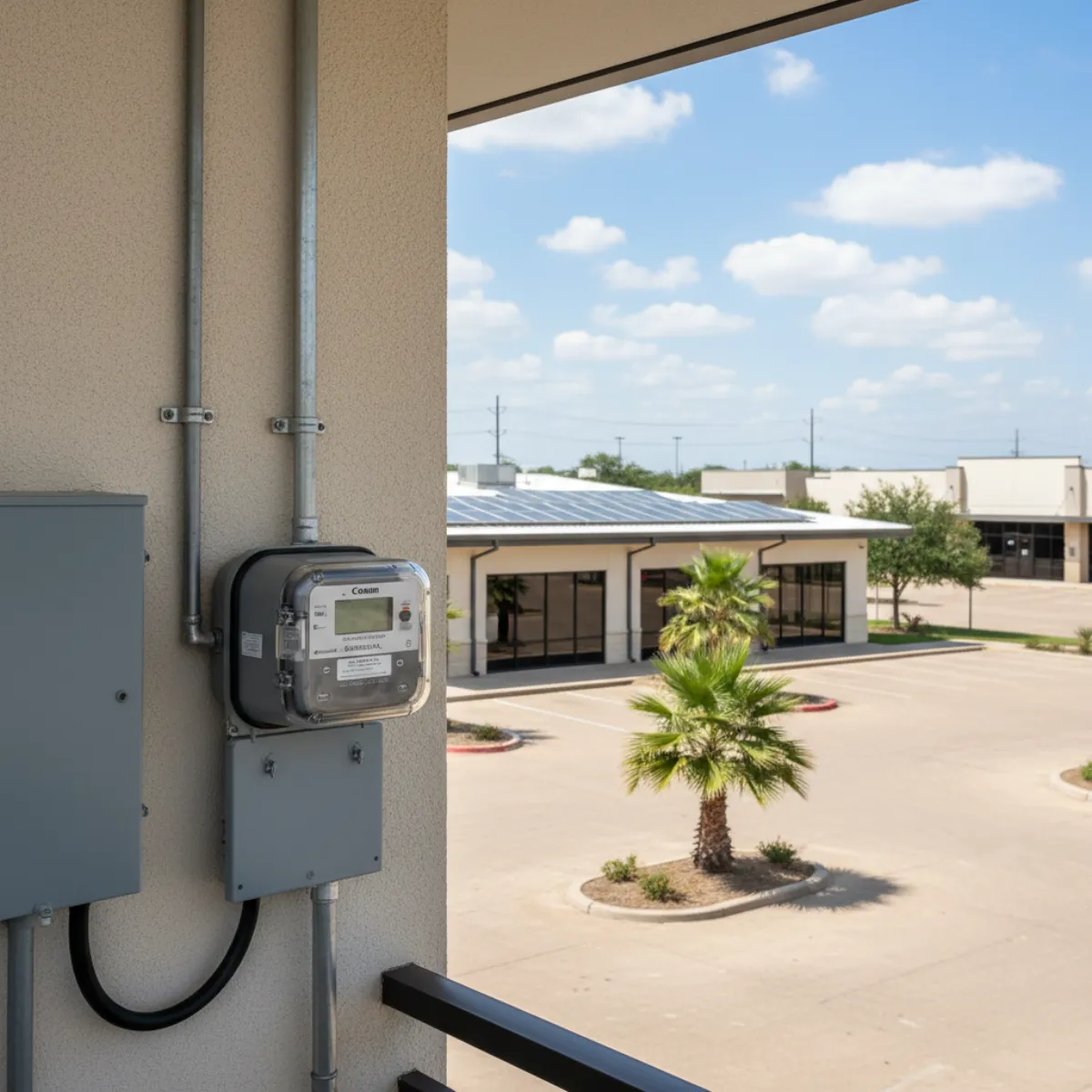
In the ERCOT deregulated market, Retail Electric Providers (REPs) compete for commercial customers by offering solar buyback plans with varying rates and structures. The best plans offer retail-match buyback — effectively functioning like 1:1 net metering. Lower-tier plans pay a fixed rate that may be well below your consumption rate. Commercial properties can also negotiate custom buyback terms as part of larger electricity supply contracts.
Solar Energy Buyback
Retail-match
Highest buyback rate available. 100% renewable energy. Monthly net billing — credits at same rate as consumption. Effectively functions like 1:1 net metering. Best for high-export systems.
Solar Buyback
Retail-match
Credits excess solar at the same retail rate you pay for consumption. One of the oldest solar buyback programs in TX. Available for commercial accounts with some restrictions on system size.
SolarSpree
Fixed buyback
Fixed buyback rate regardless of consumption rate. Major REP with strong commercial account support. Good for businesses with predictable solar production but higher consumption rates.
Solar Buyback
Retail-match
Community solar provider that offers direct solar buyback. 100% solar energy plan. Lower rate but matching buyback creates predictable economics.
Solar Buyback
Negotiated
Large commercial REP that offers negotiated solar buyback rates as part of custom commercial contracts. Rates depend on system size, production profile, and term length.
Solar Buyback
Negotiated
Offers solar buyback as an add-on to commercial electricity plans. Buyback rates negotiable for larger commercial accounts.
Solar Sellback
Negotiated
Houston-area focused. Solar sellback rate depends on contract terms and generation capacity. Commercial negotiation available.
Large commercial accounts (500+ kW demand) can negotiate solar buyback terms beyond published plans. Request solar riders or addendums to your commercial supply contract. Get competitive bids from at least 3 REPs with buyback included. Consider working with a TX energy broker who specializes in commercial solar contracts. Time your contract renewal to coincide with solar installation for maximum negotiating leverage.
Texas municipal utilities operate outside the ERCOT deregulated market and set their own solar compensation policies. The differences are stark — Austin Energy's VoS at 9.91¢/kWh is nearly three times CPS Energy's 3-4¢/kWh avoided cost rate. If your commercial property is in a municipal utility territory, the solar economics are primarily determined by your utility's policy.
Value of Solar (VoS)
Monthly credit on bill at VoS rate for all solar production. Separate from consumption charge. Production and consumption are not netted — you are credited for production and charged for consumption independently.
Highest municipal buyback in TX. Stable, predictable rate. Updated annually but grandfathered for existing customers.
Not available outside Austin Energy territory. Rate has decreased from ~11¢ (2019) as methodology is updated. Only for Austin Energy commercial customers.
Territory: City of Austin, Travis County (partial)
Avoided Cost Solar
Exports credited at avoided cost rate — the marginal cost CPS Energy would have paid to generate or purchase that energy. Much lower than retail rate.
San Antonio is a large commercial market. CPS has good solar interconnection processes.
Worst buyback rate among major TX utilities. 3-4¢/kWh makes solar exports nearly worthless. System must be sized for maximum self-consumption.
Territory: City of San Antonio, Bexar County (partial)
Member Solar
Monthly credit for excess generation at avoided cost. Co-op territory surrounding Austin.
Large co-op service area in Hill Country. Growing solar adoption.
Low buyback rate. Limited commercial options. Co-op board sets rates.
Territory: Hill Country (west of Austin)
Net Metering
True net metering for grandfathered systems. New systems under avoided cost rate.
Grandfathered commercial systems get full retail net metering. Excellent solar resource (El Paso = 302 sunny days/year).
New installations no longer qualify for retail net metering. Avoided cost rate for new systems is much lower.
Territory: El Paso metro, Far West TX
In Texas, self-consumed solar kWh is almost always worth more than exported kWh — except in Austin Energy territory where the VoS can exceed retail rates for some commercial customers. This table shows the value differential across the three main utility environments in Texas.
| Metric | ERCOT Deregulated | Austin Energy | CPS Energy |
|---|---|---|---|
| Value of Self-Consumed kWh | $0.06-$0.11/kWh (retail rate) | $0.06-$0.09/kWh (retail rate) | $0.07-$0.10/kWh (retail rate) |
| Value of Exported kWh | $0.05-$0.169/kWh (REP buyback) | $0.0991/kWh (VoS) | $0.03-$0.04/kWh (avoided cost) |
| Self-Consumption Premium | 0-6¢/kWh | -4¢ to +3¢/kWh | +3-7¢/kWh |
| Optimal Sizing Strategy | Size for 80-100% self-consumption with good REP | Can oversize — VoS is generous | Size strictly for self-consumption |
| Battery Value-Add | High — 4CP + demand charge reduction | Moderate — backup + demand mgmt | High — avoids worthless exports |
If your commercial property is in CPS Energy territory (San Antonio), exporting solar electricity is effectively throwing away value. At 3-4¢/kWh avoided cost, exports are worth less than one-third of the retail rate. Size your solar system to match 80-90% of daytime load and consider battery storage to capture midday overproduction for evening use. Every kWh you self-consume saves 3-7¢ more than exporting it.
Beyond energy buyback, commercial solar in Texas provides significant value through demand charge reduction and 4CP avoidance. These behind-the-meter savings often exceed the value of exported energy and are available regardless of your REP buyback rate. For large commercial loads, 4CP avoidance alone can justify a solar installation.
ERCOT transmission costs are allocated based on a commercial customer's demand during the four highest peak demand intervals of the year (June-September, typically 3-5 PM). Solar production during these peaks directly reduces transmission cost allocation. A 200 kW reduction in 4CP demand can save $10,000-$25,000+ annually depending on the TDU.
Combine solar production with battery storage to reduce maximum demand (kW) readings. Demand charges can be $7-$15/kW/month in Texas. Reducing peak demand by 100 kW saves $8,400-$18,000/year in demand charges alone, independent of energy savings.
Store midday solar production in batteries and discharge during evening peak periods when ERCOT real-time prices spike. Summer 2025 saw real-time prices exceed $5,000/MWh during multiple peak events. Battery arbitrage can be highly profitable in ERCOT.
Right-size the solar system to match the building's daytime load profile, minimizing exports. In Texas's deregulated market where export values range from 3¢ to 17¢/kWh, maximizing self-consumption at $0.06-$0.11/kWh retail rates ensures every kWh generated displaces a kWh purchased.
Total behind-the-meter value: $0.08-$0.14/kWh equivalent — often exceeding the export value with most REP plans.
Complete guide: ITC stacking, MACRS, ERCOT commercial rates, pricing, and ROI analysis.
Calculate your energy savings by metro, TDU, and REP plan with real-time rate data.
Complete residential solar buyback guide for Texas with REP plan comparisons.
Side-by-side REP solar buyback rate comparison for Texas in 2026.
Why Texas has no net metering and how solar buyback plans compare.
How ERCOT deregulation affects solar economics, REP choice, and demand charges.
No. Texas does not have statewide net metering. Instead, the deregulated ERCOT market (which covers approximately 85% of the state) relies on Retail Electric Provider (REP) buyback plans that vary widely in rates and terms. Some REPs offer retail-match buyback (Rhythm Energy at 16.9¢/kWh, Green Mountain at retail rate), while others offer lower fixed rates (TXU at 8.9¢, Chariot at 8.5¢). Municipal utilities have their own programs: Austin Energy's Value of Solar pays 9.91¢/kWh, while CPS Energy in San Antonio only pays 3-4¢/kWh avoided cost. This fragmented landscape means the export value of commercial solar varies enormously depending on location and REP choice.
We analyze your utility territory, load profile, and REP options to design a system that maximizes self-consumption and behind-the-meter savings.