Loading NuWatt Energy...

We use your location to provide localized solar offers and incentives.
We serve MA, NH, CT, RI, ME, VT, NJ, PA, and TX
Loading NuWatt Energy...
NuWatt designs, installs, and manages solar, battery, heat pump, and EV charger systems across 9 states. One company, one warranty, one point of contact.
Get a Free QuoteIRC §179D rewards Texas commercial building owners — and designers of tax-exempt buildings — for HVAC, lighting, and envelope upgrades that cut energy use at least 25% below ASHRAE 90.1. In Texas it is a purely federal play: with no state income tax, the deduction’s cash value is your federal marginal rate times the per-square-foot amount, full stop. For an eligible 100,000 sq ft project that began construction by June 30, 2026, the 2026 PWA cap can translate to roughly $125k in federal tax savings at a 21% corporate rate.
$5.94
Max PWA /sq ft (2026)
25%
Min Savings vs ASHRAE
5×
PWA Multiplier
3
Qualifying System Types
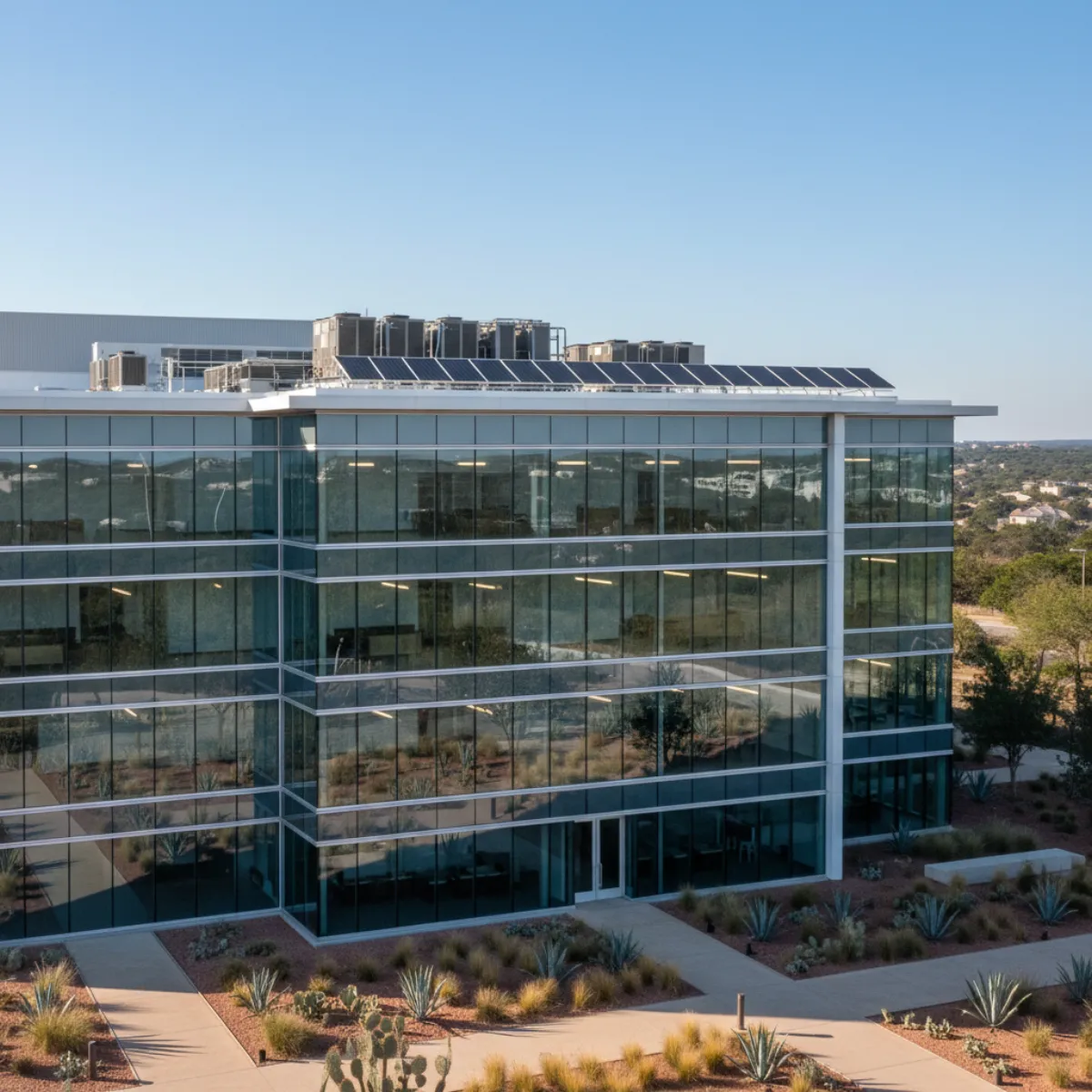
TL;DR: §179D is now available only for qualifying property whose construction began by June 30, 2026; property starting later is ineligible. Earlier-start HVAC, lighting, hot-water, and envelope projects still must beat the applicable ASHRAE 90.1 baseline by at least 25% and document any PWA increase. Texas specifics: no state income tax means it’s a federal-only benefit (no state analog); the lean 2015-IECC code baseline often leaves more headroom above code to hit the threshold; cooling — not heating — is the dominant load; and ERCOT’s deregulated market has no statewide net metering. Owners claim directly; A/E designers claim on UT/Texas A&M, ISD, and municipal work.
Section 179D of the Internal Revenue Code is a federal tax deduction for energy-efficient commercial building property. Originally enacted in the Energy Policy Act of 2005, it was substantially expanded by the Inflation Reduction Act of 2022 — which raised the deduction ceiling, added a 5× bonus for prevailing-wage and apprenticeship compliance, and extended the designer allocation to cover tax-exempt building owners.
The One Big Beautiful Bill Act (signed July 4, 2025) reshaped the federal energy tax landscape. Residential solar (§25D) and residential heat pumps (§25C) are gone. The commercial ITC (§48/§48E) remains: projects that began construction on or before July 4, 2026 locked in the longer placed-in-service pathway (through roughly 2030), while projects that begin construction after that date can still qualify but generally must be placed in service by December 31, 2027.
Section §179D was terminated for property whose construction begins after June 30, 2026. Earlier-start projects may still qualify when they satisfy the remaining energy-savings, certification, allocation, PWA, and filing rules. Later-start projects should carry $0 of §179D value in the pro forma.
Source of truth: IRS Form 7205 instructions (June 30, 2026 construction-start termination), Rev. Proc. 2025-45 (2026 indexed rates), IRC §179D, and Treasury PWA guidance.
Rates are inflation-adjusted each year. For qualifying property that began construction by June 30, 2026, the 2026 range is $0.59–$1.19/sq ft, or $2.97–$5.94/sq ft with PWA compliance.
| Year | Base Rate Range | PWA Rate Range | Per-Point Bonus (Base / PWA) |
|---|---|---|---|
| 2023 | $0.54–$1.07/sf | $2.68–$5.36/sf | $0.02 / $0.10 |
| 2024 | $0.57–$1.13/sf | $2.83–$5.65/sf | $0.02 / $0.11 |
| 2025 | $0.58–$1.16/sf | $2.90–$5.81/sf | $0.02 / $0.12 |
| 2026current | $0.59–$1.19/sf | $2.97–$5.94/sf | $0.02 / $0.12 |
Start at 25% savings. Each additional percentage point of energy savings adds $0.02/sf (base) or $0.12/sf (PWA) in 2026, subject to the applicable caps.
25% Savings
$0.59/sf
$2.97/sf PWA
30% Savings
$0.69/sf
$3.57/sf PWA
40% Savings
$0.89/sf
$4.77/sf PWA
50% Savings
$1.09/sf
$5.94/sf (cap) PWA
§179D covers three categories of commercial building property. A single project can qualify under one or a combination — and the energy model aggregates savings across all three. In Texas the biggest lever is the cooling plant, because the climate is cooling-dominated and the statewide 2015-IECC code floor leaves the existing stock with room to improve.
High-efficiency chiller plants, commercial VRF, premium-SEER rooftop units, demand-controlled ventilation, dedicated outdoor air systems, and heat-pump water heaters. Texas is a cooling-dominated climate — the opposite of the Northeast — so the highest-leverage §179D scope is usually the cooling plant, not a boiler conversion. Replacing aging packaged rooftop units that were installed to the 2015 IECC floor (or earlier) with high-efficiency equipment frequently moves the energy model past the 25% threshold on the mechanical scope alone.
Examples NuWatt Installs
LED retrofits with advanced controls, daylight harvesting, occupancy sensors, and networked lighting control systems. Lighting is usually the cheapest path to a §179D-qualifying energy reduction in Texas’s older commercial stock, and in cooling-dominated Texas the LED swap also cuts the internal heat load — which compounds the HVAC savings in the energy model.
Examples NuWatt Installs
Cool-roof membranes, roof and wall insulation upgrades, high-performance solar-control glazing, and air sealing. In the Texas climate the envelope lever that matters most is solar-heat-gain control — high-reflectance cool roofs and low-SHGC glazing cut the cooling load directly. Envelope work pairs naturally with a commercial solar roof install: if NuWatt is already on the roof, the cool-roof membrane and insulation upgrade often make the energy-model delta big enough to clear §179D.
Examples NuWatt Installs
Texas anchors its commercial energy code to the 2015 IECC as the statewide minimum — maintained by HB 3215 in 2023, with ASHRAE 90.1-2013 accepted as an alternative compliance path — and lets cities layer stricter local amendments (Austin’s solar-ready roof rule, Dallas’s commercial energy-benchmarking ordinance). That floor sits several code cycles behind Massachusetts’s Stretch / Specialized Code and Connecticut’s 2021-IECC base. For §179D, which measures savings against the federal ASHRAE 90.1 reference rather than the Texas code, that has a real upside: buildings put up to the leaner 2015-IECC baseline frequently have more practical headroom to add high-efficiency cooling, LED, and cool-roof work and clear the 25% threshold. The catch is the flip side — unlike MA and CT, Texas code does not already require the whole-building energy modeling that overlaps with the §179D certification, so that modeling is net-new work, not a byproduct of code compliance. The practical recommendation: budget the §179D energy model as a distinct line item, and wire it into design early rather than reverse-engineering it after construction.
Four eligible taxpayer categories. The third — designers of tax-exempt buildings — is the lever most commonly missed, and in Texas it is one of the most valuable recurring tax assets available to A/E firms with a public-sector practice.
Owners of Texas commercial buildings that place qualifying property in service can claim §179D directly on their federal return. The deduction reduces federal taxable income in the year the property is placed in service (subject to the capitalization rules for the property). Because Texas has no state income tax, the benefit is entirely federal — there is no state-level deduction stacking on top, but there is also only one rate to model.
Since January 1, 2023, designers of energy-efficient commercial building property installed in buildings owned by tax-exempt entities can have the §179D deduction allocated to them. In Texas that includes the University of Texas and Texas A&M systems, large independent school districts (Houston ISD, Dallas ISD, Northside, Austin ISD, Cypress-Fairbanks), city and county facilities, and nonprofit hospital systems — all of which are tax-exempt and cannot use the deduction themselves.
Architects, engineers, contractors, and design-build firms that design energy-efficient systems for federal, State of Texas, county, city, or public-school buildings can receive an allocation of §179D from the government owner. This is a recurring tax asset for A/E firms working across Houston, DFW, Austin, San Antonio, Fort Worth, and El Paso public-sector portfolios.
Tenants that place qualifying property in service (typically during a tenant build-out or significant leasehold improvement in a Houston Energy Corridor, Austin tech, or DFW office space) may claim §179D if they are the party that owns the property for tax purposes. Ownership analysis matters — the lease structure determines who can deduct.
The Designer Allocation Play for Texas A/E Firms
Texas has one of the largest pools of tax-exempt commercial square footage in the country: the University of Texas and Texas A&M university systems and their medical branches; some of the nation’s biggest independent school districts (Houston ISD, Dallas ISD, Northside in San Antonio, Cypress-Fairbanks, Austin ISD); city and county facilities across Houston, Dallas, San Antonio, Austin, Fort Worth, and El Paso; and nonprofit hospital systems statewide. None of these owners has any income tax liability to offset with §179D — and Texas itself levies no income tax — so before 2023 the deduction simply went unused on these projects.
Since January 1, 2023, the tax-exempt owner can allocate the deduction to the designer(s) of the energy-efficient property. For a Texas A/E firm designing cooling and LED retrofits across an ISD or university portfolio, that can translate to six-figure recurring federal deductions. NuWatt supports these projects as the implementation partner — we build the system, engineer the energy model, and supply the documentation the A/E firm needs to secure the allocation letter from the institution.
The deduction value depends on three things: square footage, the achieved energy savings percentage, and whether PWA requirements were met. The corporate tax rate converts the deduction into cash — and in Texas that is purely the federal rate (21% corporate shown), because there is no state income tax to layer on top.
Numbers below are illustrative and modeled on typical Texas project profiles — cooling-led mechanical scope rather than the boiler-to-heat-pump conversions that drive savings in the Northeast. Actual values depend on verified energy modeling, certification by a qualified engineer, and final audit posture.
Energy Savings
40% below ASHRAE 90.1
Base (No PWA)
PWA Compliant
Energy Savings
30% below ASHRAE 90.1
Base (No PWA)
PWA Compliant
Energy Savings
50% below ASHRAE 90.1
Base (No PWA)
PWA Compliant
Energy Savings
35% below ASHRAE 90.1
Base (No PWA)
PWA Compliant
The PWA Math Almost Always Wins
The base → PWA jump is roughly 5×. On the Austin cold storage example above, PWA compliance moves the 2026 tax benefit from $22,890 to $124,740 — a $101,850 swing. Even after paying the prevailing-wage premium on labor and coordinating apprentice hours, the arithmetic favors PWA on projects of any meaningful scale. Plan for PWA compliance as the default, not the exception.
§179D covers both new construction (EECBP) and qualified retrofits of existing buildings (EEBRP). The retrofit path has a 5-year age requirement and different measurement rules — important to get right before starting work.
The 5× bonus hinges on meeting two IRS/Treasury requirements. Both are documentation-heavy — the tax savings are real, but so is the audit risk if you don’t maintain records.
All laborers and mechanics employed on the project — by the taxpayer, contractors, and subcontractors — must be paid at or above the Davis-Bacon prevailing wage rate for the applicable locality and classification.
A minimum percentage of total labor hours must be performed by qualified apprentices from a registered apprenticeship program. The percentage ratchets up over time.
Texas is a right-to-work state with relatively few union apprenticeship programs outside the major metros. Finding qualified apprentices for the DOL-registered programs can be the binding constraint, especially on rural or small-metro projects. NuWatt has working relationships with registered programs in DFW, Houston, Austin, and San Antonio — pairing our installation scope with compliant labor is part of the coordination we handle on the commercial side.
On a full Texas commercial retrofit — say, rooftop solar + battery storage + commercial heat pump conversion + LED retrofit — three federal incentives apply to different line items. They don’t overlap and can be claimed simultaneously.
30% base credit (up to 50% with domestic content + energy community bonuses) on the cost basis of the solar array and battery storage system. Dollar-for-dollar credit against tax owed. Projects that began construction on or before July 4, 2026 locked in the longer placed-in-service pathway; projects starting later can still qualify but generally must be placed in service by December 31, 2027.
Up to $5.94/sq ft deduction (2026 PWA rate) on the eligible pre-cutoff efficiency scope: the heat pump system, the LED retrofit, the roof insulation and cool-roof membrane. Deduction reduces taxable income; cash value = marginal tax rate × deduction.
Accelerated depreciation on the solar + storage basis. 5-year MACRS schedule plus 100% first-year bonus depreciation (permanent under OBBBA, IRC §168(k)). Independent of §48E and §179D — one further layer of tax-driven project economics.
Combined effect on a typical TX commercial retrofit: effective out-of-pocket cost can compress to roughly 40–55% of gross capex. Texas has no state income tax, so unlike the Northeast there is no state-level credit or deduction to add — but Texas substitutes other mechanisms: the property-tax exemption for the solar improvement (Tex. Tax Code §11.27), TCEQ NTIG funding on qualifying storage scope, PACE financing, and utility commercial rebates such as Oncor’s and CPS Energy’s programs. And in ERCOT’s deregulated market, the right retail electric provider buyback plan can add ongoing value to the solar export — though, with no statewide net metering, that value is set by contract, not statute.
NuWatt provides the engineering and energy modeling that underpins a defensible §179D claim on Texas commercial HVAC, lighting, and envelope projects. Whether you’re the owner, the tenant, or the A/E designer on a tax-exempt build, we can scope the eligibility path and coordinate the PWA documentation.
§179D is unavailable for property whose construction began after June 30, 2026. Earlier-start projects require project-specific tax review before any value is included.
Last verified: July 9, 2026
Sources: IRS Form 7205 instructions, Rev. Proc. 2025-45, IRC §179D, Treasury PWA guidance, ASHRAE 90.1-2019