Loading NuWatt Energy...

We use your location to provide localized solar offers and incentives.
We serve MA, NH, CT, RI, ME, VT, NJ, PA, and TX
Loading NuWatt Energy...
NuWatt designs, installs, and manages solar, battery, heat pump, and EV charger systems across 9 states. One company, one warranty, one point of contact.
Get a Free QuoteThe New Technology Implementation Grant (NTIG) is the TERP subprogram that funds emission-reducing technology at stationary sources, oil & gas operations, and electricity storage charged from renewable energy. Statewide eligibility. Up to 50% cost reimbursement. The next competitive cycle is expected to open in May 2026.
50%
Max Reimbursement
3
Funded Categories
254
TX Counties Eligible
May ’26
Expected Reopen
TL;DR for commercial sites: If you’re planning a Texas commercial solar + battery storage project (or an industrial electrification or O&G emission-control project), NTIG can reimburse up to half the eligible scope. Stacked with the federal §48E ITC and MACRS depreciation, your effective out-of-pocket can land around 25–35% of gross capex. The §48E begin-construction safe harbor closed July 4, 2026; new starts still qualify if placed in service by December 31, 2027.
The New Technology Implementation Grant (NTIG) is one of several Texas Emissions Reduction Plan (TERP) subprograms administered by the Texas Commission on Environmental Quality (TCEQ). NTIG is distinct from better-known TERP vehicle programs — it focuses on stationary sources and storage rather than mobile sources.
The federal incentive landscape for commercial clean energy narrowed in 2025. Residential §25D and §25C credits expired December 31, 2025. The commercial §48 and §48E Investment Tax Credits remain; the begin-construction safe harbor closed July 4, 2026, so projects that began construction on or before that date locked in the longer timing pathway, and new starts must be placed in service by December 31, 2027. State-level programs like NTIG are increasingly the swing incentive that decides whether a Texas commercial project pencils.
NTIG’s electricity-storage category is particularly well-timed. As ERCOT wholesale volatility rises and 4CP transmission charges become a larger share of commercial utility bills, behind-the-meter storage is becoming an economic necessity, not a nice-to-have. NTIG reimburses up to half the storage scope on eligible renewable-paired systems.
TERP background: The Texas Emissions Reduction Plan was created in 2001 to improve air quality, funded through vehicle registration surcharges, title fees, and emissions inspection fees. NTIG is one of roughly a dozen TERP subprograms. Unlike the vehicle-focused DERI or LDPLIP programs, NTIG targets industrial and commercial stationary sources.
NTIG funds projects that fall into one of three categories. Your project must map cleanly to one of these to be eligible.
New technology projects that reduce criteria pollutants, hazardous air pollutants (HAPs), or other pollutants regulated by the federal Clean Air Act or TCEQ at stationary sources — manufacturing plants, refineries, commercial boilers, industrial process equipment.
Example Eligible Projects
Projects reducing emissions from upstream, midstream, and downstream oil & gas activities — including engine replacement, repowering, retrofitting, and systems that minimize gas loss or flaring.
Example Eligible Projects
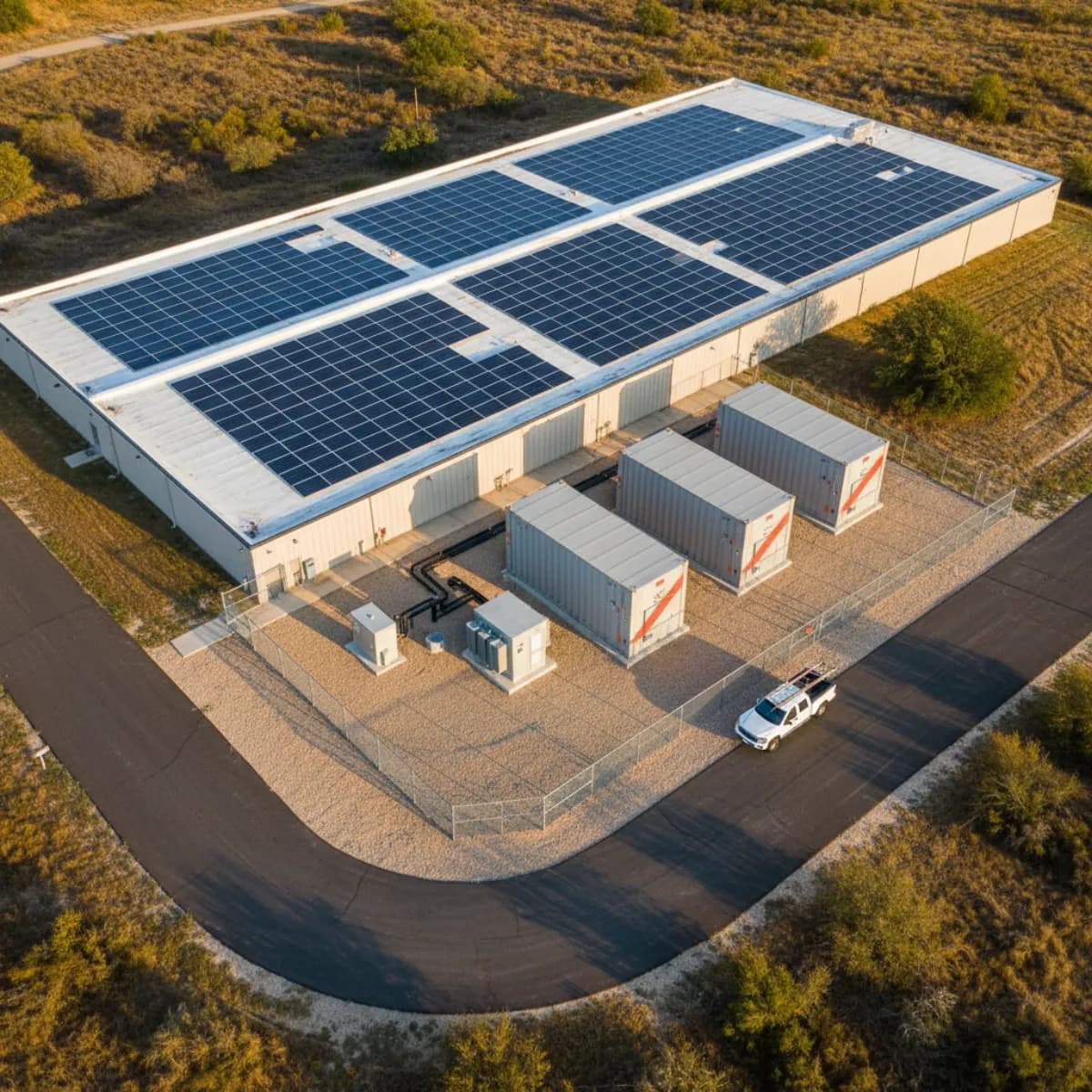
Projects that store electricity generated from renewable energy sources. This is the category that directly fits commercial solar + battery storage (BESS) installations paired with on-site PV on Texas commercial and industrial sites.
Example Eligible Projects
Mobile-source projects (fleet EVs, light-duty passenger vehicles — those run through LDPLIP or similar TERP subprograms). Standalone renewable generation without an emission-reduction argument tied to one of the three NTIG categories. Projects located outside Texas. Projects already completed before the grant award (NTIG does not retroactively reimburse past work).
Six conditions must all be met. NTIG’s applicant definition is very broad — the gate is the project, not who you are.
Individuals, state and local governments, corporations, LLCs, partnerships, nonprofits, cooperatives, or any other legal entity may apply. Unlike some TERP subprograms that restrict applicants to fleet owners or specific industries, NTIG is deliberately broad.
The project must be implemented in Texas. NTIG is not limited to nonattainment counties — it is open statewide across all 254 Texas counties, including rural and non-metro areas.
The project must fall into one of the three funded categories: stationary-source emission reductions, oil & gas operations emission controls, or electricity storage from renewable sources. Projects outside these categories are ineligible.
Applicants must demonstrate a measurable reduction in air pollutant emissions attributable to the new technology. Baseline emissions, expected reductions, and the monitoring methodology typically have to be documented in the application.
NTIG is not first-come, first-served. Projects are scored under a Request for Grant Applications (RFGA) process. TCEQ evaluates cost-effectiveness, emissions impact, technology readiness, and program priorities.
NTIG reimburses up to 50% of eligible project costs. Applicants must have a credible plan to fund the remaining share — from their own capital, debt, tax credits (§48E ITC), utility rebates, or other stacked incentives.
NTIG is a reimbursement program with a 50% cap. Understanding the mechanics matters — it changes how you plan cash flow, tax treatment, and financing.
TCEQ will reimburse up to half of eligible project costs. The actual award can be lower based on the RFGA scoring and TCEQ’s cost-effectiveness threshold. Your cost-share is the remaining project balance, funded by capital, debt, tax credits, or other stacked incentives.
NTIG reimburses as scope is completed — it does not pay up front. You must have the capital (or financing) to build the project, then submit documentation at defined milestones to trigger reimbursement. Plan for bridge financing on the grant portion.
TCEQ evaluates applications partly on cost-effectiveness — the dollars of NTIG reimbursement per ton of emissions reduced. Projects that reduce more pollution for less grant money tend to rank higher. Tight, defensible emissions math is one of the strongest levers applicants have.
NTIG grant proceeds can affect the depreciable basis of federally tax-credited property (like §48E storage) and may be taxable income depending on how the grant is structured. The interaction with the §48E ITC and MACRS depreciation is project-specific. Engage a CPA familiar with TERP grants and §48E before closing on financing — the right sequencing can swing effective project cost by 5–10 percentage points.
The real power of NTIG shows up when you stack it. Below are four representative Texas commercial archetypes and how the incentives layer. These are illustrative — actual awards depend on RFGA scoring, project specifics, and tax posture.
In all four cases, the stacked incentives typically compress the effective out-of-pocket to roughly 25–35%of gross capex. The §48E ITC component’s begin-construction safe harbor closed July 4, 2026 — new starts must be placed in service by December 31, 2027, now the single most important scheduling constraint for projects considering NTIG.
Gross Project
$1.8M
NTIG
Up to 50% of eligible scope (~$600–900k)
Federal ITC
§48E ITC — 30–50% base credit (storage)
Depreciation
Federal MACRS 5-yr (bonus 40% in 2026)
How it stacks: NTIG covers half the emission-reducing storage scope. §48E ITC applies to the remaining BESS basis and the on-site solar. MACRS accelerates depreciation on the whole system. Effective out-of-pocket can drop to roughly 25–35% of gross project cost.
Gross Project
$2.4M
NTIG
Engine replacement AND on-site storage both eligible categories
Federal ITC
§48E ITC on solar + storage only (engines not eligible for ITC)
Depreciation
MACRS on renewable asset; engine depreciation standard schedule
How it stacks: A site-wide emission-reduction story: NTIG funds the compressor replacement under the O&G category and the solar-charged BESS under the storage category. §48E ITC layers on top of the renewable portion. Best fit for operators under methane-rule compliance pressure.
Gross Project
$3.2M
NTIG
Storage scope up to 50% reimbursement
Federal ITC
§48E ITC — solar + BESS
Depreciation
MACRS 5-yr
How it stacks: NTIG on the storage portion plus §48E ITC on solar+storage plus MACRS plus 4CP demand-charge avoidance. Payback on many DFW cold storage profiles can land in the 3–5 year range once NTIG lands.
Gross Project
$6.5M
NTIG
Storage scope eligible; subject to competitive score
Federal ITC
§48E ITC — solar + BESS (safe harbor closed July 4, 2026; new starts placed in service by Dec 31, 2027)
Depreciation
MACRS 5-yr
How it stacks: High-load, 24/7 facilities stack well because NTIG prioritizes quantifiable emissions impact — and data centers displace large volumes of ERCOT marginal (often gas) generation when running on solar-charged storage.
What to tell your CFO
A Texas commercial solar + battery project that might have carried a 7–9 year unlevered payback on §48E ITC alone can compress to a 3–5 year payback once NTIG lands on the storage portion. The catch: NTIG is competitive and reimbursement-based, so you need a project that will get built regardless — NTIG is the upside, not the load-bearing assumption. Build the base case without it.
NTIG is a competitive Request for Grant Applications (RFGA) process. Applications open when TCEQ publishes the cycle’s RFGA. The next cycle is expected to open in May 2026, subject to change.
Verify the project fits one of the three NTIG categories (stationary source, O&G, or renewable storage). Confirm the site is in Texas and that you can quantify the emissions reduction.
TCEQ publishes a Request for Grant Applications (RFGA) that opens the application cycle. The current cycle is expected to begin accepting applications in May 2026 (subject to change per TCEQ). Subscribe to TCEQ TERP email alerts so you do not miss the window.
Document baseline emissions (with the incumbent equipment or operating pattern) and expected post-project emissions. For storage + solar projects, this typically involves modeling the displaced grid mix on ERCOT and the resulting NOx, SO2, and CO2 reductions.
Submit the full RFGA package: project description, engineering scope, emission-reduction methodology, project budget with cost-share plan, schedule, and any required environmental permits. Weaker applications typically fail on vague emissions math, not on technology fit.
TCEQ scores applications against the RFGA criteria — cost-effectiveness ($/ton reduced), technology readiness, geographic distribution, and program priorities. Not all submissions are funded; rank matters.
Awarded applicants sign a grant agreement, complete the project per the approved scope, and submit reimbursement documentation as milestones are met. NTIG is a reimbursement program — projects must be built with the applicant's capital and reimbursed after verification.
TERP has multiple subprograms. Knowing which one to target saves wasted effort — NTIG is not the right fit for every project.
| TERP Subprogram | What It Funds | Applicant | Selection |
|---|---|---|---|
| NTIG (this page) | Stationary-source, O&G, renewable-storage projects | Any legal entity | Competitive RFGA |
| LDPLIP | New EV / PHEV / hydrogen light-duty vehicle purchase ($2,500 grant) | TX residents / businesses | First-come, first-served |
| DERI | Diesel emissions reduction — fleet heavy-duty truck replacements, off-road equipment | Fleet owners in affected counties | Scored, nonattainment geography limits |
| TxVEMP / EV Infrastructure | EV charging infrastructure along travel corridors and at public sites | Charging providers, property owners | Competitive RFGA |
Multiple TERP subprograms can be pursued for different parts of the same corporate decarbonization plan — e.g., DERI for fleet trucks, NTIG for on-site storage, LDPLIP for company car purchases. They do not compete for the same applicant.
NuWatt designs, engineers, permits, and installs commercial solar + battery storage projects across Texas. For NTIG-eligible scopes, we provide the engineering and modeling inputs your application needs.
We build the baseline emissions picture (current grid mix or on-site fossil generation) and model the post-project reduction using ERCOT marginal emissions data. This becomes the core of the RFGA technical submission.
Full system design: PV array sizing, BESS capacity and duration, inverter topology, controls strategy, interconnection path, and 4CP / peak-shaving optimization. Engineering documentation supports both the NTIG application and the §48E ITC basis calculation.
We handle AHJ permits, utility interconnection (Oncor, CenterPoint, AEP, TNMP, or municipal), and project scheduling — including the §48E December 31, 2027 placed-in-service deadline for new starts (the begin-construction safe harbor closed July 4, 2026). A shovel-ready project scores materially better in the RFGA than one still in due diligence.
Note on grant writing:NuWatt is not a grant-writing firm. We provide the engineering, emissions modeling, and project documentation that form the technical backbone of an NTIG submission. For the narrative sections, application assembly, and ongoing TCEQ communication, most clients pair us with a grant-writing consultant or in-house sustainability team. We’re happy to recommend firms we’ve worked with on prior TERP applications.
Let’s map your site to the NTIG category that fits, size the solar + storage scope, and build the emissions model your application will need. The §48E ITC placed-in-service deadline for new starts (December 31, 2027; the begin-construction safe harbor closed July 4, 2026) makes timing tight.
NTIG next cycle expected to open May 2026. RFGA windows often close within 60–90 days.
Last updated: April 2026
Sources: TCEQ NTIG program page (tceq.texas.gov/airquality/terp/ntig.html), TERP program overview, IRC §48E, §48, §168 (MACRS), OBBBA (P.L. 119-XX)