Loading NuWatt Energy...

We use your location to provide localized solar offers and incentives.
We serve MA, NH, CT, RI, ME, VT, NJ, PA, and TX
Loading NuWatt Energy...
NuWatt designs, installs, and manages solar, battery, heat pump, and EV charger systems across 9 states. One company, one warranty, one point of contact.
Get a Free QuoteThe Governmental Alternative Fuel Fleet (GAFF) Grant Program funds Texas state agencies, cities, counties, and school districts to purchase alternative-fuel fleet vehicles — fully electric, plug-in hybrid, hydrogen, CNG, LNG, and LPG — plus associated charging or fueling infrastructure. Fleets of 15+ vehicles are eligible. Next application window expected to reopen around December 2026.
15+
Fleet Size Minimum
~10%
Charging Scope Cap
1–8
Vehicle Classes Eligible
Dec ’26
Expected Reopen
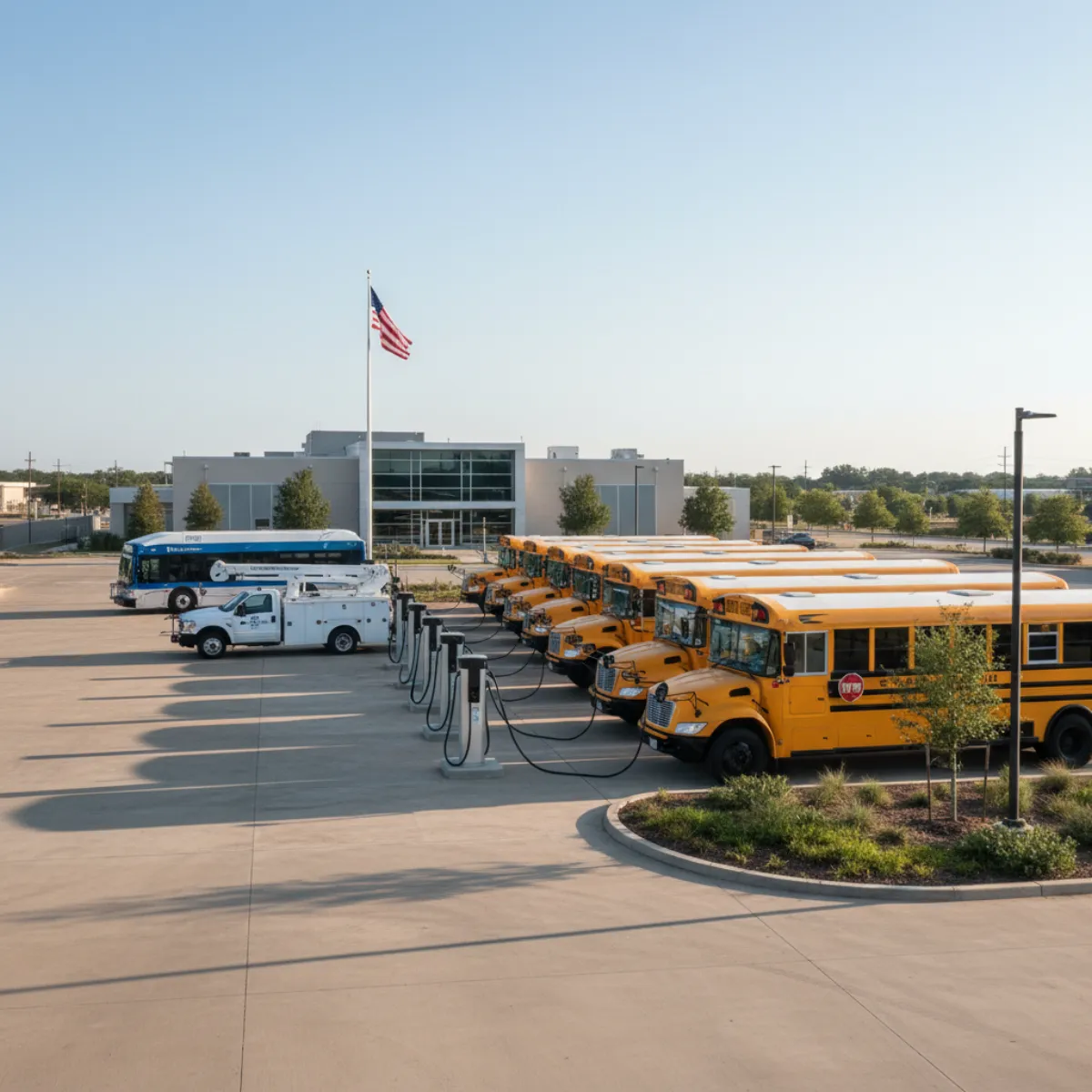
TL;DR for Texas government fleets: GAFF funds new alternative-fuel vehicles (EV, PHEV, hydrogen, CNG, LNG, LPG) and up to ~10% of the award for related charging/fueling infrastructure — if your agency runs a 15+ vehicle fleet. The current cycle is closed. The next competitive RFGA is expected around December 2026. Use the gap to build fleet inventory, baseline your routes, and scope a depot charging plan so you’re ready to submit the day the window opens.
The Governmental Alternative Fuel Fleet (GAFF) Grant Program is a Texas Emissions Reduction Plan (TERP) subprogram administered by the Texas Commission on Environmental Quality (TCEQ). GAFF specifically funds governmental fleets transitioning to alternative-fuel vehicles, including fully electric and plug-in hybrid vehicles.
Texas municipalities and school districts face growing pressure on fleet operating costs — fuel volatility, maintenance on aging diesel school buses, and constituent demand for cleaner local air, especially near schools and neighborhoods. GAFF is one of the few Texas-specific funding streams built explicitly for public-sector fleet conversion.
GAFF is particularly well-suited to multi-vehicle EV rollouts where a government fleet can consolidate charging at a central depot. The ~10% charging-infrastructure carve-out turns what would otherwise be an unfunded capital project (service upgrades, trenching, chargers, management software) into a recoverable scope — as long as it’s planned in parallel with the vehicle purchases.
TERP context: The Texas Emissions Reduction Plan funds ~a dozen subprograms. GAFF is the one dedicated to governmental fleets. Sister programs — DERI (diesel replacement), LDPLIP (light-duty EV purchase incentive), NTIG (stationary-source projects), and TxVEMP (public EV corridor charging) — serve different audiences and do not overlap with GAFF on the same vehicles.
GAFF is explicitly a government-fleet program. Private commercial fleets, nonprofits that are not governmental entities, and individual residents are not eligible. The 15+ vehicle fleet minimum is a hard gate.
State departments, authorities, and agencies with owned or leased fleets operating in Texas. Any agency-controlled fleet that meets the 15-vehicle threshold may apply for qualifying vehicle and charging scopes.
Incorporated Texas cities and municipal governments — including public-works fleets, parks departments, code-enforcement units, and municipal utilities — operating 15 or more fleet vehicles.
Texas county governments operating fleets of 15+ vehicles. Sheriff departments, public-works fleets, road-and-bridge crews, and county inspection vehicles are typical GAFF-eligible scopes.
Independent school districts (ISDs) with fleets of 15+ vehicles — most commonly school-bus fleets, but also transportation-department support vehicles, maintenance trucks, and nutrition-services vans.
Texas junior colleges and community college districts operating qualifying fleets. Shuttle vans, campus-security vehicles, grounds trucks, and facilities-maintenance units are typical eligible use cases.
Additional governmental bodies recognized under the program definition — e.g., transit authorities, river authorities, water districts — may be eligible. Confirm entity status against the current RFGA before applying.
Private commercial fleets (including those operating under government contract but owned by a private entity), individual residents, non-governmental nonprofits, and any governmental fleet smaller than 15 vehicles. Private commercial fleets typically pursue TxVEMP (corridor EV charging) or federal programs like EPA Clean Heavy-Duty Vehicle grants. Residential EV buyers have historically used TCEQ LDPLIP.
GAFF funds new (not used) alternative-fuel fleet vehicles. Per TCEQ’s program page, eligible fuel types include fully electric, plug-in hybrid electric, hydrogen fuel cell, compressed natural gas, liquefied natural gas, and liquefied petroleum gas (propane).
Battery-electric vehicles powered solely by on-board batteries — light-duty sedans, SUVs, pickups, and medium-to-heavy-duty trucks and buses. This is the most commonly funded category under recent GAFF cycles.
Plug-in hybrids that operate primarily on electricity with a gasoline range extender. PHEVs are eligible under GAFF alongside fully electric vehicles.
Fuel-cell electric vehicles (FCEVs). Eligible under GAFF, though applications are less common in Texas outside a few hydrogen-hub-adjacent counties.
Dedicated CNG or bi-fuel CNG vehicles. Still eligible under GAFF for government fleets where CNG is the practical fit (e.g., refuse trucks, heavy-duty transit).
LNG-fueled heavy-duty vehicles. Eligible but relatively uncommon in modern GAFF awards compared to EV and CNG options.
Propane autogas fleet vehicles — still seen in school-district bus fleets and some municipal support fleets. Eligible under GAFF.
GAFF covers a broad range of vehicle classes — from light-duty sedans (Class 1) to heavy-duty buses and tractors (Class 8). Per-vehicle grant amounts typically scale by class: heavier vehicles with larger diesel-vs-alternative incremental cost carry larger caps. The exact dollar figures are published in each cycle’s RFGA and are not static — always confirm against the current RFGA.
| Class | Weight (GVWR) | Example Vehicles | Typical Government Fit |
|---|---|---|---|
Class 1–2 | Up to 10,000 lbs GVWR | Sedans, compact SUVs, 1/2-ton pickups, small cargo vans | Light-duty fleet sedans, inspection vehicles, admin pool cars, code-enforcement SUVs |
Class 3 | 10,001–14,000 lbs GVWR | 3/4-ton pickups, 1-ton pickups, utility vans | Parks-department trucks, facilities vans, small public-works pickups |
Class 4–6 | 14,001–26,000 lbs GVWR | Medium-duty box trucks, bucket trucks, step vans, smaller dump trucks | Municipal maintenance trucks, mid-size school-district maintenance fleet |
Class 7 | 26,001–33,000 lbs GVWR | Large school buses, refuse trucks, heavier municipal equipment | ISD electric school buses, city refuse fleet, county heavy support |
Class 8 | Over 33,000 lbs GVWR | Heavy-duty tractors, heavy refuse trucks, large transit buses | Transit authority buses, heavy public-works tractors, refuse haulers |
We deliberately do not publish specific per-class dollar caps on this page. Per-class grant amounts are set in each RFGA cycle and can change from one cycle to the next. Past GAFF cycles have ranged widely — light-duty EVs have been funded at smaller incremental amounts, while Class 7/8 electric buses and refuse trucks have carried significantly larger per-vehicle caps reflecting their higher alternative-fuel premium. For the current figures, refer to the active TCEQ GAFF RFGA when the next window opens.
Per recent TCEQ program guidance, up to approximately 10% of the GAFF award may be used for alternative-fueling or EV-charging infrastructure directly supporting the funded vehicles. For electric fleets, this is the piece that makes the rollout actually work.
Most municipal light- and medium-duty EV fleets are best served by Level 2 charging at the depot. Typically 7.2–19.2 kW per port, overnight charging window, shared between pool vehicles. GAFF’s infrastructure allowance typically covers the chargers, trenching, and panel work for a depot Level 2 deployment.
Electric school buses and Class 6–8 fleet trucks typically require DCFC (50 kW up to 350 kW) to recharge in realistic operational windows. The ~10% allowance can offset a meaningful portion of the charger hardware and make-ready, but heavy electric fleets often need additional funding sources (utility make-ready programs or federal Clean School Bus program funding).
New EV depots almost always require service upgrades — a larger transformer, new switchgear, branch circuits, and in some cases a utility service extension. This make-ready electrical scope is typically eligible under the infrastructure carve-out when it directly supports the funded chargers.
The federal §30C Alternative Fuel Vehicle Refueling Property Credit expired June 30, 2026, so the GAFF + §30C elective-pay stack is no longer available for chargers placed in service after that date. Fund depot charging through GAFF’s infrastructure carve-out, utility make-ready programs, and federal Clean School Bus funding instead, and coordinate with your CPA or tax counsel.
GAFF is a competitive Request for Grant Applications (RFGA) process. The current cycle is closed; TCEQ has signaled the next window is expected to open around December 2026, subject to change. Use the gap to prepare the work that takes the longest — fleet inventory, route data, depot site plan, utility coordination.
Confirm your governmental entity operates at least 15 vehicles in its fleet. The 15-vehicle threshold is a program gate — fleets below that size are not GAFF-eligible under current program rules. Gather fleet inventory documentation before you apply.
TCEQ opens GAFF via a Request for Grant Applications (RFGA) defining funding available, eligible vehicle types, per-class grant caps, and submission deadlines for that cycle. The next GAFF window is currently expected to reopen around December 2026, subject to TCEQ scheduling. Subscribe to TERP email updates so you catch the exact open date.
GAFF funds vehicles and allows a portion of the award (up to approximately 10% per recent program guidance) to be used for related charging infrastructure. Plan the charging depot sizing, service upgrade, and make-ready scope in parallel with the vehicle list — not after. Charging scope cannot exceed the portion defined in the active RFGA.
Submit the full application: entity information, fleet inventory and usage data, vehicle make/model/class for each requested unit, charging infrastructure scope and site plan, project schedule, and any required procurement documentation. Weak submissions typically fail on vague charging scopes or missing fleet-usage data.
GAFF is a competitive grant — not first-come, first-served. TCEQ scores applications against the RFGA criteria (cost-effectiveness, fleet mission fit, readiness to execute, geographic distribution). Awards are announced after the review window closes.
Awarded entities sign a grant agreement with TCEQ, procure the approved vehicles, install the approved charging infrastructure, and submit reimbursement documentation once vehicles and chargers are in service. GAFF is a reimbursement program — vehicles and chargers must be delivered and operating before reimbursement is paid.
TERP has multiple subprograms targeting different fleet, stationary, and public infrastructure use cases. GAFF is the one aimed specifically at governmental fleets.
| TERP Subprogram | What It Funds | Applicant | Selection |
|---|---|---|---|
| GAFF (this page) | Government fleet alternative-fuel vehicles + ~10% charging scope | Govt entities w/ 15+ vehicle fleets | Competitive RFGA |
| DERI | Diesel emissions reduction — heavy-duty truck/equipment replacements | Fleet owners in affected counties | Scored, nonattainment geography limits |
| TxVEMP / EV Infrastructure | Public EV charging along corridors and at public sites | Charging providers, property owners | Competitive RFGA |
| NTIG | Stationary-source, O&G, renewable-storage industrial projects | Any legal entity | Competitive RFGA |
| LDPLIP | Light-duty EV / PHEV / hydrogen vehicle purchase ($2,500 grant) | TX residents / businesses | First-come, first-served |
A county or city can potentially use DERI for heavy diesel-truck replacements, GAFF for broader alternative-fuel fleet rollout, and TxVEMP for public-facing EV charging — the programs target different scopes and do not conflict on the same vehicles or chargers.
NuWatt is a Texas commercial solar + storage + EV-charging installer. For GAFF applicants, we focus on the charging infrastructure portion — the depot design, service upgrades, and commissioning that the ~10% carve-out is meant to fund. We do not procure fleet vehicles or write the grant application itself.
Level 2 and DCFC depot layouts sized to the fleet’s actual duty cycle, not nameplate specs. Load management, stall layout, cable management, and expansion headroom so the depot doesn’t need to be re-done when the fleet doubles in five years.
New transformer, switchgear, branch circuits, trenching, and conduit. Coordination with Oncor, CenterPoint, AEP, TNMP, or the municipal utility on service extensions and long-lead transformer orders — which on current utility timelines often drive the entire project schedule.
AHJ permits, utility interconnection, charger commissioning, and the as-built documentation GAFF reimbursement requires. We produce the paper trail (permits, invoices, commissioning reports) your grant administrator will submit to TCEQ for reimbursement.
Note on scope:NuWatt is not a grant writer and does not sell vehicles. For a GAFF application, you’ll typically pair a grant-writing consultant (or internal sustainability/fleet team) for the RFGA narrative, an OEM or state-contract vendor for vehicle procurement, and an installer like NuWatt for the depot-charging scope. We’re happy to coordinate with all three and provide the engineering and cost documentation the application needs for the charging portion.
We’ll help you scope a depot-charging plan — Level 2 or DCFC, service upgrades, utility coordination — sized to the fleet you’re actually electrifying. That scope becomes the charging-infrastructure portion of your GAFF submission when the next RFGA opens.
GAFF next window expected around December 2026. Competitive cycles often close within 60–90 days of opening.
NuWatt does not write GAFF applications or sell fleet vehicles — we build the depot charging scope.
Last updated: April 2026
Sources: TCEQ GAFF program page (tceq.texas.gov/airquality/terp/gaff), TERP program overview, IRC §30C (elective pay guidance for tax-exempt entities)