Loading NuWatt Energy...

We use your location to provide localized solar offers and incentives.
We serve MA, NH, CT, RI, ME, VT, NJ, PA, and TX
Loading NuWatt Energy...
NuWatt designs, installs, and manages solar, battery, heat pump, and EV charger systems across 9 states. One company, one warranty, one point of contact.
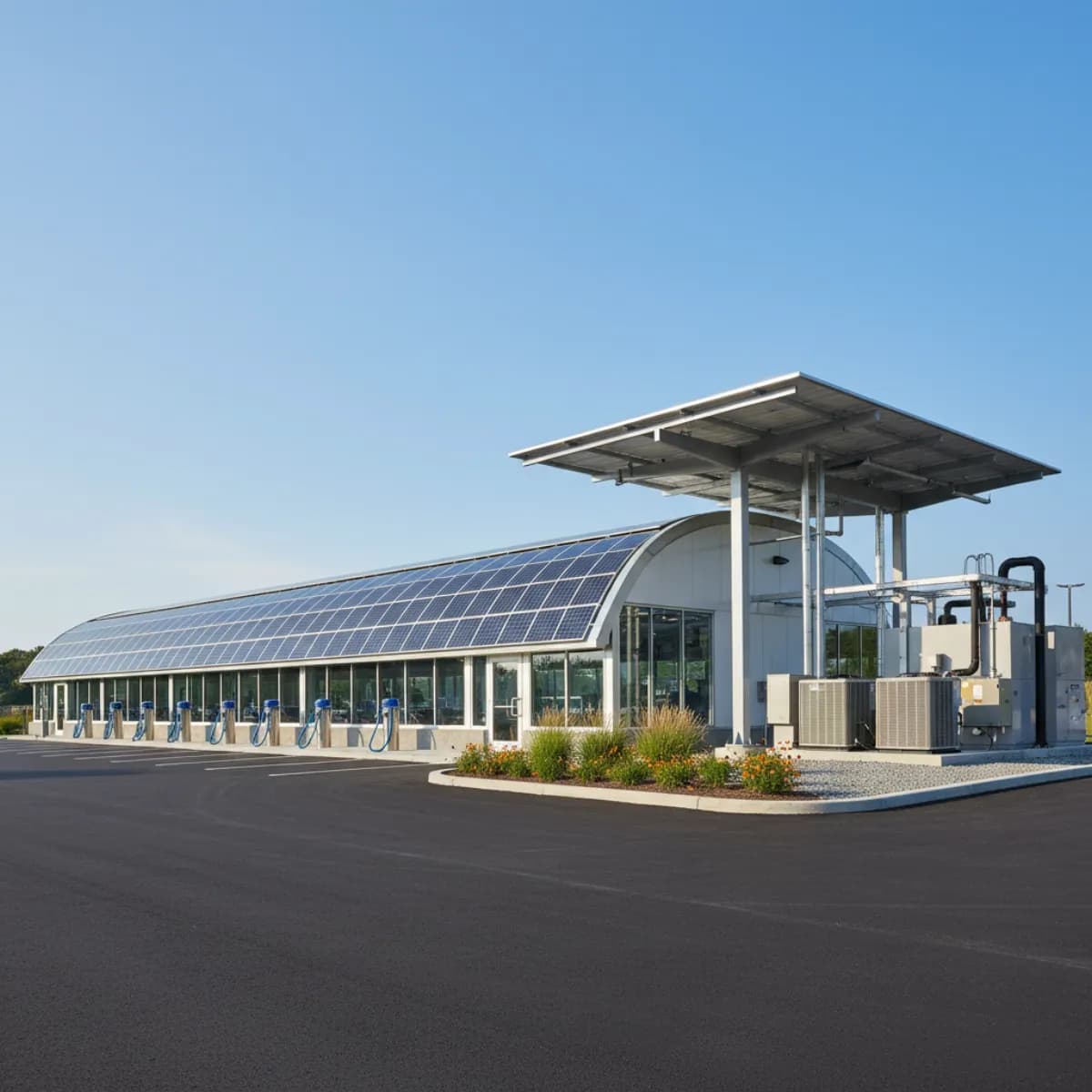
Get a Free QuoteConnecticut has 200+ operating carwashes. Water heating alone is 60-75% of site load — a profile that makes commercial solar plus a heat pump water heater plus a battery one of the highest-returning electrification bundles in the state, especially when financed through CT Green Bank C-PACE.
Water heating share
60-75%
Of carwash site load
Tunnel monthly kWh
15-30k
Express format
Peak demand
100-200 kW
Tunnel peak draw
Typical payback
3-5 yrs
Solar + HPWH bundle
Yes — more than for most CT commercial buildings. A carwash spends 60-75% of energy on water heating and another 15-20% on dryers and pumps, which matches solar production hours almost perfectly. Replacing a gas tankless water heater with a commercial heat pump water heater (HPWH) converts the single largest site load from gas to electricity that rooftop solar can cover. Stacking the 30% federal §48E ITC, CT NRES tariff compensation, MACRS depreciation, Energize CT HPWH incentives, C-PACE long-term financing, §6418 transferability for limited-tax-appetite owners, and — for rural CT carwashes — USDA REAP grants, the combined solar + HPWH + battery bundle typically nets a 3-5 year payback on projects ranging from $50k (self-serve) to $400k+ (express tunnel).
Most Connecticut commercial buildings are loads-first and water-heating-second. A carwash is the reverse. For an express tunnel, roughly 60-75% of total site energy goes to heating water — for presoak, tire cleaner, foamy applications, and rinse — with another 15-20% going to blower-dryer arrays and 10-15% to high-pressure pumps and reclaim equipment. That profile changes the math of electrification in three important ways.
First, replacing gas tankless water heaters with a commercial heat pump water heater (HPWH) converts the dominant site load from fossil fuel to electric, which makes rooftop solar a direct offset for that load. In a CT restaurant, solar offsets refrigeration and lighting; in a CT carwash, solar offsets the single biggest energy line on the entire P&L.
Second, carwash operating hours align with solar production and with NRES economics. Most tunnels run 8 AM to 7 PM with peak customer volume on weekends and sunny days — exactly when the rooftop array is producing. Self-consumption ratios for a properly sized CT carwash solar system routinely hit 85-95%, versus 60-70% for a typical office building. That high self-consumption is what makes NRES Netting superior to Buy-All for this vertical: self-consumed kWh offset the full retail rate, while exported kWh clear at the lower PURA tariff rate.
Third, a carwash has a large, contiguous, flat, unshaded roof — the best-case surface for commercial solar pricing. Tunnel roofs are long rectangles over pump rooms and wash bays, typically 6,000-12,000 sqft for express formats, with minimal rooftop obstructions. Installed costs routinely hit the lower end of CT commercial ranges at $2.15-$2.50/W.
On top of that, Connecticut's GC3 decarbonization roadmap is pushing commercial construction toward electrified baselines, natural gas delivery costs in Eversource CT and United Illuminating territory have risen sharply from 2024 to 2026, and CT Green Bank's C-PACE program can finance 100% of a solar + HPWH + battery bundle over 20-25 years with payments attached to the property tax bill. Carwash operators who were indifferent to HPWH economics in 2022 are seeing 3-5 year simple payback on HPWH alone before solar is even considered.
Express tunnels, in-bay automatics, and self-serves behave very differently on the Eversource CT or UI meter. Format determines how big the solar array should be, how the HPWH is sized, whether a battery is worth adding, and whether NRES Netting or Buy-All is the right tariff election.
Highest-value solar + HPWH candidate in CT
HPWH often the single biggest win
Solar canopy over bays is common
For an express tunnel, typical annual hot-water energy demand is roughly 2,100 therms (gas) or 21,000 kWh (HPWH at COP ~3.0). Here is how the two options compare on operating cost, emissions, and incentive treatment at CT commercial rates.
| Metric | Gas Tankless | Commercial HPWH | Advantage |
|---|---|---|---|
| Annual Energy Input | ~2,100 therms | ~21,000 kWh (COP ~3.0) | HPWH |
| Annual Operating Cost (CT) | ~$4,400 at $2.10/therm | ~$4,200 grid; near $0 marginal under solar hours | HPWH |
| CO2 Emissions / Year | ~11.2 metric tons | ~4.0 tons CT grid today; ~0 with on-site solar | HPWH |
| Upfront Equipment (40 kW heating) | $18,000-$28,000 installed | $45,000-$75,000 installed | Gas |
| Energize CT Commercial HPWH Rebate | Not eligible (fossil) | Prescriptive + custom incentive pathways | HPWH |
| Pairs with Solar + NRES Export | No load-shift benefit | Pre-heat reservoir during sun hours, reduce exported kWh to capture full retail offset | HPWH |
| CT Decarb Roadmap Alignment | Counter to 2040 goals | Aligns with CT GC3 electrification plan | HPWH |
An HPWH paired with a 1,000-2,000 gallon insulated reservoir unlocks solar-hour pre-heating. A reservoir controller runs the HPWH aggressively from 10 AM to 3 PM when rooftop solar is peak-producing, storing thermal energy in the buffer tank. Through late-day wash hours, the reservoir discharges at tunnel flow rates without the HPWH cycling hard. The CT-specific effect: nearly all HPWH kWh is offset by same-day solar kWh that would otherwise export to the grid at the PURA NRES rate — so the load-shift converts low-value exported kWh into high-value self-consumed kWh. This is the single biggest architectural decision on a CT carwash electrification project.
Net costs below are after applicable incentives (§48E ITC, MACRS NPV, Energize CT HPWH incentive, CT sales tax exemption, and NRES net revenue assumptions). Gross project costs run roughly 2.2-2.8x net. For a full overview of CT commercial solar pricing, see our CT commercial solar overview.
| Carwash Format | Roof / Canopy | Solar System | HPWH Heating | Net Cost | Payback | Annual Savings |
|---|---|---|---|---|---|---|
| Self-Serve (4 bays) | 1,200-2,000 sqft | 8-15 kW | 5-10 kW heating | $9,000-$19,000 | 4-6 years | $2,800-$5,200 |
| Self-Serve w/ Canopy | Canopy over queuing | 15-25 kW | 8-12 kW heating | $20,000-$34,000 | 4-6 years | $5,200-$8,500 |
| In-Bay Automatic | 2,500-4,000 sqft | 25-45 kW | 15-25 kW heating | $30,000-$58,000 | 4-6 years | $8,000-$15,500 |
| Express Tunnel (small) | 6,000-9,000 sqft | 75-120 kW | 25-35 kW heating | $100,000-$165,000 | 3-5 years | $29,000-$52,000 |
| Express Tunnel (large) | 10,000+ sqft | 150-250 kW | 30-40 kW heating | $190,000-$310,000 | 3-5 years | $54,000-$92,000 |
Note: Ranges assume current CT commercial solar pricing ($2.15-$2.60/W rooftop, $3.05-$3.80/W canopy), current commercial HPWH pricing ($1,500-$2,200/kW heating installed), and current NRES tariff allocations from PURA. Actual cost depends on service upgrade scope, Eversource CT or UI interconnection queue, reclaim system integration, and whether the project is new construction or retrofit.
CT carwash projects can stack more incentive layers than a typical office or retail building because they combine solar (§48E, NRES), electrification (Energize CT HPWH, §179D), financing (CT Green Bank C-PACE), monetization (§6418 transferability), and — if rural — federal USDA REAP grants on top.
Commercial clean electricity ITC — active; the July 4, 2026 begin-construction safe harbor has closed, so new starts must generally be placed in service by December 31, 2027. Stacks to 40-50% with domestic content and energy community adders applicable in CT census tracts.
PURA-approved replacement for LREC/ZREC. Carwash systems enroll in the Buy-All or Netting (self-consumption) tariff, with PURA-set compensation rates locked for 20 years. Netting election typically wins for carwashes because of strong daytime self-consumption.
Accelerated depreciation on solar and commercial HPWH equipment against carwash profits. Apply current-year bonus schedule to Year 1 and standard MACRS to Years 2-5.
Commercial Property Assessed Clean Energy — long-term (up to 25-year) financing that attaches to the property, not the owner. 100% project cost coverage typical, with repayments on the property tax bill. Designed for solar + HPWH + battery bundles.
Carwash LLCs with limited tax appetite can transfer the §48E ITC to an unrelated taxpayer for cash — typically 92-95 cents on the dollar. Converts an illiquid credit into near-term project cash.
Energize CT commercial water-heating incentives (Eversource CT + United Illuminating) offer prescriptive and custom rebates on commercial HPWH installs sized by rated heating capacity.
Up to $5/sqft deduction for new carwash construction meeting envelope, HVAC, and lighting efficiency targets — stacks with §48E on the same project.
Rural Energy for America Program covers up to 50% of project cost for carwashes in CT towns under 50k population — applies to much of Litchfield, Windham, and rural New London County. Eligible for the solar + HPWH bundle.
Connecticut exempts qualifying commercial solar equipment from the 6.35% state sales tax, saving roughly $12-$20k on an express tunnel project.
Federal timing — §48E begin-construction window closed
§48E ITC at the 30% base rate required construction to begin on or before July 4, 2026 to lock in the full timing pathway; that window has closed, so projects starting now still qualify at 30% but generally must be placed in service by December 31, 2027. Projects that met the deadline kept four additional years to reach placement in service. Design and permitting typically take 3-6 months for a CT carwash solar + HPWH project, so a new-start project should factor that lead time into hitting the December 31, 2027 placed-in-service deadline. §179D has no sunset and remains available for qualifying new-build envelope, lighting, and HVAC upgrades.
Connecticut's Non-Residential Renewable Energy Solutions (NRES) tariff, approved by PURA and administered through Eversource CT and United Illuminating, is the commercial successor to LREC and ZREC. At interconnection, a carwash operator chooses one of two paths:
For a carwash, Netting almost always wins. A 125 kW tunnel array in central CT produces roughly 150,000 kWh/year. If the tunnel consumes 85% of that directly (127,500 kWh self-consumed at retail ~$0.24/kWh) and exports 15% (22,500 kWh at NRES rate ~$0.15/kWh), the blended effective value is ~$0.225/kWh. Under Buy-All, every kWh clears at the NRES rate (~$0.15/kWh) regardless — roughly one-third less annual revenue.
This is why the HPWH + solar pairing is so powerful for CT carwashes specifically: the HPWH absorbs solar kWh during peak production that would otherwise export at the lower NRES rate. For a complete NRES walkthrough, see our NRES commercial tariff guide.
A family-owned express tunnel carwash on a commercial parcel in Hartford County, averaging 110 cars/hour during peak weekends and roughly 22,000 kWh/month on electricity plus 1,800 therms/year of natural gas for water heating. Service is on Eversource CT Rate 58 with peak demand around 180 kW. The owner is planning a tunnel re-roof and is evaluating a combined solar + HPWH + battery project with C-PACE financing.
Key Insight
The HPWH is the hidden lever. It converts a 60-75% gas-driven thermal load into an electric load that the 125 kW solar array can cover during daytime production. A smart reservoir controller pre-heats water to 140F during peak solar hours, then holds that reservoir through late-day washing — which also minimizes NRES exports, because self-consumed kWh offsets retail rate (~$0.24/kWh) while exported kWh clears at the PURA-set NRES rate. The battery shaves the 180 kW afternoon demand peak to roughly 130 kW, cutting Eversource CT demand charges. Financed through C-PACE, the project is often cash-flow positive from Year 1.
Illustrative scenario. Assumes 24% marginal federal tax rate, MACRS 5-year schedule with 2026 bonus, CT commercial blended rate $0.24/kWh, gas at $2.10/therm, PURA-set NRES export rate applied to surplus kWh, Eversource CT Rate 58 demand charge ~$13/kW, and a 60 kWh battery dispatched for peak-demand shaving. Actual project performance varies by utility territory (Eversource CT vs UI), interconnection conditions, NRES block availability at permit date, and tunnel throughput. Consult your CPA on §48E basis-adjustment interactions with MACRS and §6418 transferability.
Connecticut is one of the strongest C-PACE (Commercial Property Assessed Clean Energy) markets in the country, administered by CT Green Bank. For a carwash owner, C-PACE solves three problems simultaneously:
The interaction with §48E and MACRS matters: C-PACE financing does not reduce the ITC basis or affect MACRS depreciation. The ITC and depreciation are still claimed on the gross project cost as if self-financed. For a complete walkthrough, see our CT C-PACE commercial solar guide and our overview of CT Green Bank programs.
Many Connecticut carwashes are owned by family LLCs or single-member S-corps with limited federal tax liability — roughly $20-60k in annual federal tax — meaning a $120k §48E ITC would take multiple years to absorb, eroding its present value. IRC §6418 transferability solves this cleanly.
Under §6418, the carwash LLC sells the §48E ITC to an unrelated taxpayer for cash in the same tax year the project is placed in service. Current market pricing for solar ITCs is 92-95 cents on the dollar, transferred through a brokered or direct-buyer transaction. For a $120k credit, that is roughly $110-114k in near-term cash — substantially better than waiting 3-5 years to absorb the credit against ordinary income.
Process-wise: (1) the project is placed in service and the ITC is claimed, (2) the seller and buyer execute a transfer agreement, (3) the buyer claims the credit on their return, (4) the seller reports the cash received as taxable income. Our federal transferability and elective pay guide covers the full mechanics, documentation requirements, and typical buyer profiles.
An express tunnel at peak throughput routinely draws 150-200 kW — dryers, main pump, reclaim, compressors, lighting, and HPWH all running simultaneously. On Eversource CT Rate 58 or UI's commercial demand-billed tariffs, peak demand translates to a demand charge of $11-$16 per kW-month, or $1,700-$3,200/month in demand-only charges before any energy charges are added.
A 60-100 kWh commercial battery with a smart controller can shave that peak by 40-70 kW by discharging during the afternoon busy hour, cutting monthly demand charges by roughly $500-$1,000/month. Over a year that is $6,000-$12,000 in pure demand-charge savings — a line that often pencils the battery on its own, before any outage value is considered.
On resilience: Connecticut carwashes lose business during storm-driven outages (Isaias 2020 and subsequent events left many on the coast offline for days). A battery with islanding capability can keep payment systems, office, lighting, and reclaim basics online during an outage, which preserves customer goodwill and preserves perishables in on-site coffee/retail operations. A full tunnel restart during an outage still typically requires a standby generator — the battery is a bridge, not a substitute. For detailed battery economics, see our battery guide at CT commercial solar.
Carwash load is highly seasonal — summer volumes can be 2-3x winter. Pull full-year electric (kWh + demand kW) and gas (therms) data from Eversource CT or UI to size solar and HPWH correctly.
Collect reclaim system specs, current hot water heater (gas or electric), heater capacity, reservoir volume, and peak hot water flow rate per tunnel minute. This drives HPWH sizing and reservoir spec.
Tunnel roof age, membrane type, load capacity, HVAC curbs, and skylight placement. For self-serves, assess canopy opportunities over queuing or vacuum bays.
Review Eversource CT or UI service transformer capacity, main panel rating, and any pending interconnection queue constraints. Carwashes often need a service upgrade to support HPWH + EV charging together.
Model Buy-All vs Netting for your specific load shape. For most CT carwashes with strong daytime self-consumption, Netting wins — but the decision is made at interconnection and is difficult to change later.
Most CT carwash owners choose C-PACE for 100% financing with property-transfer portability. If you have strong tax appetite, cash + MACRS can outperform. If tax appetite is limited, plan §6418 transferability from Day 1.
If the carwash sits in a CT town under 50,000 population — much of Litchfield, Windham, and rural New London County — REAP can cover up to 50% of project cost. Applications have defined funding windows.
The biggest cost mistake is sizing solar and HPWH independently. A combined design with a shared controller that runs the HPWH during solar peak hours is what unlocks the 3-5 year payback.
Full sizing, pricing, incentive stack, and financing overview for commercial solar in Connecticut.
Deep-dive on PURA's Non-Residential Renewable Energy Solutions tariff — Buy-All vs Netting, rate blocks, and contract terms.
For smaller self-serve carwashes and single-bay operators, the small-business solar guide covers lower-kW financing paths.
Accelerated depreciation mechanics, 2026 bonus schedule, and ITC basis-reduction interactions for CT commercial projects.
CT Green Bank C-PACE financing mechanics, lender consent process, and 25-year amortization economics.
For self-serve formats or small tunnels with constrained roof, canopy structures over queuing bays add capacity and customer amenity.
§6418 transferability mechanics for CT carwash LLCs with limited federal tax appetite.
Full catalog of CT Green Bank programs beyond C-PACE — Smart-E loans, Solar For All, and commercial incentives.
Probably not. A 4-bay self-serve carwash in Connecticut can still support an 8-15 kW system on the bay roofs or a solar canopy over the queuing lane, and payback is comparable to larger installations because §48E ITC and MACRS depreciation scale with project size. For smaller carwashes, the bigger question is whether a heat pump water heater alone (without solar) pays off first. In most CT cases, yes — commercial HPWHs replace gas tankless units with 3-5 year simple payback given CT gas delivery costs and Energize CT rebates. Solar then becomes an additive upgrade that covers the HPWH load with clean generation, and the whole bundle can be financed via C-PACE with no money down.
Connecticut carwash operators are pairing rooftop solar, commercial heat pump water heaters, and batteries — often financed through C-PACE — for 3-5 year payback. Free site assessment, no obligation.