Loading NuWatt Energy...

We use your location to provide localized solar offers and incentives.
We serve MA, NH, CT, RI, ME, VT, NJ, PA, and TX
Loading NuWatt Energy...
NuWatt designs, installs, and manages solar, battery, heat pump, and EV charger systems across 9 states. One company, one warranty, one point of contact.
Get a Free Quote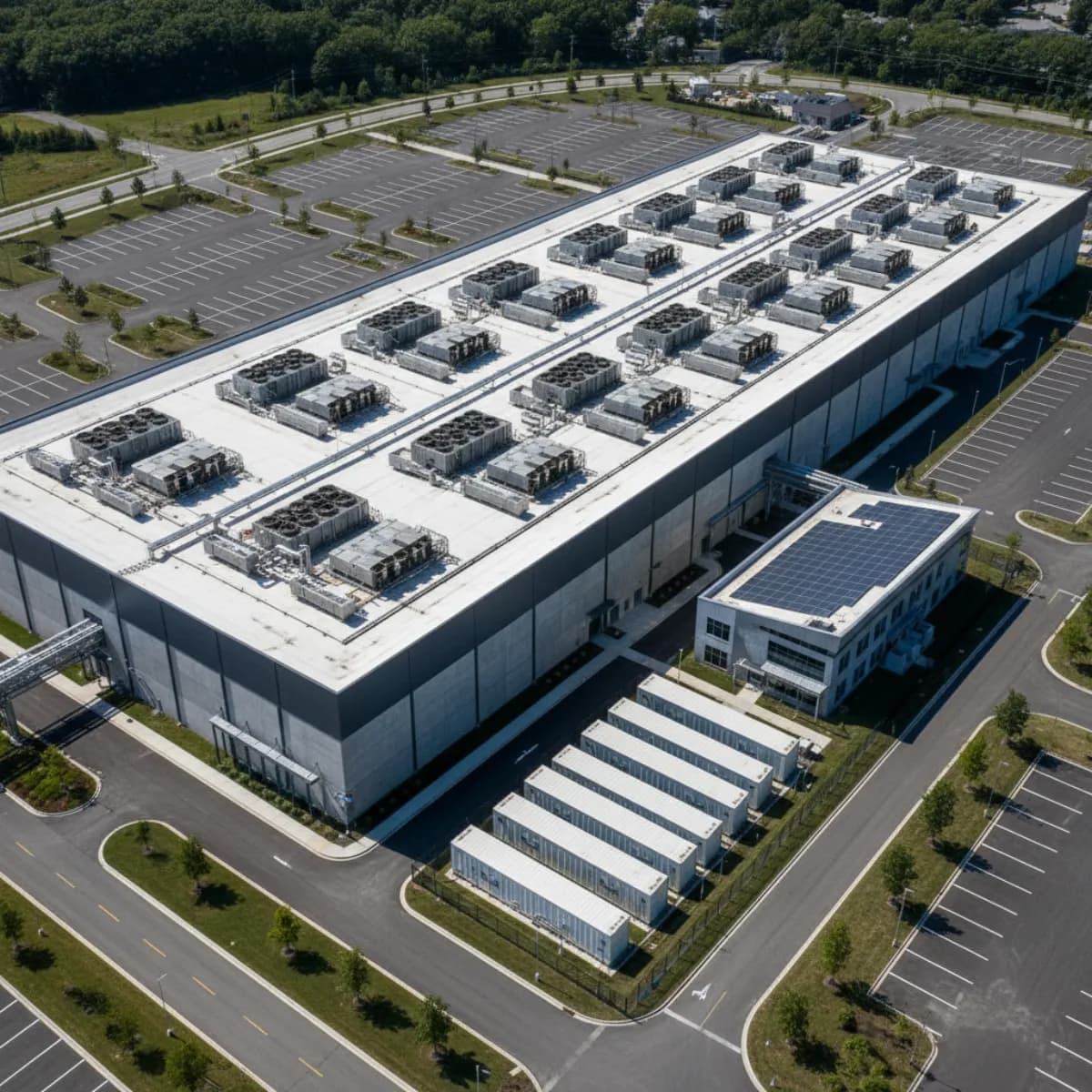
AI and colocation demand is rising across Fairfield County, Shelton, and Windsor Locks. With rooftop solar capped at under 5% of typical data center load, virtual PPAs paired with behind-the-meter battery storage are the dominant CT strategy — delivering Scope 2 RECs, CT ESS Program revenue, and 24/7 carbon-free energy matching in ISO-NE under active PURA scrutiny.
CT Data Center Load
240+ MW
Growing 12-18% annually
Rooftop Solar Fit
<5%
Of typical 24/7 IT load
VPPA Strike (TX/PJM)
3-4.5¢
Bundled voluntary RECs
BESS CT ESS Stack
$200-450
Per kW-year (Upfront + Perf.)
Connecticut data centers almost never source the majority of their load from on-site solar. A typical CT facility fits 0.5-2 MW of rooftop PV on a building drawing 10-40 MW of continuous 24/7 IT load — rooftop coverage rarely exceeds 5%. The dominant strategy is a virtual PPA (VPPA) with a utility-scale solar project in ERCOT, PJM, or ISO-NE: the generator sells into its local wholesale market, the data center pays or receives the difference against a fixed strike price, and the renewable energy credits are transferred for Scope 2 reporting. This is paired with behind-the-meter battery storage for CT ESS Program Upfront and Performance revenue, ISO-NE frequency-response ancillary services, and peak-shaving against Eversource CT and United Illuminating transmission and capacity charges. On-site rooftop and carport solar remain relevant for admin-and-cooling-support load, CT NRES commercial tariff compensation, and sustainability signaling — but the Scope 2 accounting work is done by the off-site VPPA, and PURA rate dockets increasingly expect a credible demand-side portfolio as part of large-load siting.
Connecticut is a smaller data center market than Massachusetts — there is no direct parallel to the Westborough/Marlborough cluster — but it is growing meaningfully and for distinct reasons. CT's footprint is anchored by Fairfield County financial colocation (Stamford and Norwalk, serving NYC-proximal trading systems), Shelton and the lower Naugatuck Valley (pharma, insurance, regional enterprise edge), and Windsor Locks plus the Bradley corridor (airport-proximal telecom edge, Hartford financial services and aerospace). The state hosts roughly 240-290 MW of active data center load across colocation, enterprise, and edge deployments.
The growth pattern differs from Texas or Northern Virginia — and is lower-scale than MA's Westborough cluster — but the economic drivers are identical: medium-scale colocation (5-20 MW) and edge facilities (1-5 MW) dominate, with emerging AI/GPU pods pushing rack densities and driving selective 20-60 MW buildouts. Tenant mix skews toward latency-sensitive financial trading (Stamford), pharma/life-sciences HIPAA workloads (Shelton/Valley), and regional cloud edge nodes for the three major hyperscalers. The result is distinct solar procurement dynamics: physical footprint is constrained (rooftop solar covers a small fraction of load), but tenant sustainability demands and active PURA rate dockets on large-load cost allocation push operators toward sophisticated VPPA, CT NRES, and behind-the-meter storage strategies.
Solar strategy in CT therefore looks less like “build a 50 MW ground mount next to the data center” and more like a layered procurement stack: modest on-site PV under the CT NRES commercial tariff for the admin and cooling-support meter, behind-the-meter BESS stacking CT ESS Upfront + Performance incentives with ISO-NE ancillary revenue, and one or more off-site VPPAs to cover the remaining 90%+ of load for Scope 2 matching.
CT primary data center cluster
Solar Strategy: Eversource CT territory with the highest commercial retail rates in ISO-NE; proximity to NYC financial trading systems pushes latency-sensitive tenants into Stamford and Norwalk. Rooftop is constrained by dense urban lots, which amplifies the value of off-site VPPAs and behind-the-meter BESS stacked on the CT ESS Program.
Enterprise + edge colocation corridor
Solar Strategy: United Illuminating (UI) territory; Route 8 and I-95 access with slightly more land availability than Fairfield County, enabling larger carport and limited ground-mount arrays. CT NRES tariff suits ancillary and admin-load solar up to 5 MW AC. Pharma tenants in the Valley drive sustained Scope 2 demand.
North-central CT edge market
Solar Strategy: Eversource CT territory with larger parcels and lower site costs than Fairfield County; access to the Hartford financial-services and aerospace load cluster. Ground-mount solar is physically feasible where roof area is insufficient, and CT ESS Program + CT Grid Edge battery incentives stack on the same asset.
Emerging secondary market
Solar Strategy: Eversource CT territory with mature commercial solar interconnection process; CT NRES commercial tariff supports admin-meter offset; access to CT ESS Program Upfront + Performance incentives for behind-the-meter storage. Lower land costs than Fairfield County enable mid-scale on-site supplementation.
Even in a mid-sized market like CT, AI workloads are pushing rack densities from 5-8 kW to 30-80+ kW. A single 20-rack GPU deployment can draw 1-2 MW continuously — doubling a small colocation facility's IT load. In an ISO-NE grid with winter gas constraints and some of the highest commercial retail rates in the country, every incremental megawatt of AI load amplifies the value of a fixed-price VPPA hedge and a peak-shaving BESS. That same growth has also shifted PURA rate-case discussions, which increasingly examine whether large-load interconnection costs should be allocated to data center customers rather than the residential ratepayer base.
30-80+
kW/rack (AI clusters)
15-23¢
All-in retail $/kWh (CT)
3-5 yr
ISO-NE interconnection queue
Data centers operate at 95-99% utilization of their nameplate power every hour of every day — routinely above 90%+ annualized. A 10 MW facility consumes roughly 87,600 MWh/year — comparable to 10,000 CT homes. The load is almost perfectly flat: no weekend dip, no overnight valley, no seasonal break beyond modest cooling-driven variation. This flat 24/7 profile is the core reason rooftop solar cannot carry a data center in CT. A rooftop array generates 16-18% of its nameplate over the year, concentrated between 9 AM and 4 PM. Matching that intermittent production against flat baseload means even a fully rooftop-covered data center (which is physically rare) generates only a small fraction of annual MWh — and zero at night when IT load continues.
24/7 baseload, cooling-dominant, distributed CT locations
Annual Load
8,760-43,800 MWh/year
Rack Density
5-8 kW/rack
PUE Target
1.3-1.5
Typical Procurement
CT NRES ancillary + small VPPA + on-site BESS
Solar Fit in CT: On-site rooftop (0.3-1.5 MW AC) typically covers 3-8% of annual load. Dense Stamford/Norwalk sites often have <5% rooftop coverage. Behind-the-meter BESS for peak shaving and CT ESS Program revenue. Small VPPA or CT NRES-backed offset for the remaining 90%+.
High density, 2N redundant power, multi-tenant, tenant-driven renewable demand
Annual Load
43,800-175,200 MWh/year
Rack Density
8-15 kW/rack
PUE Target
1.2-1.4
Typical Procurement
Off-site VPPA + on-site BESS (CT ESS)
Solar Fit in CT: On-site rooftop + carport (1-3 MW AC) covers 2-5% of load. Off-site VPPA (10-50 MW) required for meaningful Scope 2 reduction. Behind-the-meter BESS for 4-hour peak shaving stacking CT ESS Upfront + Performance payments and ISO-NE frequency-response revenue.
Campus-scale, often multi-tenant with anchor hyperscale pod, multi-decade PPA portfolios, 24/7 CFE commitments
Annual Load
175,200-525,000+ MWh/year
Rack Density
10-30+ kW/rack (AI/GPU clusters)
PUE Target
1.1-1.3
Typical Procurement
Multi-region VPPA portfolio + on-site BESS
Solar Fit in CT: On-site solar is typically under 2% of load — symbolic rather than material. Multi-PPA portfolio across ISO-NE, PJM, or ERCOT via VPPA is the core strategy. Dedicated utility-scale solar + offshore wind + storage contracts to approach 24/7 hourly CFE matching, with CT-based in-region PPAs used to back Class I RPS-adjacent claims for CT regulators and tenants.
Across CT colocation and enterprise data centers, on-site rooftop PV consistently covers under 5% of annual kWh consumption. The math: a 50,000 sq ft rooftop supports roughly 0.5-0.8 MW AC. In New England that array generates 700-1,100 MWh/year. A 5 MW data center consumes 43,800 MWh/year. The ratio is structural — power density of silicon PV per square meter simply cannot keep up with power density of rack-mounted servers per square meter. Off-site procurement is not a preference; it is an engineering necessity.
Data center operators in Connecticut have five primary solar and renewable energy procurement paths, each with distinct cost profiles, accounting treatment, and REC eligibility. Most large-colocation operators build a portfolio — small on-site under the CT NRES commercial tariff for signaling and admin-meter load, behind-the-meter BESS for revenue stacking under the CT ESS Program, and one or more off-site VPPAs for the overwhelming majority of Scope 2 claims. The specific portfolio depends on whether the operator needs CT Class I RPS compliance (rare for voluntary corporate claims) or Scope 2 market-based accounting (universal).
Capacity: 100 kW - 2 MW AC
Complexity: Low
Accounting: Operating expense (PPA) or capital asset (§48E owned, or leased via §6418 transfer)
Capacity: 1-5 MW AC
Complexity: Medium
Accounting: Operating expense (PPA) or capital asset
Capacity: 5-50 MW AC
Complexity: High
Accounting: Operating expense (service contract)
Capacity: 10-200+ MW AC
Complexity: Very High
Accounting: Financial derivative (ASC 815 mark-to-market)
Capacity: Any (utility-mediated)
Complexity: Low
Accounting: Operating expense (bundled with utility supply)
For-profit data center operators use Section 48E Clean Electricity Investment Tax Credit (30% base, plus bonus adders for domestic content and energy communities) paired with 5-year MACRS accelerated depreciation. §48E remains available: projects that began construction on or before July 4, 2026 locked in the full timing pathway, and projects starting now still qualify but generally must be placed in service by December 31, 2027. If the operator's tax appetite cannot fully absorb the credit, Section 6418 transferability allows the credit to be sold to an unrelated taxpayer for cash at roughly $0.90-$0.95 per dollar of credit — common for colocation REITs and newer operators without legacy tax capacity. Coordinate with a qualified tax advisor before signing; for new starts, the December 31, 2027 placed-in-service deadline is binding.
A virtual PPA (VPPA) is a financial contract for differences paired with a REC transfer — it is not a supply agreement. Under a VPPA, the generator (typically a utility-scale solar farm in ERCOT, PJM, or MISO) sells its output into its local wholesale market at real-time or day-ahead prices. The data center continues to take retail supply from its local utility — in CT, that is Eversource CT or United Illuminating. The VPPA sits on top as a financial swap: the data center agrees to pay the generator a fixed strike price per MWh, and in return receives the wholesale market price plus the RECs for every MWh generated.
When the wholesale market price is above the strike, the generator pays the difference to the data center (a hedge gain). When the wholesale price is below the strike, the data center pays the difference to the generator (a hedge loss). Over a full year, the net settlement is expected to be small — the strike is priced to approximate the generator's long-run average expected wholesale revenue. The real value flows through the RECs, which are retired on behalf of the data center for Scope 2 reporting, and the price certainty, which locks a portion of the operator's energy cost for 12-20 years.
Generator Side (in ERCOT)
Data Center Side (in CT)
Net economic outcome: At a strike price of ~$35/MWh and ERCOT long-run average of ~$35-40/MWh, the hedge roughly breaks even over the contract life. Value delivered = 100% annual REC matching + long-duration price hedge + balance-sheet demonstration of climate commitment + credible PURA testimony position on demand-side management.
High — fully exposed to ISO-NE winter price spikes and capacity charges
10 MW annual: $13.1M-$20.1M
Eversource CT and United Illuminating commercial rates for large load are among the highest in the continental US. ISO-NE winter natural-gas constraints routinely push wholesale prices above $200/MWh. Forward Capacity Market charges add $15-30/kW-year. Transmission and distribution demand charges — governed by PURA rate cases — compound the exposure, and CT data centers face active PURA docket scrutiny on cost allocation as large-load growth accelerates.
High — rooftop is symbolic, not a material hedge
10 MW annual: $12.3M-$19.3M
Rooftop offsets a single-digit percent of load on the office/support meter. Useful for sustainability signaling and modest demand-charge relief, but the overwhelming share of 24/7 data center load still rides the Eversource CT or UI retail tariff. Pair with BESS and a VPPA to make a dent.
Medium — Scope 2 covered, ISO-NE retail exposure remains
10 MW annual: $12.3M-$16.6M
A ~30-60 MW VPPA struck at $30-$45/MWh generates enough RECs to claim 100% annual matching for voluntary corporate reporting. The hedge gain/loss flows to P&L via ASC 815. Retail supply from Eversource CT or UI continues in parallel — the VPPA does not displace physical delivery. Most common path for hyperscale and large-colocation Scope 2 goals in CT.
Lower — peak shaving + CT ESS revenue offsets retail cost
10 MW annual: $10.5M-$14.9M
A 5-20 MW / 4-hour battery shaves the ICAP tag and transmission peak, earns CT ESS Program Upfront incentives at commissioning, and then earns Performance incentives for dispatches during designated system-peak hours across a 10-year payment tail. Stacks cleanly on top of an off-site VPPA for Scope 2.
Very Low — 90%+ hourly matching, diversified across ISO regions
10 MW annual: $11.4M-$15.8M
Combines in-region CT/MA solar PPAs (for ISO-NE hourly matching and CT Class I adjacency), offshore wind PPAs (Vineyard Wind, Revolution Wind), out-of-region VPPAs (for cost-effective volume), and behind-the-meter BESS (for peak shaving and short-duration firming). Premium-priced, but the only credible path to granular hourly CFE claims in an ISO-NE footprint.
VPPAs are financial derivatives under US GAAP and require mark-to-market treatment on the balance sheet unless hedge accounting is elected and supported. Quarterly fair-value changes can swing earnings meaningfully — a 50 MW VPPA with a $10/MWh move in forward prices implies roughly $1-2 million of P&L volatility per quarter for a 15-year contract. CFOs should model worst-case settlement scenarios (sustained low wholesale prices below strike, or extended negative pricing during spring oversupply events) before signing, and consider hedge accounting qualification for a cleaner P&L profile.
The industry is moving from annual matching (buy enough RECs to cover total annual consumption) to hourly matching(demonstrate carbon-free generation for every hour of operation on the same grid). Google's 24/7 CFE methodology and Microsoft's 100/100/0 pledge are the canonical frameworks. In ISO-NE this is meaningfully harder than in ERCOT or MISO: New England has modest solar capacity factors (16-18% vs 22-28% in TX), limited onshore wind, and winter natural-gas-constrained grid-mix carbon intensity that spikes during cold snaps.
A credible CT 24/7 CFE portfolio layers in-region solar PPAs (for CT Class I-adjacent daytime matching), offshore wind PPAs (Revolution Wind, Vineyard Wind, future projects — with strong winter production), behind-the-meter BESS (short-duration firming, peak shaving, and CT ESS Performance dispatch), and an accepted grid-backstop allowance for multi-day low-generation periods such as polar-vortex weeks. Blended costs typically land at $0.08-$0.12/kWh — a premium over annual-matching VPPAs, but the only defensible path to granular hourly claims in an ISO-NE footprint.
| Strategy | Hourly Match | Annual Match | Coverage Gap | Blended Cost |
|---|---|---|---|---|
| Annual RECs Only (Unbundled) | Not measured | 100% | No hourly signal — widely criticized as greenwashing | $0.005-$0.02/kWh (REC adder) |
| VPPA — Annual Volumetric Matching | ~30-40% | 100% | No coverage nights/winter mornings; overproduction during shoulder seasons | $0.03-$0.045/kWh (strike) |
| Solar VPPA + 4hr BESS (On-Site, CT ESS) | ~45-55% | 100% | Winter evenings and multi-day storm periods uncovered | $0.06-$0.09/kWh (blended) |
| Solar + Offshore Wind VPPA Portfolio | ~65-80% | 100% | Low-wind/low-sun days (polar vortex weeks) | $0.05-$0.08/kWh |
| Full 24/7 CFE Portfolio (Solar + Wind + Storage + Backstop) | ~90-98% | 100% | Extreme multi-day generation droughts | $0.08-$0.12/kWh (blended firm) |
Connecticut does not have a single “Climate Act” statute comparable to MA's 2024 framework, but it does operate a parallel policy stack: the Global Warming Solutions Act (amended to target a zero-carbon electric sector by 2040), active PURA rate dockets examining large-load cost allocation and interconnection, the CT Energy Storage Solutions (ESS) Program (Upfront + Performance incentives), the CT Green Bank C-PACE program for commercial financing, and the CT Non-Residential Energy Solutions (NRES) tariff for commercial solar compensation. For data centers — which virtually always exceed 1 MW of continuous load — this stack creates both compliance overhead and meaningful financial leverage for a well-designed solar + storage + VPPA portfolio.
The Public Utilities Regulatory Authority (PURA) has opened active dockets examining how transmission, distribution, and capacity costs are allocated as AI and colocation load grow. Large data centers are increasingly expected to justify interconnection cost causation, and PURA may require dedicated tariff classes or cost-of-service studies for loads above defined thresholds. Solar and storage commitments are a credible mitigation narrative in testimony and compliance filings.
Operator takeaway: Bring VPPA + on-site BESS + CT NRES procurement into PURA interconnection filings and any cost-allocation testimony. Regulators consistently give weight to operators demonstrating active demand-side management rather than pure passive consumption.
CT is on a statutory path to a zero-carbon electric sector by 2040 (one of the most aggressive state targets). Large commercial loads are expected to contribute — via Class I RPS compliance on the retail side and voluntary Scope 2 procurement on the corporate side. Compliance reporting aligns with MA Climate Act large-load conventions, creating a parallel framework across the ISO-NE footprint.
Operator takeaway: Operators that adopt MA-style large-load reporting conventions (annual energy use + REC retirement) ahead of mandatory CT frameworks are better positioned for PURA and DEEP scrutiny and consistently face fewer siting obstacles.
The CT Green Bank C-PACE (Commercial Property Assessed Clean Energy) program allows commercial owners to finance solar, storage, and efficiency improvements via a property-tax assessment, often at rates below corporate cost of capital and with 20-25 year terms. C-PACE is underutilized by data center operators but is well-suited to on-site solar + BESS projects that lack tenant-led capital flexibility.
Operator takeaway: For colocation operators with multi-tenant capital constraints, pair C-PACE financing with §48E / §6418 tax monetization — the C-PACE assessment stays with the property through asset sales, reducing covenant risk.
The CT Energy Storage Solutions program pays commercial battery owners Upfront incentives at commissioning (declining block) plus a 10-year stream of Performance incentives tied to dispatch during designated distribution-peak and system-peak hours. Combined with ISO-NE frequency-response ancillary revenue and retail peak-shaving, a well-designed 5-20 MW BESS at a data center site earns payments from three independent channels on the same asset.
Operator takeaway: Size and commission the BESS to optimize for all three revenue streams simultaneously — the CT ESS Upfront reservation window and interconnection approval both gate the Performance payment structure, so sequencing matters.
Most hyperscalers and large colocation operators use out-of-region VPPAs for the bulk of voluntary Scope 2 claims and hold smaller in-region Class I positions for tenant-facing marketing and PURA testimony credibility. The MA and CT frameworks evolve in parallel across the ISO-NE footprint — a CT portfolio designed on MA Climate Act conventions ages well.
Data center UPS architecture already assumes N+1 or 2N redundant battery support for short-duration ride-through. Extending that architecture with a grid-tied behind-the-meter battery (5-20 MW / 4-hour) turns a resilience asset into a three-revenue-stream asset: (1) peak shaving against the ISO-NE ICAP tag and transmission peak hour, (2) CT ESS Program Upfront incentives at commissioning plus 10-year Performance payments for discharges during designated Distribution Peak and System Peak windows, and (3) ISO-NE ancillary services — particularly frequency response and regulation — which CT-sited BESS can bid into directly. A well-designed battery captures all three without compromising IT resilience.
Discharging during the ISO-NE coincident peak hour reduces the facility's capacity-market tag, cutting Forward Capacity Market charges by roughly $15-30 per kW-year of reduction plus avoided CT transmission peak demand charges.
Upfront incentives at commissioning (declining block) plus 10 years of Performance payments tied to dispatch during designated Distribution and System Peak hours. A 5 MW / 20 MWh commitment earns $1-2 million per year in Performance alone.
CT behind-the-meter BESS can bid short-duration frequency response and regulation into ISO-NE ancillary markets, adding a third revenue stream independent of retail peak and CT ESS dispatch. Typical realized revenue: $15-40/kW-year.
Direct Revenue
Avoided Cost
Combined: $3.0-5.0M per year in recurring revenue + upfront lump sum + §48E credit monetization. Stacks on top of a VPPA for Scope 2 without conflict — the VPPA delivers the RECs, the battery delivers the peak economics and the PURA-facing demand-side narrative.
Complete CT commercial solar guide: §48E ITC stacking, CT NRES tariff, utility rates, pricing, and ROI for Connecticut businesses.
CT Energy Storage Solutions program mechanics: Upfront + Performance payment structure, zone pricing, and commissioning timeline.
Grid Edge battery incentive stacking with CT ESS and ISO-NE ancillary markets for commercial behind-the-meter storage.
Non-Residential Energy Solutions commercial tariff: compensation structure, eligibility, and interconnection process for CT commercial solar.
Section 6418 tax credit transfer and §6417 elective pay for CT commercial solar and storage projects through July 2026 deadline.
CT VPP participation for commercial BESS: aggregator mechanics, dispatch obligations, and revenue stacking with CT ESS.
5-year MACRS accelerated depreciation stacking with §48E for CT commercial solar: timing, mechanics, and §6418 monetization.
ISO-NE cluster study process and CT commercial interconnection timeline: cost allocation, queue position, and large-load considerations.
A typical CT data center rooftop fits 0.5-2 MW of solar on a facility drawing 10-40 MW of continuous 24/7 IT load. Even a fully built-out rooftop covers only 2-5% of annual consumption. Virtual PPAs (VPPAs) solve this by letting the data center contract with a utility-scale solar project in a higher-capacity-factor market such as ERCOT or PJM. The generator sells its output into the wholesale market where it sits, the data center pays or receives the difference against a fixed strike price, and the renewable energy credits are transferred to the data center for Scope 2 reporting. No electrons move across state lines — the contract is a financial swap paired with REC transfer. That structure scales from 10 MW to 200+ MW without being bottlenecked by CT rooftop area or ISO-NE interconnection queues.
NuWatt helps CT data center operators design layered portfolios — on-site solar under the CT NRES commercial tariff, behind-the-meter BESS stacking CT ESS Upfront + Performance and ISO-NE ancillaries, and off-site VPPAs for Scope 2 RECs. ISO-NE market expertise, PURA testimony support, and full procurement diligence.