Loading NuWatt Energy...

We use your location to provide localized solar offers and incentives.
We serve MA, NH, CT, RI, ME, VT, NJ, PA, and TX
Loading NuWatt Energy...
NuWatt designs, installs, and manages solar, battery, heat pump, and EV charger systems across 9 states. One company, one warranty, one point of contact.
Get a Free Quote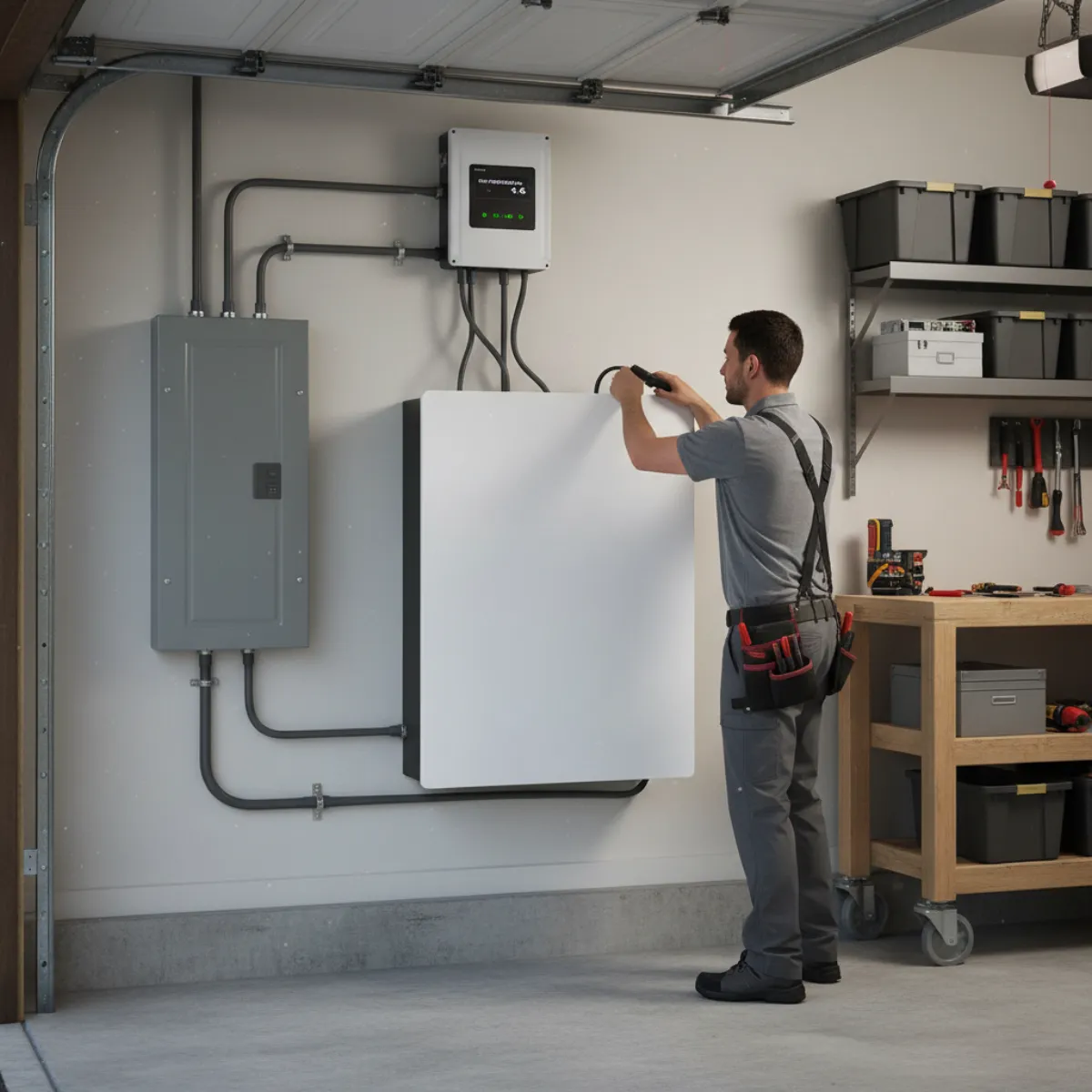
Already have solar panels on your MA home? Adding a battery unlocks ConnectedSolutions revenue of $2,250-$3,163/year, backup power during nor'easters, and TOU savings. This guide covers compatibility by inverter type, top retrofit batteries, costs, and step-by-step installation.
Yes, and in MA it's one of the best energy investments you can make. Any grid-tied solar system can add a battery through AC-coupling. The cost is $8,000-$15,000 installed, with 0% financing through the Mass Save HEAT loan (up to $25,000 for 7 years). The biggest financial driver: ConnectedSolutions pays $2,250-$3,163/year for a 13.5 kWh battery, creating a 3-5 year payback. Enphase microinverter systems are the easiest to retrofit; SolarEdge and older string inverter systems require AC-coupling but are still fully compatible.
If you installed solar panels in Massachusetts before 2025, you likely didn't add a battery. That was rational at the time — batteries were expensive and net metering provided full retail credit for excess production. But three things have changed that make a 2026 battery retrofit one of the highest-ROI home energy investments available.
First, ConnectedSolutions revenue has increased. Eversource now pays $275/kW in summer and $50/kW in winter. National Grid pays $225/kW summer and $50/kW winter. A single 13.5 kWh Tesla Powerwall 3 generates $2,588-$3,163 in annual demand-response revenue. This alone creates a 3-5 year payback on the battery — far faster than any other home energy upgrade.
Second, grid reliability is declining. The 2024-2025 storm season brought 14 significant outages to Massachusetts, with four major nor'easters causing extended outages of 12-48 hours. If you have a heat pump (or plan to get one), losing power in January means losing heat. A battery keeps your heat pump running through outages.
Third, battery prices have dropped 30-40% since 2022. The Tesla Powerwall 3, released in 2024, offers 13.5 kWh and 11.5 kW continuous power for $11,500-$13,500 installed — down from $16,000-$18,000 for the Powerwall 2 at its peak. Enphase IQ 5P units are $5,500-$7,000 each. These price reductions, combined with ConnectedSolutions revenue, make the economics compelling.
The residential Section 25D ITC expired at end of 2024. Homeowners purchasing batteries directly no longer receive a federal tax credit. However, batteries may qualify under the commercial Section 48E credit through third-party ownership (TPO) structures. If your installer offers a battery lease or PPA, the 48E credit reduces their cost and gets passed to you through lower payments. Ask specifically about TPO battery options.
The single most important factor in a battery retrofit is your existing inverter type. This determines which batteries integrate most easily, whether you need additional hardware, and the total retrofit cost. Here's the compatibility matrix for the three main inverter types found in Massachusetts solar installations.
Enphase IQ 5P
Plug-and-play with Enphase ecosystem. IQ 5P communicates natively with IQ microinverters. No inverter replacement needed. Most common retrofit in MA.
Enphase IQ System Controller required (~$1,500-$2,000 installed)
Tesla Powerwall 3 or Franklin aPower2
SolarEdge Energy Hub inverter supports battery directly, but older SE models do not. If you have a non-Hub SolarEdge inverter, an AC-coupled battery (Powerwall 3, Franklin aPower2) works without replacing the inverter.
AC-coupling hardware + gateway. If upgrading to Energy Hub: $2,500-$4,000 for new inverter.
Tesla Powerwall 3 or Franklin aPower2
Older string inverters cannot communicate with batteries directly. AC-coupled batteries work alongside the existing inverter. If the string inverter is near end-of-life (10+ years), consider replacing with a hybrid inverter.
AC-coupling + potential inverter replacement ($2,000-$5,000). Panel upgrade may also be needed if older than 150A.
Look at your solar monitoring app — Enphase Enlighten, SolarEdge, or your inverter manufacturer's app. Alternatively, check the inverter label on the unit (typically installed near your electrical panel in the garage or basement). If you have micro-inverters, each panel has its own small inverter on the back. If you have a single large box (the size of a small suitcase), you have a string or optimizer inverter. Not sure? Contact NuWatt for a free compatibility check.
These three batteries cover every retrofit scenario in Massachusetts. All three qualify for ConnectedSolutions, provide backup power, and work with existing solar systems. The right choice depends on your inverter type, backup needs, and budget.
A battery retrofit is significantly simpler than a full solar installation. No roof work, no new panel mounting, no structural engineering. The battery connects to your electrical panel at the ground level. Here's the step-by-step process for Massachusetts homeowners.
Installer inspects your current solar system, inverter type, electrical panel, and identifies the optimal battery location. They confirm 200A service (or recommend panel upgrade).
Engineer designs the battery integration, AC-coupling details, and backup circuits. Permits submitted to your municipality. Interconnection application sent to Eversource or National Grid.
Battery mounted (wall or floor). Gateway/controller installed. Wiring to electrical panel. AC-coupling with existing inverter. Critical load panel configured for backup circuits.
Municipal electrical inspection. System tested for backup switching, grid export, and load management. Utility interconnection approval (Permission to Operate).
Enroll battery in Eversource or National Grid ConnectedSolutions program. Configure dispatch settings and backup reserves. Revenue starts with the next event season.
Battery systems require 200A electrical service. Many MA homes built before 1990 have 100A or 150A panels. Signs you may need an upgrade:
A 200A panel upgrade costs $2,000-$4,500 in Massachusetts. If you need one, bundle it with the battery install to save on labor costs.
ConnectedSolutions is the single biggest reason to add a battery in Massachusetts. This demand-response program pays you for allowing your battery to discharge during grid peak events — typically 1-4 hours on the hottest summer afternoons or coldest winter evenings.
How to enroll after your retrofit: Once your battery is installed and has received Permission to Operate (PTO) from your utility, your installer submits the ConnectedSolutions enrollment application. Approval takes 2-4 weeks. You configure your backup reserve (typically 20-30%) so you always have storm protection. Revenue begins with the next event season.
Event schedule: Winter events run December through March (the highest-paying season). Summer events run June through September. Events are dispatched by the utility and your battery responds automatically. You can opt out of individual events if needed, though this reduces annual revenue.
| Battery | Eversource | Nat'l Grid |
|---|---|---|
| Enphase IQ 5P (5 kWh) | $1,375/yr | $1,125/yr |
| 2x Enphase IQ 5P (10 kWh) | $2,750/yr | $2,250/yr |
| Franklin aPower2 (13.6 kWh) | $2,750/yr | $2,250/yr |
| Powerwall 3 (13.5 kWh) | $3,163/yr | $2,588/yr |
Revenue based on Eversource $275/kW summer + $50/kW winter; National Grid $225/kW summer + $50/kW winter. Actual revenue depends on event frequency and participation.
| Component | Cost Range |
|---|---|
Battery unit Depends on capacity (5-13.6 kWh) | $5,500-$12,500 |
Gateway / controller Required for backup & ConnectedSolutions | $1,000-$2,500 |
Electrical panel work 200A service if not already present | $500-$2,500 |
AC-coupling hardware If not using matching inverter ecosystem | $500-$1,500 |
Installation labor 1-2 day install typical | $1,500-$3,000 |
Permitting & inspection Varies by municipality | $200-$500 |
| Total Installed | $8,000-$15,000 |
The Mass Save HEAT loan offers 0% interest financing up to $25,000 for 7 years for qualifying energy improvements, including battery storage. A $12,500 battery financed through HEAT loan costs just $149/month with zero interest — while ConnectedSolutions pays you $188-$264/month. The battery is cash-flow positive from day one.
Home equity loans and lines of credit (HELOCs) are another option, typically at 6-8% APR with potential tax-deductible interest. For homeowners who don't qualify for the HEAT loan, some installers offer in-house financing at 3-7% APR.
Yes. Any grid-tied solar system in MA can add a battery through a process called AC-coupling. The battery connects to your electrical panel alongside your existing solar inverter — no need to replace panels or rewire the array. The ease and cost of the retrofit depends on your current inverter type: Enphase microinverter systems are the simplest, SolarEdge systems are moderate, and older string inverters may require additional work. Most retrofits take 1-2 days to install.
A battery retrofit in Massachusetts costs $8,000-$15,000 installed, depending on the battery (Enphase IQ 5P: $5,500-$7,000 per unit; Tesla Powerwall 3: $11,500-$13,500; Franklin aPower2: $10,500-$12,500) plus installation, gateway hardware, and any electrical panel upgrades. The Mass Save HEAT loan offers 0% financing up to $25,000 for 7 years, making the monthly payment very manageable.
Usually not. AC-coupled batteries like the Tesla Powerwall 3 and Franklin aPower2 work alongside any existing inverter without replacement. If you have Enphase microinverters, the Enphase IQ 5P integrates seamlessly. The only scenario where inverter replacement makes sense is if your current string inverter is 10+ years old and approaching end-of-life — in that case, upgrading to a hybrid inverter during the battery install saves a future service call.
ConnectedSolutions is a demand-response program run by Eversource and National Grid. After installing a qualifying battery, you enroll and allow the utility to dispatch your battery during grid peak events (typically 1-4 hours on extreme weather days). Eversource pays $275/kW summer and $50/kW winter; National Grid pays $225/kW summer and $50/kW winter. A 13.5 kWh Powerwall earns $2,588-$3,163/year. You keep backup reserves for storms.
The residential Section 25D Investment Tax Credit expired at the end of 2024 for homeowners purchasing systems directly. However, batteries may still qualify for the commercial Section 48E credit through third-party ownership (TPO) structures like solar leases or PPAs. If your installer offers a TPO battery option, the tax credit reduces the lessor cost and gets passed to you through lower payments. Ask your installer about TPO battery options.
Most battery retrofits take 1-2 days to install. Day one involves mounting the battery, installing the gateway/controller, and wiring to the electrical panel. Day two (if needed) is for testing, commissioning, and utility interconnection paperwork. The longer timeline is permitting and interconnection approval, which takes 2-6 weeks depending on your municipality and utility. Total project timeline from contract to operational is typically 4-8 weeks.
No. Adding a battery does not change your net metering arrangement. Your solar panels continue to produce and export the same amount of electricity. The battery stores excess solar production for evening use or backup instead of sending it all to the grid — but since MA has full retail net metering credit, the economic difference is minimal. The real financial gain comes from ConnectedSolutions revenue ($2,250-$3,163/year), which far exceeds any slight net metering adjustment.
The Enphase IQ 5P is the natural choice for existing Enphase systems. It communicates natively with IQ7, IQ7+, and IQ8 microinverters through the Enphase ecosystem, providing seamless monitoring and control in the same Enlighten app. Each IQ 5P unit provides 5 kWh — stack 2-4 units for whole-home backup (10-20 kWh). You will also need the Enphase IQ System Controller (~$1,500-$2,000 installed) for backup switching.
Full program guide: enrollment, revenue math, qualifying batteries.
Complete battery comparison with pricing and specs.
In-depth review of specs, installation, and performance.
Modular battery system review for Enphase homes.
Get a free battery retrofit quote from NuWatt. We'll check your inverter compatibility, recommend the right battery, and handle ConnectedSolutions enrollment.