Loading NuWatt Energy...

We use your location to provide localized solar offers and incentives.
We serve MA, NH, CT, RI, ME, VT, NJ, PA, and TX
Loading NuWatt Energy...
NuWatt designs, installs, and manages solar, battery, heat pump, and EV charger systems across 9 states. One company, one warranty, one point of contact.
Get a Free Quote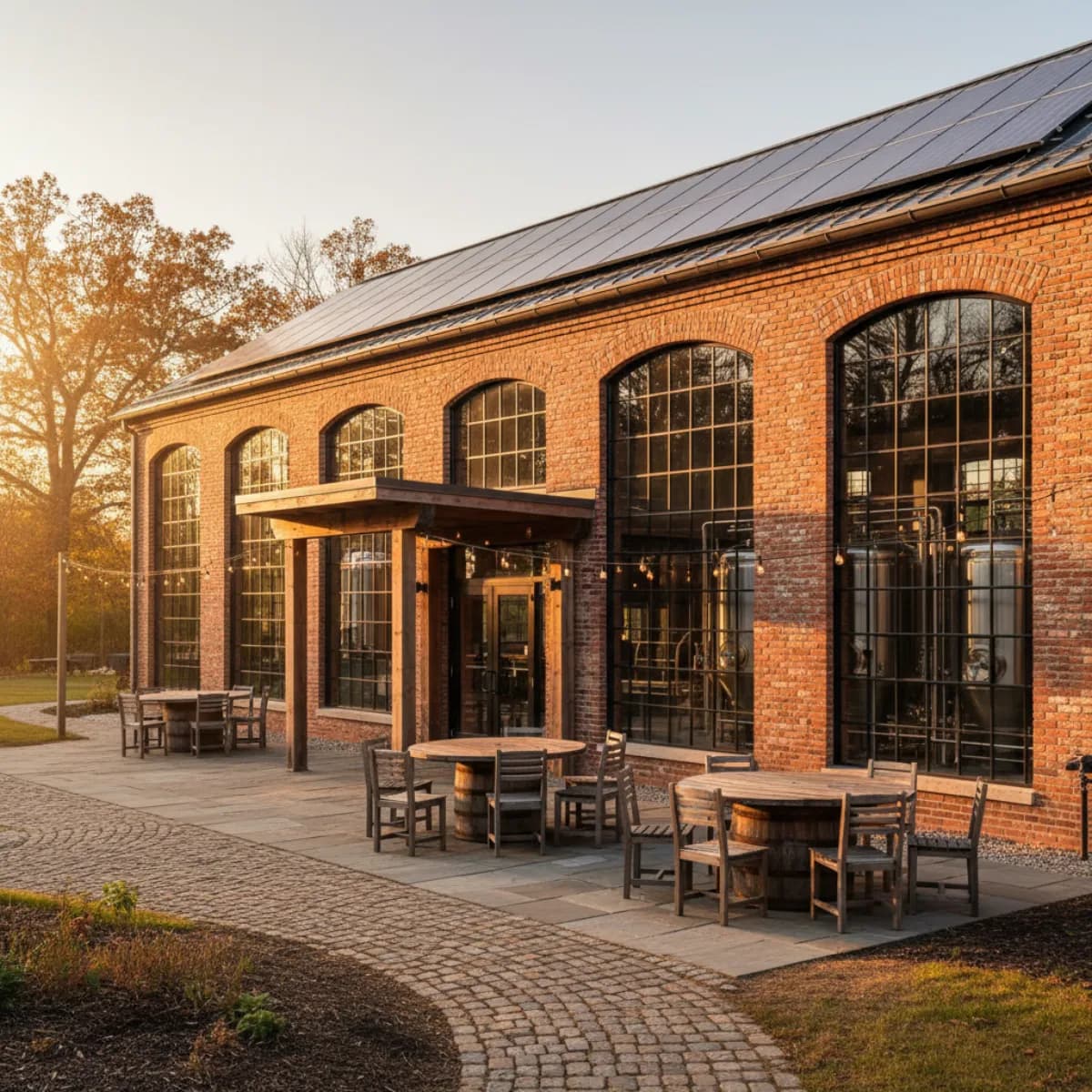
Massachusetts is home to 200+ craft breweries, dozens of distilleries, and a fast-growing winery and cidery sector. These are energy-intensive production facilities — glycol chillers, CIP hot water, stillhouse cooling, barrel-room conditioning — and some of the strongest commercial solar candidates in New England.
MA Craft Breweries
200+
Plus distilleries, wineries, cideries
15-BBL Energy Use
30-60k
kWh/month plus propane/NG
Incentive Stack
60-80%
With REAP + §48E + MACRS
Net Payback
1.7-2.5 yrs
Rural producers with REAP grant
A 15-BBL Massachusetts taproom brewery using 30,000-60,000 kWh per month plus 400-800 gallons of propane (for CIP and mash) can cut total energy costs 50-70% by combining a 75-100 kW solar PV system with a commercial heat pump water heater for CIP and mash pre-heat. After stacking the 30% federal Section 48E ITC (new starts in service by Dec 31, 2027), MACRS 5-year depreciation, USDA REAP grants (up to 50% for rural producers), Massachusetts SMART 3.0 production incentives, MA sales and property tax exemptions, and Mass Save commercial HPWH rebates, net payback typically lands in 1.7-3 years — among the fastest of any commercial vertical in the state. Glycol chillers running continuously provide an ideal base load that maximizes solar self-consumption at the full retail rate.
Massachusetts has become one of the densest craft-beverage ecosystems in the country. From Tree House Brewing in Charlton and Wormtown in Worcester, to Night Shift in Everett, Trillium in Canton, Lord Hobo in Woburn, and Turtle Swamp in Jamaica Plain, plus hundreds more across every region of the state — craft breweries are a legitimate economic anchor for many Massachusetts communities. Layer on the distillery boom (Short Path, Bully Boy, Berkshire Mountain, GrandTen, and growing), the winery sector across the South Shore, Pioneer Valley, and Martha's Vineyard, and a meaningful cidery cluster, and the state hosts a large, energy-intensive production base that has mostly not yet electrified or solarized.
These are distinct commercial customers from the restaurants and hotels our restaurants & hospitality commercial solar guide covers. Production facilities have entirely different energy profiles — continuous refrigeration base loads from glycol chillers, significant thermal demand for mash heating and CIP that often still runs on propane or natural gas, bottling and canning lines with compressed-air loads, and temperature-controlled cold storage. Treating a brewery like a restaurant will undersize the solar system and miss the biggest wins (thermal electrification). This page addresses the production side directly.
Geographically, many MA craft producers occupy historic mill buildings — adaptive reuse projects in Lowell, Lawrence, Worcester, Fall River, New Bedford, Holyoke, and similar Gateway Cities. These buildings offer strong roof structural capacity and often qualify for the federal Energy Community ITC bonus. Rural breweries — those in Worcester County hill towns, the Pioneer Valley, the Berkshires, and parts of the South Shore — also qualify for USDA REAP grants up to 50% of project cost. The combination of stacked incentives and high production-facility energy density makes this the highest-ROI commercial vertical we work with in Massachusetts.
Craft beverage production facilities have energy profiles that look nothing like offices or retail. The numbers below reflect typical Massachusetts facilities — actual consumption depends on production volume, degree of electrification, and taproom/tasting-room operations.
The following breakdown reflects a representative 15-BBL Massachusetts taproom brewery producing roughly 2,000-2,500 BBL/year with a full kitchen and 60-90 taproom seats. Monthly electric use typically runs 35,000-50,000 kWh, with additional propane or natural gas for mash heating and CIP.
| Load | Typical kWh/Month | % of Electric Load | Notes |
|---|---|---|---|
| Glycol chiller (20-ton) | 9,000-12,500 | ~25-30% | Runs continuously, especially during fermentation |
| Hot liquor tank + mash heating | 6,000-9,000 | ~15-22% | Only if already electric; propane breweries show this as gas therms |
| CIP / sanitation hot water | 3,500-5,500 | ~10-13% | Shifts to HPWH on electrification path |
| Taproom HVAC + kitchen | 5,500-9,000 | ~15-22% | Seasonal swing, higher in summer |
| Lighting + office + POS | 2,500-4,000 | ~6-10% | LED retrofit is always a Phase 0 move |
| Compressed air, pumps, packaging, CO2 | 2,800-5,000 | ~7-12% | Canning days spike this; VFDs reduce it |
| Walk-in cooler / keg cooler | 2,200-4,500 | ~6-10% | 34-38°F finished-product storage |
Glycol refrigeration alone accounts for roughly a quarter to a third of total electric consumption at a 15-BBL brewery — and it runs around the clock. That continuous base load of 10-16 kW is the single most important reason brewery solar economics are so strong: every solar kilowatt-hour produced during daytime is consumed on-site at the full retail rate, rather than exported at net-metering credit value. Sizing the array to match or slightly exceed that base load is the most capital-efficient first move.
Glycol chiller sizing scales roughly with batch volume plus cold-storage load. Here is how chiller draw lines up with a properly-sized solar PV array for each brewery tier.
| Brewery Size | Glycol Chiller (tons) | Continuous Electric Draw | Matching Solar PV | Daytime Offset |
|---|---|---|---|---|
| 3-7 BBL (nano) | 5-10 ton | 3-6 kW | 25-50 kW | Full chiller + partial balance of plant |
| 10-15 BBL (taproom) | 15-25 ton | 10-16 kW | 50-100 kW | Full chiller + HVAC + most production loads |
| 20-30 BBL (production) | 25-40 ton | 16-26 kW | 100-250 kW | Full chiller + packaging line + CIP HPWH |
| 40+ BBL (regional) | 40-80 ton | 26-50 kW | 250-500 kW+ | Full process load; excess exports under SMART |
Rule of thumb: Solar PV sized at roughly 5-7x the continuous chiller draw (in kW) typically covers chiller, taproom HVAC, lighting, office, and packaging loads during daylight hours, while still producing enough excess for SMART net metering credits on off-days and weekends. For breweries planning to add a heat pump water heater for CIP or mash, add another 30-50% to solar sizing to cover the new HPWH load.
The biggest hidden opportunity in brewery decarbonization is not the solar array — it is electrifying mash heating and CIP hot water with commercial heat pump water heaters (HPWH). Combined with solar, HPWH retrofits effectively eliminate operating fuel cost for those thermal loads. Learn more in our Mass Save HPWH rebate guide.
Current Fuel
Often propane or natural gas
Electrified Option
Heat pump water heater (HPWH) + insulated storage, or direct-fire electric element as backup
Solar Synergy
HPWH 3-4x more efficient than resistance; solar-powered HPWH effectively eliminates mash fuel cost
MA Rebate Path
Mass Save commercial HPWH rebates available — verify current tier with your account rep
Current Fuel
NG/propane water heater or tankless
Electrified Option
Commercial HPWH (CO2 or R290) with 80-120 gallon buffer tank
Solar Synergy
CIP cycles typically run daytime during production — aligns with solar generation window
MA Rebate Path
Mass Save commercial HPWH rebates stack with federal 48E when paired with on-site solar
Current Fuel
Electric (15-40 ton depending on size)
Electrified Option
Already electric — focus on VFD upgrades and high-efficiency chiller replacement
Solar Synergy
Continuous base load makes glycol the single best match for solar self-consumption
MA Rebate Path
Mass Save commercial HVAC prescriptive rebates for efficient chiller replacement
Current Fuel
Mixed — HVAC electric + some propane humidification
Electrified Option
Cold-climate heat pump HVAC with tight humidity control (whiskey/rum aging 55-65°F; wine 55°F)
Solar Synergy
24/7 conditioning creates consistent base load; battery storage extends daytime offset into evening
MA Rebate Path
Mass Save custom incentive path for specialty process HVAC
Current: Brewery uses ~500 gallons/day of CIP hot water heated with propane at ~85% combustion efficiency. Propane at $3.20/gal, ~92,000 BTU/gal. Daily demand ~150,000 BTU. Monthly propane cost ~$520-$700 depending on production days.
Electrified: Commercial HPWH (COP ~3.5) plus 120-gallon insulated storage. Same 150,000 BTU/day thermal demand = ~12.5 kWh/day electric input. At $0.26/kWh = $3.25/day.
With solar: CIP cycles run during daytime production window, so the HPWH pulls directly from the solar array. Effective marginal operating cost approaches zero.
Annual savings: ~$5,500-$7,500 in propane eliminated. Mass Save commercial HPWH rebate plus §48E/MACRS on the solar array that powers it brings the HPWH retrofit to 2-3 year payback on its own.
Costs shown are after all applicable incentives (Section 48E ITC, MACRS, USDA REAP where eligible, MA sales/property exemptions, and SMART revenue). Gross system costs typically run 2.5-3.5x the net figures shown below. For a detailed breakdown, see our MACRS depreciation guide.
| Producer Type | Facility Size | System Size | Cost After Incentives | Payback | Annual Savings |
|---|---|---|---|---|---|
| Nano Brewery / Taproom (3-7 BBL) | 2,500-4,500 sqft | 25-50 kW | $32,000-$65,000 | 3-5 years | $8,000-$18,000 |
| Taproom Brewery (10-15 BBL) | 5,000-9,000 sqft | 50-100 kW | $65,000-$140,000 | 4-6 years | $18,000-$40,000 |
| Production Brewery (20-30 BBL) | 10,000-25,000 sqft | 100-250 kW | $140,000-$340,000 | 4-6 years | $40,000-$95,000 |
| Craft Distillery | 4,000-12,000 sqft | 40-120 kW | $52,000-$165,000 | 4-6 years | $15,000-$45,000 |
| Winery (Small-to-Mid) | 3,500-10,000 sqft | 30-75 kW | $40,000-$105,000 | 4-6 years | $12,000-$32,000 |
Note: Ranges reflect typical MA commercial solar pricing ($1.95-$2.55/W for 25-250 kW systems) and current incentive levels. Rural producers eligible for USDA REAP grants will see net costs at the lower end of each range. Actual costs depend on roof condition (mill-building roofs often need membrane evaluation), electrical infrastructure, utility territory, SMART 3.0 capacity allocation, and whether battery storage or HPWH are bundled. See our commercial solar permitting guide for MA-specific interconnection timelines.
Craft beverage producers are one of the few commercial verticals that can tap every layer of the federal, state, and utility incentive stack simultaneously — including USDA REAP, which most urban commercial customers cannot access. Combined coverage of 60-80% of total system cost is typical for rural MA breweries.
Up to 70% with domestic content, energy community, and low-income bonuses. Projects that began construction on or before July 4, 2026 locked in the full credit timing; projects that start later still qualify if placed in service by December 31, 2027.
Up to 50% grant for rural MA producers (population under 50,000). Stacks with §48E and MACRS. Breweries and distilleries are eligible as rural small businesses.
Up to 75% loan guarantee through a partner lender. Can be combined with the REAP grant for extremely favorable financing.
Massachusetts pays $0.06-$0.08/kWh of solar production for 10-20 years depending on size and configuration. Separate from electricity savings.
5-year accelerated depreciation with 100% first-year bonus (permanently restored by OBBBA for property placed in service after Jan 19, 2025). The entire depreciable basis is expensed in year one, recovering 25-30% of remaining basis through tax savings for profitable breweries.
Deduction up to $5.65/sqft in 2026 if major envelope or HVAC retrofit accompanies the project — relevant for mill-building brewery conversions.
20-year exemption on the added solar equipment value. MA also waives the 6.25% sales tax on qualifying solar equipment purchases.
Commercial heat pump water heater rebates available for breweries displacing propane/NG on CIP and mash heating. Verify current tier with your utility.
* Example assumes rural REAP-eligible location, 24% marginal tax rate, and MACRS basis reduced by 50% of ITC per IRS rules. §48E basis is also reduced by REAP grant. Consult your tax advisor on interaction of stacked grants. Urban (non-REAP) breweries still see 50-65% total incentive coverage through §48E + MACRS + MA exemptions + SMART alone.
These illustrative scenarios show how solar + heat pump retrofits perform across different MA craft beverage producer types. Each uses real MA electricity rates, current incentive levels, and typical production-facility energy consumption.
A 15-BBL taproom brewery in Worcester County producing roughly 2,500 BBL/year. Uses a 20-ton glycol chiller for fermentation and brite-tank cooling, a propane-fired HLT for mash heating, and a propane tankless for CIP. National Grid territory at $0.26/kWh. The brewery owns a former machine-shop building with a large flat EPDM roof above the production area.
Facility
7,500 sqft (production + taproom)
Current Energy Bill
$5,400/month electric + $1,800/month propane
System Size
90 kW PV + 120-gal commercial HPWH
System Cost
$186,000 gross (PV) + $14,000 (HPWH retrofit)
After Incentives
$68,000 net PV + $4,500 net HPWH (after §48E + MACRS + REAP 40% + MA exemptions + Mass Save HPWH)
Monthly Savings
$3,900/month electric + ~$1,500/month propane displaced
Payback Period
~1.8 years net cost payback
SMART 3.0 Revenue
$7,600/year (108,000 kWh x ~$0.07/kWh SMART rate)
Key Insight
The 20-ton glycol chiller creates an almost-constant ~14 kW base load 24/7. That means every kilowatt-hour of solar generated during daytime is consumed on-site rather than exported — maximizing effective savings at the retail rate. The HPWH swap alone eliminates most propane use for CIP; the mash HLT can run on HPWH pre-heat with a resistive polishing element. USDA REAP eligibility at 40% (the brewery sits in a sub-50k population town) drops the net PV cost below 2-year payback.
A whiskey distillery in western MA running two pot stills, a column still, and a dedicated barrel-aging room conditioned to 58-62°F year-round. Substantial condenser cooling water demand during still runs, plus 24/7 aging-room HVAC. The property is in USDA REAP-eligible rural MA. Eversource Western territory at $0.24/kWh.
Facility
6,200 sqft (still house + aging + tasting)
Current Energy Bill
$4,200/month electric + $2,100/month propane
System Size
75 kW PV + 150 kWh battery
System Cost
$168,000 gross (PV + battery)
After Incentives
$59,000 net (after §48E 30% + MACRS + REAP 50% grant + MA exemptions)
Monthly Savings
$3,100/month electric + condenser-water recirculation displaces ~$800/month propane on boiler preheat
Payback Period
~1.7 years net cost payback
SMART 3.0 Revenue
$6,300/year (90,000 kWh x ~$0.07/kWh SMART rate + battery adder)
Key Insight
The distillery hits the USDA REAP 50% grant ceiling thanks to its rural location. Condenser cooling-water reuse (feeding preheated water back into the next mash) combined with solar-offset electric distillation makes the whole still-house operation dramatically more efficient. The 150 kWh battery captures midday solar overproduction and discharges it through evening tasting-room hours, also enrolling in ConnectedSolutions for an additional $4,500/year in demand-response revenue.
A small-production winery on the South Shore with an on-site tasting room, a temperature-controlled barrel room held at 55°F, irrigation pumps for 8 acres of vinifera, and a small bottling line. Eversource territory at $0.28/kWh. The vineyard has a sunny unused corner suitable for a small ground-mount array.
Facility
4,800 sqft (production + barrel room + tasting) + 8 vineyard acres
Current Energy Bill
$2,900/month electric
System Size
50 kW PV (roof) + 25 kW PV (vineyard ground mount)
System Cost
$164,000 gross (combined roof + ground)
After Incentives
$58,000 net (after §48E + MACRS + MA exemptions; USDA REAP 40% grant)
Monthly Savings
$1,900/month electricity savings + SMART revenue
Payback Period
~2.5 years net cost payback
SMART 3.0 Revenue
$5,900/year (85,000 kWh x ~$0.07/kWh SMART rate)
Key Insight
The ground-mount portion doubles as a functional piece of the vineyard — panels are arrayed to avoid shading vines, and the land under the array is converted to pollinator habitat (boosting vineyard yield as a side benefit). Barrel-room cooling is a steady base load. Summer irrigation pumping runs during peak solar hours. Tasting-room HVAC matches solar production closely. The winery also qualifies for MA Agricultural Solar adders under SMART for the dual-use ground portion.
The USDA Rural Energy for America Program (REAP) is the single most important incentive most rural MA craft beverage producers do not know they qualify for. It provides grants up to 50% of eligible project costs (capped at $1M per project for larger producers) plus loan guarantees up to 75%, specifically for renewable energy systems and energy-efficiency improvements at rural small businesses and agricultural producers.
The REAP grant reduces the basis for the federal §48E ITC (you cannot claim ITC on federal grant dollars). However, the math still works strongly in favor of stacking: on a $220,000 project, a 40% REAP grant ($88,000) leaves $132,000 of eligible basis for the 30% ITC, which yields $39,600 in tax credits. Combined coverage lands at roughly 58% of gross from REAP + ITC alone, before MACRS, SMART, and MA tax exemptions push effective coverage to 75-80%.
REAP applications are scored on a competitive rubric — energy savings per federal dollar is weighted heavily. Projects that bundle solar PV with HPWH thermal electrification typically score higher than solar alone, because the total energy reduction per dollar is greater. Work with an installer and grant writer who have documented REAP wins in Massachusetts.
Craft beverage producers often have unique financing needs — seasonal cash flow, heavy equipment debt, and significant inventory working capital. The right financing structure depends on ownership of the building, tax appetite, and whether you qualify for USDA REAP.
For rural MA breweries/distilleries/wineries: up to 50% grant plus up to 75% loan guarantee through a partner bank. Must demonstrate energy cost ratio thresholds.
Best for: Producers in towns under 50,000 population (much of central/western MA and parts of the South Shore)
Advantages
Considerations
SBA 7(a) loans up to $5M; 504 loans can go higher for owner-occupied commercial real-estate projects that bundle building + equipment + solar.
Best for: Owner-operator breweries with 2+ years of operating history and positive cash flow
Advantages
Considerations
Commercial Property Assessed Clean Energy: 100% financing repaid through a voluntary property tax assessment over 20-25 years.
Best for: Property owners doing major renovations (mill-building brewery conversions, historic rehabs)
Advantages
Considerations
Third-party ownership — solar company owns the system, the brewery buys electricity at a fixed rate below utility pricing. Zero upfront cost.
Best for: Breweries with limited capital, insufficient tax appetite, or tenants with landlord cooperation
Advantages
Considerations
Interest-free financing through Mass Save for qualifying commercial energy improvements — pairs well with HPWH displacement of propane on CIP and mash heating.
Best for: Breweries bundling solar, HPWH, LED, and HVAC into a single retrofit
Advantages
Considerations
A striking number of Massachusetts craft breweries occupy converted 19th-century mill buildings — Wormtown in Worcester's former Ames Shovel Works, Lord Hobo in a Woburn light-industrial building, Bone Up in Everett, and dozens more scattered across Lowell, Lawrence, Fall River, New Bedford, Holyoke, Pittsfield, and the Blackstone Valley. These buildings combine two powerful attributes for commercial solar:
If your brewery is in a mill conversion, read our full Mill-Building Adaptive Reuse Solar guide for deeper detail on historic commission approval, structural considerations, roof membrane evaluation, and MA Gateway City overlay incentives. The economics for a mill-building brewery are typically the strongest in the state.
Solar sizing requires a full annual picture. Breweries typically have significant seasonal swing — summer glycol and taproom HVAC loads can double winter bills. Propane delivery records let us quantify the CIP and mash thermal load and size a potential HPWH retrofit.
Check if your taproom address is in a town under 50,000 population and confirm NAICS code small-business status. If eligible, REAP alone can cover 25-50% of the project. Application windows open twice a year — timing matters.
Mass Save covers audits for commercial customers. The audit identifies LED, HVAC, refrigeration tune-up, and HPWH opportunities that improve the base load profile before sizing the solar array. Also qualifies you for 0% HEAT Loan financing.
Brewery roofs often have rooftop exhaust for the brewhouse, walk-in condensers, HVAC units, and plumbing penetrations. A proper assessment maps usable array area around those obstructions. Mill-building roofs may need membrane inspection; post-and-beam warehouse roofs need live-load calculation.
Profitable breweries with tax appetite should own the system to capture §48E + MACRS + REAP. Early-stage or cash-constrained breweries can pair REAP + SBA 504 for long-term amortization, or use a PPA with a REAP-eligible third-party owner.
SMART capacity is allocated on a first-come, first-served basis. Your installer handles the application, but early engineering kickoff gives the best chance of locking in your block and capacity ahead of the §48E December 31, 2027 placed-in-service deadline (the begin-construction window closed July 4, 2026).
HPWH retrofits for CIP and mash are most efficient to install in the same construction window as solar, to share electrical service upgrades and avoid a second round of production downtime. Align the HPWH install with a brewhouse maintenance break.
Complete commercial solar guide for Massachusetts — sizing tiers, pricing, incentive stacks, and financing.
For breweries with a heavy food-service side, the restaurant vertical covers kitchen-specific loads and considerations.
Small business solar sizing, loan options, and incentive paths for under 50 kW systems.
Rebate detail for commercial HPWH systems — the key tool for displacing propane on mash and CIP.
Historic mill conversions make exceptional brewery homes — and exceptional solar candidates.
5-year MACRS accelerated depreciation with 100% first-year bonus depreciation and worked examples.
MA interconnection timelines, permitting, and site-assessment process for commercial solar projects.
Battery pairing for craft beverage producers — demand response revenue and peak shaving strategy.
A 15-BBL taproom brewery in Massachusetts typically consumes 30,000-60,000 kWh per month depending on production volume, taproom hours, and whether mash heating is electrified. A 75-100 kW solar system on a flat production-building roof will offset 40-70% of annual electricity. The exact size depends on available roof area, structural capacity of the roof (EPDM on mill buildings is often straightforward; older slate or membrane roofs may need reinforcement), and whether you plan to also electrify mash and CIP with heat pump water heaters. A free commercial energy audit paired with 12 months of utility data is the first step.
MA craft beverage producers are among the highest-ROI solar candidates in the state. Free assessment covering solar sizing, USDA REAP eligibility, HPWH retrofit planning, and incentive stack — no obligation.