Loading NuWatt Energy...

We use your location to provide localized solar offers and incentives.
We serve MA, NH, CT, RI, ME, VT, NJ, PA, and TX
Loading NuWatt Energy...
NuWatt designs, installs, and manages solar, battery, heat pump, and EV charger systems across 9 states. One company, one warranty, one point of contact.
Get a Free QuoteNor'easters, thunderstorms, heavy snow — Massachusetts throws a lot at your roof. Here is how solar panels hold up, what insurance covers, and exactly how to file a claim if the worst happens.
<0.1%
Panels damaged annually
1" @ 52mph
IEC 61215 hail test
$50-100/yr
Added insurance cost
2-6 wks
Typical claim timeline
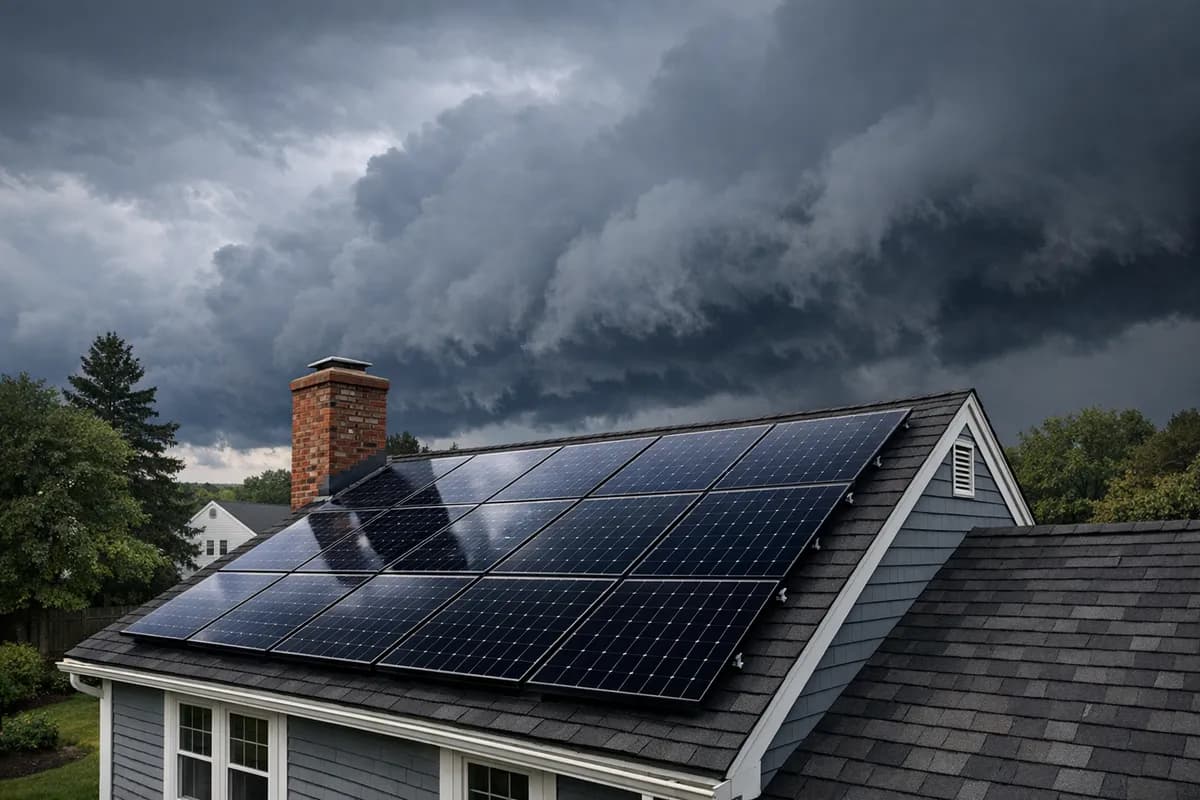
Massachusetts weather is harsh but predictable. Solar panels are engineered for conditions far worse than what New England delivers. Here is a threat-by-threat analysis.
Frequency
3-5 per winter
Wind
40-80 mph gusts
Hail Risk
Low (rain/snow dominant)
Details
The primary storm threat in MA. Panels are tested to 120+ mph wind loads when properly mounted. Risk comes from debris impact and improper mounting.
Frequency
20-30 per year
Wind
30-60 mph gusts
Hail Risk
Low-moderate (0.5-1" hail)
Details
MA hail is typically small (under 1 inch). IEC 61215 testing covers 1-inch hail at 52 mph. Summer storms rarely damage properly installed panels.
Frequency
5-15 events per winter
Wind
N/A
Hail Risk
N/A
Details
Panels are designed for 40-60 psf snow loads (MA requires 30-50 psf depending on zone). Snow slides off the smooth glass surface. Ice dams at the panel edge can cause water intrusion if flashing is poor.
Frequency
Rare (1-2 per decade near MA)
Wind
60-110+ mph
Hail Risk
Low
Details
MA is at the northern edge of the hurricane belt. Hurricane-force winds can exceed panel mounting ratings. Most MA systems are designed to 110+ mph. Insurance covers hurricane damage.
Frequency
10-20 days/year in MA
Wind
N/A
Hail Risk
N/A
Details
Direct lightning strikes on panels are extremely rare. The greater risk is electrical surge damaging the inverter or optimizer. Whole-house surge protectors ($200-$400) are recommended.
Frequency
Seasonal — worst in nor'easters
Wind
N/A
Hail Risk
N/A
Details
The most common cause of actual solar panel damage in MA. Proactive tree trimming is the best prevention. Insurance covers tree-fall damage to panels and the roof beneath.
Every solar panel sold in the United States must pass rigorous testing standards. Understanding these tests shows why panel damage from hail is extremely rare — especially in Massachusetts where hailstones rarely exceed three-quarters of an inch.
| Standard | Hail Size | Velocity | Impacts | Requirement | Pass Criteria |
|---|---|---|---|---|---|
| IEC 61215 | 25mm (1") | 23 m/s (52 mph) | 11 points | Mandatory — all panels must pass | No cracking, <5% power loss |
| UL 61730 | 25mm (1") | 23 m/s (52 mph) | 11 points | Required for US market | No safety hazard, ground fault test |
| FM 4474 (Class 1) | 32mm (1.25") | 28 m/s (63 mph) | Multiple angles | Optional — premium tier | Enhanced hail resistance rating |
| MIL-STD-810 (military) | 50mm (2") | 40 m/s (90 mph) | Full surface | Extreme — not standard | Military-grade durability |
MA hail vs. testing standards
Massachusetts averages only 2-3 significant hail events per year, with hailstones typically under 0.75 inches. The IEC 61215 test uses 1-inch hail at 52 mph — far exceeding what MA typically experiences. For comparison, Texas and Colorado regularly see 1.5-2 inch hail, which is why panel damage rates are higher in those states.
Tempered glass is tough
Modern solar panels use 3.2mm tempered glass — the same type used in car windshields and shower doors. Tempered glass is 4-5 times stronger than regular glass. It is designed to fracture into small, safe pieces if it does break, rather than sharp shards. Even cracked panels usually continue producing power (at reduced efficiency) until replaced.
Massachusetts homeowners get better solar insurance terms than most other states. No separate wind/hail deductibles. No coastal solar exclusions. Standard dwelling coverage applies.
Not all insurers handle solar claims equally. Massachusetts regional carriers (Amica, MAPFRE, Arbella) tend to have better solar expertise than national carriers.
| Insurer | Solar Coverage | Premium Impact | AM Best | Notes |
|---|---|---|---|---|
| Amica Mutual | Excellent | $50-$75/yr | A+ | MA-based. Solar-friendly. No special endorsement needed for roof-mount. |
| MAPFRE Insurance | Good | $60-$90/yr | A | Largest MA writer. May require coverage limit increase notification. |
| Arbella Insurance | Good | $55-$85/yr | A | MA regional carrier. Standard dwelling coverage applies. |
| Safety Insurance | Good | $60-$100/yr | A- | MA-focused. May need endorsement for systems over $30K. |
| Plymouth Rock | Good | $50-$80/yr | A- | NE regional. Generally smooth claims process for solar. |
| State Farm | Standard | $60-$100/yr | A++ | National carrier. May categorize ground-mount differently. |
| Liberty Mutual | Standard | $70-$110/yr | A | Boston-based HQ. Standard dwelling coverage. Verify limits. |
If storm damage does occur, acting quickly and documenting thoroughly makes the difference between a smooth claim and a frustrating one.
Take photos and videos of all visible damage from ground level and (safely) from the roof. Screenshot your monitoring app (Enphase, SolarEdge) showing the production drop. Note the date, time, and weather conditions. Do not attempt to repair anything yourself.
Log into your Enphase, SolarEdge, or other monitoring app. Compare current production to pre-storm levels. Screenshot panel-level data — a damaged panel will show zero or reduced output while surrounding panels are normal. This data is powerful evidence for your claim.
File a claim within 24-48 hours. Provide: date of loss, description of damage, photos, and monitoring data. Ask about your deductible and whether they send their own adjuster or accept contractor estimates.
Your solar installer inspects the system and provides a written damage report including: equipment model/serial numbers of damaged components, photos from the roof, repair/replacement cost estimate, and electrical testing results. This report drives the insurance payout.
Your insurer may send an adjuster to verify the damage. Have the installer report ready. If the adjuster is unfamiliar with solar (many are), the installer report provides the technical details they need. Dispute any lowball estimate with manufacturer pricing data.
Once the claim is approved, your installer orders replacement equipment and schedules the repair. Panel replacements take 1-2 days. Inverter replacements may take longer due to supply. Your system may operate at reduced capacity during this period — the monitoring data documents lost production.
Documentation checklist
If panels are damaged, replacement is straightforward. Your installer handles the technical work; insurance covers the cost.
Single panel replacement
Panel + labor + rewiring
Microinverter replacement
Per unit (Enphase)
String inverter replacement
SolarEdge or central
Optimizer replacement
Per unit (SolarEdge)
Racking/mount repair
Per damaged section
Roof repair beneath panels
If flashing/shingles damaged
Full 20-panel system
Complete replacement
If your exact panel model is discontinued, the insurer pays for a comparable replacement. Mismatched panels can affect string inverter performance — microinverters handle mixed panels better.
Replacement panels get a new manufacturer warranty. The original warranty on undamaged panels remains in effect. Your installer warranty may need to be updated to cover the new work.
Document daily production loss in your monitoring app during the replacement period. Some policies cover loss of income (net metering credits). Even if yours does not, the documented loss strengthens your claim for prompt replacement.
If your system is leased or PPA, the financing company owns the equipment and handles the insurance claim. Your job is to report the damage. They repair/replace at their expense. Your lease/PPA payments may be paused during repair.
While panels are inherently tough, proper installation and maintenance are the best storm protection.
Code-compliant mounting with correct bolt torque, flashing, and lag spacing. The racking fails before the panel does — insist on engineered mounting.
The #1 cause of actual panel damage in MA is falling branches. Trim trees within fall distance of your array before every nor'easter season.
A visual inspection of mounting hardware, wiring, and connections every 12 months catches loose bolts and wear before a storm exploits them.
A $200-$400 surge protector at your electrical panel prevents lightning-induced voltage spikes from frying your inverter and optimizer electronics.
A sudden drop in one panel's output after a storm indicates possible micro-cracking not visible from the ground. Enphase and SolarEdge apps make this easy.
Notify your insurer when panels are installed. Update dwelling coverage to reflect the system value. Review your policy annually as the system ages.
Proper installation is the best storm protection. Get a free quote with code-compliant mounting, monitoring, and insurance guidance included.
Yes. All solar panels sold in the US must pass IEC 61215 hail testing, which involves firing 1-inch (25mm) ice balls at 52 mph directly at the glass surface from 11 impact points. Most modern panels also pass UL 61730 and can handle hailstones up to 1.5 inches at 60+ mph. Massachusetts rarely sees hail larger than 1 inch — the state averages only 2-3 significant hail events per year, far less than Texas, Colorado, or the Midwest.
Yes, in most cases. Solar panels attached to your roof are covered under dwelling coverage (Coverage A) of a standard Massachusetts homeowners policy. Hail damage is a named peril covered by virtually all policies. Your standard deductible applies ($500-$2,500 in most MA policies). Unlike Texas and Florida, Massachusetts does not have separate hail/wind deductibles — your regular deductible applies.
Individual panel replacement in Massachusetts costs $300-$600 per panel installed, including the panel, labor, and electrical work. Inverter replacement (if damaged) adds $1,000-$3,000. Racking/mounting hardware replacement adds $200-$500 per section. A full 20-panel system replacement runs $6,000-$12,000. Your insurance covers replacement cost minus your deductible.
IEC 61215 is the international standard for solar panel durability. The hail test fires 25mm (1-inch) ice balls at 23 m/s (52 mph) at 11 defined impact points on the panel. The panel must show no visible cracking, no power output decrease greater than 5%, and no ground fault after testing. All panels legally sold in Massachusetts must pass this test. Premium panels from REC, Silfab, and others often exceed this standard.
Step 1: Document the damage immediately — photos, videos, monitoring data showing production drop. Step 2: Contact your insurance company within 24-48 hours. Step 3: Get an inspection from your solar installer documenting specific damage. Step 4: File the claim with your insurer, including the installer report and monitoring data. Step 5: Your insurer sends an adjuster. Step 6: Once approved, your installer replaces the damaged equipment. Typical claim resolution: 2-6 weeks.
No special policy is needed in most cases. Roof-mounted solar panels are covered as part of your dwelling under standard homeowners insurance. You should notify your insurer when panels are installed to ensure your dwelling coverage limit reflects the added value ($15,000-$35,000 for a typical system). This typically adds $50-$100/year to your premium. Ground-mounted systems may need separate coverage under Coverage B (other structures).
Nor'easters are covered perils under all standard Massachusetts homeowners policies. Wind damage, flying debris, and ice/snow load damage are all covered. If panels are torn from the roof, the roof damage is also covered. Your installer inspects, provides a repair/replacement quote, and the insurance company pays replacement cost minus your deductible. If the system is leased/PPA, the financing company handles the claim — you just report it.
Very rarely. Industry data from the National Renewable Energy Laboratory (NREL) shows that fewer than 0.1% of solar panels are damaged by weather events annually nationwide. In Massachusetts, the primary risks are nor'easters (wind), ice loading (heavy snow), and rare hail events. Proper installation with code-compliant racking and correct load calculations is the best protection — most storm damage is actually a result of poor installation, not panel failure.
Full insurance coverage details
Read guideWarranty vs insurance claims
Read guidePower through nor'easters
Read guideCurrent MA costs & payback
Read guideProduction in all seasons
Read guideBest & worst roofs for panels
Read guide