Loading NuWatt Energy...

We use your location to provide localized solar offers and incentives.
We serve MA, NH, CT, RI, ME, VT, NJ, PA, and TX
Loading NuWatt Energy...
NuWatt designs, installs, and manages solar, battery, heat pump, and EV charger systems across 9 states. One company, one warranty, one point of contact.
Get a Free QuoteMassachusetts is leading the nation in building electrification. The Specialized Opt-in Stretch Energy Code now requires solar-ready and electrification-ready new construction in 56 municipalities — including Boston, Cambridge, Brookline, and Newton. Mixed-fuel homes must install a minimum 4 kW solar system. All-electric homes must be solar-ready. Here is what it means for builders, buyers, and homeowners.
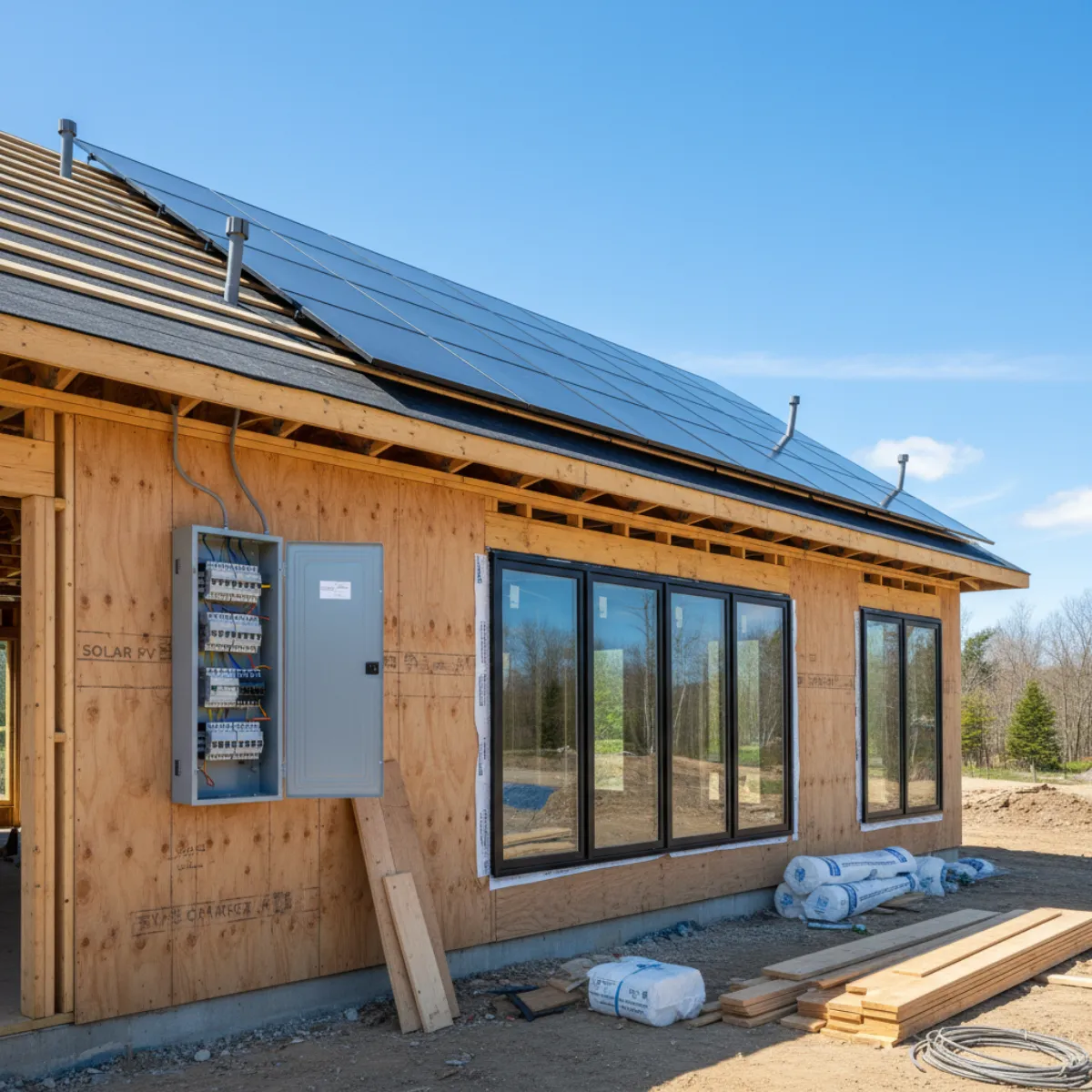
Massachusetts has a tiered building energy code system. Communities can choose which tier to adopt. The Specialized Code is the most aggressive tier, requiring specific clean energy readiness features that the base code and Stretch Code do not.
Standard energy code. Meets minimum federal and state requirements for insulation, windows, HVAC efficiency, and air sealing.
Solar: Not required
Electrification: Not required
Adoption: Default for all towns
Higher energy efficiency standards. Better insulation, tighter air sealing, more efficient HVAC. Reduces energy use 10-20% vs base code.
Solar: Not required
Electrification: Not required
Adoption: 245 municipalities
Everything in Stretch Code plus solar-ready, electrification-ready, and mandatory solar for mixed-fuel buildings.
Solar: 4 kW min (mixed-fuel) / ready (all-electric)
Electrification: Required (200A+, dedicated circuits)
Adoption: 56 municipalities
The current version of the Specialized Code took effect on February 14, 2025 for low-rise residential (1-3 family, townhouses) and commercial buildings. Projects that received building permits before that date may be grandfathered under the previous code version. Check with your local building department for specific applicability to your project.
The Specialized Code distinguishes between mixed-fuel buildings (those using both fossil fuels and electricity) and all-electric buildings. Mixed-fuel buildings face stricter requirements because they carry a higher carbon footprint and need solar to offset it.
Buildings that use natural gas, propane, or oil for any purpose (heating, cooking, hot water) alongside electricity.
Buildings that use electricity exclusively for all energy needs — no fossil fuel connections for heating, cooking, or hot water.
Why the distinction? All-electric buildings already have a lower carbon footprint because they do not burn fossil fuels on-site. The code incentivizes all-electric construction by making its requirements less onerous (solar-ready vs. mandatory solar). For builders, going all-electric can actually simplify construction by eliminating gas lines, gas meter installation, and dual-fuel HVAC systems — while avoiding the mandatory 4 kW solar requirement.
Solar-ready construction ensures that a building can accommodate a solar installation in the future without expensive structural or electrical modifications. For builders, these requirements add minimal cost during new construction ($500-$2,000) but save homeowners thousands in retrofit costs later.
A minimum 1-inch conduit must be installed from the designated roof solar zone to the main electrical panel. This conduit will carry DC wiring from the solar panels to the inverter. Without it, a future installation requires drilling through floors and walls, adding $500-$1,500 to the retrofit cost.
The roof structure in the designated solar zone must support the additional dead load of solar panels, racking, and ballast — typically 3-5 lbs per square foot. For standard asphalt shingle roofs, this usually means ensuring adequate rafter sizing and spacing. For flat roofs, structural capacity for ballasted racking must be verified. Retrofitting structural support later costs $2,000-$5,000+.
At least two dedicated breaker spaces in the main electrical panel must be reserved for the solar inverter connection. The panel label should note these spaces as "reserved for future solar." With modern 200A+ panels required by the Specialized Code, this is straightforward. In older homes, panel capacity is often the biggest barrier to solar installation.
A contiguous area on a south-, east-, or west-facing roof must be kept free from obstructions (HVAC equipment, plumbing vents, skylights, dormers) to accommodate future solar panels. The zone must receive adequate solar exposure — generally 4+ peak sun hours daily. Architects and builders must plan roof layouts to preserve this zone during design.
Building plans must document the solar-ready features, including conduit routing, structural load calculations, reserved panel spaces, and the designated solar zone. This documentation helps future solar installers understand the building-specific infrastructure already in place, reducing installation time and cost.
Solar-ready construction costs 75-85% less than retrofitting the same features later. The electrical panel upgrade alone can cost $2,000-$4,000 as a retrofit, while a 200A panel is already required by the Specialized Code at marginal additional cost during new construction.
Electrification-ready construction ensures that a building can convert from fossil fuels to all-electric with minimal additional electrical work. For mixed-fuel buildings in Specialized Code towns, every gas appliance must have a parallel electrical circuit ready for its electric replacement.
| Future Electric System | Circuit Requirement | Typical Load | Notes |
|---|---|---|---|
| Heat Pump (HVAC) | 240V / 40-60A | 3-7 kW | Dedicated circuit to HVAC location; supports ducted or ductless system |
| EV Charger (EVSE) | 240V / 50A | 7.7-9.6 kW | Circuit to garage or parking area; supports Level 2 charging up to 48A |
| Induction Cooktop | 240V / 40-50A | 7.2-9.6 kW | Circuit to kitchen; replaces gas range connection |
| Heat Pump Water Heater | 240V / 30A | 4.5 kW | Circuit to water heater location; hybrid HPWH units draw less than standard electric |
| Electric Dryer | 240V / 30A | 5.4 kW | Standard requirement; heat pump dryers draw 50% less |
A traditional home with gas heating, a gas stove, and no EV charger might only need 100-150 amps of electrical service. But an all-electric home with a heat pump, EV charger, induction cooktop, heat pump water heater, and solar needs 200+ amps to handle simultaneous loads. The Specialized Code requirement for 200A+ panels ensures new homes can support full electrification without a costly panel and service upgrade later.
Supports basic electric loads. Cannot handle heat pump + EV + induction simultaneously. Upgrade to 200A costs $2,000-$4,000+ as retrofit including new service entrance.
Supports full electrification: heat pump + EV + induction + HPWH + solar + battery. Marginal cost increase during new construction: $200-$500 vs 100A panel.
As of December 2025, 56 Massachusetts municipalities have adopted the Specialized Opt-in Stretch Energy Code. Below are 20 of the largest and most notable. The full list is maintained by the Massachusetts Department of Energy Resources (DOER) and is updated as new towns adopt.
| Municipality | Population | Region |
|---|---|---|
| Boston | 675,647 | Greater Boston |
| Cambridge | 118,977 | Greater Boston |
| Brookline | 63,191 | Greater Boston |
| Newton | 88,923 | Greater Boston |
| Somerville | 81,360 | Greater Boston |
| Arlington | 46,204 | Greater Boston |
| Lexington | 34,454 | Greater Boston |
| Concord | 19,341 | MetroWest |
| Wellesley | 29,673 | MetroWest |
| Amherst | 39,263 | Pioneer Valley |
| Northampton | 28,549 | Pioneer Valley |
| Provincetown | 3,188 | Cape Cod |
| Truro | 2,090 | Cape Cod |
| Watertown | 35,329 | Greater Boston |
| Belmont | 26,116 | Greater Boston |
| Lincoln | 7,208 | MetroWest |
| Sudbury | 19,655 | MetroWest |
| Acton | 24,021 | MetroWest |
| Medford | 59,249 | Greater Boston |
| Waltham | 64,015 | Greater Boston |
New municipalities can adopt the Specialized Code at any time through a town meeting vote or city council ordinance. The trend has been strongly upward — from roughly 30 towns in early 2024 to 56 by December 2025. Several additional communities are expected to adopt in 2026, particularly in the Pioneer Valley and MetroWest regions. If you are building in a town that has not yet adopted but is considering it, building to Specialized Code standards proactively is a wise investment.
If you are buying a newly constructed home in one of the 56 Specialized Code municipalities, your home is already built for the clean energy future. Here is what that means for you practically and financially.
With conduit already in place, structural support verified, and panel space reserved, installing solar on a solar-ready home costs $1,500-$3,000 less and takes 1-2 fewer days than on an older home. You skip the panel upgrade, structural assessment, and conduit installation that add cost and time to retrofit projects.
The dedicated 240V/50A circuit to your garage means installing a Level 2 EV charger is as simple as mounting the unit and plugging it in. No electrician needed for the circuit itself — just the charger installation. This saves $500-$1,500 compared to running a new circuit from the panel.
If your home was built mixed-fuel (gas furnace + dedicated heat pump circuit), converting to a heat pump later only requires the HVAC work — the electrical infrastructure is already in place. This reduces conversion cost by $1,000-$2,500 and eliminates permit delays for electrical work.
Homes built to Specialized Code standards are increasingly valued by buyers who want EVs, heat pumps, and solar. A Lawrence Berkeley National Lab study found that homes with solar sell for approximately 4.1% more than comparable homes without. Solar-ready and electrification-ready infrastructure adds additional value even before solar is installed.
As more towns adopt the Specialized Code and Massachusetts moves toward its 2050 net-zero goals, building standards will only get stricter. A home built to 2025 Specialized Code standards will meet or exceed any building code changes for the next decade, protecting your investment from obsolescence.
When you add up all the infrastructure that is already in place in a Specialized Code home, the total savings compared to retrofitting an older home are substantial:
The Specialized Code primarily applies to new construction. However, certain types of renovations can trigger compliance requirements. Understanding these triggers helps homeowners and contractors plan projects appropriately.
The exact triggers vary by municipality and the scope of work. Before starting a major renovation in any of the 56 Specialized Code towns, contact your local building department to determine which code requirements apply to your project. Getting clarity upfront avoids costly surprises during inspection.
If you are building in one of the 56 Specialized Code municipalities, here is a condensed compliance checklist. This covers the solar-ready and electrification-ready requirements on top of the base Stretch Code energy efficiency requirements.
NuWatt works with buildersacross the 56 Specialized Code municipalities to design and install compliant solar systems for new construction. We handle the full scope: system design, permitting, installation, interconnection, and SMART program enrollment. For mixed-fuel projects requiring the minimum 4 kW solar installation, we can design a right-sized system that meets code while maximizing the homeowner's energy savings and incentive value.
The Specialized Opt-in Stretch Energy Code (also called the Specialized Code) goes beyond the standard Stretch Code that 245 municipalities have adopted. It adds requirements for solar readiness, electrification readiness, and in some cases mandatory solar installation for new construction. As of December 2025, 56 municipalities have adopted the Specialized Code, including Boston, Cambridge, Brookline, Newton, Somerville, and other progressive communities. The requirements took effect February 14, 2025 for low-rise residential and commercial buildings.
It depends on the building type. Mixed-fuel new construction (buildings that use both gas and electric) must install a minimum of 4 kW of solar for single-family homes. All-electric new construction must be solar-ready — meaning the infrastructure must support future solar installation (conduit, structural reinforcement, reserved panel space) — but actual solar panel installation is not mandatory. The logic is that mixed-fuel homes need solar to offset the carbon impact of fossil fuel use, while all-electric homes are already cleaner.
Solar-ready construction requires: (1) conduit pathway from the roof to the electrical panel for future solar wiring, (2) structural reinforcement of the roof to support solar panel weight (typically 3-5 lbs/sq ft), (3) reserved breaker space in the main electrical panel (at least 2 dedicated spaces for a future solar inverter connection), and (4) a designated area on the roof free from obstructions (vents, skylights, HVAC equipment) that receives adequate solar exposure. The cost of solar-ready construction is minimal during new construction — typically $500-$2,000 — but retrofitting later costs significantly more.
Electrification-ready means the building must be pre-wired to support future conversion of all fossil fuel appliances to electric. Specifically: (1) a 200-amp or larger main electrical panel (to handle future electric loads), (2) dedicated 240V circuit and outlet for a future heat pump system, (3) dedicated 240V circuit for a future EV charger (Level 2 EVSE), (4) dedicated circuit for induction cooking, and (5) dedicated circuit for a heat pump water heater. For mixed-fuel buildings, this means every gas appliance must have a parallel electrical circuit ready for its electric replacement.
As of December 2025, 56 municipalities have adopted the Specialized Code. Notable towns include: Boston, Cambridge, Brookline, Newton, Somerville, Arlington, Lexington, Concord, Wellesley, Amherst, Northampton, Provincetown, Truro, and many others. The full list is maintained by the MA Department of Energy Resources (DOER). Towns can adopt the Specialized Code at any time via town meeting or city council vote. The number continues to grow as more communities pursue aggressive climate action.
New homes built in Specialized Code municipalities are already wired for the clean energy future. Buyers benefit from: (1) a 200A+ electrical panel ready for EVs, heat pumps, and solar, (2) conduit and structural support for easy solar installation, (3) lower retrofit costs if they want to add solar or electrify later, and (4) in mixed-fuel homes, an existing 4 kW solar system that immediately reduces electricity costs. These features add value to the home and reduce the cost of future clean energy upgrades by 50-75% compared to retrofitting an older home.
The Specialized Code applies primarily to new construction. For renovations, compliance is triggered when a project involves a substantial renovation or gut rehabilitation — generally defined as replacing more than 50% of the building systems or structure. Minor renovations, additions under certain thresholds, and routine maintenance do not trigger full Specialized Code compliance. However, any new electrical work should still follow current electrical code, which increasingly requires capacity for future electrification.
The base Stretch Code (adopted by 245 municipalities) requires higher energy efficiency than the base building code but does not mandate solar readiness or electrification readiness. The Specialized Opt-in Code (adopted by 56 municipalities) goes further, requiring solar-ready construction, electrification-ready wiring, and for mixed-fuel buildings, mandatory solar installation (4 kW minimum for single-family). Think of it as three tiers: base code, Stretch Code (better efficiency), and Specialized Code (efficiency + solar + electrification readiness).
NuWatt works with builders and homebuyers across all 56 Specialized Code municipalities. Whether you need a compliant 4 kW system for mixed-fuel construction, a full-sized system for maximum savings, or help planning solar for an all-electric new build — we design, permit, install, and interconnect. Get a quote tailored to your new construction project.