Loading NuWatt Energy...

We use your location to provide localized solar offers and incentives.
We serve MA, NH, CT, RI, ME, VT, NJ, PA, and TX
Loading NuWatt Energy...
NuWatt designs, installs, and manages solar, battery, heat pump, and EV charger systems across 9 states. One company, one warranty, one point of contact.
Get a Free QuoteUnitil customers in the Fitchburg area pay the highest electric rates in Massachusetts. The February 2026 supply rate jumped to 16.2-20.4 cents/kWh, pushing the all-in rate to $0.48/kWh. Partial rate relief of 25% (Feb-March) and 10% (April) softened the blow, but Unitil rates remain the highest in the state. The upside: Unitil customers see the fastest solar payback of any MA utility, and Unitil offers the best seasonal heat pump rate discount.
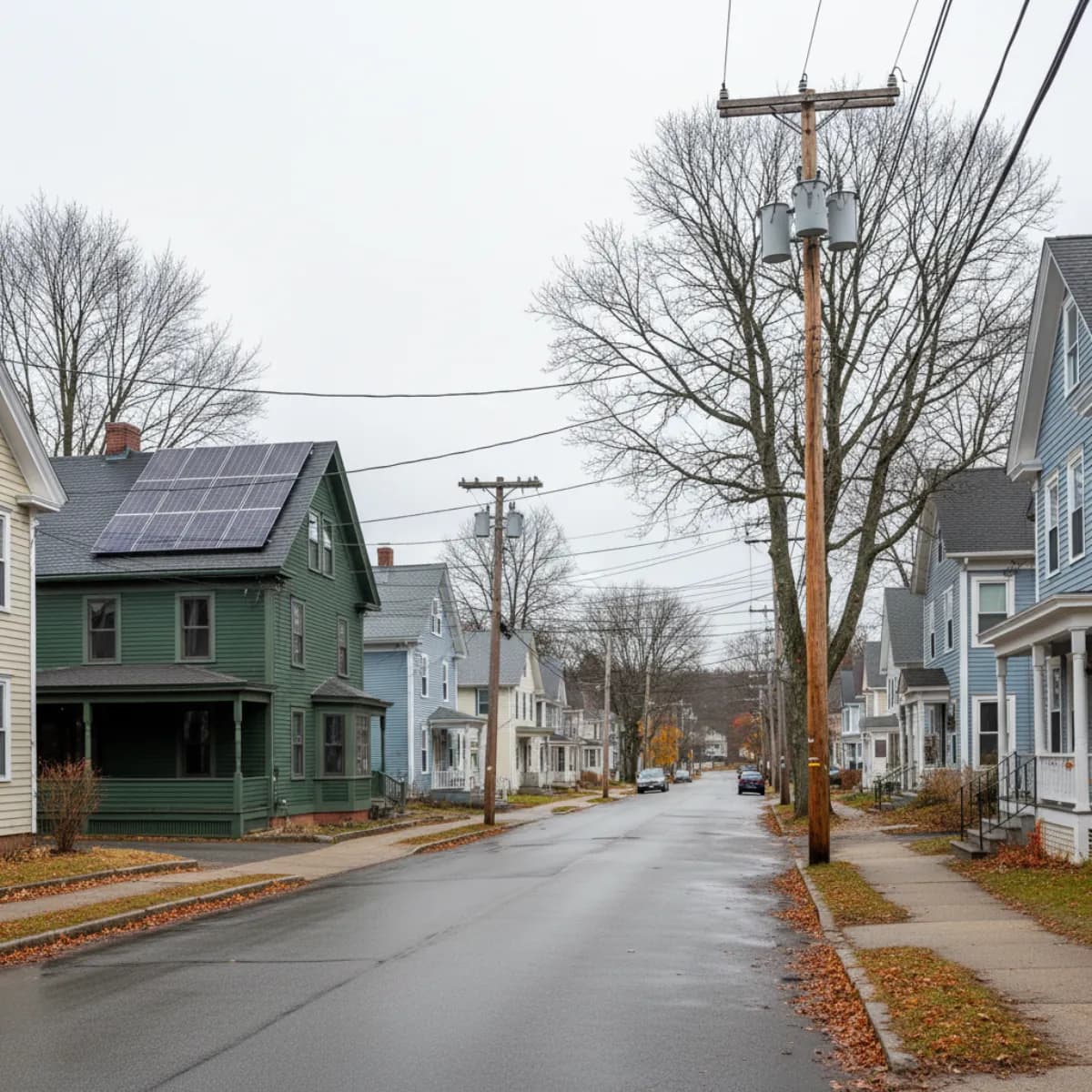
Unitil rates have been the most volatile in Massachusetts. The all-in residential rate swung from $0.280/kWh in 2021 to a peak of $0.48/kWh in 2026 — a 72% increase in just 5 years. The small customer base amplifies the impact of supply cost fluctuations.
| Year | Supply ($/kWh) | All-In ($/kWh) | YoY Change | Monthly Bill (750 kWh) | Notes |
|---|---|---|---|---|---|
| 2021 | $0.112 | $0.280 | -- | $210 | Post-COVID, relatively stable period |
| 2022 | $0.178 | $0.345 | +23.2% | $259 | Record spike — gas crisis, small contract exposure |
| 2023 | $0.165 | $0.338 | -2.0% | $254 | Slight supply relief, distribution costs up |
| 2024 | $0.148 | $0.320 | -5.3% | $240 | New procurement contracts, wholesale gas dip |
| 2025 | $0.162 | $0.340 | +6.3% | $255 | Supply rate increase, distribution rate case |
| 2026 | $0.185 | $0.481 | +41.6% | $361 | Feb 2026: supply to 16.2-20.4c/kWh; partial rate relief |
* Rates are annual averages for Unitil MA residential basic service customers. Feb 2026 supply rate: 16.2-20.4c/kWh range depending on rate class. Rate relief of 25% (Feb-Mar 2026) and 10% (Apr 2026) applied. Monthly bill based on 750 kWh usage. Sources: DPU filings, Unitil tariff schedules.
In February 2026, Unitil basic service supply rates jumped sharply to approximately 16.2-20.4 cents/kWh, shocking customers who were already paying the highest rates in Massachusetts. The spike was driven by tighter winter natural gas markets, the timing of Unitil's supply procurement contracts, and the inherent volatility of serving a small customer base.
25% reduction on supply charges for February and March 2026 billing periods
10% reduction extended through April 2026 to ease the transition
Relief measures are time-limited — underlying cost structure unchanged
Temporary rate relief lowers your bill for a few months but does not change the structural factors driving Unitil's high costs: small customer base, gas dependency, and aging infrastructure. The only way to permanently protect yourself from Unitil rate volatility is to generate your own electricity with solar. Once installed, your solar system's effective cost per kWh stays fixed regardless of what happens to Unitil's rates.
Unitil serves only about 25,000 electric customers — compared to 1.4 million for Eversource and 1.3 million for National Grid. Fixed infrastructure costs, administrative overhead, and procurement expenses are divided among far fewer ratepayers. A pole replacement that costs $15,000 is shared among 25,000 customers at Unitil versus 1.4 million at Eversource.
Unitil procures electricity through competitive bidding like other utilities, but its small volume means less leverage in negotiations. Unitil also has fewer contract periods to diversify risk — a bad procurement window has an outsized impact. The Feb 2026 spike from 16.2-20.4 cents/kWh was partly driven by unfavorable contract timing during tight winter gas markets.
Like all MA utilities, Unitil is heavily dependent on natural gas generation (~70% of New England power). But Unitil customers are more exposed to gas price volatility because the utility cannot hedge as effectively as larger utilities with bigger portfolios and longer contract horizons.
Unitil distribution charges are approximately $0.102/kWh — high by MA standards. The Fitchburg-area infrastructure requires ongoing maintenance and storm hardening investment, and these costs are spread over just 25,000 customers. Grid modernization requirements from the DPU apply equally to all utilities regardless of size.
Unitil rates fluctuate more dramatically than Eversource or National Grid because of the factors above. The all-in rate swung from $0.280 (2021) to $0.345 (2022) to $0.320 (2024) to $0.48 (2026) — a roller coaster that makes budgeting difficult for households and businesses. Solar eliminates this volatility entirely.
The highest rates mean the fastest payback. Unitil customers save more per kWh of solar production than anyone else in Massachusetts. Here is a concrete side-by-side comparison of an 8 kW solar system across all three MA utilities.
| Metric | Unitil | National Grid | Eversource |
|---|---|---|---|
| All-In Rate (2026) | $0.48/kWh | $0.42/kWh | $0.37/kWh |
| System Cost (8 kW, no ITC) | $25,000 | $25,000 | $25,000 |
| Annual Production | 9,600 kWh | 9,600 kWh | 9,600 kWh |
| Year 1 Savings | $3,510/yr | $2,928/yr | $2,630/yr |
| Effective Solar Cost/kWh | $0.085 | $0.085 | $0.085 |
| Savings Per kWh | $0.366 | $0.305 | $0.274 |
| Simple Payback | ~7 years | ~8.5 years | ~9.5 years |
| 25-Year Net Savings | $110,000-$130,000 | $85,000-$105,000 | $72,000-$92,000 |
* Assumes 8 kW system at $3.10/W installed, 1,200 kWh/kW annual production, SMART incentive included in effective cost. Simple payback does not account for rate escalation — with 3-5% annual increases, actual payback is faster. 25-year savings use mid-range rate projection.
Your Solar Cost
$0.085/kWh
Fixed for 25+ years.
Unitil Today
$0.48/kWh
Current all-in rate. 5.7x your solar cost.
Unitil 2030
~$0.60/kWh
Projected rate (mid scenario). 7.0x your solar cost.
Despite having the highest base rates, Unitil offers the most aggressive seasonal heat pump rate discount of any Massachusetts utility. During the heating season (November through March), qualifying heat pump customers see their distribution charge drop dramatically. This creates a uniquely compelling case for heat pump adoption in Unitil territory.
A heat pump using 3,000 kWh during the November-March heating season saves approximately $196 in distribution charges alone with the seasonal discount (3,000 kWh x ($0.1018 - $0.0363) = $196.50). Stack this with solar to offset supply charges, and you can heat your home for a fraction of what oil or propane costs. No other MA utility offers a discount this deep.
| Utility | Standard Dist. Rate | HP Seasonal Rate | Discount |
|---|---|---|---|
| Unitil | 10.18c | 3.63c | 64% |
| Eversource | 8.70c | 5.22c | 40% |
| National Grid | 9.20c | 5.98c | 35% |
Unitil's 64% distribution discount during heating season is nearly double the discount offered by National Grid (35%). For households switching from oil or propane to a heat pump, this discount makes the economics especially compelling. When paired with solar to eliminate supply charges, Unitil heat pump customers can reduce their total heating costs by 60-75% compared to fuel oil.
The combination of solar and a heat pump is uniquely powerful in Unitil territory because of the stacking effect: solar eliminates the high supply charges, the seasonal heat pump rate slashes distribution charges, and net metering credits are valued at the highest rates in MA.
The stacking math works like this: (1) Solar offsets most of your electricity usage, including heat pump consumption. (2) The seasonal heat pump rate discount reduces distribution charges on any remaining grid consumption by 64% during winter. (3) Net metering credits for excess solar production are valued at $0.48/kWh — the highest in MA. The result is near-zero energy costs once the solar system is paid off, typically within 7 years for Unitil customers.
Given Unitil's historical volatility and structural cost disadvantages, we model three scenarios for future all-in residential rates.
| Year | Conservative (+3%/yr) | Mid-Range (+5.5%/yr) | High (+7.5%/yr) |
|---|---|---|---|
| 2026 (Current) | $0.481/kWh | ||
| 2027 | $0.496 | $0.508 | $0.518 |
| 2028 | $0.511 | $0.536 | $0.556 |
| 2029 | $0.526 | $0.565 | $0.598 |
| 2030 | $0.542 | $0.596 | $0.643 |
At mid-range projections (5.5% annual increases), a Unitil customer using 750 kWh/month:
Over 25 years at 5.5% annual increases, a Unitil household using 750 kWh/month will pay an estimated $205,000+ in total electricity costs. With solar, that same household locks in its electricity rate at $0.085/kWh for the entire period.
Net metering credits for Unitil residential customers are valued at approximately the full retail rate — which means credits worth $0.48/kWh. That is 16-26% more valuable than net metering credits at National Grid or Eversource, simply because Unitil rates are higher.
* Based on 10 kW system exporting approximately 6,000 kWh/year. Class I residential net metering. Actual credit value subject to current rate at time of billing.
This is the hidden advantage of high Unitil rates: every kWh you export to the grid earns a premium credit. As Unitil rates continue to rise, the value of your net metering credits automatically increases without any action on your part. A system installed today could be earning credits worth $0.60/kWh or more by 2030.
Unitil is the smallest investor-owned electric utility in Massachusetts, serving approximately 25,000 customers in a compact territory centered on Fitchburg.
Electric customers: ~25,000 (MA)
Gas customers: ~18,000 (MA)
Headquarters: Hampton, NH
Also serves: Parts of NH
Regulatory body: MA DPU
Stock: Publicly traded (NYSE: UTL)
The Fitchburg area receives approximately 4.5-4.7 peak sun hours per day (annual average), consistent with central Massachusetts averages. A well-sited 8 kW solar system in Fitchburg can produce 9,200-9,800 kWh annually. At Unitil's $0.48/kWh rate, that production is worth $4,150-$4,420/year in offset electricity — more than it would be worth in any other utility territory in the state for the same system.
As of 2026, the Unitil residential all-in rate in Massachusetts is approximately $0.48/kWh, making it the highest-cost utility in the state. The basic service supply rate jumped to approximately 16.2-20.4 cents/kWh in February 2026, depending on rate class. When you add distribution (approximately $0.102/kWh), transmission, and other charges, the total all-in rate of $0.48/kWh significantly exceeds both National Grid ($0.42/kWh) and Eversource ($0.37/kWh). Unitil did implement partial rate relief measures in early 2026.
Unitil is a small utility serving only about 25,000 electric customers in the Fitchburg area — a fraction of Eversource (1.4M) or National Grid (1.3M). This small customer base means infrastructure and procurement costs are spread over fewer ratepayers, leading to higher per-customer charges. Unitil also procures electricity through smaller contracts with less buying power, and its distribution infrastructure in the Fitchburg area requires proportionally more maintenance investment per customer.
In response to the sharp rate increase in February 2026, Unitil implemented a 25% rate reduction for the February-March 2026 billing period, followed by a 10% reduction extended through April 2026. This relief was designed to cushion the blow of the supply rate spike. However, even with the temporary relief, Unitil rates remained the highest in Massachusetts. The relief measures were temporary and did not address the underlying cost structure.
Unitil serves approximately 25,000 electric customers in Massachusetts, concentrated in the Fitchburg area and surrounding towns including Lunenburg and parts of the North Central MA region. Unitil also serves gas customers in the same territory. For comparison, Eversource serves 1.4 million and National Grid serves 1.3 million — making Unitil by far the smallest investor-owned utility in the state.
Unitil offers the most aggressive seasonal heat pump distribution rate discount of any Massachusetts utility. During the heating season (November through March), heat pump customers on the eligible rate can see distribution charges drop from approximately 10.18 cents/kWh to 3.63 cents/kWh — a 64% reduction in the distribution component. This makes Unitil territory uniquely attractive for heat pump adoption despite the high base rates, especially when paired with solar to offset the supply charges.
Unitil customers typically see the fastest solar payback periods in Massachusetts due to the highest rates. An 8 kW system at Unitil rates ($0.48/kWh) can pay for itself in approximately 6.5-7.5 years, compared to roughly 8-9 years for National Grid customers and 9-10 years for Eversource customers. The higher the rate, the more valuable each kWh of solar production becomes — both for direct consumption and net metering credits.
Unitil net metering follows the same Massachusetts state framework as Eversource and National Grid. Residential systems under 10 kW qualify for Class I net metering, receiving credits at approximately the full retail rate. At the Unitil rate of $0.48/kWh, each exported kWh earns a credit worth $0.48 — significantly more than the $0.42 (National Grid) or $0.37 (Eversource) credits at the other utilities. This makes net metering especially valuable for Unitil customers.
Unitil customers benefit most from combining solar with a heat pump. Solar eliminates the high supply charges, while the seasonal heat pump rate discount reduces distribution charges by 64% during winter (10.18 cents to 3.63 cents/kWh). The combination means you are generating your own electricity for free via solar, then paying a deeply discounted distribution rate for any additional winter consumption. A typical Unitil household switching from oil heat to a heat pump + solar bundle can reduce total energy costs by 50-70%.
At $0.48/kWh, Unitil customers have the highest rates and the fastest solar payback in Massachusetts. Your net metering credits are worth 16-26% more than other utilities. Add the seasonal heat pump rate discount, and the combined savings are extraordinary. Stop paying the highest rates in MA — lock in your electricity cost with solar.