Loading NuWatt Energy...

We use your location to provide localized solar offers and incentives.
We serve MA, NH, CT, RI, ME, VT, NJ, PA, and TX
Loading NuWatt Energy...
NuWatt designs, installs, and manages solar, battery, heat pump, and EV charger systems across 9 states. One company, one warranty, one point of contact.
Get a Free QuoteAs of July 9, 2026, the REAP grant window is closed while USDA rewrites the program regulations and drafts a replacement funding notice. The guaranteed-loan track stays open to eligible Massachusetts farms and rural small businesses. Read this as a guide to test eligibility and get your documentation in order — not as a signal to pencil in a grant award.
Paused
Grant Applications
~7,000
MA Farms Potentially Eligible
75%
Eligible Cost Loan Ceiling
Open
Guaranteed Loans
Current status: REAP grants are paused and no quarterly grant window is open. Guaranteed loans remain available. Historical grant-stack examples below explain the former program design only; rerun every project after USDA publishes the replacement regulations and funding notice, and account for SMART 3.0's pending tariff approval separately.
Test your eligibility, run the pre-pause cost-share scenarios against your own MA project number, and read the guaranteed-loan terms that are still available today. Each figure recalculates from what you enter — treat it as a readiness tool for the day grants reopen, not as a live application you can submit now.
Check eligibility and model the numbers for when grants reopen — not a live-grant calculator.
REAP grants are paused; guaranteed loans remain open.
USDA is rewriting the REAP grant regulation and is not accepting grant applications — there are no live deadlines, and prior applicants will reapply under a forthcoming funding notice (NOFO). The grant figures below are planning scenarios for the reopening under the pre-pause framework, which may change. Guaranteed-loan terms in the loan panel are actionable today. Verified July 2026.
Applicant type
Choose an applicant type to see the binding eligibility question.
This is a self-check, not a determination. Confirm the exact parcel on USDA's property-eligibility map at eligibility.sc.egov.usda.gov before committing application effort.
25% cost share
Standard RES / EEI projects
27% of gross cost
Pre-pause framework — may change under the new NOFO.
50% cost share
Zero-GHG RES (standard solar), energy-community, EEI, or tribal
2% of gross cost
Pre-pause framework — may change under the new NOFO.
RES grants ran from a $2,500 minimum (25% share) / $5,000 minimum (50% share) up to a $1,000,000 project maximum, with a per-applicant cap of $1,500,000 per fiscal year across all REAP awards.
Your project's combined ceiling
$165,000
A REAP grant and guaranteed loan together cannot exceed 75% of eligible cost. With grants paused (grant = $0 today), a guaranteed loan alone can cover up to $165,000.
USDA would guarantee ~85% of that loan ($140,250).
Guaranteed-loan terms
These are planning estimates driven entirely by the values you enter — not a quote, an application, or a promise of funding. Program facts reflect USDA sources as of July 2026, when REAP grants are paused pending revised regulations and a new funding notice; the replacement rules may change cost shares, caps, and eligibility. Grant, ITC, and depreciation interactions depend on your tax posture and entity type. This is not tax advice — confirm the credit, the depreciable basis, and any grant-basis treatment with your CPA.
Turn this into a REAP-ready project file
We build the technical report, energy audit, system design, and state-tariff strategy your REAP application needs — and coordinate the tax stack with your CPA.
Run by USDA Rural Development, the Rural Energy for America Program (REAP) exists to help agricultural producers and rural small businesses put in on-site renewable generation and energy-efficiency upgrades — through a mix of grants and loan guarantees. It traces back to the 2002 Farm Bill and was significantly broadened by the 2022 Inflation Reduction Act, which lifted the maximum grant share from 25% up to 50% of eligible cost. In Massachusetts the program has historically been a workhorse for cranberry, dairy, and orchard operations across the western and southeastern counties; that grant track is now paused, but the framework and the loan guarantee remain the reference points for planning.
Renewable Energy Systems (RES)
Covers newly installed solar PV, wind, biomass, geothermal, and hydro generation, along with a battery paired to that generation. In the framework now paused, RES grant awards started at a $2,500 floor (25% share) or $5,000 floor (50% share) and climbed to a $1M-per-project ceiling, all inside a $1.5M-per-applicant limit each fiscal year — figures a MA farm should treat as historical reference, not a current offer.
Energy Efficiency Improvements (EEI)
Think milking-parlor retrofits, greenhouse glazing, LED conversions, HVAC, swapped-out irrigation pumps, and refrigeration — the efficiency measures common on a Pioneer Valley dairy or a Cape cranberry receiving station. The EEI grant ceiling ran near $500k under the paused rules.
There are two eligible applicant lanes, and nearly every Massachusetts project lands cleanly in one of them. The pivot between the two is the agricultural-producer test: whether at least half of gross income comes from farming.
Entities that derive at least 50% of gross income from agricultural operations. Massachusetts is home to roughly 7,000 farms spanning cranberry bogs on the South Coast, dairies in the Pioneer Valley and north-central MA, orchards across Worcester and Hampshire counties, greenhouses and nurseries statewide, and vegetable operations in the Connecticut River Valley. All are candidates for REAP.
Typical MA Examples
Non-agricultural small businesses located in rural areas — generally defined as areas with population under 50,000. Must meet SBA size standards for their industry. In Massachusetts that covers most of Berkshire, Franklin, Hampshire, and northern Worcester counties, plus large parts of Hampden, Plymouth, and Barnstable. Rural manufacturers, inns, cideries, farm-to-table restaurants, and professional services all qualify when sited outside the I-95 metros.
Typical MA Examples
USDA maintains a property-eligibility map at eligibility.sc.egov.usda.gov. Enter any Massachusetts address and it will confirm REAP eligibility instantly. Many MA towns in the MetroWest exurbs, on Cape Cod, and along the North and South Shores that feel suburban actually qualify — the USDA definition is more generous than most applicants assume. Check before ruling yourself out.
REAP-rural Massachusetts is much broader than the common stereotype of “western MA only.” Below is the practical county-by-county breakdown — always confirm a specific address against the USDA eligibility map, but these patterns hold.
All municipalities under the 50,000 threshold. Heavy concentration of dairy, orchard, and agritourism operations.
Pioneer Valley dairy and vegetable belt. One of the most active REAP application regions in the Northeast.
Outside of Northampton and Amherst proper, virtually all towns qualify. Orchards, dairy, and vegetable farms dominate.
Springfield metro excluded; hilltowns and smaller municipalities (Blandford, Chester, Monson, Wales) qualify.
Worcester proper excluded; northern and southern tier towns (Athol, Petersham, Barre, Hardwick, Sturbridge) largely qualify.
Most towns exceed 50k threshold or adjoin larger metros; a handful of western Middlesex towns may qualify — check the map.
Core cranberry-growing region. Carver, Middleborough, Lakeville, Plympton, Rochester all typically qualify.
Cape Cod towns are nearly all under 50k. Active cranberry bogs and greenhouses throughout.
Fall River and New Bedford excluded; surrounding smaller towns qualify.
Islands qualify in full. Limited ag base but eligible rural small businesses.
Boston metro and North Shore commuter towns generally exceed the threshold. A few outer-ring exceptions — confirm on the map.
Keep in mind that USDA refreshes both its rural definition and the underlying census data from time to time, so a given Massachusetts parcel should always be checked against eligibility.sc.egov.usda.gov before you sink effort into an application.
MA ag is small in total farm count compared to the Midwest but unusually diverse. Each major sector has a distinctive energy profile — and a specific REAP angle.
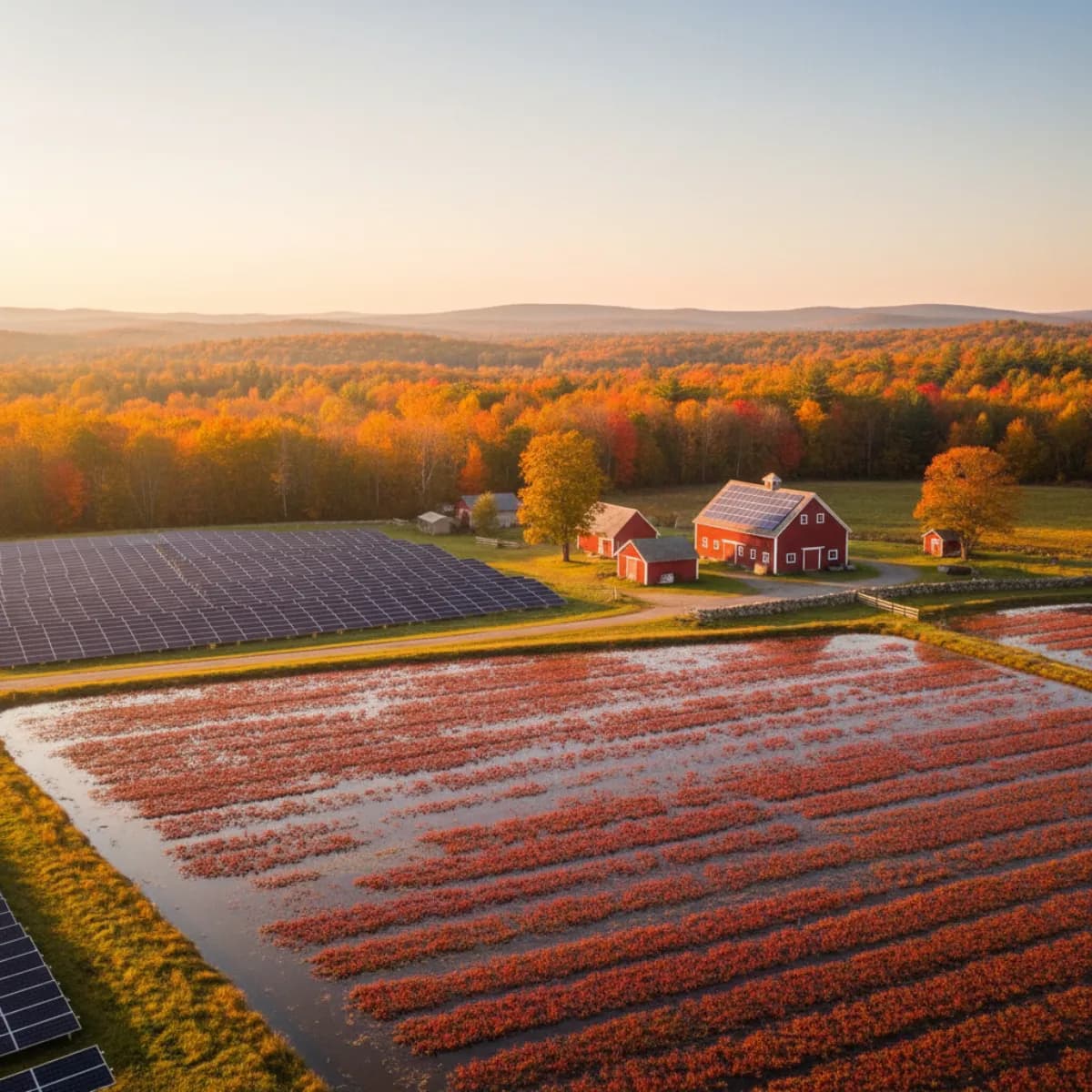
Concentrated in Plymouth and Barnstable counties; MA is the second-largest cranberry producer in the US. Bogs have significant pump load (irrigation, flooding, harvest), refrigeration at receiving stations, and frequent greenhouse propagation. Dual-use solar over cranberry bogs is an active research area and scores well on REAP community-benefit criteria.
REAP fit: RES solar + paired storage; EEI for irrigation pump upgrades and cold storage
Concentrated in Franklin, Worcester, and Hampshire counties. Dairy barns run 24/7 with heavy refrigeration, ventilation, lighting, and parlor vacuum loads. MA dairies are strong candidates for both RES (barn-roof solar, ground-mount in pasture) and EEI (parlor heat recovery, LED lighting, variable-speed milk pumps).
REAP fit: Both tracks — RES solar on barns, EEI on parlor and refrigeration
Apple, peach, and stone-fruit orchards across central MA (Worcester County) and the Pioneer Valley. Controlled-atmosphere cold storage is a major load. Pack houses, cidery operations, and farm-store refrigeration all add to the energy profile. Rooftop solar on pack-house barns is a common REAP configuration.
REAP fit: RES rooftop solar + paired storage; EEI for CA storage and refrigeration
Year-round greenhouse operators and commercial nurseries have heavy heating loads (winter) and ventilation loads (shoulder seasons). Geothermal ground-source heat pumps and biomass heat systems are REAP-eligible and often transformative for the operating cost structure. Solar PV offsets daytime ventilation and lighting.
REAP fit: RES (solar, geothermal, biomass); EEI for glazing and curtain upgrades
Diversified vegetable farms along the Connecticut River Valley and across Essex, Middlesex (where rural), and Worcester counties. Energy loads include irrigation pumps, walk-in coolers, wash-pack facilities, and farm-store refrigeration. Agrivoltaic (dual-use) arrays are increasingly being piloted on vegetable farms.
REAP fit: RES solar (ground-mount or dual-use); EEI for cooling and irrigation
MA has a growing farm-winery, cidery, distillery, and agritourism sector. Many of these operations qualify under the 50% ag income test or under the rural small business category. Combined process-heat, refrigeration, and hospitality loads make for strong stacked RES+EEI REAP applications.
REAP fit: Combined RES solar + EEI for process heat and refrigeration
Six broad technology categories sit inside REAP. Solar PV dominates the MA farm caseload by a wide margin, but the eligible scope reaches well beyond panels — most applicants underestimate how much of their operation could qualify.
Rooftop, ground-mount, pole-mount, and carport. Agrivoltaics configurations (solar over cranberry bogs, solar plus grazing, dual-use arrays over vegetable fields) are specifically allowed and often scored favorably.
Eligible when paired with a qualifying renewable generation system. Pairs well with the MA SMART Energy Storage Adder and ConnectedSolutions utility dispatch revenue.
Small wind turbines up to mid-scale. Cape and South Coast sites with adequate class-3+ wind resource can make economic sense at the farm scale.
Ground-source heat pumps for greenhouses, farm dwellings, inns, and rural commercial buildings. Strong fit for MA given winter heating loads and state heat-pump incentives.
Dairy digesters, on-farm biomass for greenhouse heat, and biogas for process heat. Good match for Pioneer Valley dairies and greenhouse operations.
HVAC upgrades, LED lighting, irrigation pump upgrades, greenhouse curtain and glazing upgrades, refrigeration, dairy parlor efficiency, and grain dryers. Separate EEI grant category.
Massachusetts was the first US state to adopt a dedicated dual-use (agrivoltaic) tariff adder under SMART, and MassCEC has funded multiple demonstration projects. REAP application scoring rewards projects that preserve active agricultural use under the array — and MA has more mature dual-use design precedent than anywhere else in the country.
Plymouth and Barnstable county cranberry growers are piloting elevated PV over active bogs — solar production layered on top of cranberry harvests with minimal yield impact in early-stage research.
Elevated single-axis tracker arrays over hay, forage, and shade-tolerant vegetable crops. UMass Amherst research on spacing, panel height, and crop selection has informed MA SMART dual-use adder rules.
Of all the dual-use setups, running sheep beneath the panels is the least complicated: the flock keeps the vegetation down in place of a mower while the same acreage yields both lamb and kilowatt-hours. It is turning up more and more on farm-scale ground-mount sites across Massachusetts.
This table documents how the prior REAP grant structure interacted with other incentives. USDA is not accepting grant applications, and SMART 3.0 Final Statements of Qualification remain blocked pending DPU tariff approval. Treat every value as a scenario to rerun, not as an available 2026 offer.
| Incentive | Type | Value | Who Administers |
|---|---|---|---|
| USDA REAP | Federal grant — paused | No applications accepted; former terms up to 50% | USDA Rural Development (MA State Office, Amherst) |
| MA SMART 3.0 | State production tariff | 20-year per-kWh payments + adders | DOER / Eversource, National Grid, Unitil |
| Section 48E ITC | Federal tax credit | 30% base; up to 50% with bonuses | IRS (Treasury) — projects that began construction by July 4, 2026 kept best timing; later starts placed in service by Dec 31, 2027 |
| MACRS 5-Yr + Bonus | Accelerated depreciation | 5-year MACRS + 100% first-year bonus (permanent, OBBBA) | IRS (Treasury) |
| MA Solar Property Tax Exemption | State exemption | 100% exemption (G.L. c.59 s.5 cl.45) | Local Board of Assessors |
| ConnectedSolutions (storage) | Utility dispatch revenue | Per-kW-summer performance pay | Eversource / National Grid |
Historical Scenario Only: 100 kW Solar on a Plymouth County Cranberry Bog
Profile: 100 kW rooftop/ground-mount solar on an active cranberry operation in Carver or Middleborough at about $2.20/W gross = $220,000 project.
Historical modeled net out-of-pocket: roughly $15,000 to $55,000 on a $220k gross project — or effectively 7% to 25% of gross capex once SMART payments arrive over 20 years. Exact numbers depend on tax posture, SMART adder eligibility, and grant-basis interaction with Section 48E. Consult your CPA. NuWatt models the full stack in the project proposal.
One tax nuance for a Massachusetts farm: a REAP grant lands as taxable income on a Form 1099-G, and no settled rule forces it to shrink your Section 48E basis — practice varies between CPAs. The figures above take the conservative route and reduce basis by the grant; other advisors run the credit on full project cost. The scenario planner lets you flip between the two, but the call belongs to your CPA.
With the grant window shut, there is no submission calendar to chase — a replacement funding notice should follow once the revised regulations are effective, and the guaranteed-loan track stays open throughout. Read the sequence below as the readiness checklist a Massachusetts applicant works through now, so the file is ready the moment grants reopen.
Establish that you clear either the agricultural-producer half-of-gross-income test or the rural-small-business SBA size standard, then verify the parcel itself on USDA's rural eligibility map at eligibility.sc.egov.usda.gov. Only when both the applicant and the site pass does the rest of the work make sense.
An RES project needs a Technical Report from a qualified engineer; an EEI project generally needs an Energy Audit. NuWatt produces both for Massachusetts ag and rural-business sites, and it matters: USDA reviewers scrutinize this document harder than any other part of the file.
MA projects should size and structure around the SMART tariff at the same time as the REAP package. Which SMART block, which adders (agricultural, dual-use, energy storage, low-income), and which utility queue the interconnection goes into will all shape the final project economics.
Pull the applicant entity’s tax returns (documenting the ag-income share or SBA size), proof you can fund the portion no grant would cover, and — where a loan guarantee is in play — a commitment letter from a participating lender.
USDA conducts a categorical exclusion review under NEPA for most REAP projects. MA ground-mount projects may also intersect with MEPA review, wetland resource areas under the Wetlands Protection Act, and local Conservation Commission permitting. Document this up front.
Hold off on submitting or promising any grant dollars until USDA has published both the revised regulations and the new funding notice — and keep the project file current so it can be adapted the moment that window opens.
Guaranteed-loan applications remain open through USDA Rural Development. Confirm current terms with the Massachusetts State Office and do not begin construction before required environmental review and lender conditions are cleared.
With the grant track closed, the practical question for a Massachusetts farm or rural business is how to fund the project now without waiting on a grant that may not return for months. Two Massachusetts-specific tools bridge that gap alongside the still-open USDA guaranteed loan.
For the commercial, industrial, or agricultural buildings on a rural MA operation in a participating municipality, C-PACE can finance up to the full eligible project cost over terms as long as 20 years, repaid as a special assessment on the property-tax bill. Because it is structured so energy savings exceed the annual payment, most MA commercial projects run cash-flow positive from year one — and the obligation stays with the property, not the owner, if the farm or business changes hands.
Best fit: barn-roof or ground-mount solar on a taxed commercial ag parcel where the town participates in C-PACE
C-PACE covers upfront cost; the Section 48E credit (for a taxable farm business), 5-year MACRS depreciation, the 20-year SMART tariff, and the G.L. c.59 s.5 cl.45 property-tax exemption then work down the net over time. If USDA reopens grants, a grant award can retire part of the C-PACE assessment early. This is the sequence a Massachusetts rural operator can act on today rather than waiting for the grant window to reopen.
MA C-PACE financing guideNon-ag rural businesses are often where the strongest MA REAP projects get overlooked. If your facility is outside the I-95 metro belt, you likely qualify — and the SMART + REAP combination can make solar dramatically more affordable than most owners assume.
Small manufacturers in Franklin, Worcester, and Hampden counties with rooftop space and predictable daytime loads often hit 30 to 50% utility bill reduction with rooftop solar. REAP + SMART turns a 7-year payback into a 3 to 4 year payback.
Berkshire County inns, B&Bs, and small hotels have steady baseload (HVAC, hot water, lighting) and strong roof orientations. REAP + SMART + ConnectedSolutions storage revenue is a compelling package.
A rural craft-beverage maker carries process heat, refrigeration, and tasting-room load all at once — the kind of mixed profile where an EEI efficiency scope slots naturally alongside an RES solar array in a single stacked REAP file.
Rural distribution centers and cold storage with high continuous kWh consumption are ideal REAP candidates. Solar + battery combinations address both kWh and demand charges while qualifying for the MA SMART Energy Storage Adder.
NuWatt designs, engineers, and builds REAP-eligible solar, storage, and efficiency projects across rural Massachusetts. We provide the technical report, engineering, SMART interconnection strategy, and environmental documentation that REAP applications require — and we coordinate with your CPA on the tax-credit and grant-basis interaction.
No REAP grant window is open. Prepare the technical file and monitor USDA; guaranteed-loan applications remain available.
Last verified: July 9, 2026
Sources: USDA Rural Development REAP program page and March 31, 2026 stakeholder announcement, 7 CFR Part 4280, USDA Property Eligibility Map, MA DOER SMART 3.0 program guidelines, IRC Section 48E, IRC Section 168 (MACRS), G.L. c.59 s.5 cl.45 (MA solar property tax exemption)