Loading NuWatt Energy...

We use your location to provide localized solar offers and incentives.
We serve MA, NH, CT, RI, ME, VT, NJ, PA, and TX
Loading NuWatt Energy...
NuWatt designs, installs, and manages solar, battery, heat pump, and EV charger systems across 9 states. One company, one warranty, one point of contact.
Get a Free QuoteNew Jersey pays government bodies more for the same array. The adder is worth $20/MWh for 15years, and the qualifying test is not tax exemption — it is being part of government. A town, a school district and a county clear it. A church and a private academy do not.
Public-entity adder
+$20/MWh
On the net-metered segment rate
Rooftop under 1 MW
$130/MWh
$110 base plus the adder
ADI term
15 yrs
Paid quarterly on production
Federal credit
Cash
Section 6417 elective payment
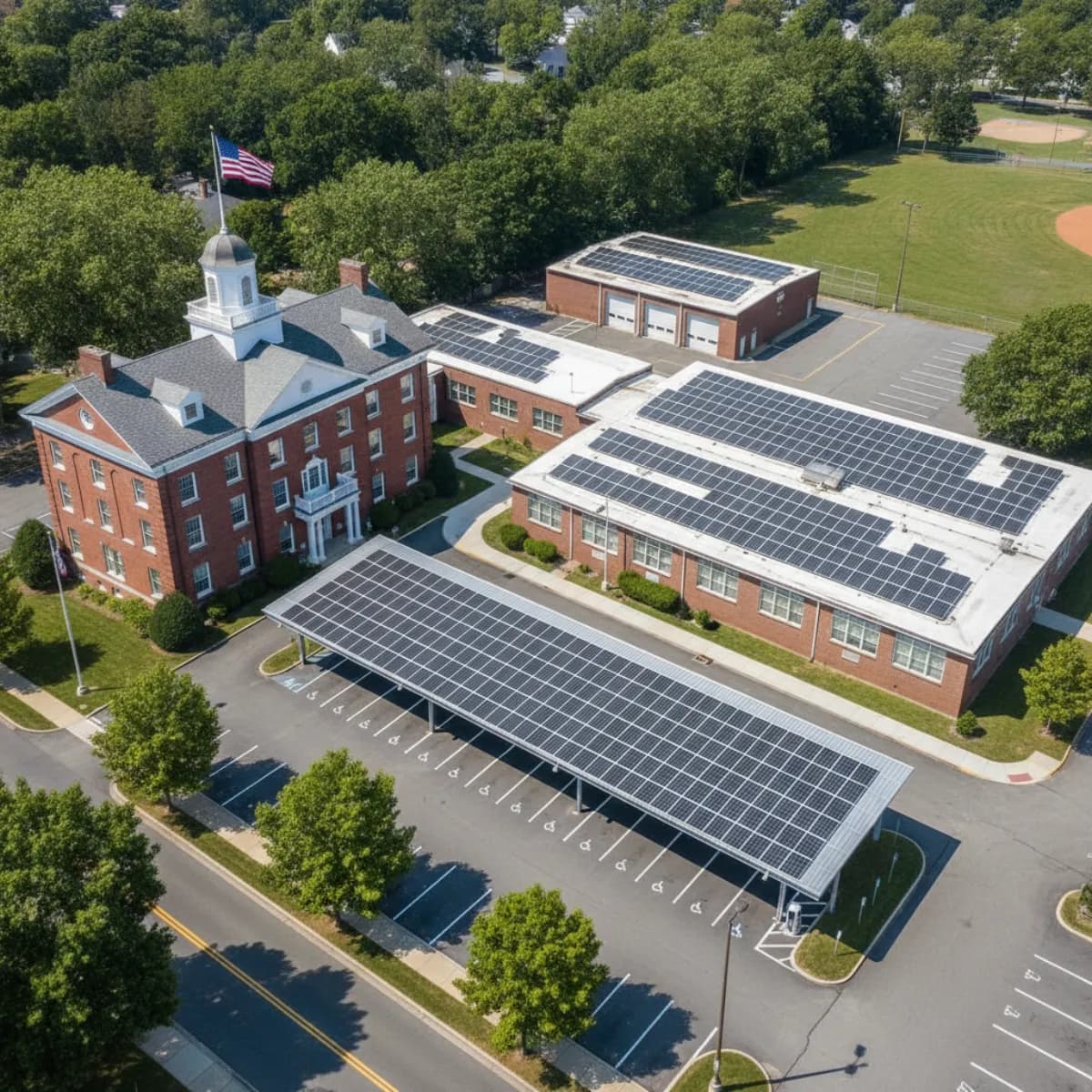
New Jersey adds $20/MWh to the ADI rate for net-metered non-residential projects benefiting a public entity, lifting a rooftop or canopy array under 1 MW from $110/MWh to $130/MWh for 15 years, paid quarterly. The entity also takes the Section 48E credit as cash through elective payment, and can finance the work through ESIP out of the energy savings. The adder's test is governmental status, not tax exemption.
Verified August 5, 2026 against NJ BPU BPU Docket No. QO22080540 materials and the ADI orders in Docket No. QO20020184, the New Jersey Clean Energy Program ESIP pages, and the nj.gov-hosted ESIP How-To Guide. GSESP constants verified August 5, 2026.
Government bodies. That is the whole test, and it is narrower than most people expect because it is routinely confused with the federal test. Section 6417 elective pay turns on being tax-exempt, which sweeps in churches, private colleges and charities. The New Jersey ADI adder turns on being part of government, which does not. The two tests overlap on a school district and diverge on a parish school, and the gap is worth $20/MWh for 15 years.
Public entity · Adds $20/MWh
A government body. Town halls, DPW garages, firehouses, public school districts, county complexes, municipal utilities authorities, community colleges and state facilities.
Tax-exempt, not public · Standard segment rate
Section 6417 elective pay still applies, because that test is tax-exempt status. The ADI adder does not, because that test is being part of government.
Tax-exempt, not public · Standard segment rate
A private academy and a public school district can sit on the same street and earn different ADI rates for identical arrays. The difference is governmental status, not mission and not tax treatment.
Neither · Standard segment rate
No adder, and no elective pay — a taxable owner uses the credit against its own liability or transfers it.
If your organisation is tax-exempt but not government,the rest of the federal analysis on this page still applies to you — you just earn the standard segment rate rather than the adder. The dedicated guide is nonprofit, church and private school solar in New Jersey, which covers PPAs, community solar and board-approval sequencing for organisations without a municipal capital process.
It stacks; it does not replace. The Board prices the non-residential ADI by market segment and project size first, and the public-entity adder is then added to whichever segment rate the project already earns. That means the mount type still matters — a canopy over a municipal lot and a roof array on the town hall of the same size earn the same base, while ground mount is priced lower — and the adder is the same $20/MWh in every case.
| Market segment | Size | Base rate | Public entity |
|---|---|---|---|
| Rooftop, carport, canopy and floating solarThe segment most municipal buildings, firehouses and school roofs land in. | Under 1 MW (dc) | $110/MWh | $130/MWh |
| Ground mountCapped landfills, water-utility parcels and unused municipal land. | Under 1 MW (dc) | $90/MWh | $110/MWh |
| Rooftop, carport, canopy and floating solarThe band a large county complex or a consolidated campus array reaches. Each system carries its own registration. | 1 MW to 5 MW (dc) | $100/MWh | $120/MWh |
| Ground mountLarger county and authority land, including closed landfill caps. | 1 MW to 5 MW (dc) | $85/MWh | $105/MWh |
Payments run 15 years, quarterly, on metered production rather than on nameplate capacity — so the array has to actually generate to earn. The rate is locked at registration, which makes the registration date a schedule item, not paperwork. The Board reviewed the adder in its March 6, 2023 one-year review of the ADI program and left it in place, with Staff writing that the importance of government leading by example in clean energy cannot be overstated. The May 21, 2026 three-year review cut the residential rate and left every non-residential segment unchanged.
It elects to be paid instead. Section 6417 elective payment — direct pay — lets an entity with no federal tax liability receive the Section 48E investment credit as a payment from the IRS rather than as an offset against tax it never owed. For a municipality or a school district that owns its array, this is the difference between a credit that is theoretically available and cash that actually arrives.
Pre-filing registration with the IRS is required, and the registration number has to appear on the return that claims the payment. Skipping it is the most common way a good public project loses the credit.
Elective payment is realised through the annual return, not at commissioning. A public entity building on a bond or a lease-purchase should model that lag rather than assuming the cash lands at energisation.
The Section 48E begin-construction window closed July 4, 2026: projects that began construction on or before that date may use the longer continuity pathway. Commercial solar projects starting now generally must be placed in service by December 31, 2027. The statutory credit is 6%; it can increase to 30% when the applicable prevailing-wage and registered-apprenticeship requirements are met.
Depreciation. MACRS is a deduction against taxable income, and a government body has none, so the 100% first-year bonus depreciation that carries a large share of private commercial solar returns (IRS Notice 2026-11) is worth nothing to a town. That is not a footnote — it is the reason a third-party ownership offer can sometimes beat what the entity could achieve by self-funding, and it is why both structures deserve to be run rather than assumed.
The comparison is not the usual one, because a public entity has an unusual pair of facts: it can convert the federal credit to cash, and it can use no depreciation whatsoever. Those two pull in opposite directions, which is why the answer varies by entity rather than resolving to a rule.
Best for: Entities that can raise the capital and want the full incentive stream on their own books.
Best for: Entities without capital capacity, or where the procurement calendar cannot accommodate a bond.
Yes, through the Energy Savings Improvement Program. ESIP was created by P.L. 2009, c.4 and further defined as a form of performance contract by P.L. 2012, c.55. It lets a government entity pay for energy improvements out of the value of the savings those improvements produce, rather than out of a capital budget that is already committed. It reaches the full range of government entities, from school boards to municipalities to State agencies, each under its own procurement statute.
Energy conservation measures are defined to include facilities for the production of renewable energy, and the State guide states plainly that an ESIP can include installation of renewable energy facilities such as solar panels, with the reduced cost of energy reflected as savings.
A power purchase agreement executed pursuant to Chapter 83 of P.L. 2008 can be included in the calculation of energy savings. That is the mechanism behind most of the school-district solar in New Jersey that was delivered without a capital appropriation.
Allowable revenue offsets are narrow: energy savings, maintenance and operation savings, and state and federal funding sources. The plan has to show positive cash flow in each year, which is what stops an ESIP from becoming deferred debt dressed as efficiency.
Before the governing body adopts the Energy Savings Plan, an independent third party must certify that the savings were calculated per BPU protocols — and that verifier cannot be the ESCO or the firm that wrote the plan.
The State guide is explicit that SREC revenue cannot be included as a revenue offset when developing the Energy Savings Plan. New Jersey has since moved from SRECs to the ADI, and the guide does not address ADI payments. Confirm the current treatment with the BPU ESIP coordinator rather than assuming either way.
Not at the scale public buildings sit in. This matters for public entities more than for most hosts, because a school gymnasium or a municipal building is often the designated cooling or warming centre for its town — so the resilience case gets made long before the incentive exists to fund it.
The Board has not published Phase 2 incentive amounts. The June 18, 2025 Order states that incentive levels for the distributed segment "will be set to reflect market conditions at the time those phases of the program are released", and the program FAQ still describes the Phase 2 design as yet to be determined. Any per-kWh or per-kW figure circulating for a New Jersey commercial battery today is an estimate someone built from other states, not a New Jersey number.
Phase 2 eligibility, as recommended in the June 18, 2025 Order, reaches distributed standalone storage and storage paired with a distributed Class I renewable resource, provided the energy storage system is installed after the effective date of Phase 2. A battery energized before that date should not be assumed to qualify retroactively.
An administratively determined fixed incentive, offered through capacity blocks whose size the Board expects to set on an annual basis.
A payment tied to what the battery delivers when the utility calls it. The June 2025 Order directs the electric distribution companies to develop design proposals; it does not fix the final design.
| Distributed size class | Range | Where public facilities land |
|---|---|---|
| Small | Less than 100 kW | Residential and very small commercial |
| Medium | 100 kW to 500 kW | Most single-site commercial installations |
| Large | Greater than 500 kW | Industrial, campus and multi-building loads |
The provisional distributed target recommended in the June 18, 2025 Order is 500 to 800 MW across 2026-2030, with the Board reserving the right to reallocate between segments. The federal side is more settled than the state side here: Energy storage technology is not subject to the December 31, 2027 placed-in-service deadline or the July 4, 2026 begin-construction trigger — both apply to applicable wind and solar facilities only, and Section 48E(e)(4)(C) expressly excepts energy storage technology (IRS Notice 2025-42, section 2.02). A standalone commercial battery remains eligible for the statutory 6% Section 48E credit, increased to 30% when the applicable wage and apprenticeship requirements are met, under the standard clean-electricity phase-out that starts at the later of 2032 or when U.S. greenhouse gas emissions from electricity are 25% of 2022 emissions or lower. Energy storage technology is its own qualifying category under Section 48E(c)(2). There is no requirement that a commercial battery be paired with solar or charged from a renewable source to claim the credit.
The adder is $20/MWh on top of the segment rate, for 15 years, paid quarterly on metered production.
The qualifying test is governmental status, not tax exemption. A school district clears it; a parish school does not.
Section 6417 elective pay converts the Section 48E credit into cash, but only if the IRS pre-filing registration happens before the return is filed.
MACRS is worth nothing to an entity with no taxable income, so the 100% bonus that drives private returns does not apply — run the third-party ownership comparison rather than assuming ownership wins.
ESIP (P.L. 2009, c.4, refined by P.L. 2012, c.55) funds the work out of the savings, explicitly reaches renewable energy facilities, and can count a Chapter 83 power purchase agreement in the savings calculation.
The ESIP plan must show positive cash flow in every year and be verified by an independent party that is neither the ESCO nor the plan author.
No New Jersey incentive value has been published for distributed storage, so treat any per-kWh battery figure you are shown as an out-of-state estimate.
Storage is not on the solar placed-in-service clock federally, which gives a public entity room to phase a battery after the array.
New Jersey adds $20/MWh to the Administratively Determined Incentive rate for net-metered non-residential projects benefiting public entities. It stacks on the segment rate rather than replacing it, so a rooftop, carport or canopy array under 1 MW moves from $110/MWh to $130/MWh, and a ground mount under 1 MW moves from $90/MWh to $110/MWh. Payments run 15 years and are paid quarterly on metered production. The BPU reviewed the adder in its March 6, 2023 one-year review of the ADI program and left it unchanged, with Staff writing that the importance of government leading by example in clean energy cannot be overstated.
The other side of the audience split: tax-exempt organisations that are not government. Same Section 6417 elective pay, standard ADI segment rate, no public-entity adder.
The cluster hub: ADI segments, net metering, exemptions and the full commercial stack.
What the Garden State Energy Storage Program pays for today, and what it has not published yet.
Municipal lots, school parking and commuter decks — the segment where a public entity often has more usable area than roof.
The layer a public entity cannot use, and the reason third-party ownership sometimes wins on price.
We will model direct ownership against third-party ownership on your actual load and roof, including the public-entity adder, before anything goes to your governing body.