Loading NuWatt Energy...

We use your location to provide localized solar offers and incentives.
We serve MA, NH, CT, RI, ME, VT, NJ, PA, and TX
Loading NuWatt Energy...
NuWatt designs, installs, and manages solar, battery, heat pump, and EV charger systems across 9 states. One company, one warranty, one point of contact.
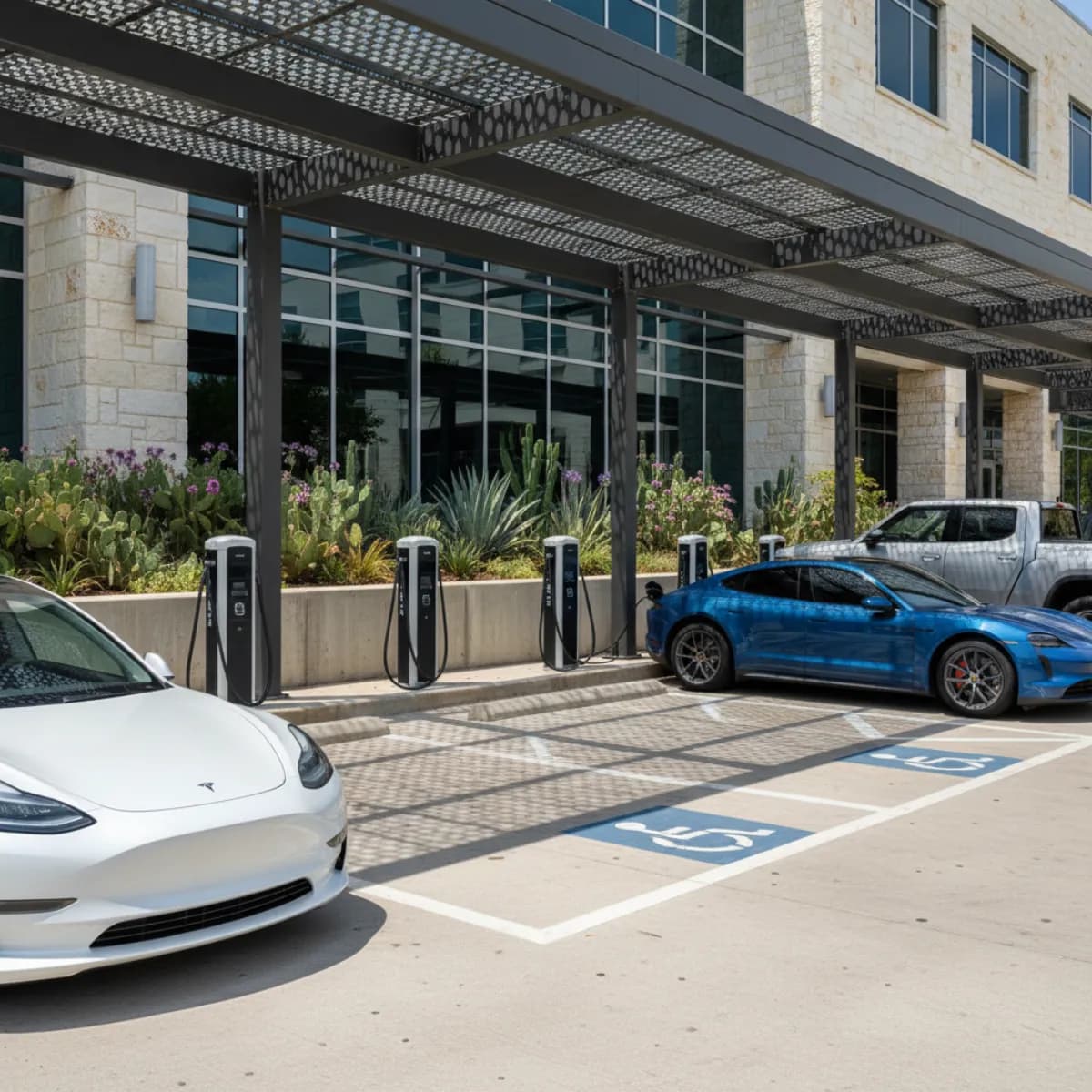
Get a Free QuoteAustin Energy’s Business EV Charger Rebate offers up to $3,000 per Level 2 port and up to $5,000 per DC fast charger for commercial account holders inside Austin Energy territory. Workplaces, multifamily properties, and fleet yards all qualify — and the rebate stacks on top of the federal Section 30C EV charger credit.
Federal context: the Section 30C EV charger credit expired June 30, 2026. The Section 30D new clean vehicle credit and Section 25E used clean vehicle credit were repealed by the One Big Beautiful Bill Act. Commercial ITC under Sections 48 / 48E stays active — its begin-construction safe harbor closed July 4, 2026, and new starts must be placed in service by Dec 31, 2027. Confirm timing with your tax advisor.
Austin Energy commercial account holders can receive up to $700 per Level 1, up to $3,000 per Level 2, and up to $5,000 per DC fast charger, capped at 50% of equipment and installation costs. Each address can apply for up to 6 stations per fiscal year (October–September). Stations must be new, ETL/cETL/UL-listed, and OCPP networked; DCFC must be open to the public. The federal Section 30C EV charger credit (30% up to $100,000/item for commercial property) expired June 30, 2026; the utility rebate now pairs with off-peak commercial-rate alignment and state / federal fleet grants instead.
Tiered by charging level, with a 50% cap on equipment and installation costs and a per-address annual station limit.
Dedicated 120V circuit for EV charging. Typically used at long-dwell parking — overnight tenant parking, extended-stay workplaces. New, ETL/cETL/UL listed.
The workhorse of workplace and multifamily charging. Must be new, ETL/cETL/UL listed, and an Open Charge Point Protocol (OCPP) networked station.
High-power public fast charging. Station must be open to the public to qualify. OCPP networked, ETL/cETL/UL listed. Typical for retail, hospitality, travel corridors.
Rebate per station cannot exceed 50% of combined equipment and installation costs. Maximum 6 stations per address per fiscal year (October–September).
The rebate is designed for commercial Austin Energy accounts. Four archetypes dominate applications:
Employers that want to offer charging as an amenity, attract EV-driving talent, and decarbonize Scope 3 commuter emissions. Property must have an active Austin Energy commercial account.
Apartment buildings, condominiums, and mixed-use properties. Chargers may be deployed for residents, guests, or a mix. Level 2 is most common at long-dwell multifamily parking.
Service fleets, delivery, last-mile, and commercial vehicles depot-charging at an Austin Energy-served yard. Level 2 overnight and DCFC top-up configurations both qualify when requirements are met.
Grocery, restaurant, hotel, and other public-facing sites. Required configuration for the $5,000 DCFC tier — fast chargers must be open to the public to qualify.
Illustrative Austin Energy rebate stack at a typical Austin office site. The federal Section 30C credit expired June 30, 2026, so it no longer reduces the net. Your actual numbers depend on bids and rate schedule.
Illustrative only. Austin Energy rebate is subject to the 50% equipment-and-installation cap (which does not bind here because 6 x $3,000 = $18,000 while 50% of $48,000 = $24,000). The federal Section 30C credit expired June 30, 2026 and no longer applies to chargers placed in service after that date, so the net above reflects the Austin Energy rebate only. Confirm remaining incentives with a qualified tax advisor.
From territory check to bill-impact modeling. Austin Energy requires the City of Austin permit inspection to be final before you apply.
The site must be on an active Austin Energy commercial account. Many suburbs of Austin (for example Cedar Park, Round Rock, Pflugerville) are served by Oncor, Pedernales Electric Cooperative, or Bluebonnet — those addresses do not qualify for the Austin Energy rebate and would need to explore their own utility programs.
Decide how many ports, at what level (L1 / L2 / DCFC), and who they serve (employees, residents, fleet, public). Austin Energy caps the program at 6 stations per address per fiscal year (October–September), so larger deployments may need a phased multi-year plan.
Check the existing service size, panel capacity, and available breaker space. DCFC typically requires 480V three-phase service and may trigger a transformer upgrade. Load management and networked OCPP stations can often avoid a costly service upgrade on Level 2 deployments.
Stations must be new and ETL/cETL/UL listed, and Level 2 and DCFC stations must be OCPP networked. Station upgrades to a newer model, leased equipment, and make-ready-only scopes are not eligible. Build the equipment list around hardware that is already known to meet these criteria.
Pull a City of Austin electrical permit, install per the approved plan, and include the required physical protection — wheel stops, bollards, or curbs — and the standard “EV Charging ONLY” and tow-away signage. Close out the City of Austin permit inspection before applying.
Bring OCPP networked stations online with the chosen network operator, test each port under load, and document serial numbers, make/model, and commissioning date. Austin Energy will need to see that the stations are operational at application time.
Applicants must submit the rebate application within 180 days of station installation and activation. Include the itemized equipment and installation invoices, station specs, photos, final City of Austin permit inspection, and the Austin Energy commercial account number.
The Section 30C Alternative Fuel Vehicle Refueling Property Credit expired June 30, 2026, so it no longer offsets commercial charger installs placed in service after that date. Layer the Austin Energy rebate with off-peak commercial-rate alignment and any state / federal fleet-specific grants instead, and confirm your options with your tax advisor.
Program charging to off-peak windows, deploy load management on networked L2, and review whether a time-varying commercial rate option reduces bill impact. NuWatt can model charging load against your account’s current rate to forecast the monthly cost.
Critical: Submit Within 180 Days
Austin Energy will not process applications submitted more than 180 days after station installation and activation. Track the install-and-activation date and schedule the application inside that window — the program is first-come, first-served against an annual funding budget.
The federal Alternative Fuel Vehicle Refueling Property Credit (Section 30C) expired June 30, 2026, so it can no longer be stacked with the Austin Energy rebate for chargers placed in service after that date. Off-peak commercial-rate alignment and state / federal fleet grants are the remaining offsets.
30%
Commercial Base Credit Rate (While Active)
Was subject to prevailing-wage / apprenticeship rules
$100K
Cap per Item, Commercial (While Active)
Applied per qualifying charger
Jun 30, 2026
Credit Expired
No longer available for new installs
Rebate dollars cover capital. The bigger lever for operating economics is how the new EV load interacts with your existing commercial rate schedule.
Austin Energy commercial tariffs include demand components that bill against the property’s peak kilowatt draw. A single uncoordinated DCFC can set a new demand peak and add meaningful monthly cost. Networked load management and off-peak scheduling reduce that risk.
Overnight Level 2 workplace and multifamily charging typically falls outside peak windows anyway. OCPP-networked chargers let property owners cap simultaneous power, stagger sessions, and ensure the new load does not reshape the site demand profile.
Load management on networked L2 can often fit 6–12 ports inside an existing panel with no transformer swap. Properly scoped, this is the single largest lever on the total project budget — far larger than the rebate itself.
For sites adding DCFC against limited service capacity, commercial battery storage paired with solar may qualify under Sections 48 / 48E (commercial ITC; the begin-construction safe harbor closed July 4, 2026, and new starts must be placed in service by Dec 31, 2027) and can shave demand spikes created by fast charging sessions.
The rebate is strictly for Austin Energy commercial accounts. Several Austin-area addresses are served by other utilities and do not qualify.
The only authoritative answer is the utility name on the property’s current electric bill. Confirm that first, before scoping the rebate.
Austin Energy offers up to $700 per station for EV-dedicated Level 1, up to $3,000 per station for Level 2, and up to $5,000 per station for DC fast charging. The rebate cannot exceed 50% of combined equipment and installation costs, and one address can apply for up to 6 stations per fiscal year (October through September). DCFC stations must be open to the public to qualify at the $5,000 tier.
All three qualify, as long as the site is an Austin Energy commercial account holder (or an authorized representative) inside Austin Energy service territory. That includes employer workplaces, multifamily properties (apartments and condos), fleet depots, retail and hospitality sites, and government or nonprofit facilities. Residential single-family installations are covered under a separate home EV charger rebate, not this program.
Stations must be new and ETL, cETL, or UL listed. Level 2 and DC fast chargers must be Open Charge Point Protocol (OCPP) networked stations — Austin Energy does not rebate non-networked commercial L2 or DCFC. Lease-only arrangements, make-ready-only scopes (conduit and service upgrade without a station), and simple model upgrades to a newer version of an existing charger are not eligible. Each installed station also requires physical protection (wheel stops, bollards, or curbs) and the standard signage.
You have 180 days from charging station installation and activation to submit the rebate application, and the City of Austin permit inspection must be finalized before you apply. Funding is limited and is distributed on a first-come, first-served basis, so submitting early in the fiscal year and before the funding budget is exhausted is strongly recommended.
The federal Section 30C Alternative Fuel Vehicle Refueling Property Credit expired June 30, 2026, so it is no longer available to stack with the Austin Energy rebate for chargers placed in service after that date. While it was active it provided a 30% commercial credit up to $100,000 per item, subject to location-eligibility and prevailing-wage / apprenticeship rules. Today the Austin Energy rebate pairs instead with off-peak commercial-rate alignment and any state / federal fleet-specific grants — confirm your options with your tax advisor.
Yes. Austin Energy’s published program rules require DCFC stations to be open to the public to qualify for the rebate. That does not mean charging has to be free — station owners may still charge market rates via their network — but access cannot be restricted to employees, residents, or fleet-only drivers at the DCFC tier. If the site use case is gated fleet-only DC fast charging, the project is better scoped to Level 2 for this rebate and considered for other fleet-specific programs.
Charging shifts load profiles — often adding peak demand if uncontrolled. Austin Energy customers can pair the rebate with networked OCPP load management and schedule charging for off-peak windows, which reduces the monthly demand impact on a commercial rate schedule. NuWatt models the projected kWh and kW contribution of the new chargers against the existing commercial rate tariff so property owners understand the monthly operating bill before committing to the project.
The Austin Energy rebate follows the utility account, not the city limits. Parts of the Austin metro — particularly the outer suburbs like Cedar Park, Round Rock, and Pflugerville, and some pockets inside the city — are served by other utilities, most commonly Oncor, Pedernales Electric Cooperative, or Bluebonnet. Those sites are not eligible for this rebate. Check the utility name on a current electric bill before scoping the project.
No. Austin Energy’s program explicitly excludes make-ready-only scopes, leases, and station upgrades. Make-ready costs are eligible when they are part of the same project that installs a qualifying new networked charger — in that case the trenching, conduit, panel, and labor roll into the total equipment-and-installation cost that the 50% cap is measured against.
Up to 6 stations per address point per fiscal year, where the fiscal year runs October through September. Larger deployments (20, 40, 100 ports) are typically phased across multiple fiscal years, or paired with other funding sources — tax-exempt financing for government fleets, or state / federal fleet-specific grants — to cover ports beyond the annual cap. (The federal 30C charger credit that once helped here expired June 30, 2026.)
For context on the broader federal EV landscape in 2026: the Section 30D new clean vehicle credit and the Section 25E previously-owned clean vehicle credit were repealed by the One Big Beautiful Bill Act, so those consumer-facing credits are no longer available under the repealed rules. The Section 30C EV charger credit expired June 30, 2026. Commercial ITC under Sections 48 and 48E for solar and storage remains active — its begin-construction safe harbor closed July 4, 2026, so projects that began by then locked in the full timing pathway, while new starts still qualify if placed in service by December 31, 2027. Coordinate with a tax advisor on the specific project timeline.
Commercial EV Charging TX
Statewide incentives and siting overview
TCEQ All-Electric EV
State light-duty EV charging grants
TCEQ GAFF Fleet
Government alternative fuel fleet program
Fleet Depot Charging TX
Depot design and load management
Austin EV Installation
Local install scoping and permits
Austin Energy Rates
2026 commercial and residential rates
Last updated: April 2026. Rebate amounts, eligibility, and program rules are subject to change and funding availability. Federal Section 30C expired June 30, 2026; Section 30D (new clean vehicle credit) and Section 25E (used clean vehicle credit) were repealed by the One Big Beautiful Bill Act. Sections 48 / 48E commercial ITC remain active — the begin-construction safe harbor closed July 4, 2026, and new starts must be placed in service by December 31, 2027. Contact Austin Energy and a qualified tax advisor for the most current information.
NuWatt helps Austin property owners, multifamily operators, and fleet managers design Austin Energy-compliant EV charging projects, align charging to off-peak windows, and model the operating bill against current commercial rate tariffs before a shovel hits the ground.
Texas-licensed electrical · Austin Energy territory experience · OCPP-networked hardware · incentive-aware project scoping