Loading NuWatt Energy...

We use your location to provide localized solar offers and incentives.
We serve MA, NH, CT, RI, ME, VT, NJ, PA, and TX
Loading NuWatt Energy...
NuWatt designs, installs, and manages solar, battery, heat pump, and EV charger systems across 9 states. One company, one warranty, one point of contact.
Get a Free Quote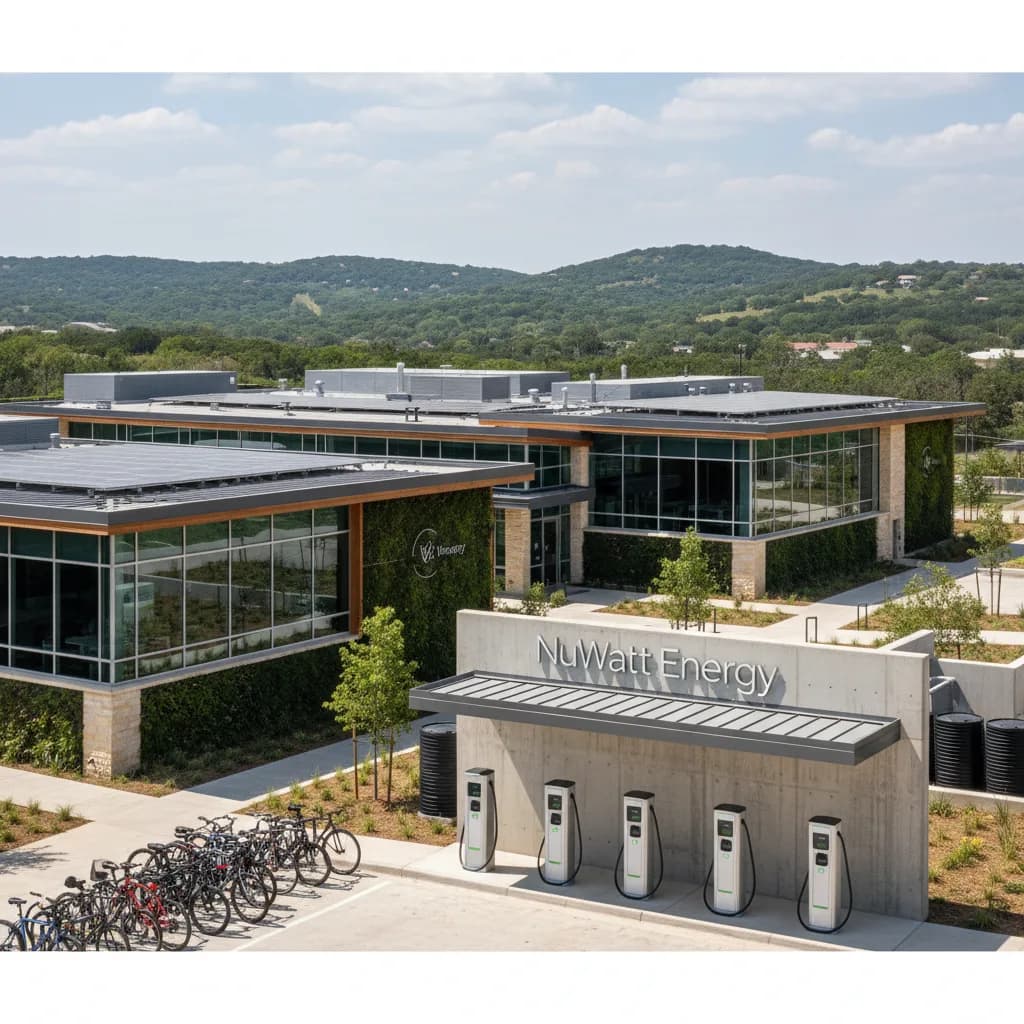
Tech workplaces, sustainability-led developers, and NACS-first destination sites — designed around Austin Energy's Plug-In EVerywhere program, municipal utility economics, hill country engineering, and the June 30, 2026 Section 30C deadline.
File Austin Development Services electrical permit and open an Austin Energy service request in parallel. Apply to Plug-In EVerywhere for publicly-listed sites. Layer Section 30C (if tract qualifies) before June 30 2026. Spec NACS-first hardware for Tesla-heavy corridors. Typical turnkey: 11–14 weeks.
Austin is one of the most EV-dense metros in the country per capita. The combination of Gigafactory Texas, a tech-employer base with sustainability budgets, a progressive municipal utility, and an unusually high rate of NACS adoption means commercial EV charging hits a steeper adoption curve here than almost anywhere else in the state. Austin Energy's Plug-In EVerywhere program also creates a public-network pathway that most ERCOT TDU territories don't offer.
Dell, Tesla, Apple, Oracle, Indeed, Meta, Atlassian, Canva, and a growing AI-startup cluster — plus the University of Texas and City of Austin fleets.
Travis and Williamson Counties post the highest EV new-vehicle share in Texas — roughly 14% in 2026, above the 11% national average, driven by Tesla household penetration.
Most Austin tech HQs disclose Scope 1/2/3 emissions and corporate fleet electrification targets; City of Austin has adopted a 2040 net-zero community goal.
Tech workplace (The Domain, Mueller, downtown), adaptive-reuse mixed-use (East Austin, South Congress), and destination DCFC (hospitality + retail on I-35 + Mopac).
Austin Energy's Plug-In EVerywhere is a flat-fee public-network program hosts can join to list their Level 2 stations on a common subscription plan. Members receive marketing inclusion, usage analytics, and a revenue-share pathway. Austin Energy separately offers commercial EV rebates for Level 2 and DCFC installations, with higher per-port incentives for publicly-accessible workplace and multifamily hosts.
Review Austin Energy EV programs →Texas Commission on Environmental Quality's All-Electric grant covers Class 4–8 vehicle replacement plus paired charging infrastructure through August 31, 2026. Central Texas transit agencies and school districts have been strong 2026 applicants. Grants do reduce the Section 30C basis dollar-for-dollar, so NuWatt models the combined capital stack before contract.
TCEQ All-Electric deep dive →Austin Energy is a municipal utility, so ERCOT 4CP transmission recovery is bundled into rates rather than billed separately. Commercial demand charges still run roughly $7–$9/kW depending on service class. Peak-period dispatch strategy and solar canopies still matter, but the coincident-peak choreography that defines Oncor or CenterPoint sites is simpler here.
ERCOT 4CP reform brief →IRS Section 30C is 6% of eligible property cost without PWA or 30% with PWA, capped at $100,000 per single item of property. Placed-in-service deadline is June 30, 2026, and the site must sit in an IRS low-income or non-urban census tract. Tax-exempt hosts (UT Austin, City of Austin, AISD) qualify for IRS direct-pay.
Section 30C guide →Austin Energy's commercial demand schedules range from $7–$9/kW depending on service class, with ERCOT transmission cost bundled into the base rate rather than recovered as a separate 4CP line item. A single 150 kW DCFC pulled unmanaged during summer still moves the needle materially:
150 kW × $8/kW Austin Energy commercial demand
Transmission uplift bundled into base energy rate
Peak shaved to ~90 kW, session queue-managed
~40% Austin Energy demand savings
165 kW PV + 200 kWh battery dispatched at summer peak
~86% reduction; on-site solar consumed first
NuWatt sizing estimates referencing Austin Energy filed commercial demand schedules. Actual rate varies by service class and any Plug-In EVerywhere subscription.
Section 30C eligibility in Austin traces the I-35 dividing line almost exactly. Most of East Austin — including 78702, 78721, 78723, Montopolis, Dove Springs, Rundberg, and parts of Riverside — qualifies as an IRS-designated low-income community. Swaths north of US-290 East and southeast of Onion Creek also qualify. That makes East Austin adaptive-reuse projects one of the best 30C-eligible workplace opportunities in Texas.
West and central Austin typically don't qualify: West Lake Hills, Tarrytown, Old West Austin, Clarksville, Zilker, Barton Hills, Hyde Park, most of downtown (especially above 6th Street), The Domain / Braker Lane corridor, Bee Cave, and Lakeway all fall outside the 30C tract set. For tenants on that side of town, the winning capital stack is usually Austin Energy commercial rebate + MACRS bonus depreciation + solar canopy investment tax credits rather than the census-tract-dependent 30C.
Run the 30C tract checkerAustin Development Services and Austin Energy are both municipal, so their review cycles are tighter than in the Oncor or CenterPoint territories — but volume is higher and historic-overlay review adds scope in East Austin and Hyde Park.
14–30 days — electrical + structural permits
DSD portal intake with PE-stamped drawings. Historic-overlay review adds 14 days for East Austin, Hyde Park, or Rainey Street properties with exterior changes.
30–45 days — design letter + interconnection
Feeder capacity review, transformer sizing, interconnection agreement. DCFC sites >250 kW add 60–120 days for transformer procurement.
10–21 days — Pflugerville / Cedar Park / Round Rock / Bee Cave
Each municipality runs its own portal. Round Rock and Cedar Park are consistently fastest; Bee Cave and West Lake Hills add hill-country site review.
+7–14 days — limestone bedrock + grade management
West Austin properties face limestone trenching cost premiums and grade-transition pedestal design. NuWatt includes geotech in pre-design on west-side sites.
Austin is the Texas market where NACS adoption is highest per capita, so NuWatt defaults to NACS-first or mixed-standard builds inside the I-35 / SH-130 Tesla corridor. Destination DCFC at downtown, Mueller, and I-35 hospitality sites is ramping quickly, while The Domain and tech workplaces lean heavily on networked Level 2.
Gigafactory corridor + Tesla-heavy tenants
Native NACS with J1772 adapter compatibility, 48A Level 2, sleek tenant-branded install — default pick inside the I-35 / SH-130 Tesla corridor
Destination + workplace
Mixed-fleet workplace (The Domain, Mueller)
Dual-port 48A L2 with OCPP 1.6J, plug-and-charge support, and deep property-management cloud integration
Tech workplace
Panel-limited East Austin mixed-use
40–48A L2 with dynamic load balancing, minimal wall footprint — fits adaptive reuse buildings and converted warehouses
East Austin creative + mixed-use
Downtown + Mueller destination DCFC
200–400 kW modular DCFC with native NACS + CCS1 cables, high uptime telemetry — standard spec for Austin Energy-coordinated destination hubs
Destination DCFC
NuWatt's Port of Houston fleet depot reference build (220 kW solar canopy + 350 kWh battery + four DCFC pedestals) carries over cleanly to an Austin tech-workplace context. For a Domain or Mueller tenant the equivalent scope is typically a 160–180 kW canopy-integrated solar array covering 50–80 networked Level 2 stations plus two destination DCFCs (Kempower C-Series with native NACS). The battery economics are slightly different under Austin Energy's bundled rate, but the engineering template maps one-to-one.
See the Texas reference projectNuWatt operates as a single nine-state EPC with Texas electrical, structural, and solar licensing — meaning a Mueller mixed-use project, a Domain tenant build, and an East Austin adaptive-reuse office can all run through one engineering team without subcontractor handoffs. Our Austin field team is certified on NACS-first hardware (Tesla Universal Wall Connector, Kempower C-Series with native NACS), trained on historic-overlay review workflows, and experienced with hill-country limestone trenching on west-side properties. Most importantly, we pre-file Austin Energy service requests the same day drawings lock — the single biggest driver of on-time Section 30C placed-in-service dates before June 30, 2026.
A 10- to 12-port Level 2 workplace install inside Austin city limits typically runs 11–14 weeks: 14–30 days through Austin Development Services (electrical permit + site/structural if canopy) plus 30–45 days for the Austin Energy service study and design letter. Because Austin Energy is a municipal utility (not an ERCOT-regulated TDU), the coordination between permit and utility is tighter than in Oncor or CenterPoint territory — but queue times stretch in summer when Plug-In EVerywhere applications spike.
City of Austin municipal utility commercial EV rebate and public network program documentation.
Austin electrical + structural permit intake, plan review, historic-overlay process.
$109.2M Texas Commission on Environmental Quality grant pool through Aug 31, 2026.
Alternative Fuel Vehicle Refueling Property Credit — 2026 filing guidance.
Municipal climate and transportation electrification framework through 2040.
Filed Austin Energy commercial demand and energy schedules.
Hill Country (west/south of Austin) commercial EV program and coop service territory.
University of Texas campus fleet electrification and Scope 1/2 framework.
Tech workplaces, adaptive-reuse mixed-use, destination DCFC — NuWatt handles Austin Energy coordination, DSD permits, Plug-In EVerywhere enrollment, and Section 30C eligibility end to end.