Loading NuWatt Energy...

We use your location to provide localized solar offers and incentives.
We serve MA, NH, CT, RI, ME, VT, NJ, PA, and TX
Loading NuWatt Energy...
NuWatt designs, installs, and manages solar, battery, heat pump, and EV charger systems across 9 states. One company, one warranty, one point of contact.
Get a Free Quote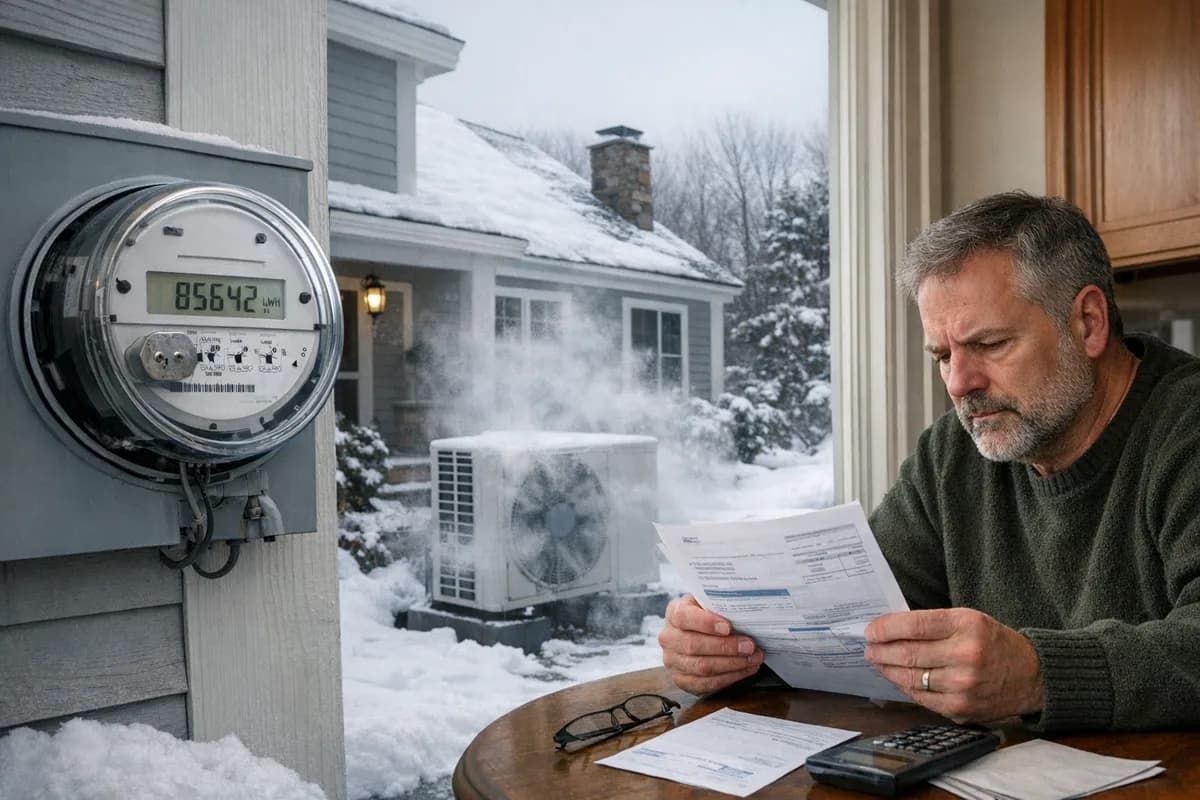
Auxiliary heat at CMP $0.27/kWh or Versant $0.32/kWh costs 3x more than normal heat pump operation. Maine has the coldest design temperatures in New England (-10°F to -18°F). Understanding your balance point is the key to controlling winter bills.
$120-$180/mo
Normal HP Cost
$340-$520/mo
Heavy Aux Cost
5-15 kW
Aux Heat Draw
-1 to -18°F
ME Design Temp
A heat pump works by extracting heat energy from outdoor air and moving it inside. This process is remarkably efficient -- for every 1 kWh of electricity used, a modern cold-climate heat pump delivers 2.5 to 3.5 kWh worth of heat (a COP of 2.5-3.5). That efficiency is why heat pumps save Maine homeowners $1,000-$2,500 per year compared to oil heating.
But as outdoor temperatures drop, there is less heat energy in the air to extract. Below a certain temperature -- called the balance point -- the heat pump alone cannot keep your home warm enough. That is when auxiliary heat kicks in.
Auxiliary heat is typically electric resistance strip heat built into ducted systems. It has a COP of exactly 1.0 -- meaning it converts electricity to heat at a 1:1 ratio with zero multiplier effect. At CMP rates of $0.27/kWh, a 10 kW strip costs $2.70 per hour to run. At Versant rates of $0.32/kWh, it costs $3.20 per hour. Compare that to the heat pump compressor at roughly $0.75-$1.15 per hour doing the same heating job above the balance point.
Auxiliary (AUX) heat: The heat pump compressor continues running alongside the backup strips. The system uses both heat sources together. This is normal during cold weather.
Emergency (EM) heat:The heat pump compressor is completely shut off. Only the backup heat runs. This is for compressor failure only. If your thermostat says "EM HEAT" and your compressor is not broken, switch it back to regular heat mode immediately. You are paying 3x more than you need to.
Electric coils in the air handler heat air directly. Draws 5-15 kW. Automatic when HP cannot keep up.
Heat pump hands off to oil boiler below switchover temp. No electric strip needed.
Similar to dual-fuel oil. HP + propane furnace share the load.
These estimates are for a typical 2,000 sq ft Maine home with a 3-ton heat pump system. Your costs will vary based on insulation, thermostat settings, and system sizing.
| Scenario | CMP ($0.27/kWh) | Versant ($0.32/kWh) | kWh Used | When This Happens |
|---|---|---|---|---|
| Normal HP operation (COP 2.8) | $120-$180/mo | $145-$215/mo | ~450-670 kWh | Heat pump running efficiently above balance point |
| Mix of HP + aux heat (20% aux) | $200-$310/mo | $240-$370/mo | ~740-1,150 kWh | January/February typical for Zone 5-6 |
| Heavy aux heat (50% aux) | $340-$520/mo | $400-$620/mo | ~1,260-1,930 kWh | Extended cold snap below balance point |
| All auxiliary/emergency heat | $480-$700/mo | $570-$830/mo | ~1,780-2,590 kWh | System malfunction or compressor locked out |
Versant customers pay 19% more for the same heat pump operation. A month of heavy auxiliary heat costs $400-$620 on Versant vs. $340-$520 on CMP. This rate difference makes dual-fuel (HP + oil backup) even more important in Versant territory.
The balance point is the outdoor temperature where your heat pump can no longer keep up on its own and needs auxiliary help. It depends on your system size, home insulation, and the heat pump model. Maine has the widest range of design temperatures in New England.
Mildest zone. Ocean moderation. Minimal aux heat needed.
Most of Maine. Aux heat needed on coldest nights.
Coldest in NE. Dual-fuel recommended over electric aux.
Maine is unique in New England for several reasons that compound the auxiliary heat problem:
Portland at -1°F is warmer than most of Maine. Bangor hits -12°F. Caribou reaches -18°F. No other NE state has design temps this low across such a large population.
Average Maine home age is 45+ years. Many farmhouses and cape cods have poor insulation (R-11 walls, R-19 attic) and significant air leakage, increasing the heating load and lowering the balance point.
CMP at $0.27/kWh and Versant at $0.32/kWh are among the highest in the country. When aux heat kicks in, these rates multiply into very expensive heating. Versant customers are hit hardest.
Maine heating season runs October through May -- 7+ months. Even with a cold-climate HP, that means more total hours where aux heat might activate compared to CT, RI, or MA.
Most Maine homeowners can cut their winter electric bill by $50-$200/month with these adjustments. Start with the free/low-cost tips first.
Every degree above 68°F increases aux heat use by 3-5%. Set to 68°F daytime, 64°F sleeping. Avoid large temperature setbacks -- reheating from 60°F to 70°F triggers aux heat.
Save $20-$60/month in winter
Older Maine homes lose 25-40% of heat through air leaks. Seal around windows, doors, attic hatches, and basement rim joists. An Efficiency Maine home energy audit ($50 copay) identifies the worst leaks.
Save $30-$80/month in winter
Some thermostats trigger aux heat too early. Work with your installer to lower the aux heat lockout temperature. Modern cold-climate HPs can operate efficiently down to 5°F or lower.
Reduce aux hours by 30-50%
A blocked outdoor unit forces constant defrost cycles, which activate aux heat. Keep 18 inches clear on all sides. Install a snow shelf if unit is in a drift zone. Never cover the top.
Prevent unnecessary aux cycles
Maine homes average R-19 attic insulation vs. the recommended R-60. Upgrading to R-49+ with Efficiency Maine insulation rebates ($1,000-$4,000) raises your balance point and cuts aux heat dramatically.
Reduce heating load 20-35%
If you still have a working oil boiler, set it as your aux heat source instead of electric strips. Oil backup at $3.82/gal costs less than electric resistance at Versant rates ($0.32/kWh) for extended cold snaps.
Save 15-25% vs electric aux
When your heat pump runs in heating mode, frost gradually builds up on the outdoor coil. Every 30-90 minutes (depending on conditions), the system runs a defrost cycle -- temporarily reversing to cooling mode to melt the frost. During this 3-10 minute cycle, your system blows cold air through the ducts unless auxiliary heat kicks in to compensate.
In Maine, where winter humidity and coastal fog are common, defrost cycles happen more frequently. Each cycle activates aux heat for a few minutes. Over the course of a day, these short bursts add up to 1-3 hours of aux heat operation, even when outdoor temps are above the balance point.
Some auxiliary heat usage is normal in Maine winters. But persistent or unexpected aux heat may indicate a problem that needs professional attention.
When outdoor temperatures drop below your heat pump balance point (typically 10-25°F depending on your system and insulation), auxiliary electric resistance heat kicks in. Aux heat draws 5-15 kW compared to the heat pump compressor at 1-3 kW, tripling your electricity consumption. In Maine, January cold snaps often push temps to -10°F or colder for days, causing sustained aux heat operation. CMP customers see bills jump from $150 to $400+ and Versant customers from $180 to $500+.
Auxiliary heat activates automatically when the heat pump cannot meet the thermostat demand alone. The heat pump continues running alongside the aux heat strips. Emergency heat shuts down the heat pump compressor entirely and runs only on backup heat (electric strips or oil boiler). Emergency heat should only be used when the compressor is broken. If your thermostat is set to "emergency heat" mode, switch it back to "heat" immediately -- you are paying 3x more than necessary.
A typical 10 kW electric resistance strip costs $2.70/hour on CMP ($0.27/kWh) or $3.20/hour on Versant ($0.32/kWh). Running for 8 hours overnight costs $21.60-$25.60. Compare this to the heat pump compressor at $0.75-$1.15/hour. Over a month of heavy aux use (200+ hours), you could see $540-$640 in extra electricity costs above normal heat pump operation.
Ductless mini-splits typically do not have electric strip aux heat -- when they cannot keep up, they simply produce less heat. The issue is more common with ducted heat pump systems. For mini-splits, the solution is ensuring you have a cold-climate rated model (Mitsubishi Hyper-Heat to -13°F, Fujitsu XLTH to -15°F) and keeping your oil or propane boiler as backup for the coldest nights rather than relying solely on the mini-split.
For southern Maine (Zone 5, Portland area), set the aux heat lockout at 15-20°F. For central Maine (Zone 6, Lewiston/Bangor), 10-15°F works for most cold-climate models. For northern Maine (Caribou), a dual-fuel system with oil switchover at 5-10°F is more cost-effective than electric aux. Have your installer adjust these settings -- many factory defaults are set too high (30-35°F), causing unnecessary aux heat activation.
At current prices (oil $3.82/gal, CMP $0.27/kWh, Versant $0.32/kWh), oil backup is slightly cheaper than electric resistance for extended cold snaps lasting more than a few hours. At CMP rates, the costs are roughly even. At Versant rates, oil wins clearly. The best strategy for most Maine homes is: heat pump above 10-15°F, oil boiler below that. This dual-fuel approach keeps total winter heating costs 40-55% below oil-only.
How your utility rate affects heating costs
Read moreModels rated for Maine Zone 5/6 winters
Read moreFull cost comparison at $3.82/gal
Read morePricing by type and metro area
Read moreEfficiency Maine weatherization programs
Read moreCMP and Versant rate breakdowns
Read moreA properly sized cold-climate heat pump with the right balance point settings can cut your auxiliary heat hours by 50-70%. Get a free assessment to find out if your system is costing you more than it should.