Loading NuWatt Energy...

We use your location to provide localized solar offers and incentives.
We serve MA, NH, CT, RI, ME, VT, NJ, PA, and TX
Loading NuWatt Energy...
NuWatt designs, installs, and manages solar, battery, heat pump, and EV charger systems across 9 states. One company, one warranty, one point of contact.
Get a Free QuoteWhy lithium batteries refuse to charge below 32°F, how Tesla Powerwall 3, Enphase IQ Battery 10, and Franklin aPower handle the physics, and why install location matters more than brand selection on the days that actually get cold in MA.
0°C
Charging floor (Li-ion)
-20°C
Discharge floor (typical LFP)
LFP
2026 MA default chemistry
0 days
Conditioned-interior impact
Every lithium-ion battery (including lithium iron phosphate / LFP chemistries used in Tesla Powerwall 3, Enphase IQ Battery 10, and Franklin aPower 2) has a charging temperature floor near 0°C (32°F). Below that, charging would cause permanent lithium plating on the anode, so the battery management system pauses charging. Discharge is different — most LFP units can still discharge down to roughly -20°C (-4°F) to power your home during a winter outage. Modern units include active thermal management that pre-heats cells to resume charging within minutes. For Massachusetts homeowners, install location matters more than brand: a battery in a conditioned basement essentially never sees the charging floor, while an outdoor-mounted unit in interior MA may see 10–30 charge-paused mornings per winter. NuWatt installs indoors when the building allows, specifies LFP over NMC, and verifies pre-heater function at commissioning.
Quick take for MA homeowners: Charging stops below 32°F because lithium plating is permanent damage. Discharge still works down to roughly -4°F on LFP units. If your battery is in a conditioned basement, this never comes up. If it’s outdoor or in a detached garage, expect some charge-paused mornings in January and February — working as designed.
Cold-weather battery behavior is not a software policy decision or an over-cautious-manufacturer thing. It is chemistry. Charging a lithium cell below its operational floor causes specific, irreversible damage — so every reputable management system refuses to do it.
When a lithium-ion cell is charged below roughly 0°C (32°F), lithium ions don’t intercalate cleanly into the graphite anode. Instead, metallic lithium plates out on the anode surface. That plated lithium never returns to solution — it is permanently lost capacity, and the dendrites it can form raise internal short-circuit risk over time. Every reputable battery management system (BMS) exists to prevent exactly this.
Charging is the restricted direction. Most lithium chemistries can discharge down to around -20°C (-4°F) with reduced capacity and higher internal resistance, but without the plating damage mode. This is why a battery can still power your house during a freezing-cold outage even when it refuses to accept solar charge from a sunny cold morning.
Lithium iron phosphate (LFP, LiFePO4) and nickel-manganese-cobalt (NMC) are the two chemistries used in residential home batteries. Both share the ~0°C charging floor. LFP tolerates a slightly wider discharge window, handles full cycling better at the extremes, and is more thermally stable under fault — which is why most 2026 residential SKUs (Tesla Powerwall 3, Franklin aPower, Enphase IQ Battery 10) have moved to LFP.
Modern battery systems include resistive pre-heaters or waste-heat recirculation that warm the cells above the charging floor before accepting current. When the battery is cold and the system has stored energy (or grid/solar power available), the BMS uses a small fraction of that energy to warm itself to operational temperature — typically adding a few minutes of latency before charging can resume. This is why a spec sheet with -20°C discharge / 0°C charge limits still works in practice: the unit warms itself before it charges.
The thermal envelope, in one sentence
A home battery’s “operational temperature range” has two different numbers: the charge range (narrower, typically starting near 0°C / 32°F) and the dischargerange (wider, typically extending to -20°C / -4°F or lower). When a spec sheet lists one range, it’s usually the discharge number — read both before you pick an install location.
The right question for an MA homeowner isn’t “what’s the absolute charging floor?” It’s “how many days per year will my specific install location actually see charge-paused conditions?” The answer depends far more on where the battery lives than which brand it is.
90–120
Days per year interior MA sees sub-0°C (32°F) overnight lows
Varies by town; Worcester, Berkshires, Franklin, and Hampshire counties are at the upper end
10–30
Days per year an outdoor-mounted battery is likely to see charge-paused minutes
Mostly early-morning pauses that resolve within the solar day
0
Days per year a conditioned-interior battery is likely to see charge-paused minutes
Provided the install is truly in the conditioned envelope
2–4%
Typical net annual round-trip efficiency hit from unconditioned-exterior MA install
Per manufacturer guidance and field data; varies by microclimate
The practical conclusion:If your battery is in a conditioned interior space, this whole topic is something to understand rather than worry about. If it’s outdoor or in an unheated garage, you’ll notice cold-weather charging behavior during the coldest stretches of January and February — typically without any impact on your annual production or ConnectedSolutions participation.
Below is a charging-behavior comparison for the four home batteries we see most often on Massachusetts quotes. Specific operational ranges are per each manufacturer’s current datasheet — ask your installer to confirm the exact number on the SKU they are quoting, since these move with firmware and product revisions.
Note: The table describes cold-weather charging behavior specifically — not overall capacity, cycle life, or price. For broader comparisons see our best MA battery storage guide.
| Brand / Model | Chemistry | Charge Range | Discharge Range | Thermal Management | MA Install Note |
|---|---|---|---|---|---|
| Tesla Powerwall 3 | LFP (LiFePO4) | Per current Tesla datasheet — LFP-typical lower bound near 0°C; unit includes active thermal management to pre-heat cells | Rated operational range extends well below freezing per Tesla spec; confirm the 2026 datasheet revision | Integrated active thermal management with internal heater. Outdoor-rated, but cold extremes cause the BMS to condition cells before charging. | IP-rated for outdoor wall or garage install. In Massachusetts, indoor or attached-garage install reduces thermal-management energy overhead and avoids edge-case charging delays during extended -10°F events. |
| Enphase IQ Battery 10 / 5P | LFP (LiFePO4) | Charge inhibited below ~0°C per Enphase documentation; passive/active thermal strategy varies by model generation | Discharge rated down to roughly -15°C to -20°C on current SKUs; confirm exact bounds on the unit label | Modular design with BMS-governed thermal limits. Newer generations include improved cold-weather firmware; older IQ Battery 10 units in the field benefit from firmware updates that tune cold logic. | Designed for flexible indoor or outdoor mount. In MA, pairing with the IQ Gateway and keeping the unit out of direct wind exposure improves cold-snap charge availability. |
| Franklin aPower 2 | LFP (LiFePO4) | LFP-typical ~0°C charge floor; active thermal conditioning per Franklin spec | Rated for operation below freezing; confirm SKU-specific limits on the current Franklin datasheet | Internal thermal management system designed to condition cells through a full New England temperature range. Franklin markets cold-climate performance as a differentiator. | Outdoor-rated enclosure. Still, indoor or conditioned-space install in MA gives the widest margin and minimizes heater-related parasitic load on the coldest days. |
| LG RESU (legacy / limited US support) | NMC on most legacy residential SKUs; LFP on newer Prime series | NMC SKUs share the ~0°C charging limit; discharge rating typically narrower than LFP alternatives | Most legacy RESU units rated to roughly 0°C to 45°C operational; older installs are indoor-only in MA | Passive thermal management on most legacy SKUs; limited active heating vs. current-gen Tesla/Franklin/Enphase | Existing MA RESU installs should be evaluated for install location (unconditioned garages are the weakest case). New installs in MA are uncommon in 2026 given LG’s reduced US residential presence. |
Manufacturer datasheets are revised periodically, and firmware updates can change the effective cold-weather behavior without changing the nameplate spec. The physics — the ~0°C charging floor, the wider discharge window, the pre-heater strategy — is stable. The exact degree-by-degree operational bounds on a 2026 production unit are best confirmed on the specific SKU’s current datasheet, which your installer should be able to produce.
Brand selection drives maybe 20% of cold-weather charging behavior. Install location drives the rest. These are the four locations we evaluate for every MA battery project, in order of preference.
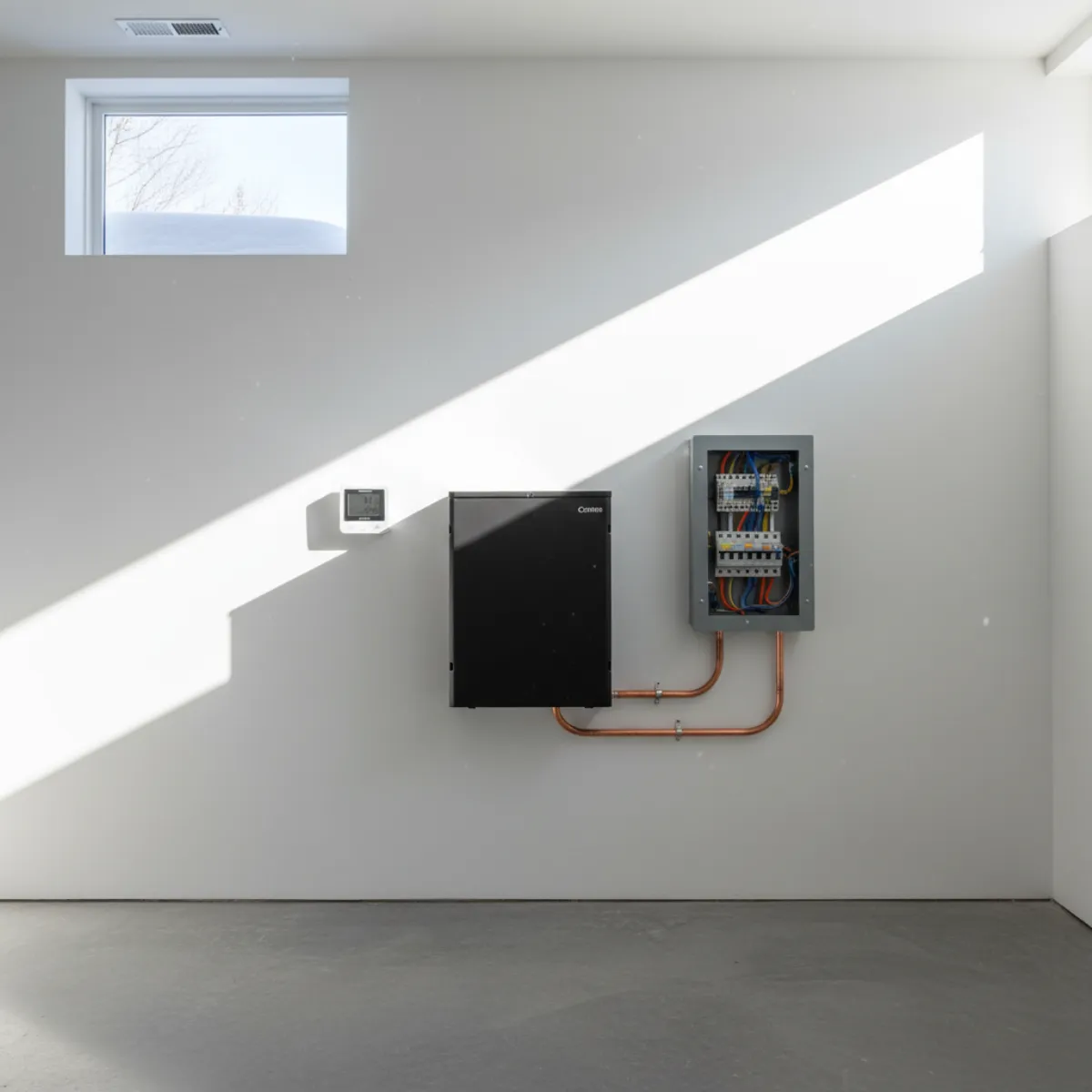
Basement or utility-room install holds 55–70°F year-round. The battery essentially never sees its cold-weather charging floor, the BMS never runs its pre-heater, and parasitic cold-weather load is effectively zero. Across MA, this is the configuration we spec whenever code, floor space, and inverter routing allow.
Attached garages on the conditioned-home envelope track somewhere between conditioned interior and outdoor. On the coldest MA days (-5°F overnight) an attached garage might reach +15–25°F — still near but generally above the charging floor once the BMS conditions cells. A reasonable compromise when basement space is not available.
Outdoor-rated batteries (Tesla Powerwall 3, Franklin aPower 2, Enphase IQ Battery 10 in outdoor mount) are engineered for this. Expect periodic charge-paused events during the coldest MA mornings, higher pre-heater energy use in January/February, and a modestly reduced net annual round-trip efficiency vs. conditioned install. Not a failure mode — a documented trade-off.
Third-party thermal sleeves and insulating blankets exist, but they interact with the battery’s own thermal-management airflow. Using one without manufacturer approval can void warranty and, worse, trap waste heat during summer cycling. If you’re considering one, ask the manufacturer in writing — don’t trust generic aftermarket marketing.
These are the five patterns we encounter most often when homeowners call in about cold-weather battery behavior. Most are not faults — they are the system doing its job. A few are real issues that need attention.
What’s happening
An exterior-wall-mounted battery in an interior MA town (Worcester, Greenfield, Springfield) during a -5°F morning may show "charging paused" in the app while solar is producing power. The BMS has measured cell temperature at or below the charging floor and refuses to accept current. If the unit has active thermal management, it may be running the pre-heater — meaning your solar is effectively diverted to warming the battery rather than storing energy.
What to do
This is expected behavior, not a failure. The battery resumes charging within minutes to tens of minutes once cells reach the operational window. If pauses are chronic during cold snaps, consider relocating to a conditioned space at your next service window.
What’s happening
An unheated detached garage routinely tracks exterior temperatures. In January and February, a wall-mounted unit in this environment can miss several full days of morning charge windows. Parasitic heater load during those days also reduces the net solar storage benefit. Customer-facing symptom: "my battery only hit 40% yesterday even though the sun was out."
What to do
Verify the install location on the original design documents. If the battery was spec’d for an unheated garage, a targeted enclosure insulation upgrade (R-13+ studwall + attic insulation) often costs less than relocating the battery and recovers the cold-day charge windows. Attached garages behind the conditioned-home envelope perform noticeably better than detached structures.
What’s happening
On units with active thermal management, a failed heater element or a firmware bug in the thermal controller presents as persistent cold-weather charging errors even in mild cold. This is rare but does occur, and it is distinct from "the battery is working as designed at -10°F" — the symptom pattern is charging paused at +20°F or higher, where the cells should be in the operational window.
What to do
Check the installer app for specific fault codes (Tesla: service alerts; Enphase: IQ Gateway event log; Franklin: mobile app diagnostics). Pre-heater or thermal-sensor faults typically require a warranty service visit. Customers notice and report these; we don’t run proactive hardware monitoring on your behalf.
What’s happening
During a winter grid outage at -5°F, your LFP battery can still discharge to power your home — but you may see reduced usable capacity (roughly 10–20% temporary reduction is common per industry data) and higher internal resistance. This is not damage; it is normal cold-temperature Li-ion behavior and recovers fully when temperatures rise. NMC legacy SKUs typically show more pronounced derating than current-gen LFP units.
What to do
Plan your backup load panel to a realistic winter-cold capacity, not the nameplate. If you rely on battery backup for medical equipment or heat-pump heating during outages, size the bank for the cold-derated number, not the nameplate — and pair with generator backup for multi-day events.
What’s happening
Battery firmware is updated over the air periodically, and cold-weather behavior is one of the most-tuned areas. An older unit running a firmware revision from 18–24 months ago may have a more conservative cold-weather profile than a newer unit of the same model — meaning the older unit pauses earlier and resumes later than the current tuning calls for.
What to do
Check your battery manufacturer’s mobile app for pending firmware. If an update is available, let the system install it during a time when the battery is warm. If the app shows the unit is up to date and cold-snap behavior still seems conservative, open a support ticket with the manufacturer and copy your installer. Firmware improvements for cold-charging logic are cumulative — running current firmware materially changes performance on some SKUs.
Four engineering practices we apply on every Massachusetts residential battery project. None of this is magic — it’s standard diligence that keeps you out of the cold-weather scenarios above.
Our first design question is "is there a conditioned space that meets code clearance for the battery?" For most MA homes the answer is yes — basement or utility room. When it’s no (finished basement, tight utility space, code clearance issue), we move to attached garage, then outdoor. We do not default to outdoor install just because the unit is rated for it.
Every new residential battery we quote in Massachusetts is LFP. LFP’s wider discharge window, better cold-weather behavior, longer cycle life, and improved thermal-runaway safety all favor New England conditions. Customers with legacy NMC units are supported — but new installs get the current chemistry.
On any outdoor or garage install, we run the design through a cold-weather thermal check: what’s the expected cell temperature at 10th-percentile-coldest-morning conditions for the specific town, given the mount location and wind exposure? That check tells us whether the unit is likely to see charge-paused events often enough to matter — and whether a different mount location makes sense.
On any active-thermal-managed unit, part of our commissioning is a pre-heater functional test — we confirm the heater element draws current, the cell-temperature sensor reports correctly, and the BMS transitions out of charge-inhibit when the unit warms. This catches the rare pre-heater-fault-from-factory before winter finds it for the homeowner.
On monitoring, one more time
We don’t run proactive hardware monitoring on customer batteries. Your manufacturer’s app is the primary status layer — it’s where charge-paused events, fault codes, and firmware updates surface. When something looks wrong to you, call us. Most cold-weather charge pauses are expected BMS behavior and don’t need a service call. The few that are real faults (pre-heater failures, sensor issues, persistent errors at non-cold temperatures) we’ll help you work through with the manufacturer under warranty.
Because this comes up on every battery quote: where things stand in April 2026.
Expired
Section 25D Residential Solar ITC
Expired December 31, 2025. Residential battery installs paired with new solar no longer qualify for the federal residential credit.
Active
MA State Programs
SMART 3.0, ConnectedSolutions dispatch revenue, Clean Peak Standard, and Mass Save-related rebates remain the active incentive stack for MA battery installations.
Active (Commercial)
Section 48E Commercial ITC
Commercial and third-party-owned battery projects can still access §48E through the July 4, 2026 construction-start deadline.
NuWatt designs residential battery installs for Massachusetts conditions — LFP chemistry as the default, indoor install when the building allows, thermal modeling at design time, and pre-heater verification at commissioning. No outdoor-by-default, no “it’ll probably be fine” on the coldest mornings.
Serving Massachusetts. Same engineering discipline on our NH, VT, RI, ME, CT, NJ, PA, and TX projects.
Last updated: April 2026
Sources: Tesla / Enphase / Franklin / LG manufacturer datasheets (current revisions), IEC 62619 / UL 9540 safety standards, NOAA/NWS MA winter climate summaries, Sun-grade BMS field reports