Loading NuWatt Energy...

We use your location to provide localized solar offers and incentives.
We serve MA, NH, CT, RI, ME, VT, NJ, PA, and TX
Loading NuWatt Energy...
NuWatt designs, installs, and manages solar, battery, heat pump, and EV charger systems across 9 states. One company, one warranty, one point of contact.
Get a Free Quote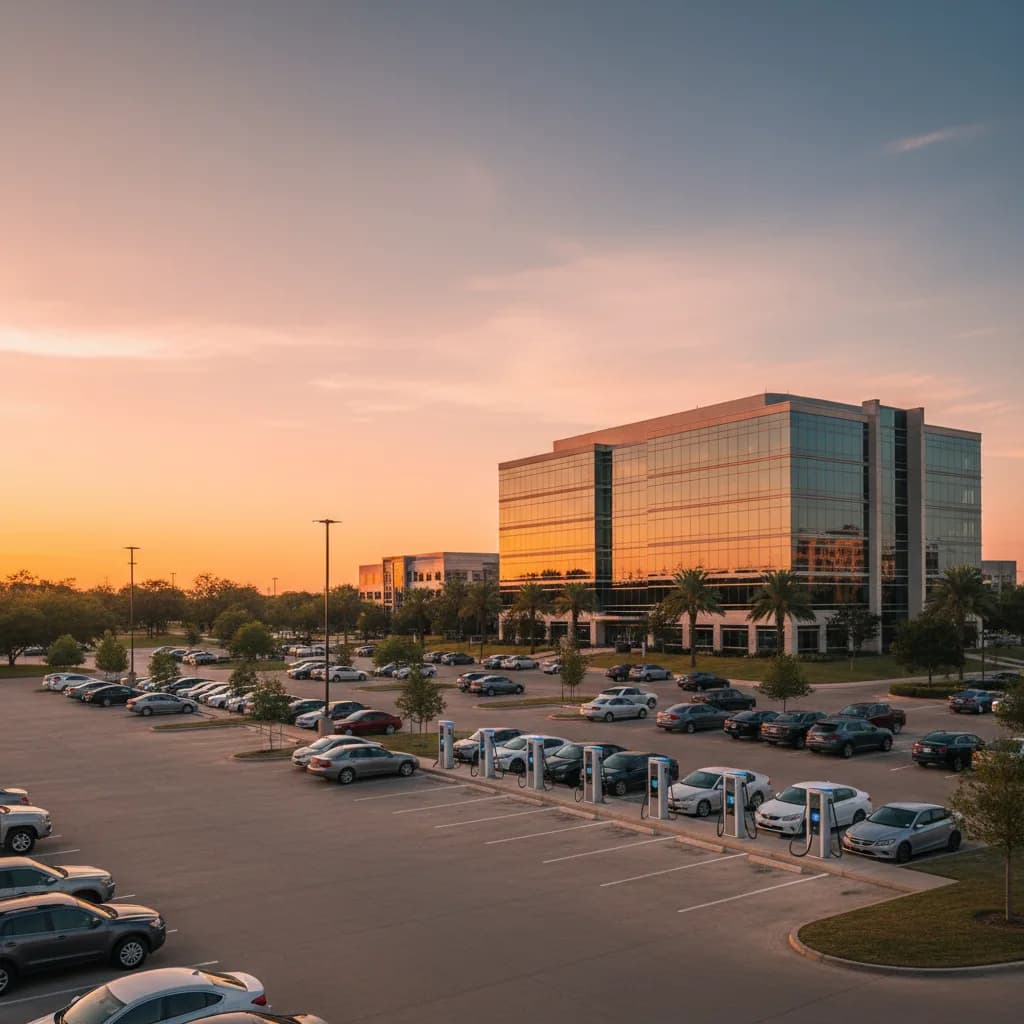
Workplace-grade EV charging for Las Colinas, Legacy/Plano, downtown Dallas, and the Telecom Corridor — built around Oncor Drive Forward, ERCOT 4CP demand strategy, hail-rated hardware, and the hard June 30, 2026 Section 30C deadline.
File Dallas Building Inspection electrical permit and the Oncor service request in parallel. Layer Oncor Drive Forward rebate with Section 30C (if census tract qualifies) before June 30 2026. Spec hail-rated IK10 chargers, and plan ERCOT 4CP-aware smart charging. Typical turnkey: 11–15 weeks.
The Metroplex has the densest concentration of Fortune 1000 corporate campuses in Texas and a workplace-first commuting pattern that rewards Level 2 charging at the office. Las Colinas, Legacy West / Legacy Central (Plano), the Telecom Corridor (Richardson), downtown Dallas, and the Uptown / Knox-Henderson corridor all have active commercial EV RFPs in flight. The combination of Class A office density, Texas deregulated retail power, and Oncor's workplace-friendly Drive Forward rebate structure makes DFW one of the fastest-moving workplace EV markets in the country.
AT&T, JPMorgan Chase, Toyota Motor North America, Liberty Mutual, Capital One, State Farm, McKesson, Charles Schwab — all with corporate EV policy roadmaps.
Collin and Denton County lead Texas counties on EV new-vehicle share (~12% in 2026), driven by Tesla Gigafactory proximity and Plano corporate fleets.
Most Plano / Irving corporate HQs now publish SASB or ISSB-aligned reports; workplace EV charging ratios are landing on board ESG scorecards.
Workplace office parks (Las Colinas, Legacy, Telecom Corridor), downtown Class A (Main / Elm), and hospitality (Uptown, Addison, Grapevine).
Oncor's commercial EV rebate program pays toward Level 2 and DCFC hardware plus make-ready for qualifying DFW hosts. Rebates scale with port count and power level, with higher per-port incentives when sites commit to smart charging and data sharing. Workplace and multifamily hosts are priority categories for 2026.
Review Oncor Drive Forward →DFW corporate campuses with multi-MW electrical load are directly exposed to ERCOT's 4CP methodology. The four highest-load 15-minute intervals across June–September lock in the next year's transmission rate. Every DCFC and heavily-utilized Level 2 array in a corporate campus needs a 4CP avoidance plan — smart charging schedulers, solar canopies, and targeted battery dispatch.
4CP strategy deep dive →Texas Commission on Environmental Quality's All-Electric grant covers vehicle replacement and paired charging infrastructure statewide through August 31, 2026. DFW municipal fleets, school districts, and private Class 4–8 fleets have been heavy recipients in prior cycles.
TCEQ All-Electric deep dive →IRS Section 30C is 6% of eligible property cost without PWA compliance or 30% with PWA, capped at $100,000 per item of property. Placed-in-service deadline is June 30, 2026, and the site must be in an IRS low-income or non-urban census tract. Direct-pay is available for tax-exempt entities (school districts, cities).
Section 30C guide →Oncor's Secondary General Service (RES-3 / GS-D) and related commercial schedules recover roughly $8/kW in distribution demand, layered on top of ERCOT 4CP transmission charges. A single 150 kW DCFC pulled unmanaged during August peak hours compounds across two cost layers:
150 kW × $8/kW Oncor RES-3 demand
Plus 4CP transmission uplift (~$15–$28/kW annually)
Peak shaved to ~95 kW, session queue-managed
~37% Oncor demand savings, partial 4CP relief
180 kW PV + 215 kWh battery dispatched at 4CP
~87% reduction; 4CP intervals fully covered
NuWatt sizing estimates based on Oncor filed rate schedules with the PUCT. Actual site rate varies by RES tier, loss factor, and REP supply contract.
Section 30C census-tract eligibility varies sharply across the Metroplex. Large portions of South Dallas, Oak Cliff, West Dallas, Pleasant Grove, the Fair Park and Deep Ellum edges, parts of East Dallas around Lake Highlands, much of Garland and Grand Prairie, and sections of Irving south of SH-183 qualify as IRS-designated low-income communities for 30C purposes. South Oak Cliff and Red Bird qualify almost in their entirety.
Neighborhoods less likely to qualify include Highland Park, University Park, Preston Hollow, north Uptown, Turtle Creek, most of Plano and Frisco, McKinney east of US-75, and West Plano's Legacy business district. For corporate tenants in those last-mile affluent tracts, the winning capital stack is usually Oncor Drive Forward + MACRS bonus depreciation rather than Section 30C — you lose the federal credit but still land roughly 18–30% of project cost in recovery.
Run the 30C tract checkerTwo simultaneous filings drive the critical path: Dallas Building Inspection (or the suburban equivalent) for the electrical permit, and Oncor for service study + design letter. Filed in parallel on Day 1, total lead time runs 44–81 days before energization.
14–21 days — electrical permit (Level 2 or DCFC)
City of Dallas electronic plan review via Oak Cliff permitting office. PE-stamped drawings mandatory for DCFC and any canopy structural scope.
30–60 days — design letter + interconnection
Feeder review, transformer sizing, and interconnection agreement. DCFC >300 kW may add 60–120 days for transformer procurement windows.
10–21 days — Plano / Frisco / Irving / Richardson
Each city runs its own permit portal. Plano and Frisco are consistently fastest; Irving (Las Colinas) usually 14 days; downtown Dallas is the slowest.
+7–14 days — structural canopy review
Canopy/carport designs for workplace charging must meet 90+ mph wind and hail impact. NuWatt defaults to steel-substructure designs with IK10 chargers.
Workplace-heavy buildings favor dual-port networked Level 2 with strong property-management integration. Hospitality and retail in Uptown, Addison, and Grapevine often layer in one or two 50–100 kW DCFC units for destination charging. All specs assume hail impact protection and 122°F continuous-operation ratings.
Class A office + tenant-improvement fit-outs
Networked dual-port 48A Level 2 with OCPP 1.6J, session metering, and property-management cloud integration
Las Colinas / Frisco / downtown
Panel-constrained corporate campus retrofits
40–48A Level 2 with dynamic load balancing across up to 24 ports — ideal for 1980s-era Plano office panels
Corporate campus retrofit
Hotel / hospitality destination charging
Networked 48A Level 2 rated for 122°F continuous operation — heat and hail-proof pedestal mounting
Uptown + Addison hospitality
Non-networked fleet backup + vendor lots
32A Level 2 commercial-grade charger with IK10 impact rating and stainless hardware — passes DFW hail tests
Fleet vendor lots
NuWatt's closest reference build in Texas is the Port of Houston fleet depot with a 220 kW solar canopy, 350 kWh battery sized around ERCOT 4CP, and four CCS1/NACS DCFC stations. For DFW Class A office parks the equivalent scope is a carport-style 180 kW PV canopy covering 60–100 workplace Level 2 ports plus 2 destination DCFC, sharing the same 4CP dispatch logic. The project math is portable from Houston to Plano, Las Colinas, or downtown Dallas with only utility-side substitutions (CenterPoint → Oncor).
See the full Texas reference projectNuWatt runs a single EPC stack across nine states — including Texas electrical, structural, and solar licensing — so a Las Colinas tenant fit-out, a Legacy corporate campus, and a downtown Dallas high-rise can all share the same engineering, design, and permitting workflow without subcontractor handoffs. We file Oncor service applications the same day drawings lock, which is the single strongest driver of on-time Section 30C placed-in-service dates before the June 30, 2026 deadline. Our DFW field team is certified on hail-rated canopy construction and has completed installs at occupied Class A buildings with no disruption to tenant operations.
A 12-port Level 2 workplace build in Dallas County runs roughly 11–15 weeks end to end: 14–21 days for Dallas Building Inspection electrical permit review plus 30–60 days for the Oncor service study and design letter. Submitting the Oncor service request and Dallas Building Inspection application in parallel on Day 1 is the single biggest schedule compressor. DCFC builds (150 kW+) along LBJ Freeway or in the Legacy corridor stretch to 4–5 months because of transformer procurement timing.
North/West Texas TDU commercial EV rebate and make-ready program documentation.
Dallas electrical permit intake, plan review, and inspection portal.
$109.2M Texas Commission on Environmental Quality grant pool through Aug 31, 2026.
Alternative Fuel Vehicle Refueling Property Credit — 2026 filing guidance.
Transmission cost recovery and coincident-peak rate mechanics.
Public Utility Commission of Texas-filed Oncor rate schedules and demand charges.
Plano permit portal for Legacy / Plano workplace charging installs.
Irving / Las Colinas permit intake for workplace and hospitality EV installations.
Las Colinas, Legacy, Telecom Corridor, downtown — NuWatt handles Oncor Drive Forward, Dallas Building Inspection, ERCOT 4CP mitigation, and Section 30C eligibility end to end.