Loading NuWatt Energy...

We use your location to provide localized solar offers and incentives.
We serve MA, NH, CT, RI, ME, VT, NJ, PA, and TX
Loading NuWatt Energy...
NuWatt designs, installs, and manages solar, battery, heat pump, and EV charger systems across 9 states. One company, one warranty, one point of contact.
Get a Free Quote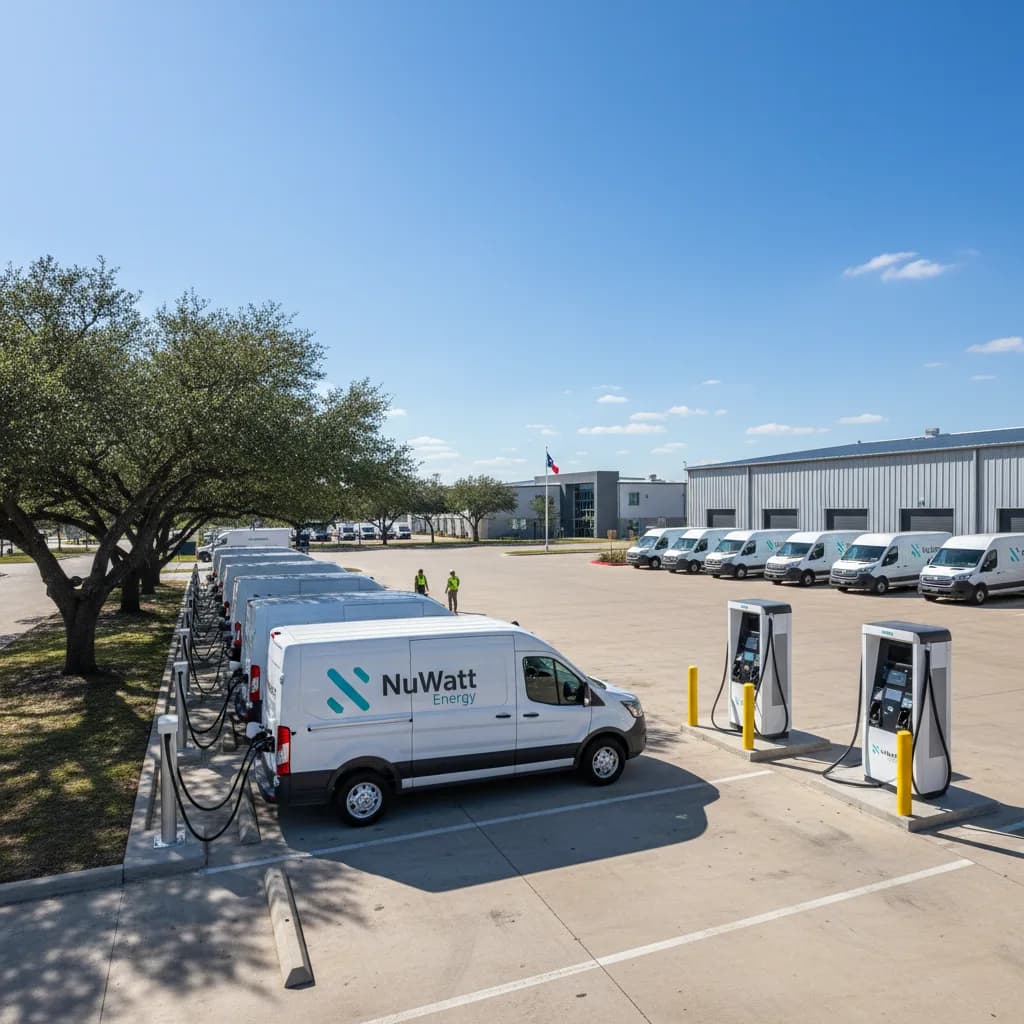
Depot-grade fleet charging for Port logistics, oil-services yards, and the Texas Medical Center — engineered around CenterPoint Energy's commercial tariff, ERCOT 4CP transmission exposure, and the hard June 30, 2026 Section 30C deadline.
Start with a CenterPoint Energy service study and an ERCOT 4CP mitigation plan. Then pull a Houston Public Works electrical permit, lock in Section 30C census-tract eligibility before June 30 2026, and layer TCEQ All-Electric funding on top. Typical turnkey: 10–14 weeks for Level 2, 4–6 months for fleet DCFC.
Houston sits at the intersection of three of the largest commercial EV catalysts in the United States: Class 6–8 logistics fleets moving cargo out of the Port of Houston, the world's largest medical complex electrifying valet and shuttle fleets at the Texas Medical Center, and an oil & gas services sector quietly converting yard trucks and light-duty service vehicles to EV as CAPEX rules shift. Combined with deregulated ERCOT economics and the TCEQ All-Electric grant pool, metro Houston has more active commercial EV RFPs in-flight today than almost any other US metro outside California.
Port of Houston terminals, Beltway 8 logistics parks, oil-services yards in Pasadena and Baytown, and the Texas Medical Center valet fleet.
Harris County 2026 new-vehicle EV share sits near 8%, modestly below the 11% national average but rising fastest in commercial Class 2b–4.
Most Houston Fortune 500 oil-services and logistics HQs now publish Scope 1/2 disclosures; fleet electrification targets are moving onto board scorecards.
Fleet depots (Port + Beltway 8), workplace clusters (Energy Corridor, Galleria, Westchase), and medical campuses (TMC, Memorial Hermann, Houston Methodist).
CenterPoint Energy's commercial EV charging program funds make-ready scope (transformer, service conductor, meter) behind new workplace, fleet, and DCFC installations across its eight-county Houston territory. Typical approval covers the utility-side work; customer-side make-ready (pad, conduit, panel) stays with the host but is 30C-eligible.
Review CenterPoint EV program →Texas Commission on Environmental Quality runs a $109.2M statewide grant for replacing diesel Class 4–8 vehicles and funding associated charging infrastructure — applications open through August 31, 2026. Port of Houston and East Harris County fleets have been the largest recipients under the prior cycle.
TCEQ All-Electric deep dive →The biggest hidden cost driver in Houston commercial EV charging is ERCOT's 4CP methodology. Your 15-minute peak demand during each of the four highest-load intervals in June–September sets the following year's transmission rate. Unmanaged DCFC can lock in 50–300 kW of unexpected 4CP exposure. Smart charging, solar canopies, and battery dispatch during 4CP windows are how you sidestep it.
ERCOT 4CP reform brief →Alternative Fuel Vehicle Refueling Property Credit (IRS Form 8911): 6% of eligible cost without PWA or 30% with PWA, capped at $100,000 per single item of property. Property must be placed in service on or before June 30, 2026and sited in a low-income or non-urban census tract. Tax-exempt entities (hospitals, universities) can use direct pay.
Section 30C guide →CenterPoint's large general service (LMS / LGS) schedules run roughly $8/kW in non-coincident distribution demand on top of ERCOT transmission pass-through recovered by 4CP. A single 150 kW DCFC hit unmanaged at 3 p.m. in August adds up fast:
150 kW × $8/kW CenterPoint LMS demand
Plus 4CP transmission uplift (~$18–$30/kW applied annually)
Peak shaved to ~90 kW, depot queue-managed
~40% CenterPoint demand savings, partial 4CP relief
150 kW PV + 250 kWh battery dispatched during 4CP
~85% reduction; 4CP intervals fully covered
NuWatt sizing estimates; CenterPoint schedules filed with the PUCT. Actual site rate depends on LMS/LGS tier, TDU loss factors, and REP energy supply contract.
Houston is unusually rich in qualifying Section 30C census tracts because so much of the city sits inside IRS-designated low-income communities or non-urban tracts. Most of the East End (Second Ward, Magnolia Park), Third Ward, Fifth Ward, Sunnyside, Acres Homes, Independence Heights, Gulfton, Sharpstown, Near Northside, and Denver Harbor qualify. A huge swath of unincorporated east Harris County around the Ship Channel also qualifies, which is why so many Port-adjacent fleet depots lock in the full 30% credit.
Areas less likely to qualify: River Oaks, Memorial Villages, West University Place, Bellaire, Tanglewood, and the Galleria / Post Oak corridor. For a Class A office tenant in the Galleria who wants workplace charging, the right play is usually to anchor the capital stack on CenterPoint make-ready plus MACRS bonus depreciation rather than the census-tract-dependent 30C credit.
Run the 30C tract checkerThe two critical-path items are the Houston Public Works electrical permit and the CenterPoint service study. Pulled in the right order, total permit + interconnection runs 37–81 days. Run them out of sequence and the stack collapses to 4–6 months.
7–21 days — electrical permit for Level 2 or DCFC
Filed via City of Houston Permitting Center; PE-stamped single-line diagram + site plan required. Structural permit adds 14 days for canopy/bollard work.
30–60 days — service study + design letter
Feeder capacity review; transformer sizing; interconnection agreement. DCFC hubs >300 kW often add 60–120 days for transformer procurement.
10–21 days — Fire Marshal electrical permit
Port, Baytown, Pasadena, and Ship Channel industrial sites outside city limits use the Harris County Fire Marshal permit track.
+14–21 days — floodplain plan check
Sites in Shepherd, Memorial, Meyerland, Greenway, or Clear Lake Zones AE/X shaded need additional floodplain review. Pedestal-raised design is standard NuWatt scope.
Houston fleet density means we specify DCFC meaningfully more often than in Northeast markets. For Class 4–8 depots along the Ship Channel we default to ABB Terra HP or Kempower C-Series split cabinets. For medical center valet and workplace we default to networked 48A Level 2 with heat-rated enclosures.
Fleet depot Level 2 with dynamic load management
Depot-grade Level 2 with per-port power sharing and OCPP telematics — fits dispatch cadence at logistics yards
Logistics + services fleets
Medical campus workplace + valet
Networked 48A Level 2 with RFID and hot-weather enclosure (tested to 122°F) — rated for Texas Medical Center garages
Workplace + healthcare
Oil & gas service yards
Rugged NEMA 4 pedestal with over-voltage ride-through — designed for switchgear-adjacent depots
Industrial yards
Class 4–8 truck and van fleets
180 kW–350 kW split-cabinet DCFC with dual CCS1 and NACS — standard build for Port of Houston distribution yards
Fleet DCFC hub
A Class 4–6 logistics fleet operating out of an East Harris County yard replaced two diesel yard trucks and five Class 4 step vans with electric. NuWatt engineered a 220 kW solar canopy, a 350 kWh battery sized for ERCOT 4CP dispatch, and four 180 kW CCS1/NACS DCFC pedestals behind a single CenterPoint service upgrade. Section 30C with PWA compliance + TCEQ All-Electric funding covered roughly 54% of project cost.
See the full Houston project writeupNuWatt operates as a single EPC across nine states and is licensed in Texas for electrical, structural, and solar scope — which means a Port of Houston fleet depot, a Memorial medical valet deck, and an Energy Corridor tenant office can all run through the same engineering and permitting team without subcontracting interconnection. We pre-file CenterPoint service applications the same day drawings lock, which is the single biggest driver of on-time Section 30C placed-in-service dates before the June 30, 2026 federal deadline. Our Houston field team is hurricane-trained, NABCEP-certified, and has completed active-campus installs at the Texas Medical Center without clinical disruption.
A 10-port Level 2 workplace build inside Houston city limits runs about 10–14 weeks end to end: 7–21 days for Houston Public Works (City of Houston PWE) electrical permits plus 30–60 days for CenterPoint Energy's service study and make-ready design letter. Larger DCFC builds tied to fleet depots (300 kW+) push into 4–6 months because of transformer lead times and CenterPoint's commercial EV pilot queue. ERCOT 4CP windows can briefly freeze new service energization during June–September peak hours.
Make-ready funding, commercial EV pilot tariff, Houston service territory scope.
Houston Public Works (PWE) electrical permits, structural permits, floodplain review.
$109.2M Texas Commission on Environmental Quality grant pool through Aug 31, 2026.
Alternative Fuel Vehicle Refueling Property Credit — 2026 filing guidance.
Transmission cost recovery and coincident-peak rate mechanics.
Port electrification initiatives, drayage truck incentives, terminal operator fleet plans.
Unincorporated Harris County electrical permit process for Ship Channel industrial sites.
TMC sustainability program and on-campus fleet electrification framework.
Fleet depots, workplace campuses, medical center decks — NuWatt handles CenterPoint make-ready, ERCOT 4CP mitigation, Section 30C eligibility, and Houston permits end to end.