Loading NuWatt Energy...

We use your location to provide localized solar offers and incentives.
We serve MA, NH, CT, RI, ME, VT, NJ, PA, and TX
Loading NuWatt Energy...
NuWatt designs, installs, and manages solar, battery, heat pump, and EV charger systems across 9 states. One company, one warranty, one point of contact.
Get a Free QuoteIRC §6417 lets Massachusetts 501(c)(3) nonprofits, municipalities, public school districts, public universities, hospital districts, and tribal governments claim the §48E solar + storage ITC as a cash refund from Treasury — no tax-equity investor, no PPA flip, no discount. Pre-register with the IRS, meet 2026 domestic content rules, receive 30-50% of project cost as a Treasury deposit.
Before anything else: the timing
The Section 48E begin-construction window closed July 4, 2026: projects that began construction on or before that date may use the longer continuity pathway. Commercial solar projects starting now generally must be placed in service by December 31, 2027. The statutory credit is 6%; it can increase to 30% when the applicable prevailing-wage and registered-apprenticeship requirements are met.
Energy storage technology is not subject to the December 31, 2027 placed-in-service deadline or the July 4, 2026 begin-construction trigger — both apply to applicable wind and solar facilities only, and Section 48E(e)(4)(C) expressly excepts energy storage technology (IRS Notice 2025-42, section 2.02). A standalone commercial battery remains eligible for the statutory 6% Section 48E credit, increased to 30% when the applicable wage and apprenticeship requirements are met, under the standard clean-electricity phase-out that starts at the later of 2032 or when U.S. greenhouse gas emissions from electricity are 25% of 2022 emissions or lower.
Elective pay changes only how the credit is monetised, not when the project has to be finished.
30-50%
ITC as Cash Refund
0%
Buyer Discount (vs §6418)
2026
Hard Domestic Content Gate
8+
Eligible Entity Classes
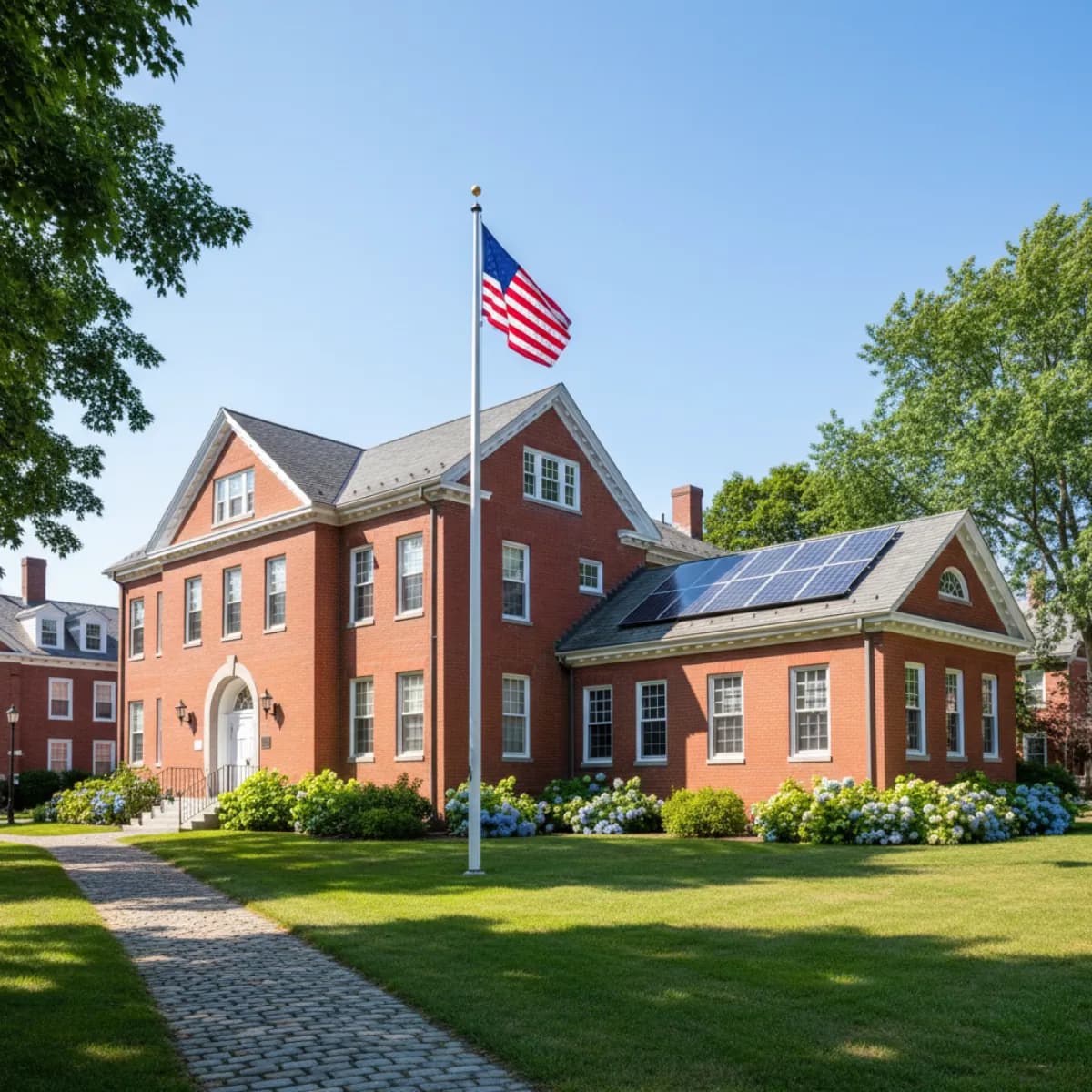
TL;DR: §6417 (Elective Payment) converts the §48E clean energy ITC into a cash refund from Treasury for Massachusetts tax-exempt entities. A MA town spending $500K on rooftop solar in 2026 can receive $150K-$250K back from the IRS — if the project meets 2026 domestic content rules and the finance officer pre-registers through the IRS ECO portal. No tax liability required.
Yes. Under IRC Section 6417 elective pay (direct pay), Massachusetts 501(c)(3) nonprofits, cities, towns, public school districts, public colleges (UMass, state universities, community colleges), hospital districts, and tribal governments can claim the Section 48E solar and storage ITC as a cash refund from Treasury — 30% of project cost, up to 50% with domestic content and energy community bonuses. A $500,000 town rooftop array can return $150,000-$250,000. Pre-filing registration through the IRS Energy Credits Online portal is mandatory before you file, and the IRS recommends submitting it at least 120 days before your return due date (a recommendation, not a deadline). Elective pay changes only how you monetize the credit — the Section 48E placed-in-service timing still governs. Facilities under 1 MW are exempt from the 2026 domestic-content phaseout, so most municipal and nonprofit rooftops keep the full credit regardless of where components are made.
Section 6417 is the Inflation Reduction Act provision that lets tax-exempt entities receive federal clean energy credits as cash payments from Treasury. For Massachusetts nonprofits, cities, towns, public schools, public universities, and tribal governments, it is the single most important federal tool enabling solar, storage, geothermal, and fleet electrification projects.
Massachusetts is one of the largest §6417 addressable markets in the country. The Commonwealth has ~50 nonprofit hospitals, 100+ higher-education institutions, 300+ cities and towns, 400+ regional and municipal school districts, and a dense §501(c)(3) sector. Every one of those organizations historically could not monetize the federal solar ITC — the credit simply went unclaimed on tax-exempt rooftops, or required an expensive tax-equity PPA flip.
§6417 removed that barrier. A small MA library doing a $150K rooftop array can now receive $45K+ back from Treasury. UMass Amherst can fund campus-scale arrays without a third-party developer. The Town of Concord can roof-mount its DPW building and close the economics without bringing in a PPA partner.
Source of truth: IRC §6417 (IRA 2022), Treasury regulations at 26 CFR §1.6417, IRS Pre-Filing Registration guidance, and IRS Form 3800 instructions for the elective payment election.
On January 15, 2026 the Healey-Driscoll administration announced $1.2 million in DOER Low-Income Services Solar Program (LISSP) grants to three Massachusetts nonprofits. LISSP is a state grant program, separate from federal §6417 direct pay, but a clear signal that tax-exempt solar is moving in the Commonwealth:
$398,000
Newton Food Pantry
17.3 kW AC + storage, ~$20k/yr savings
$500,000
Grow Associates (Randolph)
161.8 kW AC
$344,603
High Point Treatment Center (Plymouth)
280.5 kW AC
§6417 names a specific list of eligible entity types. If your organization fits one of these categories and owns (not leases) the clean energy property, you can elect direct payment.
Tax-exempt charitable, religious, scientific, and educational organizations recognized under §501(c)(3). Before §6417, these entities could only capture ITC value by giving up majority ownership to a tax-equity investor in a PPA flip structure. Direct pay lets the nonprofit own the system outright and still monetize the credit.
MA-Specific Examples
Boston Children’s Hospital, Mass General Brigham hospitals, YMCA facilities, community land trusts, Boys & Girls Clubs, food banks, and houses of worship organized under §501(c)(3).
Any state, county, city, town, or political subdivision that owns or controls clean energy property placed in service. Massachusetts has over 300 cities and towns plus dozens of special-purpose districts — all are eligible. Municipal light plants (MLPs) and water/sewer authorities also qualify.
MA-Specific Examples
Town of Concord, City of Cambridge, City of Boston, Commonwealth of Massachusetts agencies, county sheriff departments, regional transit authorities (MBTA, MVRTA), water districts, and regional planning commissions.
K-12 public school districts — municipal and regional — qualify as political subdivisions. A new rooftop array on a middle school roof that the district owns can trigger §6417 and return roughly 30-50% of the installed cost as a Treasury check.
MA-Specific Examples
Acton-Boxborough Regional School District, Boston Public Schools, Newton Public Schools, Cambridge Public Schools, and the state’s ~400 regional and municipal school districts.
State-affiliated public colleges and universities, plus community colleges, qualify as instrumentalities of state government. Campus-scale solar, battery storage, and geothermal projects are all within scope. UMass system has already cited §6417 as a key enabler for its 2030 carbon-neutral capital plan.
MA-Specific Examples
UMass Amherst, UMass Boston, UMass Lowell, Bridgewater State, Framingham State, Salem State, and Massachusetts’s 15 community colleges (Middlesex, Bunker Hill, Mass Bay, etc.).
Public hospital districts, nonprofit hospitals, and municipal health authorities. Massachusetts has ~50 nonprofit hospitals — most are §501(c)(3) entities that historically could not use the ITC. §6417 converts the ITC into working capital the hospital can redeploy into patient care or resilience microgrids.
MA-Specific Examples
Cambridge Health Alliance, Cape Cod Healthcare district affiliates, public health departments, and nonprofit safety-net hospitals organized under §501(c)(3).
Federally recognized Indian tribal governments and their political subdivisions. Subsidiary tribal entities like housing authorities, tribal schools, and tribal health clinics also qualify. §6417 is among the strongest tools tribes have to finance energy sovereignty projects.
MA-Specific Examples
Mashpee Wampanoag Tribe (federally recognized), Wampanoag Tribe of Gay Head (Aquinnah), and any entity organized under a tribal government charter.
Corporations established under the Alaska Native Claims Settlement Act (ANCSA). Listed for completeness — MA projects typically involve the other categories above.
MA-Specific Examples
Not typically relevant to Massachusetts projects — included for statutory completeness. ANCs organized under the Alaska Native Claims Settlement Act can claim §6417 on clean energy property they own, wherever sited.
Rural electric cooperatives treated as tax-exempt under §501(c)(12) and the Tennessee Valley Authority. Outside the MA service territory, but part of the full statutory list.
MA-Specific Examples
Not applicable in Massachusetts (no REA co-ops serve MA territory). The Tennessee Valley Authority (TVA) is similarly out-of-region. Noted here because the statute enumerates them as eligible §6417 claimants.
§6417 does NOT cover every federal credit — only the statutorily enumerated clean-energy and clean-vehicle credits. Below are the ones most relevant to Massachusetts tax-exempt project economics.
The successor to §48 ITC. Covers solar PV, battery storage, geothermal, small wind, and other qualified clean energy property placed in service 2025+. Base 30% credit, up to 50% with domestic content + energy community bonuses. Projects that began construction on or before July 4, 2026 locked in the most flexible placed-in-service window; projects that begin construction after that date still qualify if placed in service by December 31, 2027. Elective pay changes only how the credit is monetized — the §48E placed-in-service timing still governs.
PTC version of §48E — pays per kWh produced over a 10-year window. Rarely the right choice for a MA nonprofit or municipal rooftop project (ITC is almost always better for small-to-mid commercial), but technically elective-payment eligible.
The pre-§45Y production tax credit for wind and other qualified facilities. Still relevant for some utility-scale wind projects that began construction before 2025.
Up to $40,000 per qualified clean commercial vehicle. Highly relevant for MA school districts buying electric school buses and municipalities electrifying their fleets. §6417 direct pay lets a school district receive the credit as a cash refund per bus placed in service.
Up to 30% / $100,000 per single-item EV charger. Was useful for MA municipalities building out public curbside and municipal-lot charging via elective pay, but the credit expired June 30, 2026 and is no longer available for chargers placed in service after that date.
Additional credits on the elective-payment menu — relevant for specialized industrial projects (hydrogen production, carbon capture, clean manufacturing). Rarely triggered on MA municipal or nonprofit rooftop work, but listed for completeness.
The IRA created two separate monetization paths. §6417 is for tax-exempt entities who want a cash refund from Treasury. §6418 is for taxable entities who want to sell the credit to another taxable buyer. Different audiences, different mechanics, different gotchas.
| Feature | §6417 Direct Pay | §6418 Transfer |
|---|---|---|
| Who uses it | Tax-exempt entities: 501(c)(3)s, governments, tribes, public schools, rural co-ops | Taxable entities: C-corps, S-corps, partnerships, sole proprietors with tax liability |
| Form of benefit | Cash refund from Treasury | Cash from a third-party buyer in exchange for the credit |
| Typical discount | None — you receive 100% of the credit amount | Buyer discounts 5-15% (you sell $1.00 of credit for ~$0.85-0.95) |
| Pre-registration | REQUIRED — IRS Energy Credits Online PFR | REQUIRED — same portal, different module |
| Timing to cash | 6-12 months after return filing | Often within weeks of closing a transfer agreement |
| Domestic content (2026) | HARD requirement for full credit — 0% reduction for non-compliant projects starting Jan 1, 2026 | Standard §48E domestic content rules apply — bonus but not required |
| Counsel + structuring | Simpler — IRS form + PFR + return filing | More complex — transfer agreement, buyer diligence, tax opinions |
For 2026 and later project starts, §6417 carries a domestic content risk that §6418 does not. A MA nonprofit and a MA for-profit developer building identical solar arrays face different credit outcomes if neither project meets domestic content — the nonprofit loses everything on §6417, the for-profit still gets a reduced §48E credit to transfer under §6418. Engineering and procurement decisions made BEFORE construction begins drive this outcome.
Pre-registration through the IRS Energy Credits Online portal is mandatory for every §6417 claim. You receive a Registration Number that must appear on Form 3800 — no Registration Number, no direct pay. Here is the 6-step sequence.
Your finance officer or authorized representative creates an account on the IRS Energy Credits Online (ECO) portal. This is the same portal used for §30D vehicle credit transfers — the §6417 Pre-Filing Registration (PFR) module lives alongside it.
Detail
You will need: EIN, legal entity name matching IRS records, authorized representative name and title, and bank routing information for the eventual refund deposit.
For each facility/project, submit a PFR package containing: property description, location (address + parcel), placed-in-service date (or projected date), basis of the credit, and supporting documentation (one-line diagrams, interconnection agreements, ownership proof).
Detail
Each project gets its own unique Registration Number. If you have multiple campuses or multiple sites, each gets a separate PFR submission. Registration can be submitted after construction begins but before the return is filed.
IRS reviews the PFR submission and issues a Registration Number for the facility. Expect 2-6 weeks for review. If there are questions, the IRS may request supplemental documentation through the portal.
Detail
The Registration Number is required on Form 3800 when you file — no Registration Number, no direct pay. This is a HARD gate. The IRS recommends submitting your registration at least 120 days before your return due date (a recommendation, not a statutory deadline) to leave margin for IRS questions.
Finish construction, receive interconnection approval from Eversource / National Grid / Unitil, and place the property in service. The placed-in-service date drives the credit year and the refund timing downstream.
Detail
Keep commissioning documents, interconnection service agreements, and utility permission-to-operate letters — they document placed-in-service for audit.
Even though you have no tax liability, you file a return to make the §6417 election. Most §501(c)(3)s file Form 990-T for the elective payment year; state and local governments file Form 1120-POL or the specific IRS form indicated in the current §6417 guidance.
Detail
Attach Form 3800 (General Business Credit), Form 3468 (Investment Credit), the Registration Number, and supporting schedules. The elective payment election is made ON the return — it cannot be made later via amended return.
Treasury processes the return and issues the refund as a check or direct deposit. Historic processing time: 6-12 months after return filing for the first wave of direct-pay claims, trending shorter as the IRS builds internal capacity.
Detail
The refund is treated as an "overpayment" on the return. There is no interest paid on the amount. Budget cash flow accordingly — you are fronting ~30% of project cost for roughly 12-18 months from placed-in-service to refund receipt.
From feasibility to Treasury deposit. The critical gates are PFR submission (before return filing) and placed-in-service date (locks the credit year). Cash arrives roughly 12-18 months after the system is commissioned.
Month
T-6
Feasibility + design
NuWatt sizes array, produces EnergySage-grade quote, town meeting approves capital
Month
T-4
Submit PFR
Finance officer creates ECO account, submits Pre-Filing Registration for the project
Month
T-3
Receive Registration Number
IRS issues Registration Number (2-6 weeks typical)
Month
T-2 to T-0
Construction + interconnection
NuWatt builds, utility witness test, permission to operate
Month
T0
PLACED IN SERVICE
PTO received, meter running, system commissioned. Credit year locks.
Month
T+4 to T+10
Tax year closes + file return
File Form 990-T / 1120-POL with Form 3800, Form 3468, Registration Number, §6417 election
Month
T+10 to T+22
Treasury processing + refund
IRS reviews, Treasury issues refund (direct deposit or check). 6-12 months post-filing typical.
Bridge financing implication: between T0 (placed in service) and refund receipt (T+10 to T+22), your town or nonprofit has already paid the EPC in full but has not yet received the §6417 refund. That 12-18 month gap usually requires a bridge — a municipal bond issuance, a line of credit drawn against reserve funds, or explicit reserve fund capital. Plan this BEFORE placing the system in service; retroactive bridge financing is slower and more expensive.
The single most dangerous §6417 trap for 2026 MA projects. Domestic content is a bonus for taxable §48E claimants — it is a requirement for §6417 direct-pay claimants starting January 1, 2026.
The 100% haircut does not change the §48E credit amount on paper — it reduces the §6417 payable portion to zero. For a tax-exempt entity that cannot use the credit any other way, the effect is the same: no cash.
The 100% haircut above applies to larger facilities. A facility with a maximum net output under 1 MW AC is exempt from the 2026 domestic-content phaseout entirely — it receives the full §6417 payable credit regardless of where components are made. Most Massachusetts municipal and nonprofit rooftops (a town hall, library, school roof, or house of worship) fall under that threshold, so the cliff is primarily a risk for larger ground-mount and campus-scale systems of 1 MW AC and up. Domestic content still earns the +10% bonus on a sub-1-MW project; it just is not required to keep the base credit.
How NuWatt Handles It On MA Public-Sector Builds
For any MA direct-pay client breaking ground in 2026, we scope domestic content at the RFP stage. The EPC contract names specific US-manufactured panels, inverters, and racking; suppliers provide country-of-origin certifications; the basis schedule we deliver to your 990-T preparer includes the domestic-content compliance evidence as an attachment.
The alternative — learning at filing time that a single non-compliant inverter batch disqualified the entire $250K credit — is the single largest preventable risk on a §6417 project.
A Massachusetts town installs a 1.5 MW DC municipal ground-mount array. Because it exceeds 1 MW AC, the 2026 domestic-content rule applies — and two paths (compliant vs non-compliant) produce radically different direct-pay outcomes. Sub-1-MW rooftops are exempt from this rule (see the note above).
Town Receives
$1,200,000
Direct Treasury deposit, roughly 12-18 months after placed-in-service
Town Receives
$0
100% haircut under 2026 direct-pay domestic content rule
50 kW church
$150K cost
$45K-$75K refund
100 kW library
$250K cost
$75K-$125K refund
300 kW town hall
$500K cost
$150K-$250K refund
1 MW school roof
$1.8M cost
$540K-$900K refund
Refund ranges reflect 30% base (low) to 50% maximum (high) §48E rate, depending on domestic content + energy community bonuses. Facilities under 1 MW AC (the church, library, and town hall here) are exempt from the 2026 domestic-content phaseout, so their base credit is payable regardless of component origin; at 1 MW and above the phaseout applies.
NuWatt builds MA solar, storage, and fleet-charging projects for 501(c)(3) nonprofits, cities, towns, public school districts, universities, and tribal entities with the §6417 evidence file built in from day one — domestic content procurement, cost-segregation schedule, PFR documentation, and placed-in-service package all turnkey.
§48E remains available on a dual timing pathway: projects that began construction on or before July 4, 2026 locked in the most flexible placed-in-service window, and projects starting later still qualify if placed in service by December 31, 2027. §6417 direct pay remains available with 2026 domestic content compliance.
Last updated: April 2026
Sources: IRC §6417 (IRA 2022), 26 CFR §1.6417 Treasury regulations, IRS Pre-Filing Registration guidance (Energy Credits Online portal), IRS Form 3800 instructions, IRS Form 3468 instructions, domestic content safe harbor (Notice 2023-38 and subsequent updates).