Loading NuWatt Energy...

We use your location to provide localized solar offers and incentives.
We serve MA, NH, CT, RI, ME, VT, NJ, PA, and TX
Loading NuWatt Energy...
Use the free estimator for a preliminary layout, or share your preferred response method with the commercial team. Final feasibility still requires site, utility, and engineering review.
A kitchen's load shape decides the NRES election. The rate code on the bill decides what a battery is worth. This guide works both from Connecticut's own tariffs and programme rules rather than from a generic commercial template.
NRES term
20 yrs
Election is made once
Rate 30 demand
$32.31
Per kW-month, all four components
ESS performance
$325/kW
Years 1-5, under 500 kW
Bonus depreciation
100%
First year, permanent
Connecticut pays commercial generation through a 20-year NRES tariff, and you elect Netting or Buy-All once. A restaurant's continuous refrigeration base load usually makes Netting the stronger election. Savings then turn on the demand charge: Eversource Connecticut Rate 30 totals $32.31 per kW-month across four delivery components against Rate 35's $27.27. Energy Storage Solutions adds $325 per kW for years one to five.
Verified August 3, 2026 against the Connecticut Energy Storage Solutions Program Manual, Docket No. 25-08-05, and the published Eversource Connecticut and United Illuminating rate summaries.
Netting for most restaurants, Buy-All for sites that export most of what they generate. Connecticut's Non-Residential Renewable Energy Solutions tariff makes you choose one of two compensation structures at application, and the choice governs for twenty years. Netting lets self-consumed generation offset retail load. Buy-All sells one hundred percent of generation to the utility at an awarded price while one hundred percent of the site load is bought back at retail. Neither is universally better — the answer falls out of how much of the day the building is actually consuming what the roof is making.
There is no published fixed price for either side of this election. NRES Buy-All prices are set per tranche — Small and School tracks are set by PURA, Medium and Large clear competitively — and the retail side depends on your utility and rate class. Model it with your own award price and your own bill, which is what the tool below asks for.
Enter your system size, the share of generation you expect to consume on site, the retail rate from your own bill, and the Buy-All award price from your bid or Statement of Qualification. The comparator returns the annual mechanics of each election side by side.
Enter your own retail rate and Buy-All award to see which 20-year election wins.
NRES tranche: Medium (over 200 – under 1,000 kW)
Editable default — adjust for your site's orientation, tilt, and shading.
Share of generation used on-site (Netting only — Buy-All sells 100%).
From your Eversource or United Illuminating bill (example shown — replace with your figure).
Your bid or assumed award (example shown — replace with your figure). Medium and Large tranches are competitively bid; Small and School tracks are PURA-set.
Netting
$82,250
per year
20-year (level): $1,645,000
Buy-All
$82,250
per year
20-year (level): $1,645,000
At these inputs the two elections are effectively a tie.
Buy-All overtakes Netting once your award price rises above your retail netting rate — breakeven award here is $0.2800 per kWh.
Because Connecticut credits exported generation at the full retail rate, your self-consumption mix shifts where the Netting value comes from but not the Netting total. The real decision is Netting (valued at retail) vs. Buy-All (valued at your award), so a Buy-All award above retail wins — but Buy-All means you still buy 100% of your load at retail.
Estimates only — both NRES elections run a 20-year term. Netting value rises over the term as retail rates escalate, while a Buy-All award is a fixed 20-year price; this level view does not model escalation. This tool never sets an authoritative program rate: enter the retail rate from your bill and the award price from your bid or Statement of Qualification. The next NRES program year (PY5) RFP window runs August 3 – September 14, 2026.
Read it off the bill. Connecticut hospitality sites cluster on four classes, and two of them — Eversource Connecticut Rate 30 and Rate 35 — cover the same demand ceiling below 200 kW while being built completely differently. Rate 30 trades a low fixed charge for a high distribution demand rate; Rate 35 does the reverse. Inferring the class from square footage or seat count is how a proposal ends up wrong by a factor that matters.
| Rate class | Applies to | Components | Total per month |
|---|---|---|---|
| Rate 30 — Small General Electric ServiceEversource Connecticut | Entire electrical requirements at a single service location through one metering installation, where the customer’s maximum demand is less than 200 kW. |
| $32.31per kW-month |
| Rate 35 — Intermediate General Electric ServiceEversource Connecticut | Entire electrical requirements at a single service location through one metering installation, where the customer’s maximum demand is less than 200 kW. |
| $27.27per kW-month |
| Rate 37 — Intermediate Time-Of-Day General Electric ServiceEversource Connecticut | Entire electrical requirements at a single service location through one metering installation, where the customer’s maximum demand is less than 350 kW. |
| $19.98per kW-month |
| Rate GST — General Service Time-of-Use (demand metered)United Illuminating | Optional for all requirements on a customer’s premises. A demand meter is installed, and the customer must remain on the demand rate, once consumption exceeds 1,560 kWh in a single monthly billing cycle. |
| $12.96per kW-month |
Rate 30 — Small General Electric Service
Every component is billed only on demand above 2 kW, so the first 2 kW of peak is never billed and a battery earns nothing against it. Connecticut delivery bills also carry Combined Public Benefits, Revenue Adjustment Mechanism and FMCC charges levied per kWh rather than per kW. They are outside this total because shaving peak demand does not reduce them.
Last updated May 1, 2026 — Eversource, Summary of Connecticut Electric Rates
Rate 35 — Intermediate General Electric Service
Rate 35 covers the same 200 kW ceiling as Rate 30 but carries a $270 monthly customer service charge against Rate 30’s $44, trading a higher fixed charge for a much lower distribution demand rate. Which of the two a site is on changes what a battery saves, so read the rate code off the bill rather than inferring it from size. Connecticut delivery bills also carry Combined Public Benefits, Revenue Adjustment Mechanism and FMCC charges levied per kWh rather than per kW. They are outside this total because shaving peak demand does not reduce them.
Last updated May 1, 2026 — Eversource, Summary of Connecticut Electric Rates
Rate 37 — Intermediate Time-Of-Day General Electric Service
A time-of-day rate. The demand charge is a single monthly charge on measured peak, but Rate 37 also bills transmission per kWh on-peak — weekdays noon to 8 p.m. Eastern Standard Time, 1 p.m. to 9 p.m. during Daylight Saving Time — at roughly four and a half times the off-peak rate. A battery on Rate 37 therefore earns from shifting energy out of that window as well as from shaving peak kW, and only the second of those is modelled here. Connecticut delivery bills also carry Combined Public Benefits, Revenue Adjustment Mechanism and FMCC charges levied per kWh rather than per kW. They are outside this total because shaving peak demand does not reduce them.
Last updated May 1, 2026 — Eversource, Summary of Connecticut Electric Rates
Rate GST — General Service Time-of-Use (demand metered)
Net of a $6.23/kW State Mandated Energy Purchases credit, which the tariff publishes as a negative line — adding United Illuminating’s per-kW charges without subtracting it overstates the demand charge by about half. The per-kW total is also a smaller share of this bill than an Eversource total is of its own: demand-metered Rate GST customers additionally pay 2.8662¢/kWh of distribution, so United Illuminating recovers much of delivery volumetrically and a battery that shaves kW reaches less of the bill than the $/kW alone suggests. Every component above is a peak-period charge; off-peak demand is billed at $0.00/kW and only on excess demand. A minimum bill of $8.71 per kW of peak demand in summer and $7.41 in winter also sets a floor that peak shaving cannot cut below.
Effective July 1, 2026 — The United Illuminating Company, General Service Time-of-Use Rate GST, C.P.U.C.A. No. 2508 (Docket No. 26-01-02)
Do not rank these totals against each other
Connecticut’s two electric distribution companies do not build a demand charge the same way as each other, and neither builds it the way the Massachusetts utilities do. Eversource Connecticut states four separate delivery demand components — distribution, Electric System Improvements, transmission and the Competitive Transition Assessment — and bills its 350-to-1,000 kW classes per kVA of apparent power rather than per kW. United Illuminating states a shorter list of per-kW components and then subtracts a published State Mandated Energy Purchases credit, while recovering much of its distribution revenue through a per-kWh charge that no per-kW total can show. Read each row against its own bill, and never rank these totals against one another or against a Massachusetts total as though they were prices for the same thing.
Because it prices the dinner hours separately. Rate 37 is the intermediate time-of-day class, and its on-peak transmission charge runs at roughly four and a half times the off-peak rate across weekdays from noon to 8 p.m. Eastern Standard Time, or 1 p.m. to 9 p.m. during Daylight Saving Time. A restaurant does not get to move its service window. So on Rate 37 the building is at its hardest-drawing exactly when energy is dearest, and generation has already tailed off.
The prep and lunch block, and the first part of the on-peak window in summer. On a long June afternoon a well-oriented array is still producing meaningfully at 5 p.m.; in November it is not.
The back half of the on-peak block, which is also the busiest part of service. This is the single clearest storage argument in Connecticut hospitality, and it is a time-of-use argument rather than a demand-charge one.
Peak-kilowatt shaving only. The on-peak energy shifting that Rate 37 additionally rewards is real value sitting outside the model, so treat the output as a floor on a time-of-day rate rather than a complete answer.
A south-facing array maximises annual kilowatt-hours. On a time-of-day rate with an evening-weighted business, a west-facing or split-orientation array produces fewer total kilowatt-hours but produces more of them inside the expensive window. That trade only makes sense once you know the rate code, which is the third time on this page the same thing has decided the design.
Pick your rate class, enter the peak demand from the bill, and adjust the battery size. The tool loads the published Connecticut components rather than a generic dollar-per-kilowatt assumption.
Enter the numbers from your own utility bill to model your facility.
From your bill (highest 15-minute kW).
From your utility tariff or bill. Example shown — enter your own.
Capped at 40% — real-world peak shaving rarely exceeds this without oversizing the battery.
Peak reduction
30 kW
25% of 120 kW peak
Annual demand-charge savings
$5,400
30 kW × $15/kW-mo × 12
Annual DR revenue (yrs 1-5)
$9,750
30 kW dispatch × $325/kW-yr — CT ESS Active Dispatch performance incentive
Net cost after ITC (30%)
$45,500
$65,000 − $19,500 ITC
Simple payback
3.0 yrs
demand savings + DR revenue
10-year net value
$83,500
cumulative savings + DR − net cost
Estimates only, built entirely from the values you enter — confirm against your utility tariff and a tax professional. Demand-charge savings use your billed peak demand, your demand rate, and your expected peak-shaving fraction. Demand-response revenue uses published Energy Storage Solutions program incentive rates (CT ESS Active Dispatch performance incentive) and requires enrollment plus dispatch participation; actual payments depend on your dispatched performance and are capped here at the capacity your entered battery energy can sustain. Massachusetts and Rhode Island publish different ConnectedSolutions rates for business batteries, and this calculator keeps them separate. The federal ITC (30% base plus site-specific adders) applies to the battery cost; tax-exempt entities use elective (Direct) Pay.
Performance, not upfront cash. PURA restructured the programme in Docket No. 25-08-05, decided December 17, 2025, and enrolments from April 1, 2026 use the Construct 5 design. The declining-block upfront payment that most third-party summaries still quote is closed. What remains is a 10-year Active Dispatch performance payment, plus a per-kilowatt-hour enrolment incentive available only to priority customers.
| Class | Years 1-5 | Years 6-10 |
|---|---|---|
| Small or Medium C&IAnnual peak demand under 500 kW | $325/kW | $175/kW |
| Large C&IAnnual peak demand of 500 kW or more | $275/kW | $175/kW |
A 60 kW battery at a small or medium commercial restaurant therefore models to $150,000 of Active Dispatch performance value across the full 10-year term, before any demand-charge or resilience value.
A commercial customer in any one of these categories qualifies for $10 per kWh of rated capacity. Everyone else receives $0.
Small business
Commercial and industrial customers with annual peak demand below 200 kW.
Critical facilities
Facilities meeting the statutory definition at Conn. Gen. Stat. section 16-243y(a)(2).
Replacing a fossil-fuel generator
Customers swapping an existing fossil-fuel generator for a comparably sized battery, with an approved decommissioning plan.
Grid Edge
Sites on the top 10 percent of circuits by storm outage count, or by storm outage duration, since July 1, 2012. A circuit map is published by the programme.
Most independent restaurants clear the small-business definition on peak demand alone. A shoreline hotel on a storm-prone circuit may qualify twice over.
Active Dispatch events run 12:00 PM to 9:00 PM for 1 to 3 hours, between 30 and 60 times across June 1 - September 30. For a dinner house that is the busiest part of the day. The battery is discharging to the grid at the moment the kitchen is drawing hardest.
A battery sized only for the incentive will be empty when the kitchen needs it. A battery sized for the dispatch obligation plus a service-period reserve keeps both. The reserve is what a restaurant is actually paying for, and it should be specified in the proposal rather than discovered in August.
Winter dispatch runs November 1 - March 31 with 1 to 10 events — widened from the legacy programme. A hotel running a holiday banquet season should know that before enrolling.
The legacy programme imposed pre-scheduled summer discharges with a mandatory reserve and no negotiation. That obligation does not exist under the current structure. Any proposal that still describes mandatory scheduled summer discharges is quoting a closed programme.
A non-refundable application fee of $350 applies to commercial applicants; there is no fee on the residential track. Figures verified August 3, 2026 against the programme manual.
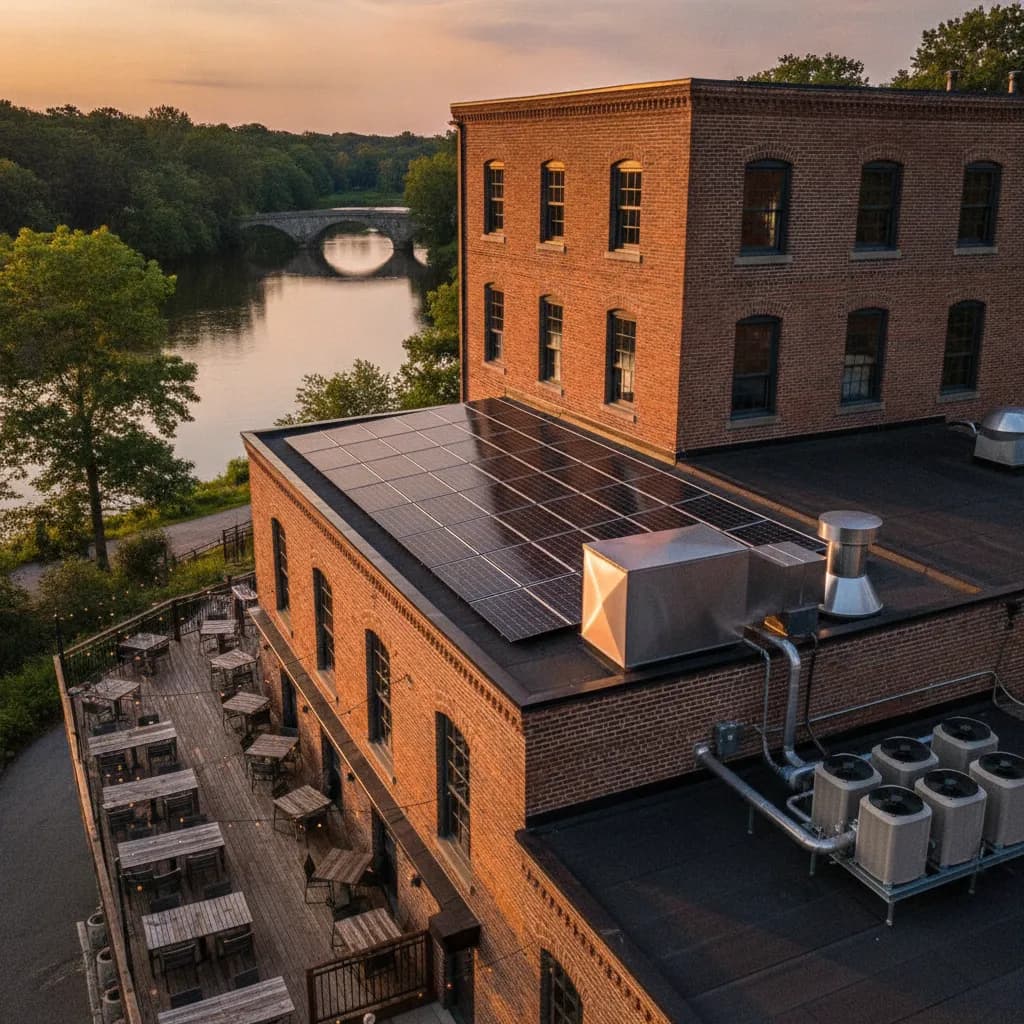
Mechanical equipment and, in Connecticut, snow drift. A kitchen roof is the most congested commercial roof there is, and the congestion is not evenly distributed — which changes not just how many modules fit but which structural bay they land on.
A Type I hood discharges hot, grease-laden vapour. Modules downwind of the fan collect a film that will not rinse off in rain, and the soiling loss compounds year on year. Setback is decided from the fan discharge direction and velocity, not from a uniform circle drawn on a plan.
A kitchen has to replace everything the hoods pull out. Make-up air units are often the biggest single object on a restaurant roof, they cast the longest shadow, and relocating one to free array area is rarely worth the mechanical cost.
Refrigeration condensers tend to be grouped over the kitchen rather than spread across the roof, which concentrates the unusable area. It also means the usable area is often the dining-room roof, which may be a different structure with a different capacity.
Connecticut ground snow loads are set locally rather than statewide, and drift against a taller kitchen bulkhead or a parapet governs the design far more often than the flat-field load. A restaurant roof with several roof-height changes is a drift problem before it is a solar problem.
A great deal of Connecticut hospitality sits in converted nineteenth-century mill and main-street buildings with framing that predates any modern load table. These need a structural assessment before array layout, not after.
The structural side of this is covered in depth in the Connecticut commercial snow-load and structural guide, and the mounting and ballast decisions in the flat-roof commercial engineering guide. Where the roof genuinely cannot take an array, a parking canopy is the usual alternative for a hotel or a destination restaurant with its own lot.
They are not four incentives that stack into one number. Each answers a different question, and they are decided in a specific order: how the generation is paid for, how a battery is paid for, how the capital is raised, and what the federal side returns.
How the generation is paid for
A 20-year tariff with Eversource Connecticut or United Illuminating. You elect Netting or Buy-All once, at application, and the election governs for the whole term. It is the single largest financial decision on a hospitality solar project and it is made before anything is built.
NRES commercial tariff explainedHow a battery is paid for
A 10-year performance programme, restructured for enrolments from April 1, 2026. Upfront declining-block payments are gone; commercial value now comes from Active Dispatch performance and, for priority customers only, an enrolment incentive. Storage is not required to be paired with solar.
What changed on April 1, 2026How the project is financed
Connecticut ran the first C-PACE programme in the country, and the assessment sits on the property rather than on the operating company. For hospitality real estate that changes hands more often than it is rebuilt, the transfer-on-sale behaviour is the feature, not a footnote.
C-PACE commercial solar guideHow the federal side lands
The Section 48E begin-construction window closed July 4, 2026: projects that began construction on or before that date may use the longer continuity pathway. Commercial solar projects starting now generally must be placed in service by December 31, 2027. The statutory credit is 6%; it can increase to 30% when the applicable prevailing-wage and registered-apprenticeship requirements are met.
MACRS depreciation calculatorThese two answers eliminate most of the options before design starts, and hospitality is the sector where they diverge most often. A franchisee rarely owns the box. A hotel is often held in a single-purpose entity with a different tax profile from the operating company. Establish this first.
Every route is open. Ownership captures the federal credit and first-year depreciation directly, and C-PACE can still be used to avoid putting cash in. This is the case where the numbers are simplest and best.
The credit and depreciation may be worth little in the near term. A third-party ownership structure moves the tax attributes to a party that can use them and returns the value as a lower price for the energy. Worth modelling honestly rather than assuming ownership wins.
C-PACE needs the property owner. A long triple-net lease can support a tenant-side project with landlord consent and a clear fixture agreement. A short lease usually points at a roof-lease or purchase-agreement structure instead.
Connecticut's roof-lease and site-host mechanics are covered separately in the roof lease and site host guide.
One bill is not enough — a Connecticut restaurant swings hard between February and August. The rate code appears on the bill itself and determines everything downstream. Multi-site groups should tabulate the code per address rather than assume a portfolio is uniform.
Self-consumption share is the input the NRES election turns on, and it cannot be estimated reliably from monthly totals. Both Eversource Connecticut and United Illuminating make interval data available to commercial accounts.
This determines which financing instruments are available at all, and whether the federal credit and first-year depreciation are worth anything to you or to a third party. It is a conversation with an accountant, not with an installer.
Remaining roof life, structural capacity of the specific bays that are actually clear of mechanical equipment, and drift loading against the taller kitchen bulkheads. A re-roof scheduled inside the payback period should be pulled forward and done once.
Run Netting and Buy-All against your real self-consumption share and the current tranche pricing before the application goes in. The election governs for twenty years and is not revisited.
Size the battery for the Active Dispatch commitment plus the service-period reserve you actually need, and get the reserve written into the proposal. Storage can also proceed on its own if the roof is not ready.
Connecticut interconnection can add months where a cluster study is triggered, and permitting varies by municipality. The federal timing is governed by when the system is placed in service, not when the contract is signed.
Interconnection timing for larger Connecticut commercial projects is covered in the cluster study guide, and the full build sequence in the Connecticut commercial project timeline.
Almost always Netting. A restaurant carries a high, continuous refrigeration base load plus a lunch HVAC and cooking peak that sits right inside the generating window, so a large share of every kilowatt-hour produced is consumed on site. Netting lets that generation offset retail load directly. Buy-All becomes worth modelling when the site exports most of what it makes — a seasonal venue, a shoreline hotel with long low-occupancy stretches, or a roof much larger than the load beneath it. The election is made once at application and governs for the whole 20-year term, so model both against 12 months of interval data before choosing.
The hub: sizing, pricing, incentives and financing across Connecticut.
Buy-All versus Netting, size tiers and the PURA tranche cadence in full.
Every Connecticut rate class, its components, and what peak shaving returns.
The commercial storage programme in detail, post-restructure.
Property-assessed financing, the SIR test, and mortgage-holder consent.
The other high-visibility Connecticut vertical: lot canopies and kVA billing.
The adjacent food-and-drink vertical, with process-heat loads.
Turning interval data into a defensible system size.
The smaller-site version of this analysis, across all sectors.
Send twelve months of bills and the rate code from each site. We model both NRES elections against your own interval data before recommending a design.