Loading NuWatt Energy...

We use your location to provide localized solar offers and incentives.
We serve MA, NH, CT, RI, ME, VT, NJ, PA, and TX
Loading NuWatt Energy...
Use the free estimator for a preliminary layout, or share your preferred response method with the commercial team. Final feasibility still requires site, utility, and engineering review.
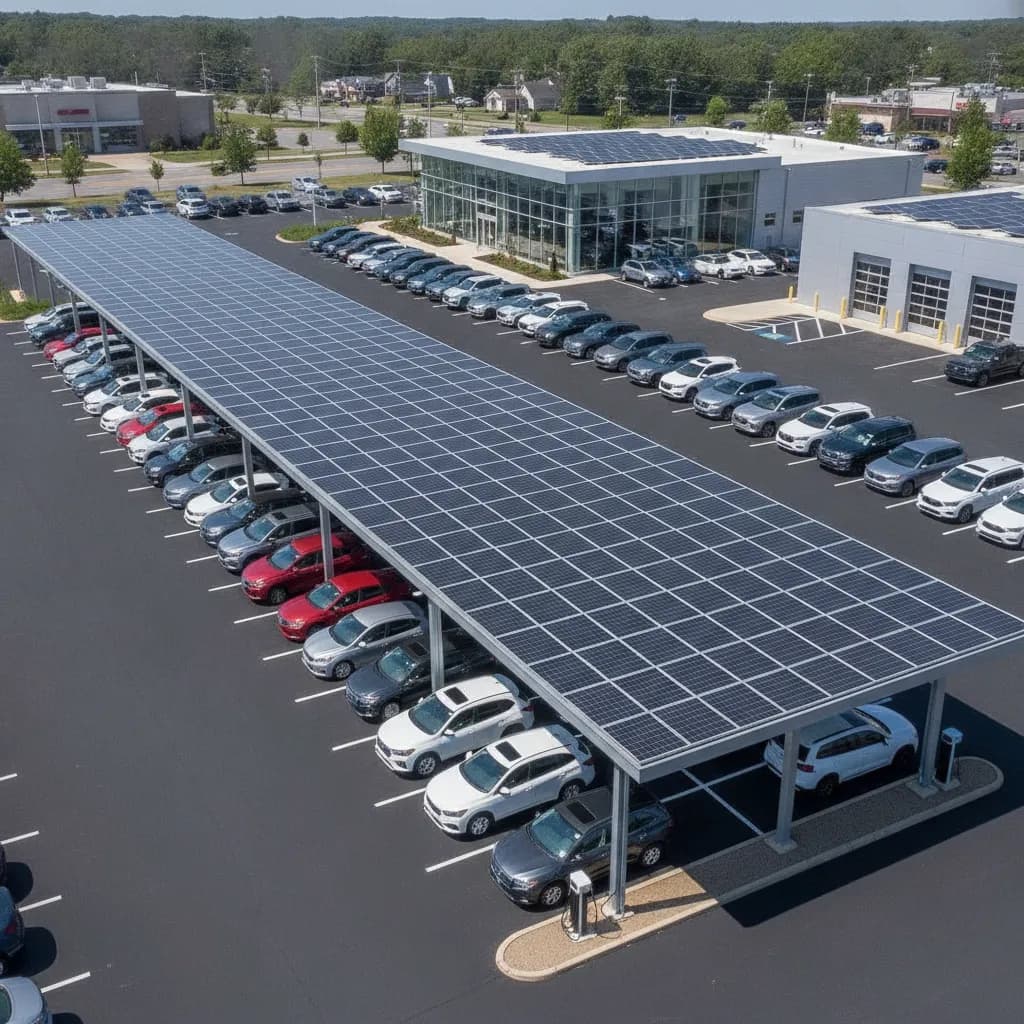
A dealership lot is the one commercial footprint that routinely supports more generation than the building consumes. That single fact drives the NRES election, and Connecticut's per-kVA billing on the mid-size classes decides what a battery is really worth alongside it.
Rate 56 demand
$26.55
Per kVA-month, not per kW
Typical NRES tier
Medium
Over 200 kW, under 1 MW
ESS performance
$325/kW
Years 1-5, under 500 kW
Bonus depreciation
100%
Applies to canopy steel too
Usually, but the model turns on two Connecticut specifics. A lot-scale canopy normally lands in the NRES Medium tier — over 200 kW and under 1,000 kW — where the array exceeds site load and Buy-All becomes a live alternative to Netting. And a dealership between 350 and 1,000 kW sits on Eversource Rate 56 at $26.55 per kVA-month, billed on apparent power, so a poor service-department power factor inflates the billed peak.
Verified August 3, 2026 against the Connecticut Energy Storage Solutions Program Manual, Docket No. 25-08-05, and the published Eversource Connecticut and United Illuminating rate summaries.
Because Eversource Connecticut's mid-size classes are written that way. A non-manufacturing customer with annual maximum demand between 350 kW and 1,000 kW takes Rate 56, and Rate 56 bills demand per kVA of apparent power rather than per kW of real power. Most commercial buildings shrug at that distinction. A dealership should not, because a service department full of lifts, compressors and welding equipment is precisely the load type that separates apparent power from real power.
The billed peak is larger than the real-power peak by the reciprocal of the power factor. The worse the power factor, the wider the gap, and the gap is billed every month regardless of how much energy the site used.
Removing one kilowatt of real load does not remove one kVA of billed demand. Any peak-shaving saving calculated on the kW figure alone overstates the result, and the overstatement scales with how poor the power factor is.
Read the power factor off a recent bill before modelling anything. Power-factor correction is frequently cheaper per dollar of avoided demand charge than storage is, and the two are complementary rather than alternatives.
A kVA figure and a kW figure are not the same measurement
Connecticut’s two electric distribution companies do not build a demand charge the same way as each other, and neither builds it the way the Massachusetts utilities do. Eversource Connecticut states four separate delivery demand components — distribution, Electric System Improvements, transmission and the Competitive Transition Assessment — and bills its 350-to-1,000 kW classes per kVA of apparent power rather than per kW. United Illuminating states a shorter list of per-kW components and then subtracts a published State Mandated Energy Purchases credit, while recovering much of its distribution revenue through a per-kWh charge that no per-kW total can show. Read each row against its own bill, and never rank these totals against one another or against a Massachusetts total as though they were prices for the same thing.
Read the code off the bill. A single-point store with a modest service department usually sits below 200 kW on Rate 30 or Rate 35; a larger store with a body shop and a charger bank crosses into Rate 56 and its per-kVA billing. United Illuminating dealerships in the greater New Haven and Bridgeport territory take Rate GST instead, which is built differently again.
| Rate class | Applies to | Unit | Total per month |
|---|---|---|---|
| Rate 30 — Small General Electric ServiceEversource Connecticut | Entire electrical requirements at a single service location through one metering installation, where the customer’s maximum demand is less than 200 kW. | kW | $32.31per kW-month |
| Rate 35 — Intermediate General Electric ServiceEversource Connecticut | Entire electrical requirements at a single service location through one metering installation, where the customer’s maximum demand is less than 200 kW. | kW | $27.27per kW-month |
| Rate 37 — Intermediate Time-Of-Day General Electric ServiceEversource Connecticut | Entire electrical requirements at a single service location through one metering installation, where the customer’s maximum demand is less than 350 kW. | kW | $19.98per kW-month |
| Rate 56 — Intermediate Time-Of-Day Electric Service, Non-ManufacturersEversource Connecticut | Non-manufacturing customers with an annual maximum demand of at least 350 kW but less than 1,000 kW, at a single service location through one metering installation. | kVA | $26.55per kVA-month |
| Rate GST — General Service Time-of-Use (demand metered)United Illuminating | Optional for all requirements on a customer’s premises. A demand meter is installed, and the customer must remain on the demand rate, once consumption exceeds 1,560 kWh in a single monthly billing cycle. | kW | $12.96per kW-month |
Every component is billed only on demand above 2 kW, so the first 2 kW of peak is never billed and a battery earns nothing against it. Connecticut delivery bills also carry Combined Public Benefits, Revenue Adjustment Mechanism and FMCC charges levied per kWh rather than per kW. They are outside this total because shaving peak demand does not reduce them.
Last updated May 1, 2026 — Eversource, Summary of Connecticut Electric Rates
Rate 35 covers the same 200 kW ceiling as Rate 30 but carries a $270 monthly customer service charge against Rate 30’s $44, trading a higher fixed charge for a much lower distribution demand rate. Which of the two a site is on changes what a battery saves, so read the rate code off the bill rather than inferring it from size. Connecticut delivery bills also carry Combined Public Benefits, Revenue Adjustment Mechanism and FMCC charges levied per kWh rather than per kW. They are outside this total because shaving peak demand does not reduce them.
Last updated May 1, 2026 — Eversource, Summary of Connecticut Electric Rates
A time-of-day rate. The demand charge is a single monthly charge on measured peak, but Rate 37 also bills transmission per kWh on-peak — weekdays noon to 8 p.m. Eastern Standard Time, 1 p.m. to 9 p.m. during Daylight Saving Time — at roughly four and a half times the off-peak rate. A battery on Rate 37 therefore earns from shifting energy out of that window as well as from shaving peak kW, and only the second of those is modelled here. Connecticut delivery bills also carry Combined Public Benefits, Revenue Adjustment Mechanism and FMCC charges levied per kWh rather than per kW. They are outside this total because shaving peak demand does not reduce them.
Last updated May 1, 2026 — Eversource, Summary of Connecticut Electric Rates
Billed per kVA, not per kW. kVA is apparent power, so a site with a poor power factor is billed against a larger number than its real-power peak, and a battery that removes one kW does not remove a full kVA. Read this total as dollars per kVA-month and check the power factor on the bill before converting it into a saving. Manufacturers at the same demand take Rate 55 instead, which is cheaper on every component. Connecticut delivery bills also carry Combined Public Benefits, Revenue Adjustment Mechanism and FMCC charges levied per kWh rather than per kW. They are outside this total because shaving peak demand does not reduce them.
Last updated May 1, 2026 — Eversource, Summary of Connecticut Electric Rates
Net of a $6.23/kW State Mandated Energy Purchases credit, which the tariff publishes as a negative line — adding United Illuminating’s per-kW charges without subtracting it overstates the demand charge by about half. The per-kW total is also a smaller share of this bill than an Eversource total is of its own: demand-metered Rate GST customers additionally pay 2.8662¢/kWh of distribution, so United Illuminating recovers much of delivery volumetrically and a battery that shaves kW reaches less of the bill than the $/kW alone suggests. Every component above is a peak-period charge; off-peak demand is billed at $0.00/kW and only on excess demand. A minimum bill of $8.71 per kW of peak demand in summer and $7.41 in winter also sets a floor that peak shaving cannot cut below.
Effective July 1, 2026 — The United Illuminating Company, General Service Time-of-Use Rate GST, C.P.U.C.A. No. 2508 (Docket No. 26-01-02)
Choose the Connecticut rate class from the bill and enter the measured peak. On a per-kVA class, treat the output as an upper bound until the power factor is corrected into it.
Enter the numbers from your own utility bill to model your facility.
From your bill (highest 15-minute kW).
From your utility tariff or bill. Example shown — enter your own.
Capped at 40% — real-world peak shaving rarely exceeds this without oversizing the battery.
Peak reduction
100 kW
25% of 400 kW peak
Annual demand-charge savings
$18,000
100 kW × $15/kW-mo × 12
Annual DR revenue (yrs 1-5)
$16,250
50 kW dispatch × $325/kW-yr — CT ESS Active Dispatch performance incentive
Net cost after ITC (30%)
$45,500
$65,000 − $19,500 ITC
Simple payback
1.3 yrs
demand savings + DR revenue
10-year net value
$259,500
cumulative savings + DR − net cost
Estimates only, built entirely from the values you enter — confirm against your utility tariff and a tax professional. Demand-charge savings use your billed peak demand, your demand rate, and your expected peak-shaving fraction. Demand-response revenue uses published Energy Storage Solutions program incentive rates (CT ESS Active Dispatch performance incentive) and requires enrollment plus dispatch participation; actual payments depend on your dispatched performance and are capped here at the capacity your entered battery energy can sustain. Massachusetts and Rhode Island publish different ConnectedSolutions rates for business batteries, and this calculator keeps them separate. The federal ITC (30% base plus site-specific adders) applies to the battery cost; tax-exempt entities use elective (Direct) Pay.
Four of the five big ones, and not the one the dealer thinks about most. A dealership generates over its lot and consumes in its shop and after dark, and being straight about that split is what separates a defensible model from a hopeful one.
Dusk to late evening, every night of the year
Lot lighting is the load a dealership cannot turn down, because the lot is the showroom after hours. It runs entirely outside generating hours, which makes it a storage and rate-structure question rather than a solar one. It is also the load most improved by a lighting retrofit before any array is sized.
Weekday service hours, in short hard bursts
Motor-driven loads that start and stop constantly. They align well with generation, but they are also the reason a dealership meter shows a poor power factor, which matters enormously on a Connecticut rate class billed per kVA.
Weekday shifts, with long high-draw booth cycles
Where a dealership operates its own body shop, booth heating and air handling create the largest single sustained draw on the property. A booth cycle landing on a summer afternoon can set the monthly peak by itself.
Midday, seasonally weighted
A glass showroom has a cooling load shaped almost exactly like a solar production curve. It is the cleanest self-consumption match on the property.
Increasingly all day and overnight
Manufacturer programmes have pushed charging hardware onto dealership lots faster than most sites planned service capacity for. Charging is the one dealership load that is genuinely schedulable, which makes it the best partner a canopy array has.
More often here than anywhere else in Connecticut commercial solar, because the array can genuinely outgrow the load. Under the Non-Residential Renewable Energy Solutions tariff a project elects one structure at application and keeps it for twenty years. Netting rewards self-consumption. Buy-All sells every kilowatt-hour at the awarded price and buys the whole site load back at retail. A dealership that canopies its inventory rows is frequently producing several times what the building draws at midday, and at that point the self-consumption advantage Netting depends on largely evaporates.
Typical fit: A single-row canopy over customer parking, or a rooftop-only project on the service building.
Posted rather than competitively bid. The simplest path, and where most single-point dealerships that stay inside their own load will land.
Typical fit: The typical outcome when a full inventory lot is canopied. A few hundred covered spaces reaches this band without difficulty.
The band a lot-scale dealership canopy usually falls into, and the point at which the Buy-All versus Netting question stops being academic, because the array can now exceed what the site consumes.
Typical fit: Multi-franchise auto malls, or a dealership group canopying several adjacent sites under common ownership.
Competitively procured. Realistic only for a group with a genuinely large contiguous footprint, and it changes the interconnection conversation substantially.
Neither side of this election has a published fixed price. Medium and Large tranches clear competitively, Small and School tracks are set by PURA, and the retail side depends on the utility and rate class. The comparator below takes both figures from you — the retail rate from the bill, the award price from the bid or Statement of Qualification — rather than asserting either. The tariff mechanics in full are on the NRES commercial tariff guide.
Set the system size to the canopy you are contemplating and drop the self-consumption share to something honest for a dealership — the showroom and shop rarely absorb a lot-scale array at midday.
Enter your own retail rate and Buy-All award to see which 20-year election wins.
NRES tranche: Medium (over 200 – under 1,000 kW)
Editable default — adjust for your site's orientation, tilt, and shading.
Share of generation used on-site (Netting only — Buy-All sells 100%).
From your Eversource or United Illuminating bill (example shown — replace with your figure).
Your bid or assumed award (example shown — replace with your figure). Medium and Large tranches are competitively bid; Small and School tracks are PURA-set.
Netting
$82,250
per year
20-year (level): $1,645,000
Buy-All
$82,250
per year
20-year (level): $1,645,000
At these inputs the two elections are effectively a tie.
Buy-All overtakes Netting once your award price rises above your retail netting rate — breakeven award here is $0.2800 per kWh.
Because Connecticut credits exported generation at the full retail rate, your self-consumption mix shifts where the Netting value comes from but not the Netting total. The real decision is Netting (valued at retail) vs. Buy-All (valued at your award), so a Buy-All award above retail wins — but Buy-All means you still buy 100% of your load at retail.
Estimates only — both NRES elections run a 20-year term. Netting value rises over the term as retail rates escalate, while a Buy-All award is a fixed 20-year price; this level view does not model escalation. This tool never sets an authoritative program rate: enter the retail rate from your bill and the award price from your bid or Statement of Qualification. The next NRES program year (PY5) RFP window runs August 3 – September 14, 2026.
Enter the number of spaces you would cover — for a dealership, count the inventory rows you are willing to build over, not the whole lot — with your own installed cost and electricity rate. The model returns net cost after the federal credit and depreciation, payback, and cost per covered space.
Enter your parking size and your own electricity rate for a live result.
Spaces and kW are linked at ~2.2 kW per covered space (a 200 kW canopy covers roughly 91 spaces at that density). Edit either field.
Published carport range $4.20-$7.55/W — carports run higher than rooftop for the steel structure. Adjust to your quote.
Enter the blended rate from your own utility bill — the placeholder is only an example, not a default.
Payback
—
Net cost
$1,157,730
25-yr value
—
Total installed cost
$2,220,000
182 spaces · 400 kW
Federal ITC (30%)
$666,000
on full carport cost
MACRS tax value
$396,270
Cost per space (net)
$6,361
$12,198 before incentives
Cumulative net cash position (25 yr)
Enter your electricity rate to see payback, 25-year value, and the cash-flow curve.
The carport premium over rooftop is not pure cost: it converts otherwise idle parking into covered, EV-charging-ready space you already own — value this model does not monetize. Connecticut compensates exports through the NRES tariff (Non-Residential Renewable Energy Solutions — Buy-All or Netting) rather than a per-kWh canopy adder, and C-PACE can finance the full structure.
These results are estimates driven entirely by the values you enter above — not a quote. Cash flows assume 0.5% annual panel degradation, upfront ITC and MACRS present value netted into the cost, and 25-year straight electricity escalation. The MACRS shield assumes a taxable owner; state conformity to federal bonus depreciation varies (Massachusetts, for example, decouples), and tax-exempt entities use Direct Pay for the ITC and cannot claim MACRS. Confirm structural cost, bonus eligibility, ITC adders, interconnection, and your actual tax position with a professional.
Turn this model into an engineer-reviewed carport proposal
We size the canopy to your lot, confirm the structural cost, and build your 25-year cash flow on your real utility tariff.
Structural configurations, the cost premium by frame type, and the general Connecticut permitting picture are covered on the Connecticut solar carport and canopy ROI guide. This page does not repeat them.
Five things, and none of them appear on a generic carport specification. A dealership lot is merchandising space with vehicles parked in it, and in Connecticut it is also covered in snow for part of the year.
A canopy sheds its snow somewhere. Over an employee lot that is an inconvenience; over a row of new inventory it is a damage claim. Connecticut canopy layouts on dealership lots have to fix the shed direction into a drive aisle or a designed catchment, and that constraint is set before the row spacing, not after.
Connecticut ground snow loads are adopted locally rather than being one statewide number, and a canopy adjacent to the showroom picks up drift off the taller building. The structure is engineered to the town, not to the state.
A dealership pays for road frontage. A canopy that blocks the view of the front row from the road destroys value that no energy model captures. Column placement and canopy height on the frontage rows are a merchandising decision that the structural engineer has to be told about early.
Canopy structures carry lighting well, and a dealership is relighting the lot anyway. Integrating the fixtures into the canopy at build removes a separate pole-and-trench project and takes lighting load down at the same moment generation goes up.
The conduit run for a canopy inverter and the conduit run for lot chargers cover the same ground. Sequencing the charger infrastructure into the canopy trenching is the largest avoidable cost on a dealership project, and it is avoidable only if the charging plan exists before the trench is cut.
Snow and drift loading for Connecticut commercial structures is set out in the commercial snow-load and structural guide.
Through Connecticut programmes and utility make-ready support, not the federal credit. The Section 30C alternative fuel refueling property credit expired for property placed in service after June 30, 2026, and the cutoff applies to business property as well as residential — there is no commercial carve-out. Any proposal still showing a federal per-charger credit for a project going in now is quoting an expired provision.
Inventory and delivery charging can move. That makes it the best possible partner for a canopy array, and the reason managed charging belongs in the design rather than being retrofitted after the first demand-charge surprise.
A bank of chargers starting together is exactly the event a demand charge is designed to price. Uncontrolled charging can cost more in demand charges than the canopy saves in energy, which is a real outcome and not a hypothetical one.
Canopy conduit and charger conduit share a route. Sequencing them together is the single largest avoidable cost on a dealership electrification project.
How controlled charging keeps a charger bank out of the demand peak.
The Connecticut programme funding that remains after the federal expiry.
Designing the canopy and the charging infrastructure as one project.
Programme mechanics and the rate interaction in detail.
Between the charger bank and the demand charge, and it is paid for twice. Once through the avoided peak, and once through Energy Storage Solutions, which PURA restructured under Construct 5 for enrolments from April 1, 2026. The declining-block upfront payment quoted by most third-party summaries is closed to new enrolments.
| Class | Years 1-5 | Years 6-10 |
|---|---|---|
| Small or Medium C&IAnnual peak demand under 500 kW | $325/kW | $175/kW |
| Large C&IAnnual peak demand of 500 kW or more | $275/kW | $175/kW |
A large dealership with a body shop and a charger bank can cross the 500kW threshold into the Large C&I band, which pays less in the first five years. Knowing which side of that line the site sits on changes the storage business case before anything is specified.
Summer events run 12:00 PM to 9:00 PM for 1 to 3 hours, 30 to 60 times across June 1 - September 30. A dealership absorbs that window far more easily than a food-service business does.
Winter events run November 1 - March 31, between 1 and 10 times.
The enrolment incentive of $10 per kWh is limited to priority customers. A large dealership will usually not qualify on the small-business category, but a site on a storm-prone circuit may qualify on the Grid Edge category instead — worth checking against the published circuit map rather than assuming.
A canopy costs more than a rooftop array of the same nameplate, and the whole of that premium sits in the depreciable, credit-eligible basis. That is the single most favourable structural fact about canopy projects, and it is why the higher installed cost per watt does not translate into a proportionally worse return.
Connecticut ran the first C-PACE programme in the country. The financing repays as a special assessment on the property tax bill over a twenty to twenty-five year term, needs no down payment or personal guarantee, and stays with the property on sale. It requires the property owner and the consent of the existing mortgage holder, and an ASHRAE Level II audit has to show a savings-to-investment ratio above 1.0.
C-PACE commercial solar guideThe Section 48E begin-construction window closed July 4, 2026: projects that began construction on or before that date may use the longer continuity pathway. Commercial solar projects starting now generally must be placed in service by December 31, 2027. The statutory credit is 6%; it can increase to 30% when the applicable prevailing-wage and registered-apprenticeship requirements are met.
Bonus depreciation is 100% in the first year and permanent under the restored Internal Revenue Code Section 168(k) (IRS Notice 2026-11). Dealership groups with substantial taxable income typically find the first-year deduction to be the largest single line in the model.
MACRS depreciation calculatorCanopy projects carry longer lead times than rooftop projects — foundations, fabricated steel, and usually a larger interconnection application. Work backwards from the placed-in-service date, not the contract date. Connecticut interconnection timing for larger projects is covered in the cluster study guide.
Because of the rate class it lands in. Eversource Connecticut Rate 56 covers non-manufacturing customers between 350 kW and 1,000 kW of annual maximum demand, and it bills demand per kVA — apparent power — rather than per kW of real power. A dealership with a busy service department full of motor-driven equipment typically runs a poorer power factor than an office building does, which means it is billed against a larger number than its real-power peak. The practical consequence: a battery that removes one kilowatt of real power does not remove a full kVA of billed demand, so a saving estimate built on the kW figure will overstate what the site actually gets. Read the total as $26.55 per kVA-month and check the power factor printed on the bill before converting it into a saving.
The hub: sizing, pricing, incentives and financing across Connecticut.
Configurations, cost premium by frame type, and Connecticut permitting.
Buy-All versus Netting, size tiers and the PURA tranche cadence.
Every Connecticut rate class and what peak shaving returns against it.
The other Connecticut vertical where load shape decides the NRES election.
Return modelling for a Connecticut commercial project.
What a Connecticut charging build actually involves on site.
Design through interconnection and permission to operate.
The smaller-site version of this analysis, across all sectors.
Send twelve months of bills with the rate code and power factor, a site plan showing your inventory rows, and your charger count. We model both NRES elections before recommending a canopy layout.